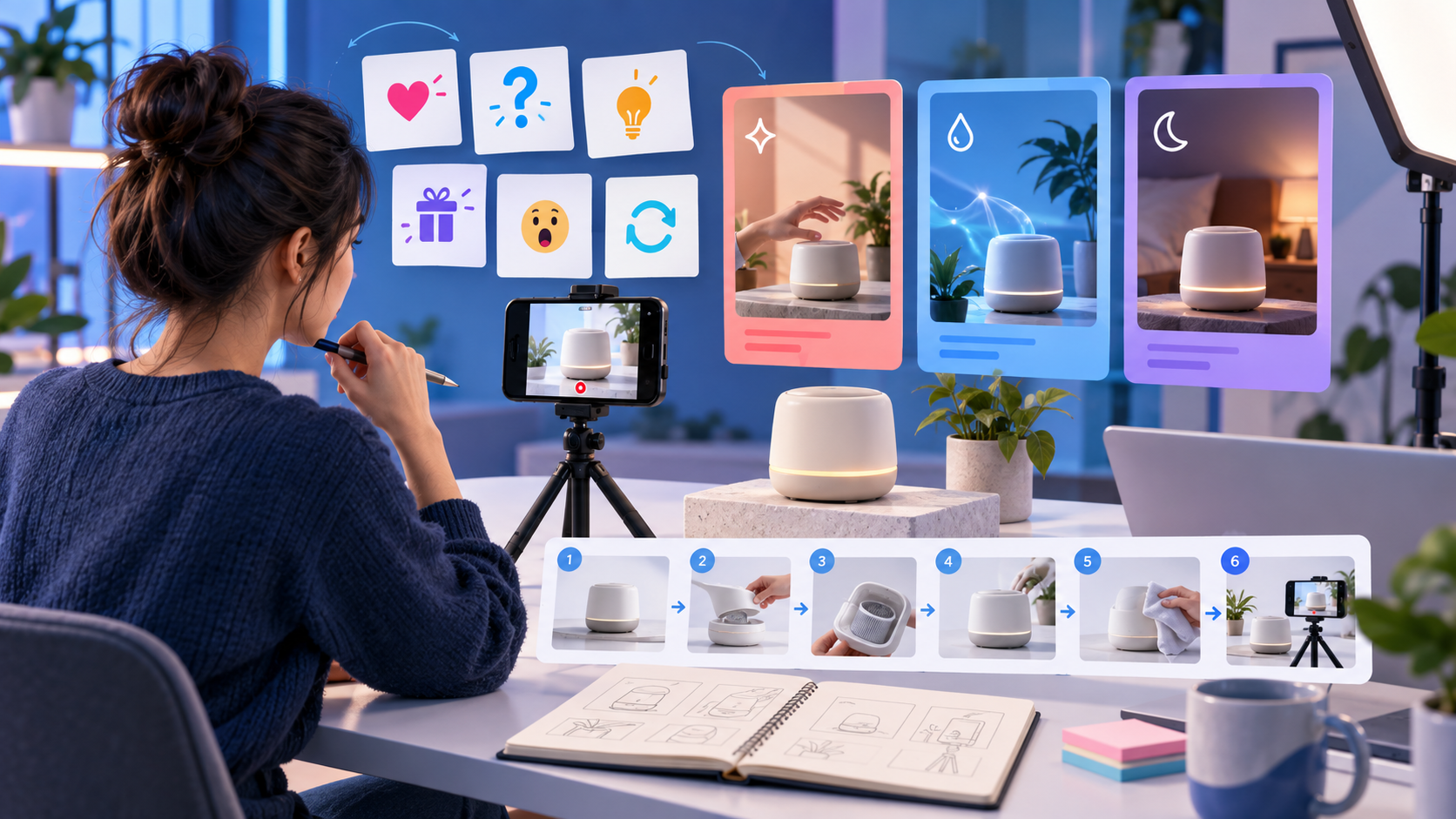

TikTok creative fatigue is most credible when an ad that previously worked weakens across comparable periods: frequency rises or reach contracts, attention falls, and CPA rises or ROAS falls without a stronger non-creative explanation. One bad day, an old video, or a high frequency number is not enough.
Before you replace a winner, compare two equivalent windows. Then rule out cold start, delivery status, tracking, offer, auction cost, landing-page performance, inventory, and audience changes. The decision should be keep, monitor, investigate, refresh, or rebuild—not “pause everything.”
What TikTok Creative Fatigue Is—and What It Is Not
Creative fatigue is a decline in response to a creative that had already established a useful performance baseline. Repeated exposure can make the opening, message, proof, or format feel less novel to the audience. TikTok’s own guidance identifies patterns such as CTR falling while frequency rises, impressions or reach declining, and CPA rising or ROAS falling as signals worth investigating.
Those signals are not universal thresholds. They are evidence to compare against the same creative’s history and current delivery context.
What you see | Is it fatigue? | Better first question |
A new creative is weak from launch | Not proven | Did it ever establish a healthy baseline? |
An established creative weakens across exposure, attention, and efficiency | Possible | Did any delivery, audience, offer, site, or measurement condition change? |
Purchases fall while CTR and watch behavior hold | Not enough evidence | Did CVR, the offer, landing page, inventory, or tracking change? |
Frequency rises while CPA and CTR improve | No fatigue signal yet | Is the winner still efficient against its own baseline? |
Spend and impressions are zero | Different diagnostic path | Is there a status, schedule, balance, review, bid, or eligibility blocker? |
The useful mental model is:
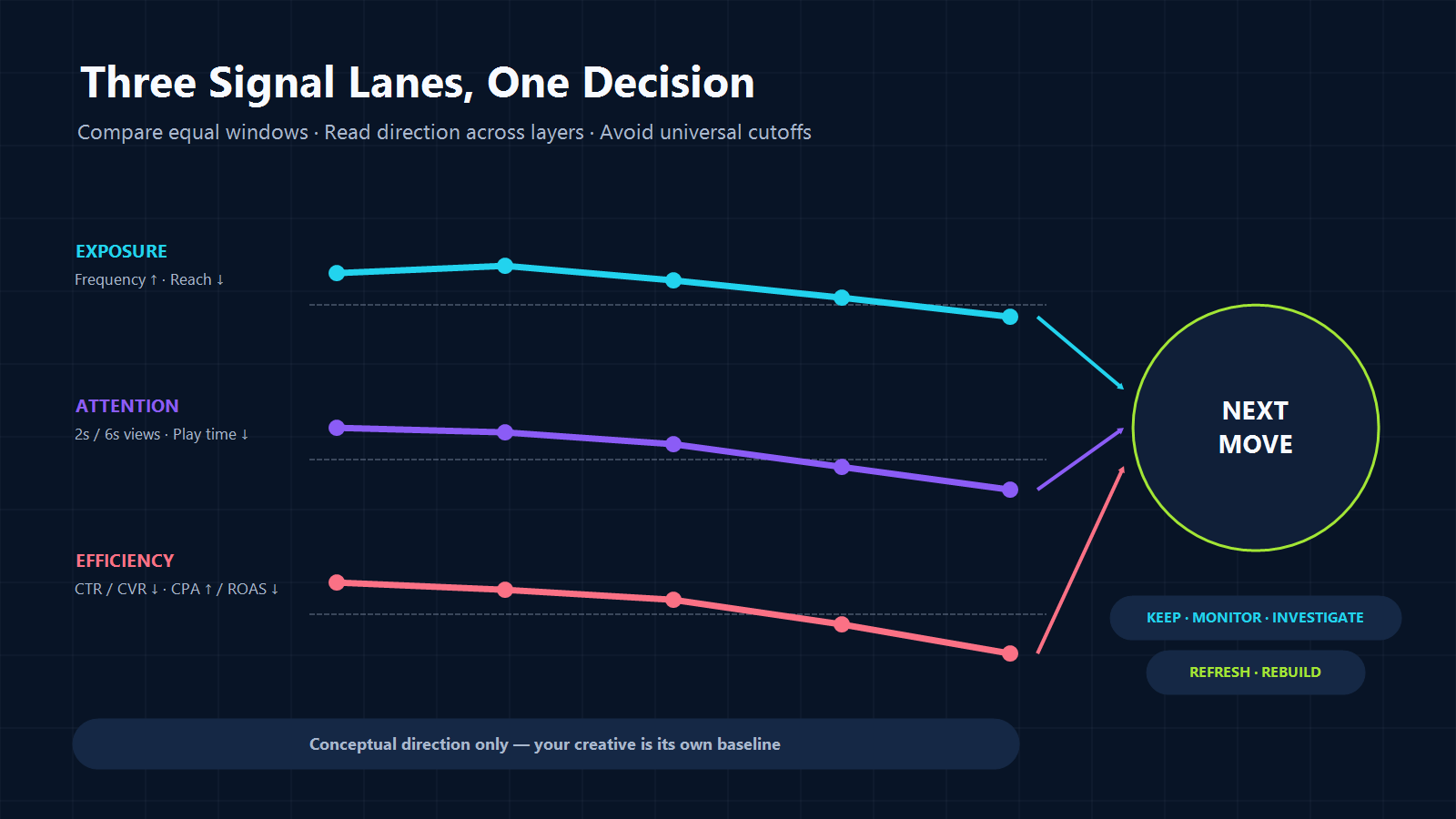
Exposure → Attention → Efficiency → Decision
Fatigue becomes more plausible when deterioration moves through more than one layer. It becomes less plausible when only a downstream metric changes and a stronger competing explanation is visible.
The 7 Warning Signs of TikTok Creative Fatigue
No single warning sign proves fatigue. Read each one against an equivalent earlier period and look for a connected pattern.
1. TikTok Shows a Fatigue Signal
Some TikTok advertising interfaces or tools may surface fatigue-related indicators or alerts. Treat one as a reason to open the underlying data, not as a command to remove the ad.
Check which object and date range the signal covers. Then inspect frequency, reach, CTR, video-view behavior, CPA, and ROAS. Interface availability can vary, so do not build your process around a field that may not appear in every account or campaign type.
2. Frequency Rises While Reach Shrinks
Frequency measures how often, on average, each reached person saw the ad during the selected period. A rising value can mean the same pool is seeing the creative more often. That matters more when reach or new-user delivery also contracts.
Do not use a universal frequency cutoff. A frequency of 3 can accompany improving performance in one campaign and weakening performance in another. Compare the creative with itself and ask whether incremental reach, CTR, watch behavior, and efficiency are weakening at the same time.
Audience saturation can produce a similar pattern. If a fresh creative also struggles to reach new people within the same audience, the constraint may not be the original video alone.
3. CTR or Engagement Falls Against Its Own Baseline
A falling CTR can show that fewer impressions are producing clicks. It becomes more useful as a fatigue signal when the creative previously performed well, the comparison windows are equivalent, and bid, audience, placements, offer, and delivery status remain reasonably stable.
A one-day dip is not a diagnosis. Check the direction across several reporting points and compare it with other creatives serving the same objective. If most creatives decline together, look for an auction, seasonal, audience, or accountwide change before blaming one video.
4. Early Video Attention Weakens
The opening seconds carry the hook, proposition, and first proof. Review the available 2-second and 6-second view rates, average play time, and completion milestones against the creative’s own earlier performance.
If frequency rises while early-view behavior and CTR both weaken, the audience may be responding less to the execution. If watch behavior remains stable but purchases fall, the problem may sit after the click.
TikTok does not provide a universal watch-rate decline that proves fatigue. Use these metrics as supporting attention evidence rather than a standalone pass/fail rule.
5. Impressions or Reach Contract Despite a Stable Setup
TikTok’s auction guidance includes declining impressions or reach among the indicators to investigate. Before assigning that decline to the creative, verify that the campaign is still eligible and scheduled, with comparable budget, bid, targeting, placements, and active ads.
If delivery is at zero, diagnose the blocker first. Fatigue requires a usable history of delivery and response; it is not a substitute label for an ad that never entered or stopped entering the auction.
6. CPA Rises or ROAS Falls After a Stable Period
CPA and ROAS show the business consequence, but they sit downstream of several systems. A higher CPA can come from more expensive impressions, a lower CTR, a lower conversion rate, or a combination of all three.
Before refreshing the creative, check:
- CPM and placement mix;
- attribution and event health;
- price, promotion, shipping, and inventory;
- landing-page speed and click-to-landing-page-view rate;
- checkout or payment changes;
- whether other ads or channels changed in the same direction.
For Product GMV Max, campaign reporting may combine paid and organic contribution. Use the dedicated TikTok Shop Ads and GMV Max ROI guide rather than treating campaign-level ROI as proof that one video is fatigued.
7. A Controlled Fresh Variation Recovers the Pattern
A challenger can add useful evidence. Preserve the control, change one meaningful element, and compare the result under conditions that keep the interpretation as clean as possible.
For example, keep the same product promise and proof but change the first frame or opening hook. If attention and efficiency recover, that supports the fatigue hypothesis. If they do not, the diagnosis remains open: the audience, offer, auction, site, or concept may still be involved.
A controlled test strengthens or weakens a hypothesis. It does not prove one exclusive cause.
Creative Fatigue or a False Positive?
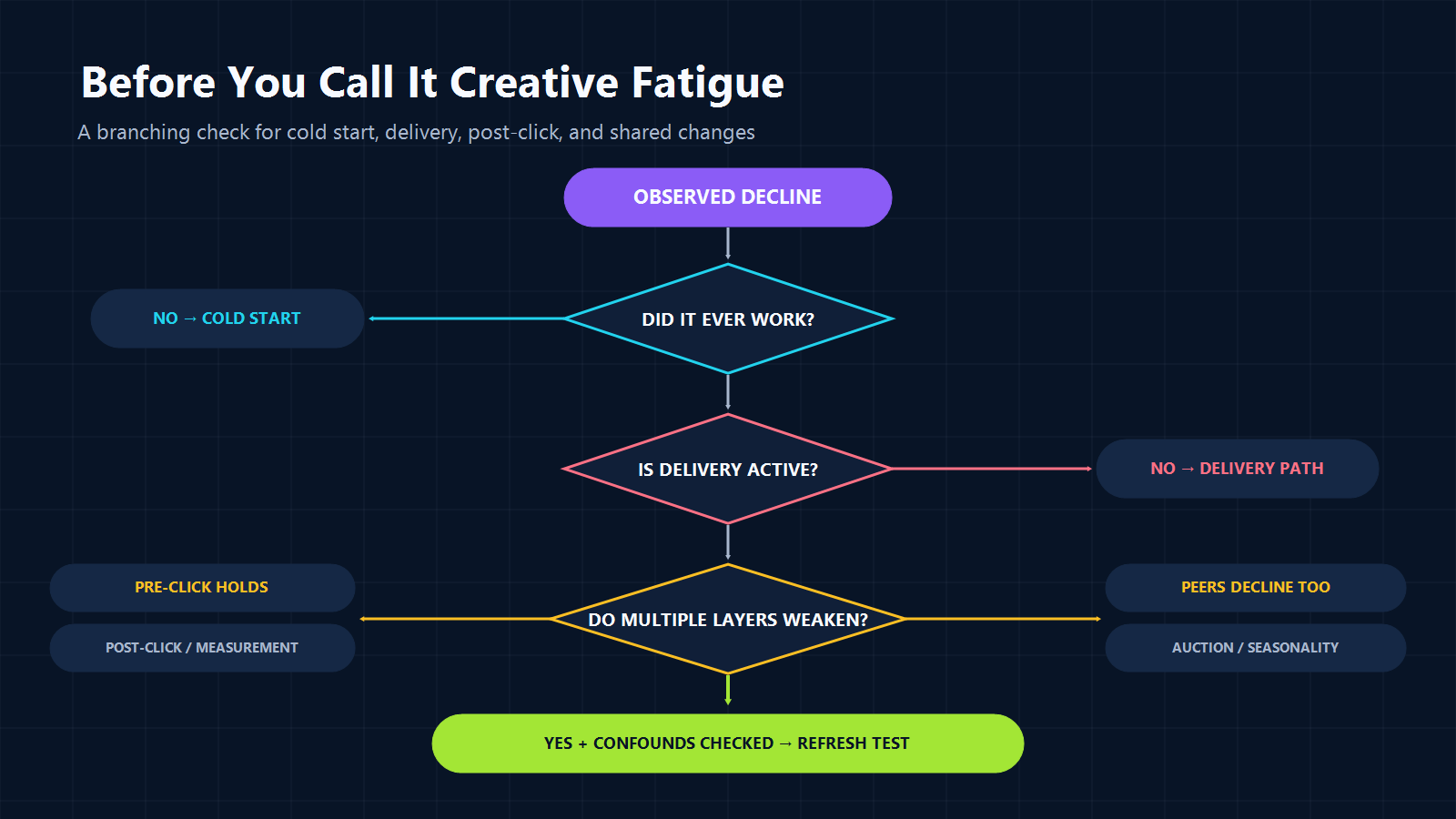
The fastest way to waste a winner is to diagnose every decline as creative fatigue. Save the evidence before editing.
Pattern | More plausible explanation to investigate | Evidence to save | Do not change yet |
New ad, no mature comparison | Cold start or never-proven concept | Launch time, status, delivery, raw metrics, peer baseline | Do not label it fatigued |
CTR and watch behavior hold; reported purchases collapse | Measurement, offer, inventory, or post-click issue | Event health, backend comparison, CVR, landing-page evidence | Do not replace the video first |
Most creatives weaken together | Auction, seasonality, shared audience, site, or accountwide change | Peer-creative and account-level comparison | Do not isolate one creative as the cause |
No impressions or a blocking status | Delivery or eligibility problem | Status, Secondary Status, schedule, balance, review evidence | Do not run a fatigue diagnosis |
Frequency rises while efficiency improves | Healthy mature winner | Reach, CTR, views, CPA/ROAS trend | Do not rotate it out because of age |
CPM rises while CTR and CVR hold | Auction-cost change may be involved | CPM by placement and comparable peer creatives | Do not rebuild the creative first |
Build Two Comparable Diagnostic Windows
Use two equal, non-overlapping periods. The exact length should match the campaign’s decision cadence and conversion maturity; it is not a universal number.
Keep these fields comparable where possible:
Dimension | Record before comparing |
Reporting | Account, object, timezone, date range, attribution setting |
Delivery | Objective, status, placements, schedule, budget, bid strategy |
Audience | Targeting, exclusions, estimated size, meaningful changes |
Commerce | Price, promotion, shipping, inventory, destination URL |
Measurement | Optimization event, Pixel/Events API health, backend comparison |
Creative | Creative ID, launch date, last edit, hook, format, creator, offer shown |
Raw outcomes | Spend, impressions, reach, clicks, landing-page views, purchases, revenue |
Recalculate the ratios from raw numerators when you can:
CPM = Spend ÷ Impressions × 1,000
Frequency = Impressions ÷ Reach
CTR = CTR = (Clicks ÷ Impressions) × 100% 和 Click-to-purchase CVR = (Purchases ÷ Clicks) × 100%
Click-to-purchase CVR = Purchases ÷ Clicks
CPA = Spend ÷ Purchases
Keep missing values as Unknown. A blank field is not zero, and an unavailable denominator cannot produce a valid ratio.
For a broader reporting workflow, see the TikTok Shop analytics guide.
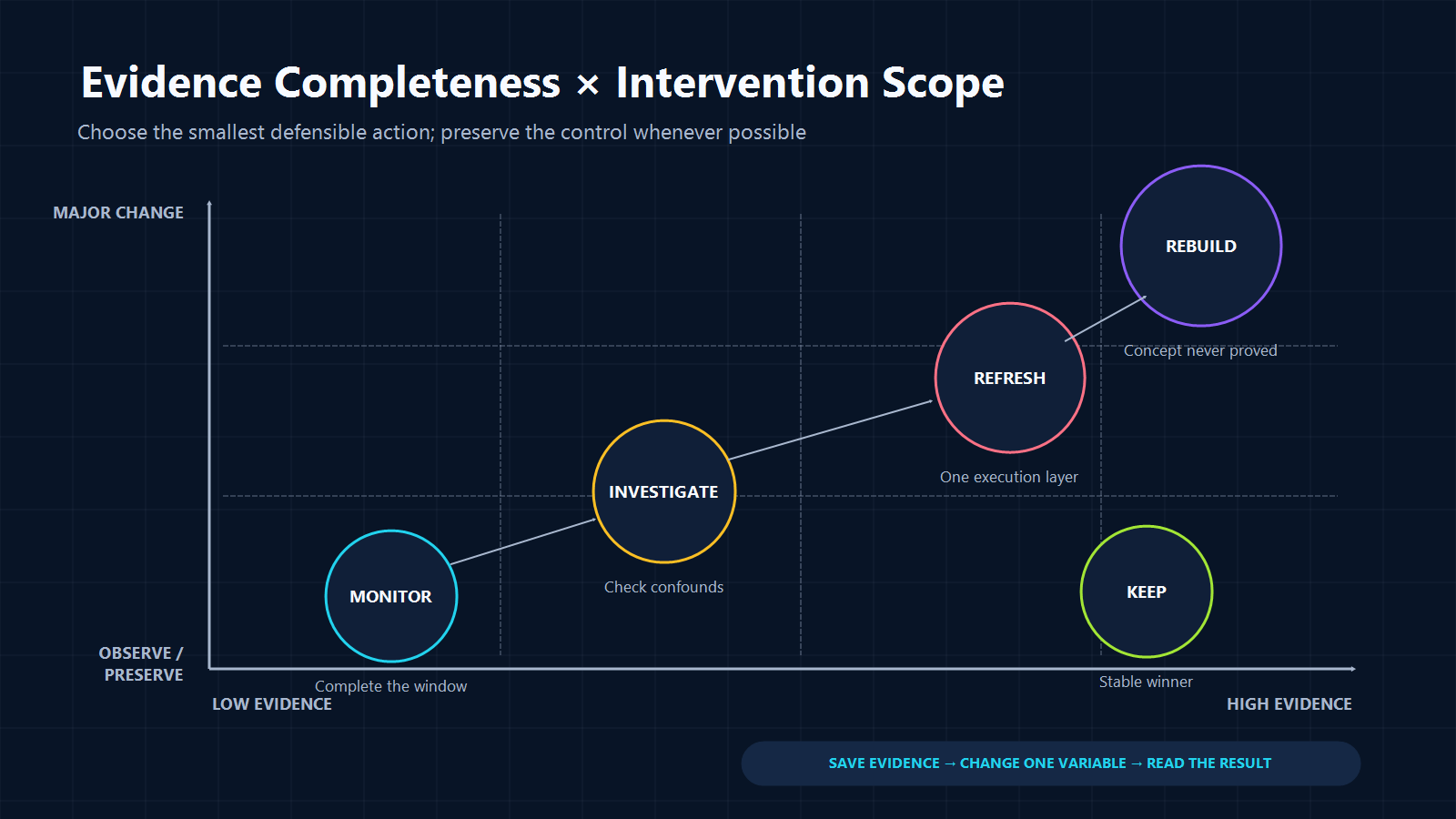
Keep, Monitor, Investigate, Refresh, or Rebuild?
Evidence state | Decision | Controlled next move |
Stable or improving winner | KEEP | Preserve it and prepare a challenger without editing the control |
One weak signal or incomplete comparison | MONITOR | Complete a comparable window and collect the missing evidence |
Creative signals hold but cost or conversion breaks | INVESTIGATE | Check measurement, auction, offer, inventory, and post-click evidence |
Exposure, attention, and efficiency weaken together | PREPARE CONTROLLED REFRESH TEST | Change one execution element and retain the baseline |
The concept never established a healthy baseline | REBUILD / NEVER PROVEN | Revisit message, proof, format, or product–audience fit |
Our Navos Creative Fatigue Test
In a September 14, 2026 editorial test, an operator reported running seven fictional creative snapshots through Navos Desktop → Square → Compliance Check → Diagnose Creative Fatigue. The simulation did not connect to or change a live TikTok account, shop, campaign, Pixel, website, or customer database.
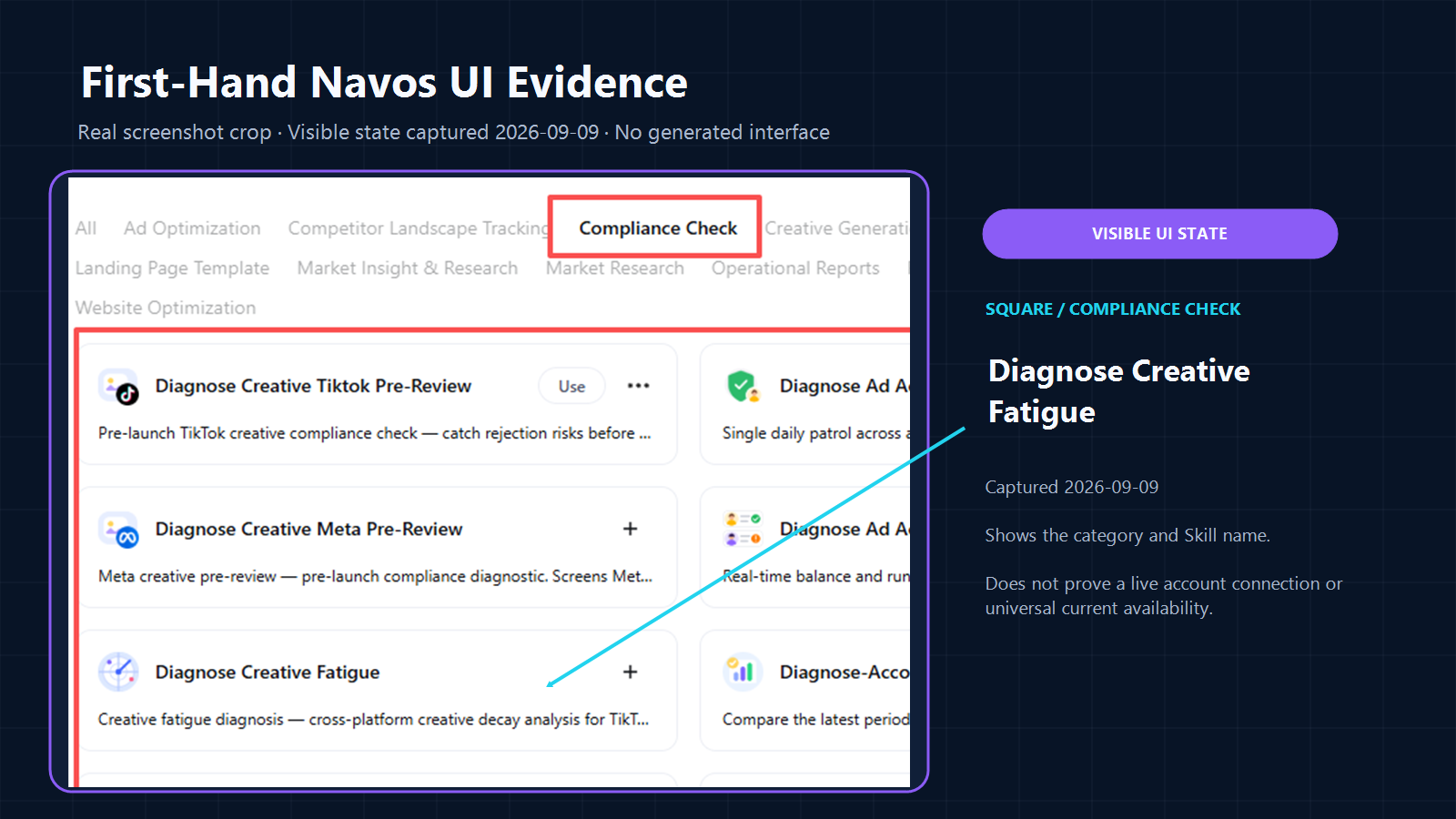
The final HTML artifact recalculated CPM, frequency, CTR, click-to-purchase CVR, and CPA, then separated input facts, diagnostic inferences, missing evidence, and untested questions. We reviewed the output against the supplied raw data before accepting it.
Fictional case | Accepted classification | Why it mattered |
C01: established UGC demo | Likely creative fatigue, Medium confidence | Frequency rose while reach, attention, CTR, CVR, and CPA weakened; audience saturation and auction change remained alternatives |
C02: 20-hour testimonial | Insufficient evidence / cold start | It had no earlier comparison window |
C03: seasonal product video | Likely non-creative confound | The conversion decline coincided with a promotion and demand change while pre-click behavior held |
C04: founder demo | Likely non-creative confound | Reported purchases diverged from synthetic backend orders after a fictional event-mapping change |
C05: 70-day comparison video | Healthy / keep running | CTR, CVR, and CPA improved despite greater age and frequency |
C06: problem–solution video | Likely non-creative confound | CPA growth largely aligned with the supplied creative and peer CPM pattern while engagement held |
C07: tutorial video | Likely non-creative confound | Stable pre-click behavior and weaker landing-page evidence supported a post-click investigation |
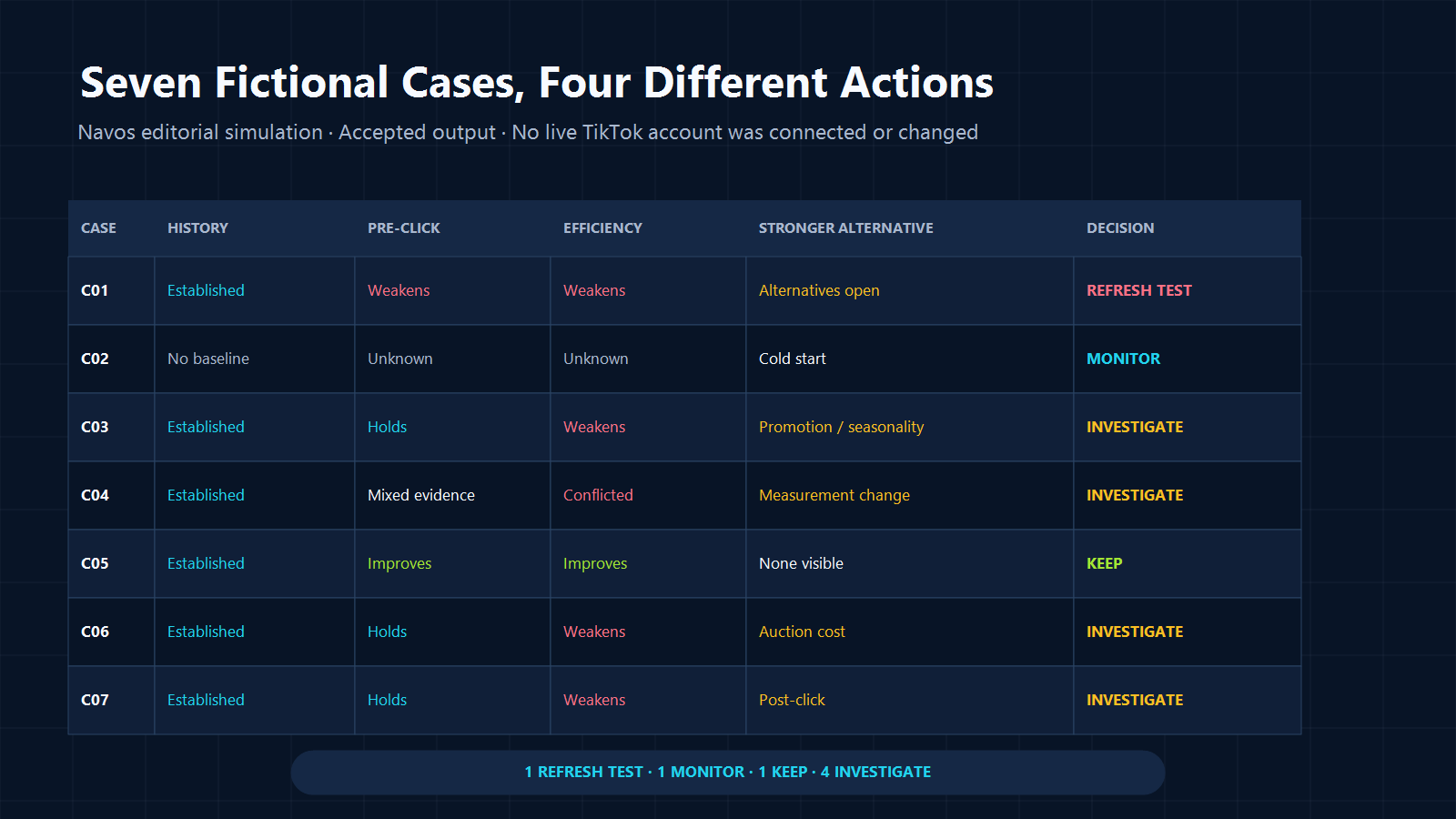
The useful outcome was not a universal fatigue score. It was a structured queue: keep the healthy winner, monitor the immature case, investigate measurement and post-click evidence, and prepare a controlled refresh only for the strongest multi-signal fatigue pattern.
This was one dated fictional simulation, not a customer case study or proof of causality. It did not test live import, automatic monitoring, pausing, replacement, rotation, or scaling, and it does not establish universal Skill availability, accuracy, or compatibility.
Refresh a Winner Without Throwing It Away
When the evidence supports a refresh, keep the validated core and change one execution layer.
Possible refresh variables include:
- the first frame or opening hook;
- the order of problem, proof, and payoff;
- creator or delivery style;
- demonstration angle;
- pacing and edit density;
- on-screen text, caption, or call to action;
- how an offer is expressed, after confirming the offer is current.
A refresh preserves the underlying concept while changing an execution element. A rebuild changes the concept, message, format, proof system, or product–audience fit. If the original never established a useful baseline, rebuilding may be more honest than calling it fatigued.
Need new directions after the diagnosis? Use recent, product-relevant TikTok creative trends, turn them into a controlled TikTok Shop video batch, or research alternative angles with the TikTok ad spy tools guide. Public competitor data can inspire a challenger, but it cannot prove that your own account is fatigued.
Measure the Refresh
Decide what success means before launching the challenger. Preserve the control and log the intended change plus any unavoidable environmental changes.
Read leading and lagging evidence together:
- Exposure: reach, frequency, impressions, incremental delivery;
- Attention: 2-second and 6-second views, play time, completion behavior;
- Response: CTR and landing-page-view rate;
- Efficiency: CPM, CVR, CPA, ROAS, and profit where available;
- Integrity: event health, backend comparison, attribution, offer, inventory, and site changes.
Do not promise an exact recovery time. Evaluate the challenger in a comparable window that fits the campaign, then keep, iterate, investigate, or rebuild based on the evidence.
For GMV Max-specific creative states and exploration controls, use the separate Creative Boost 2.0 guide.
Frequently Asked Questions
How Often Should TikTok Ad Creatives Be Refreshed?
There is no universal day count. Refresh when a previously effective creative shows sustained multi-signal deterioration under comparable conditions and stronger non-creative explanations have been checked. Maintain a challenger pipeline before that point so you do not have to replace a winner in a panic.
Does High Frequency Always Mean Creative Fatigue?
No. Frequency becomes more informative when reach, attention, CTR, and efficiency also weaken. A mature creative can remain healthy while frequency rises, as the fictional C05 case in our Navos test illustrated.
Does a Lower CTR Prove Fatigue?
No. Check the same creative across comparable windows and inspect delivery, audience, auction, offer, and seasonal changes. A lower CTR is one warning signal, not proof.
What Is the Difference Between Creative Fatigue and Audience Saturation?
Creative fatigue concerns declining response to the execution. Audience saturation concerns limited incremental reach within the eligible audience. They can occur together. A fresh-creative test and an audience/delivery comparison help separate them, but neither should be treated as perfect causal proof.
Should I Edit the Existing Ad or Launch a Challenger?
Preserve an interpretable control whenever possible. Launching a challenger with one planned difference usually makes the comparison easier to read than overwriting the only baseline. The exact setup depends on campaign type and platform compatibility.
Can Changing Only the Hook or Caption Work?
It can be a useful refresh hypothesis when the concept and proof still work. It is not a guaranteed fix. If the message, offer, or product–audience fit never worked, a larger rebuild may be necessary.
Can Ad-Spy Data Prove My TikTok Creative Is Fatigued?
No. Public ad libraries and commercial estimates can help you discover alternative angles, but they do not provide your account’s comparable delivery, attention, conversion, measurement, or post-click evidence.
Final Creative-Fatigue Checklist
Before changing a TikTok creative, confirm that you can answer these questions:
- Did the creative previously establish a useful baseline?
- Are the two reporting windows equal, non-overlapping, and comparable?
- Are frequency or reach, attention, and efficiency weakening together?
- Did audience, bid, budget, placements, offer, inventory, site, or tracking change?
- Are peer creatives or other channels showing the same pattern?
- Which facts are observed, which conclusions are hypotheses, and what evidence is missing?
- Can you preserve the control and test one deliberate change?
For a structured second pass, download Navos Desktop. If Diagnose Creative Fatigue appears in your current build, open it under Square → Compliance Check and provide a dated, sanitized evidence snapshot. Use the artifact to organize inputs, hypotheses, evidence gaps, and a controlled next move—then verify the recommendation against the live account before changing anything.
You can also explore the Navos AI Ad Strategist for the broader campaign workflow or the Navos AI Creative Director when you are ready to plan the next creative batch.