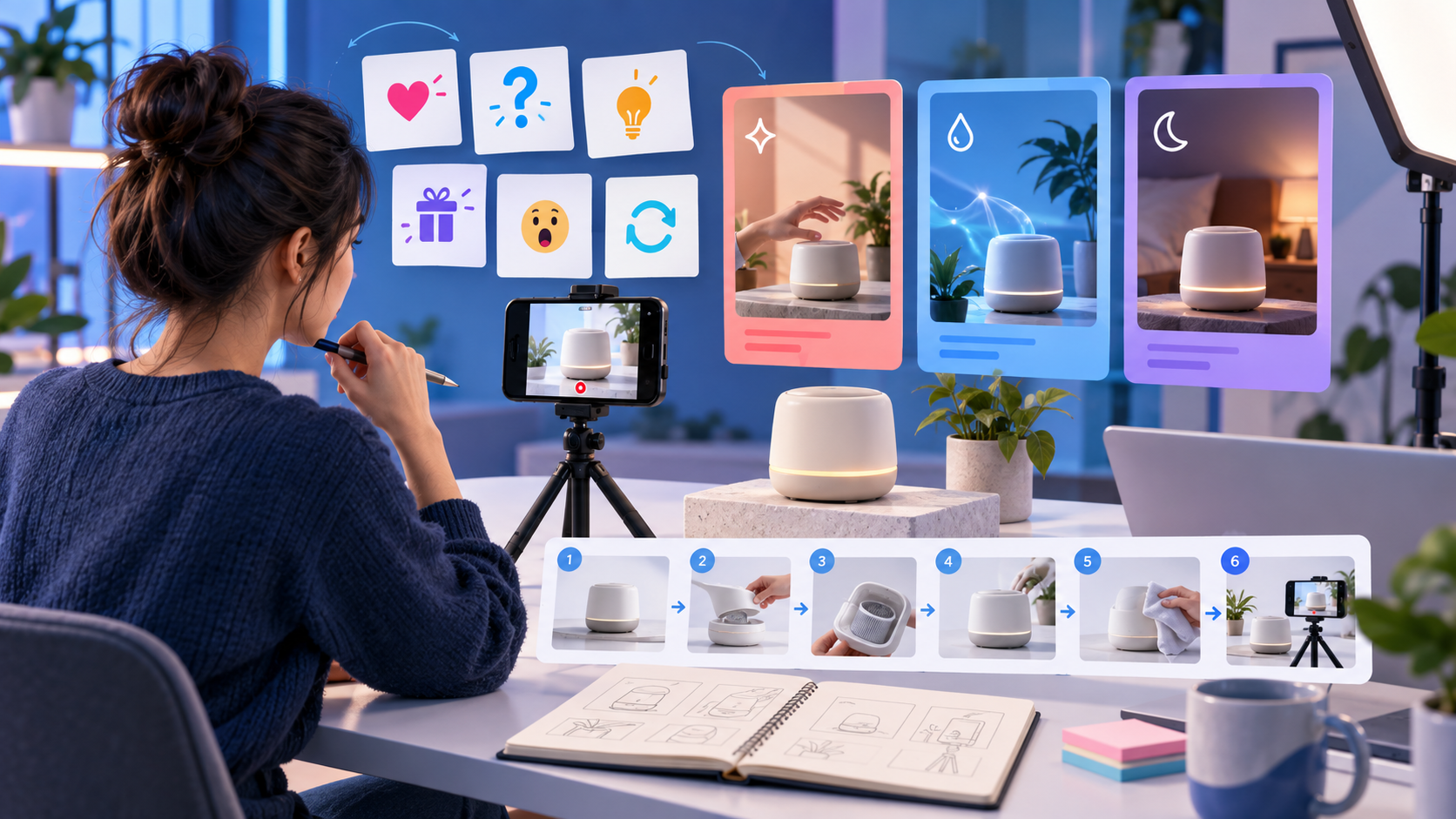
The best TikTok Shop video ideas do not start with a trendy sentence. They start with one specific audience task × verified product fact × filmable scenario. That combination gives you a relevant hook, something real to prove on camera, and a clear reason for the viewer to keep watching.
Use the list below as a planning system, not a set of performance promises. Pick one idea, replace every bracketed phrase with current product evidence, plan the proof shot, and test one meaningful variable at a time. If a fact, price, review, result, or promotion cannot be verified, remove it from the script.
The 17-Idea Quick Matrix
# | Buyer question | Video idea | Hook template | First frame | Proof the next shot owes | Main guardrail |
1 | Does this solve my exact problem? | Pain-point close-up | “If [specific problem] keeps happening, look here.” | The problem in context | Show the exact feature addressing it | Do not inflate one task into a universal result |
2 | What does this feature do? | One-feature demo | “Here is what [verified feature] actually does.” | Feature attached or activated | One continuous, visible demonstration | Avoid unsupported speed, power, or durability claims |
3 | How would my routine change? | Workflow comparison | “I used to [old process]. Now I use [feature] for this step.” | The old task | Same task under comparable conditions | Do not stage an unfair competitor comparison |
4 | Does it handle this concern? | Single-condition objection test | “Will it work when [specific concern]?” | The real test condition | Result under the stated condition | Do not generalize beyond the filmed test |
5 | What result changed? | Real outcome before-and-after | “Here is the result after [real timeframe/action].” | Honest before state | Unedited result with timeframe | No filters, fake instant effects, or absolute outcome claims |
6 | How do I complete the task? | Step-by-step tutorial | “Three steps to [specific task] with [product].” | Finished setup or problem | Each step and required item | Mention compatibility, safety, and preparation limits |
7 | Where can I use it? | Three verified use cases | “Three places I use [feature]—and where I do not.” | All three locations | One proof shot per use case | Confirm each surface or use; avoid “works everywhere” |
8 | Am I using it correctly? | Common mistake | “Do not use [product] this way before checking [fact].” | Incorrect setup, safely staged | Correct setup and source | Never demonstrate a dangerous misuse for attention |
9 | How do I set up or care for it? | Setup or care guide | “Do this before your first use.” | Package contents | Correct assembly, charging, cleaning, or storage | Follow the current manual; do not invent maintenance advice |
10 | Does it answer my question? | Community Q&A | “You asked whether [question]. Let us test that.” | The genuine question | Direct answer plus product proof | Do not fabricate comments or hide conditions |
11 | What is the first use like? | Honest first-use review | “What surprised me—and what did not—after my first use.” | Creator with physical product | Specific observation and limitation | Do not present a script or actor as a genuine customer |
12 | What comes with this variant? | Unboxing and contents | “Here is exactly what arrived in this variant.” | Sealed package and label | Continuous inventory of contents | Match the current SKU; do not imply extras are included |
13 | Why does this product exist? | Founder or why-made story | “We made this because [documented customer problem].” | Founder/team and product | Prototype, decision, or source material | Do not invent origin stories or customer demand |
14 | How is this detail checked? | Behind-the-scenes proof | “Here is how we check [quality detail] before it ships.” | Real process | Traceable step, standard, or inspection | Do not imply certification without documentation |
15 | How does someone like me use it? | Real customer experience | “Here is how [real customer] uses it for [task].” | Customer with permission | Authentic use and bounded result | Keep evidence that it is genuine; disclose commercial relationships |
16 | Which bundle parts do I need? | Bundle or value breakdown | “What is in this bundle—and who needs each part?” | Every included item | Map each item to a task | Verify contents and avoid unsupported savings claims |
17 | Can I get this offer now? | Current promotion explainer | “Before you use this offer, check these conditions.” | Current offer screen or approved graphic | Price, dates, SKU, region, and conditions | Recheck immediately before posting; never rely on memory |
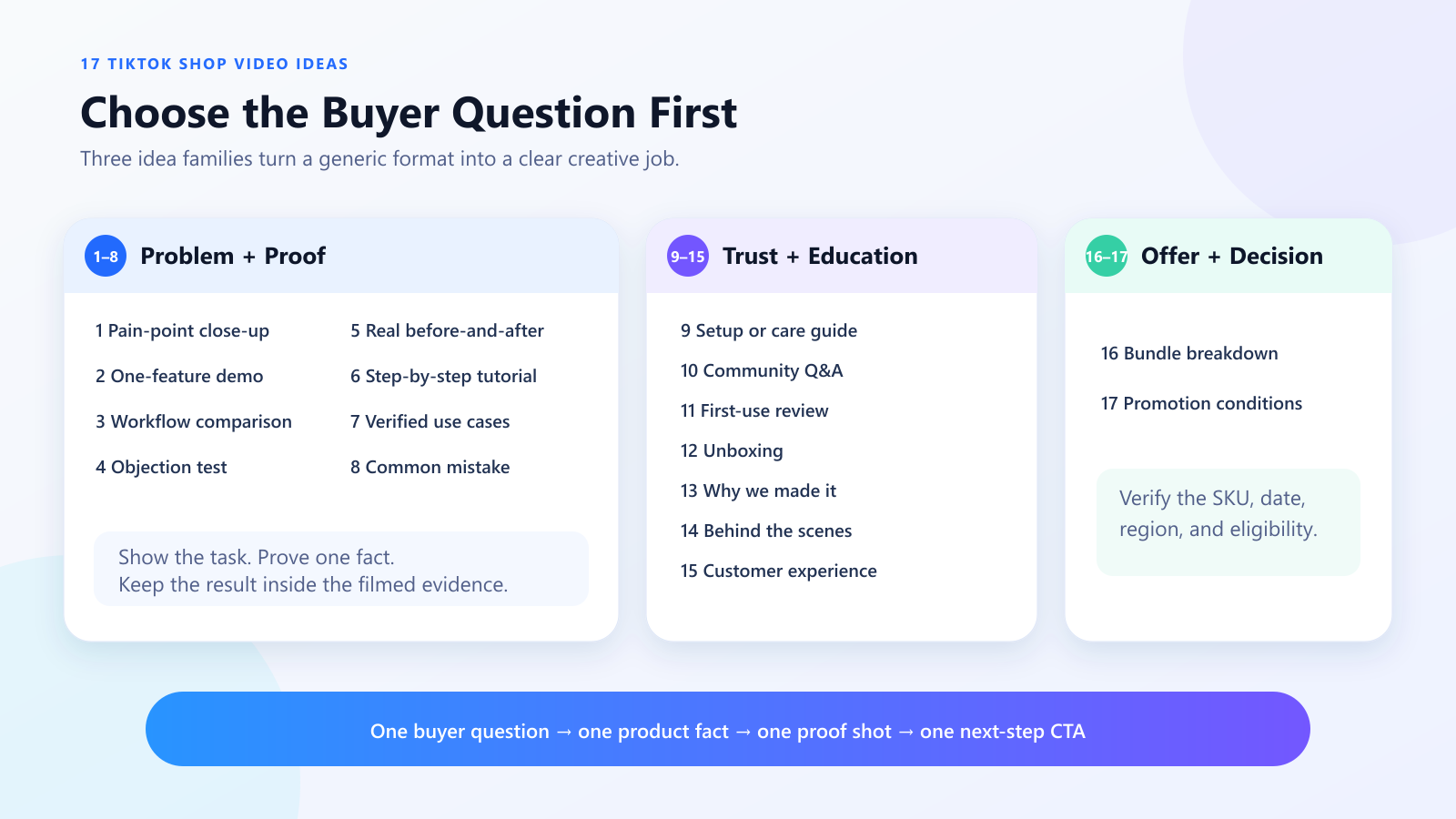
Match the CTA to the buyer's next decision
- Tutorial or setup video → invite the viewer to save the steps or check the current instructions.
- Feature, variant, or compatibility video → ask the viewer to check the current listing for the exact detail.
- FAQ or objection video → invite the viewer to compare the stated condition with their own use case.
- Bundle or offer video → ask the viewer to verify the current SKU, date, region, and eligibility before acting.
Before You Script an Idea, Build a Product Evidence Card
Generic idea lists fail when they jump from “make a demo” to a polished script without checking whether the product can support the claim. Spend five minutes on an evidence card before adapting a hook.
Record these six items:
- Evidence class: Label each input
VERIFIED_FACT,USER_SIGNAL, orAI_HYPOTHESIS.
- Verified product fact: What does the current listing, packaging, manual, or physical sample objectively confirm?
- Audience task: What is one specific job the viewer is trying to complete, and what user evidence supports it?
- Visible scenario: What can the first frame show before the product appears?
- Proof shot: What action, angle, measurement, sound, or continuous take can demonstrate the fact?
- Claim limit: What does that proof not establish?
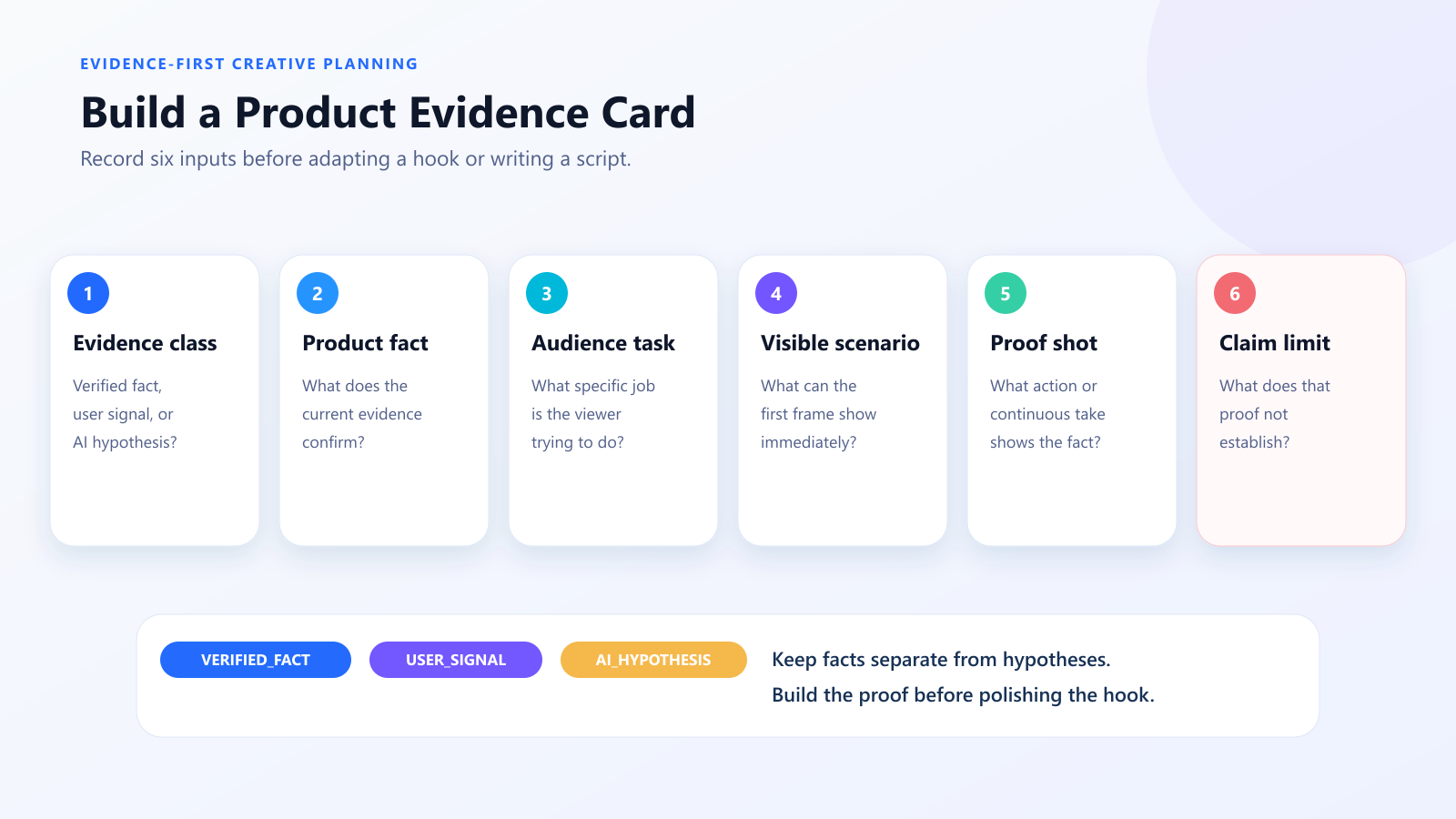
Keep facts separate from hypotheses. “Includes a narrow nozzle” can be a
VERIFIED_FACT. A review pattern about crumbs in car-seat gaps can be a USER_SIGNAL. “Busy parents will love it” is an AI_HYPOTHESIS until you have reviews, search language, interviews, or other user evidence. “Cleans every corner instantly” is neither a fact nor a safe hypothesis without much stronger proof.If you still need an upstream direction, first find product-relevant TikTok creative trends. Once you have a direction, use the evidence card to turn it into a product-specific video rather than copying the surface style.
Problem, Proof, and Demonstration Ideas
1. Open on the pain point, not the product
Start with the moment the viewer recognizes: crumbs in a car-seat gap, a cable mess behind a desk, or a bottle leaking inside a bag. Then name the task in plain language.
- Hook: “If [specific problem] keeps happening in [scenario], start here.”
- Shot list: problem close-up → creator reaction → verified feature → continuous proof → bounded result → CTA.
- Why it is worth testing: relevance is visible before the viewer has to understand the product.
- Check: the next shot must prove the connection. A pain-point hook followed by a product beauty shot leaves the promise unsupported.
2. Demonstrate one feature
Choose the feature that most directly changes the task. A single-feature video is usually clearer than naming eight specifications in ten seconds.
- Hook: “Here is what [verified feature] changes when I [specific task].”
- First frame: the feature being attached, opened, or positioned.
- Proof: capture the action in one understandable take and show the result without hiding cuts.
- Check: translate the feature into user value, but do not turn “includes three modes” into “perfect for everyone.”
For a stronger bridge from facts to language, use this guide to turn product features into creative angles and hooks.
3. Compare the old routine with the product-assisted routine
The safest version is a personal workflow comparison, not an attack on an unnamed competitor. Keep the task and conditions comparable.
- Hook: “I used to [old process]. Now I use [verified feature] for this step.”
- First frame: the repetitive or awkward part of the old routine.
- Proof: show the same task with the product and identify precisely what changed.
- Check: do not fake a slow “before,” conceal preparation, or call the alternative useless.
4. Test one real objection
Turn a real review, support question, or sales objection into a narrow test. “Does the lid stay closed when the bottle is on its side for ten minutes?” is testable. “Is it completely leakproof?” is much broader.
- Hook: “You asked whether [specific objection], so I tested [condition].”
- First frame: the exact condition and a visible timer or measurement if relevant.
- Proof: show setup, duration, and result.
- Check: report only what happened in that test. Do not convert one sample and one condition into a universal guarantee.
5. Show a real before-and-after
Before-and-after remains a useful idea family, but it carries a high evidence burden. Use the same angle and lighting, an accurate timeframe, and a result that the physical product actually produced.
- Hook: “This is the result after [truthful action and timeframe].”
- First frame: the unedited starting state.
- Proof: enough of the process to make the transition credible, followed by the result.
- Check: no beauty filter, hidden replacement, fake instant effect, or prohibited outcome claim. Add an appropriate disclaimer where current rules require one; a disclaimer cannot rescue an otherwise prohibited claim.
6. Teach a three-step task
Tutorials work best when the viewer can save and repeat them.
- Hook: “Three steps to [specific task] with [exact product/variant].”
- First frame: either the finished result or the problem the steps solve.
- Proof: one shot per step, including any preparation or safety requirement.
- Check: use the current manual for assembly, care, charging, compatibility, and warnings.
7. Map three verified use cases
Use this when one product fact genuinely supports several distinct tasks. Keep it evidence-led: three available nozzles do not automatically prove compatibility with every material.
- Hook: “Three places I use [verified feature]—and one place I do not.”
- First frame: a quick view of the three scenarios.
- Proof: repeat the same pattern for each: problem → feature → result.
- Check: validate every use case separately and name exclusions when they help a buyer decide.
8. Correct a common mistake
This format can earn attention by preventing wasted time or misuse, but the correction needs a real source.
- Hook: “Before you use [product] for [task], check this setting.”
- First frame: the wrong setup shown without creating danger or damage.
- Proof: the correct setup with packaging, manual, or interface evidence.
- Check: never manufacture a myth, demonstrate unsafe behavior, or imply that your advice replaces official safety instructions.
Trust, Education, and Story Ideas
9. Make a first-use setup or care guide
Unbox only the parts needed for setup, then show assembly, preparation, use, cleanup, or storage in order.
- Hook: “Do this before your first use of [exact variant].”
- Proof: show each included component and the relevant instruction source.
- Check: separate universal product facts from tips that are merely your own preference.
10. Reply to a genuine comment or FAQ
A real question supplies both audience language and a reason for the video to exist.
- Hook: “You asked whether [question]. Here is what the current product can prove.”
- Proof: pin or display the genuine question, then answer it directly on camera.
- Check: remove personal data, get permission when needed, and never write a fake skeptical comment to make the answer look more persuasive.
11. Give an honest first-use review
Structure the review around three parts: what you expected, what you observed, and what remains unknown.
- Hook: “What surprised me—and what did not—after my first use.”
- Proof: a specific action or observation rather than adjectives such as “amazing.”
- Check: do not present a scripted actor as a verified customer. Use a customer review, testimonial, or endorsement only when you hold documentary evidence that it is genuine, and disclose applicable commercial relationships.
12. Unbox the exact variant
People often want to know what arrives, which accessory matches which task, and what they may need separately.
- Hook: “Here is exactly what arrived in this [variant name] box.”
- Proof: show the package label and inventory the contents in one clear sequence.
- Check: bundles and gifts change. Confirm the current SKU before filming and again before publishing.
13. Tell the documented “why we made it” story
Founder and brand stories are strongest when they connect a real problem to a design decision.
- Hook: “We changed [specific product detail] after learning [documented problem].”
- Proof: show a prototype, design note, support pattern, or other approved source.
- Check: do not invent a founder struggle, community request, or number of customers affected.
14. Show behind-the-scenes proof
Take the viewer into a real packing, inspection, material-selection, or quality-control step.
- Hook: “Before this ships, here is how we check [specific detail].”
- Proof: show the actual process, the responsible person, and the pass/fail criterion where appropriate.
- Check: “We inspect this seal” does not equal “certified safe.” Use certification language only when current documentation supports it.
15. Share a real customer experience
With permission, use an existing, documented customer experience to show how a real customer used the product for a specific task.
- Hook: “Here is how [customer description] uses [product] for [task].”
- Proof: authentic use, their own bounded words, and a result the footage can support.
- Check: do not present a scripted actor as a verified customer. If a scene is a dramatization, label it as a dramatization rather than a genuine testimonial. Use reviews, testimonials, or endorsements only when you hold documentary evidence that they are genuine, and disclose applicable commercial relationships.
Offer and Decision Ideas
16. Explain a bundle by task
Instead of spinning every item in a circle, map each included part to the buyer question it answers.
- Hook: “What is in this bundle—and who actually needs each part?”
- Proof: show every current item, then demonstrate or identify its supported task.
- Check: verify quantity, variant, availability, and savings. If there is no documented comparison price, avoid “best value” or “save $X.”
17. Explain a current promotion and its conditions
Offer videos age quickly. Make accuracy the concept.
- Hook: “Before you use this offer, check the SKU, dates, and conditions.”
- Proof: display approved current details, including region and important exclusions.
- Check: recheck price, inventory, shipping, tax, coupon eligibility, and end time immediately before posting. Never describe an old screenshot as a live offer.
How to Turn One Product Into a Creative Matrix
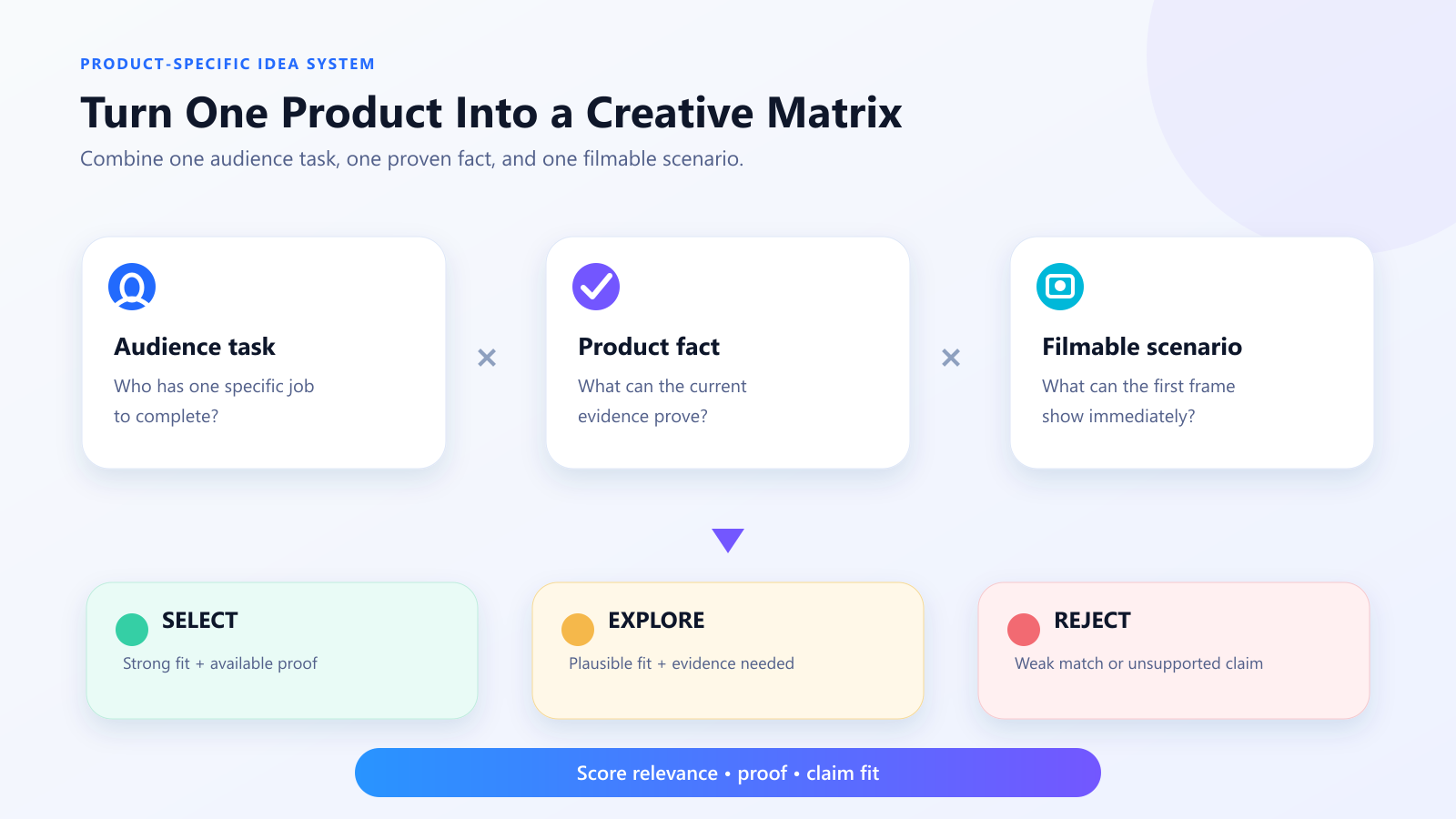
The 17 ideas are starting shapes. A creative matrix makes them specific enough to shoot.
Step 1: List only verified product facts
Name the source and the available proof for each fact. Put unverified suggestions in a separate hypothesis list. Do not let an AI-generated phrase silently become a product specification.
Step 2: Define audiences by behavior and task
“Women aged 25–34” is not a creative brief. “Apartment renters who need to store a cleaning tool in one drawer” gives you a task, setting, and objection to validate.
Step 3: Define filmable scenarios
A scenario should have a visible start: the stuck crumb, tangled cable, unopened package, real question, or current offer. If the first frame cannot show the situation, the concept will lean too heavily on explanation.
Step 4: Score every combination
For each
audience × fact × scenario row, ask:- Does this audience plausibly face this task here?
- Does this exact product fact address the task?
- Can the value be proven with an available shot?
- Does the wording stay inside current facts and rules?
Select the strongest rows, mark plausible evidence gaps for exploration, and reject mismatches. Do not rewrite the audience or scenario merely to save a weak idea.
A Six-Shot Example for a Simulated Handheld Vacuum
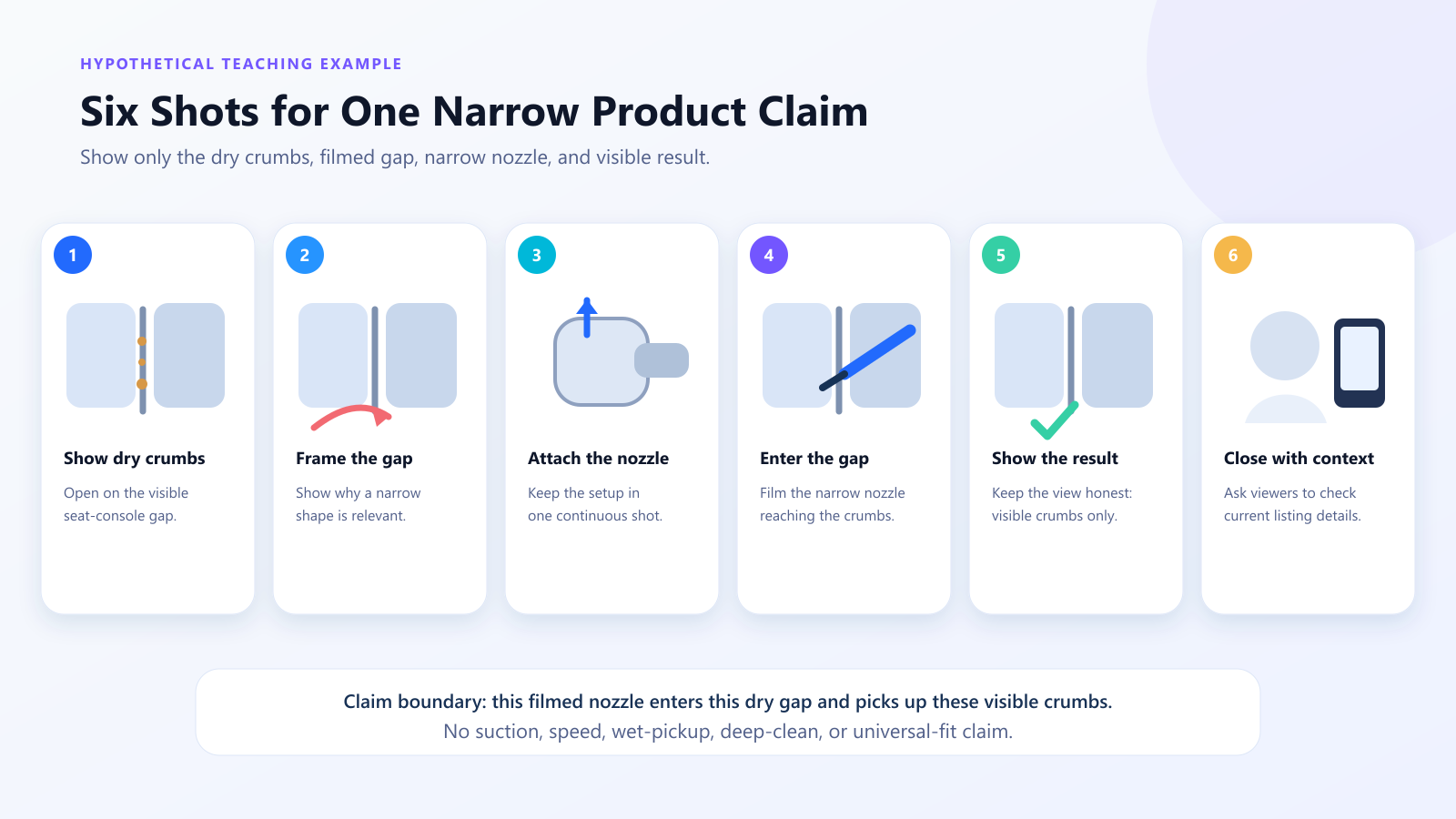
The following hypothetical teaching example is not evidence about any real merchant product or listing. Its bounded sample facts say the product includes a narrow nozzle that can be filmed entering a car-seat gap to pick up dry crumbs. The example does not provide suction, runtime, size, weight, wet-pickup, or universal-fit evidence.
Concept: Parent cleaning a family car × provided sample fact: narrow nozzle × dry snack crumbs between the seat and console.
Hook options:
- “If snack crumbs keep disappearing into this gap, start here.”
- “Can this narrow nozzle reach the dry crumbs in this filmed seat-console gap? ”
- “Watch the narrow nozzle enter the gap before we pick up these dry crumbs.”
- “Show the seat-console gap and the staged dry crumbs from the same angle; do not compare another nozzle, shape, or product”
Six shots:
- Creator's face, then a close-up of visible dry crumbs in the gap.
- Show the seat-console gap and the staged dry crumbs from the same angle; do not compare another nozzle, shape, or product.
- Attach the narrow nozzle in one continuous shot.
- Show the filmed result without filters, speed tricks, or a deep-clean claim.
- Return to the creator and ask viewers to check the current listing details for their needs.
The claim is intentionally narrow: the sample's nozzle enters this filmed dry gap and picks up the visible crumbs in this take. That proof does not establish the fastest clean, deepest clean, strongest suction, wet pickup, or universal vehicle fit.
2026 US TikTok Shop Checks Before You Film
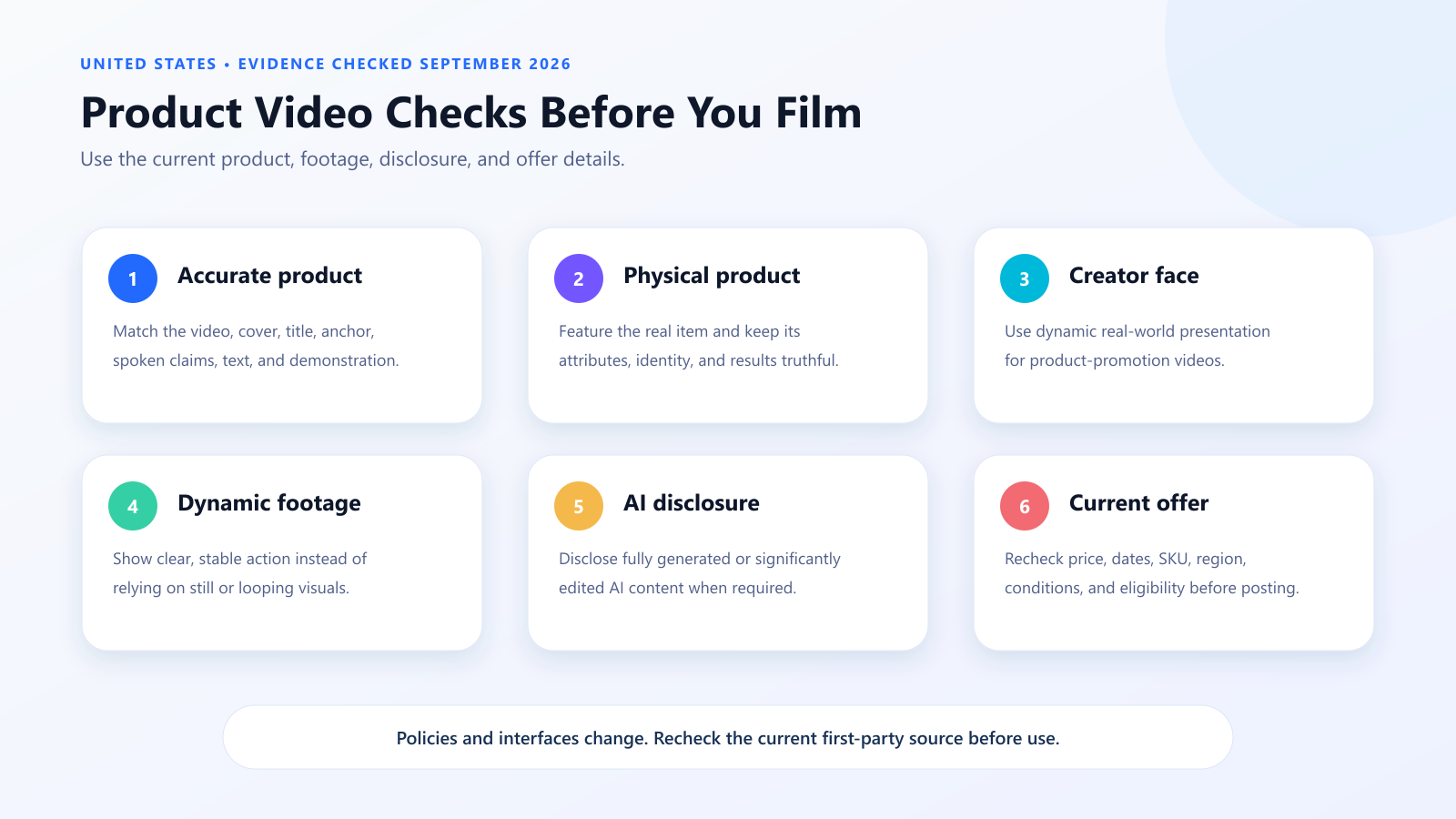
TikTok Shop's US Content Policy, dated September 1, 2026, requires content elements to remain accurate and consistent with the featured product. That includes the video, cover, title, anchor, spoken claims, on-screen text, props, and demonstrations. Price and promotion statements need current conditions. AI-generated content must not mislead viewers, change or exaggerate the promoted product, or fabricate product effects or functions.
The US guide Requirements for High-Quality Videos and LIVEs, dated July 31, 2026, calls for clear, stable, dynamic real-world product presentation. For product-promotion videos, it also calls for featuring the creator's face and the physical product. The guide advises at least three seconds of dynamic content rather than relying on still or looping visuals. A static, faceless montage of product-detail-page images is therefore not the safe default for this workflow.
The US AI-Generated Content Restrictions and Requirements, also dated July 31, 2026, permits AI-assisted scriptwriting, translation, dubbing, and editing when the output remains truthful. Creators must disclose content that is fully AI-generated or significantly edited using AI. Minor adjustments such as basic lighting, color, cropping, or noise reduction do not require disclosure under this policy. AI must not misrepresent the product's attributes, performance, results, or identity.
When a post promotes your own business or a third-party brand, product, or service, TikTok requires the content disclosure setting to be turned on. Posts without proper disclosure may be removed or restricted. Recheck the current publishing flow and music-use rules for the account, placement, and region before posting. Policies and interfaces can change after this article's evidence date. For an overview, review TikTok Shop content and product-claim rules, then confirm the current first-party policy.
Test One Variable Without Calling Every Comparison an A/B Test
Two organic posts are not automatically a randomized A/B test. Distribution, timing, comments, traffic sources, and audience composition can differ.
Use this practical comparison card:
- Hypothesis: A pain close-up will hold the target viewer longer than a product beauty shot because the task is recognizable immediately.
- Variable: first-frame hook only.
- Controls: product, creator, scenario, proof sequence, duration, caption style, CTA, and posting-window band.
- Primary metric: choose one metric closest to the hypothesis, such as hold rate to the proof shot. Treat clicks or conversions as separate downstream measures.
- Interpretation: call the result directional unless the platform setup truly randomizes exposure and controls the comparison.
Changing the hook, creator, setting, length, offer, and proof at once may produce a different video, but it cannot tell you which change mattered.
Turn a Product Brief Into a Reviewable Short-Video Plan With Navos
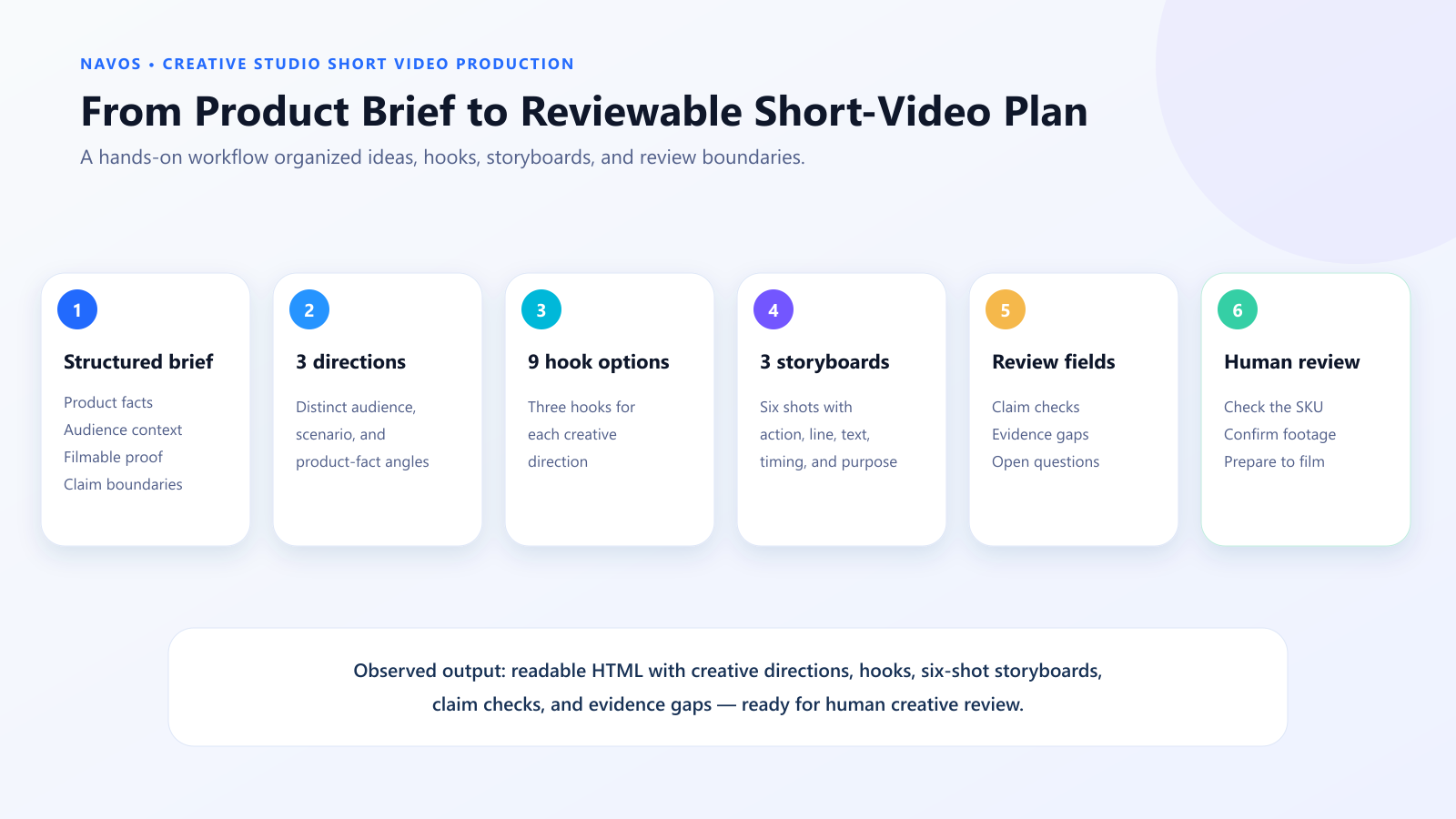
Use Creative Studio Short Video Production in Navos to turn a manually entered, structured product brief into a reviewable creative package. In our hands-on workflow, the brief separated verified product facts, audience context, filmable proof, and claim boundaries. The Skill produced three creative directions, three hook options for each direction, and six-shot storyboards covering visual action, spoken line, on-screen text, timing, and proof purpose.
The output also organized claim checks and evidence gaps in one scannable plan.That gives a creative team a practical starting point for selecting a direction, preparing footage, and reviewing product-specific language before production. Start with facts you can support, describe the audience task and filmable scenario, then review every generated statement against the current SKU and available footage.
To explore Navos’s broader creative-planning capabilities, visit the AI Creative Director.
Frequently Asked Questions
How many TikTok Shop video ideas should I test at once?
Start with three to six directions that are genuinely distinct and evidence-supported. Keep the product facts and claim boundaries constant, then vary one meaningful creative element when you need a directional comparison. More concepts are not automatically better if they repeat the same audience, message, and proof.
Can I make a faceless TikTok Shop product video?
Current US TikTok Shop guidance for product-promotion videos calls for dynamic real-world content that features the creator's face and the physical product. Do not default to a faceless slideshow or looping product images. Check the current rule for your account, content type, and market immediately before publishing.
Can AI write the whole TikTok Shop video script?
AI can help draft hooks, scripts, translations, and edits, but it cannot verify facts you did not supply. The final video must match the real product and current listing. Current US guidance requires disclosure when published content is fully AI-generated or significantly edited using AI; minor basic enhancements alone do not trigger that requirement.
What if I do not have customer reviews yet?
Use verified product facts and merchant-supplied tasks first. Label audience pain points and scenarios as hypotheses, then validate them with search language, support questions, interviews, or future reviews. Do not present an AI-generated audience idea as customer evidence.
Is a before-and-after TikTok Shop video allowed?
It depends on the product, claim category, footage, timeframe, and current policy. Use a real result, consistent presentation, an accurate timeframe, and any required disclaimer. Do not use filters, hidden replacements, fake instant effects, or absolute promises. Some prohibited claim categories remain prohibited even with a disclaimer.
Which metric should I use for a video-idea test?
Choose the metric that matches the hypothesis. A hook test may use hold rate to the first proof shot; a clarity test may use qualified comments or saves; a shopping-intent test may use product-detail-page clicks. Sales can matter downstream, but one organic post does not prove that a creative element caused the outcome.
Build the Proof Before You Polish the Hook
A useful TikTok Shop idea has a job: make one audience recognize a task, understand one product fact, and see enough proof to make the next decision. Build that chain first. Then use hooks, edits, and creative variations to express it—not to hide missing evidence.
Start with one verified fact, one filmable scenario, and one honest limit. That small discipline can turn a generic list of ideas into a repeatable creative system.