

TikTok’s 2026 GMV Max update makes creative testing easier to read and more practical to manage. Creative Exploration can carry product-level learning across campaigns, creative statuses are simpler, Product GMV Max adds exploration benchmarks and recommendations, and Creative Boost 2.0 gives advertisers more control over batch testing.
The most important change, however, is not another button. It is a clearer decision system: advertisers can see whether a creative is still gathering signals, has completed exploration, cannot enter exploration, or has earned a quality label.
That clarity only helps when the underlying campaign and creative data are valid. In our test, Navos analyzed more than 4,700 campaign-level records in approximately eight minutes. It correctly stopped before recommending budget or creative changes because the supplied export did not contain the GMV, order, ROI, product, or creative-level fields needed to support them.
This review explains what changed, how to interpret the new framework, and how to avoid using Creative Boost before the account is ready.
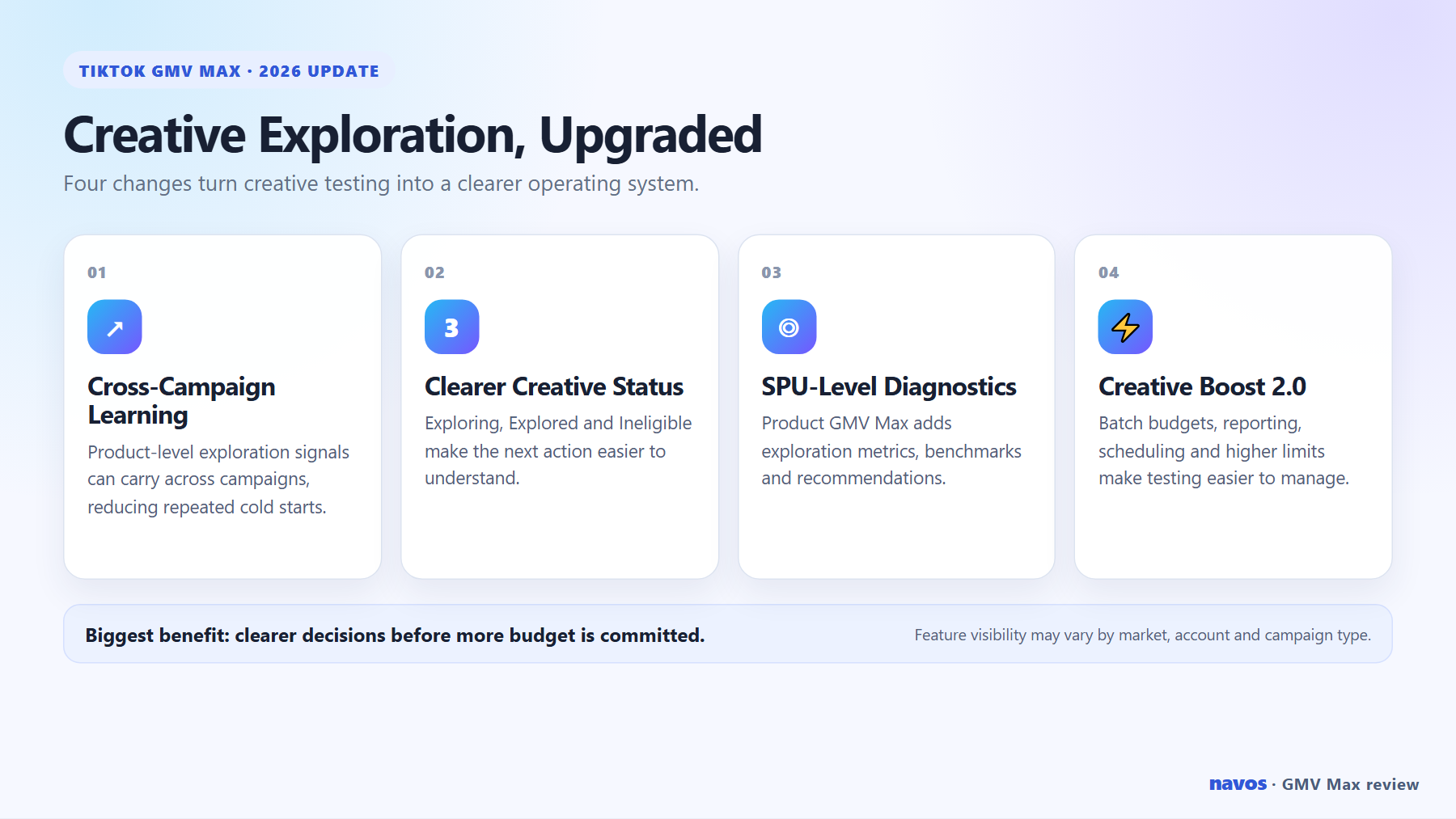
TikTok GMV Max 2026 Update at a Glance
Update | What changed | Why it matters |
Cross-campaign exploration learning | Product-level exploration signals can be reused across campaigns instead of restarting from zero in each campaign | Reduces repeated cold starts and duplicated testing |
Simplified creative statuses | Creatives are grouped as Exploring, Explored, or Ineligible | Makes it easier to distinguish learning, completed evaluation, and blocked assets |
Creative quality labels | Explored creatives can be labeled Outstanding, Performing, or Underperforming | Gives teams a clearer input for iteration and scaling decisions |
Product-level exploration diagnostics | Product GMV Max can surface SPU-level metrics, benchmarks, and recommendations | Helps identify creative supply and exploration gaps |
Creative Boost 2.0 | Adds batch-oriented budget control, reporting, scheduling, and higher limits for eligible advertisers | Makes accelerated creative testing easier to operate and measure |
TikTok GMV Max Creative Exploration operation guide describes the upgrade across Product GMV Max and LIVE GMV Max. Feature visibility may still differ by market, account, campaign type, and rollout status.
1. Creative Exploration Learning Is No Longer Trapped Inside One Campaign
The earlier exploration logic treated campaign boundaries as learning boundaries. A creative could gather useful product signals in one campaign, but a new campaign might still need to repeat part of the learning process.
The upgrade removes the campaign dimension from the exploration logic so that relevant learning can accumulate around the product. For sellers that rebuild campaigns around promotions, launches, or seasonal periods, this should reduce unnecessary relearning.
This does not mean every new creative immediately inherits winning status. Eligibility, product relevance, authorization, freshness, and current performance still matter. The benefit is that GMV Max has more historical context when deciding what deserves testing.
For operators, the practical change is simple:
- Do not judge every campaign as an isolated creative test.
- Review exploration at the product level.
- Avoid uploading duplicate assets merely to “restart” learning.
- Build new variations from proven hooks, creators, demonstrations, and offers.
TikTok’s current Product GMV Max creative exploration guidance recommends maintaining fresh creative supply, removing authorization and eligibility blockers, allowing sufficient budget and delivery, and monitoring explored rate and high-performing outcomes.
2. The New Creative Status Framework Is Easier to Act On
The new framework reduces creative exploration to three primary states.
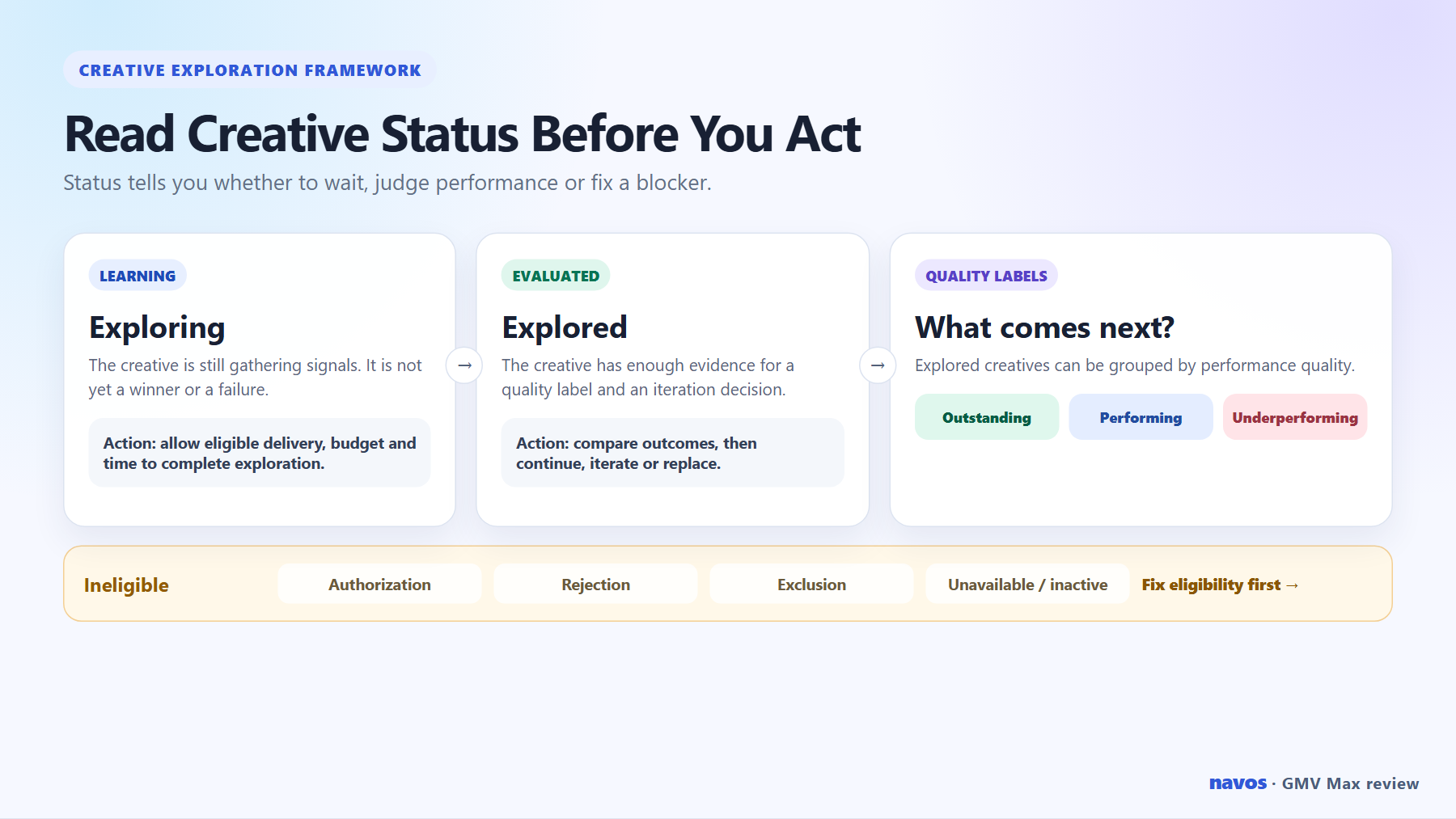
Exploring
The creative is gathering signals. It has not yet received enough evidence for a final quality judgment.
Do not treat an Exploring creative as a winner or a failure. First check whether it has enough time, eligible delivery, budget, and product demand to complete exploration.
Explored
The creative has gathered enough signals to be evaluated. Explored creatives can then receive one of three quality labels:
- Outstanding: a strong candidate for continued use, iteration, or controlled scaling.
- Performing: producing acceptable results but not necessarily the best asset in the pool.
- Underperforming: unlikely to deliver efficient results without a meaningful change.
An Explored label is not a permanent lifetime score. Price, inventory, seasonality, competition, product reviews, audience fatigue, and new creative supply can all change future performance.
Ineligible
The creative cannot enter exploration in its current state. TikTok identifies possible causes including missing authorization, rejection, exclusion, unavailability, or inactivity.
This is an operational problem before it is a creative-quality problem. Rewriting the hook will not help if the video is not authorized or the product is unavailable.
3. Product GMV Max Adds Exploration Metrics, Benchmarks, and Recommendations
For Product GMV Max, the update adds a reporting layer at the SPU level. Advertisers can use it to assess creative supply, exploration progress, and performance relative to relevant benchmarks.
This helps answer questions that raw campaign totals cannot:
- Does this product have enough eligible creatives?
- Are creatives entering exploration or getting blocked?
- Is the explored rate healthy?
- Are enough explored creatives becoming strong performers?
- Is the constraint creative quantity, creative quality, delivery, or product competitiveness?
The diagnostic sequence matters. A low Outstanding rate does not automatically mean “upload more videos.” The right action depends on where the funnel breaks.
Signal | Likely problem | First action |
Many Ineligible creatives | Authorization, rejection, availability, exclusion, or inactivity | Fix eligibility before producing more variations |
Low explored rate | Insufficient delivery, restrictive ROI target, limited budget, or weak product signal | Check delivery conditions and allow enough learning |
Healthy explored rate but few Outstanding creatives | Creative quality or product-message fit | Build new variations from the strongest patterns |
Good CTR but weak conversion | Product page, price, offer, reviews, shipping, or audience-product fit | Audit the commercial experience before replacing every creative |
Orders but weak ROI | Margin, discounting, commission, target ROI, or cost structure | Review unit economics and scaling guardrails |
The point is not to optimize every metric. It is to identify the first constraint that prevents the next stage from working.
4. What Creative Boost 2.0 Changes
Creative Boost is designed to give selected creatives additional testing or amplification budget. Creative Boost 2.0 improves the workflow in four areas.
Batch testing and shared budget control
Advertisers can accelerate multiple creatives without configuring each one separately. A shared budget makes larger tests easier to manage and reduces repetitive setup.
Clearer reporting
Individual and batch reporting can show the cost and outcome of an accelerated test, including changes in exploration status and performance across the boost period.
Scheduled launches
Teams can prepare boosts around product launches, campaigns, seasonal events, or livestream schedules instead of relying on manual activation at the last minute.
Higher capacity for larger advertisers
Expanded limits give high-volume advertisers more room to test several creatives at once.
Creative Boost is still not a substitute for good evidence. TikTok’s public LIVE GMV Max Creative Boost documentation explicitly notes that boosted budget does not guarantee ROI. Availability and reporting also vary by campaign type and account.
5. When Should You Use Creative Boost 2.0?
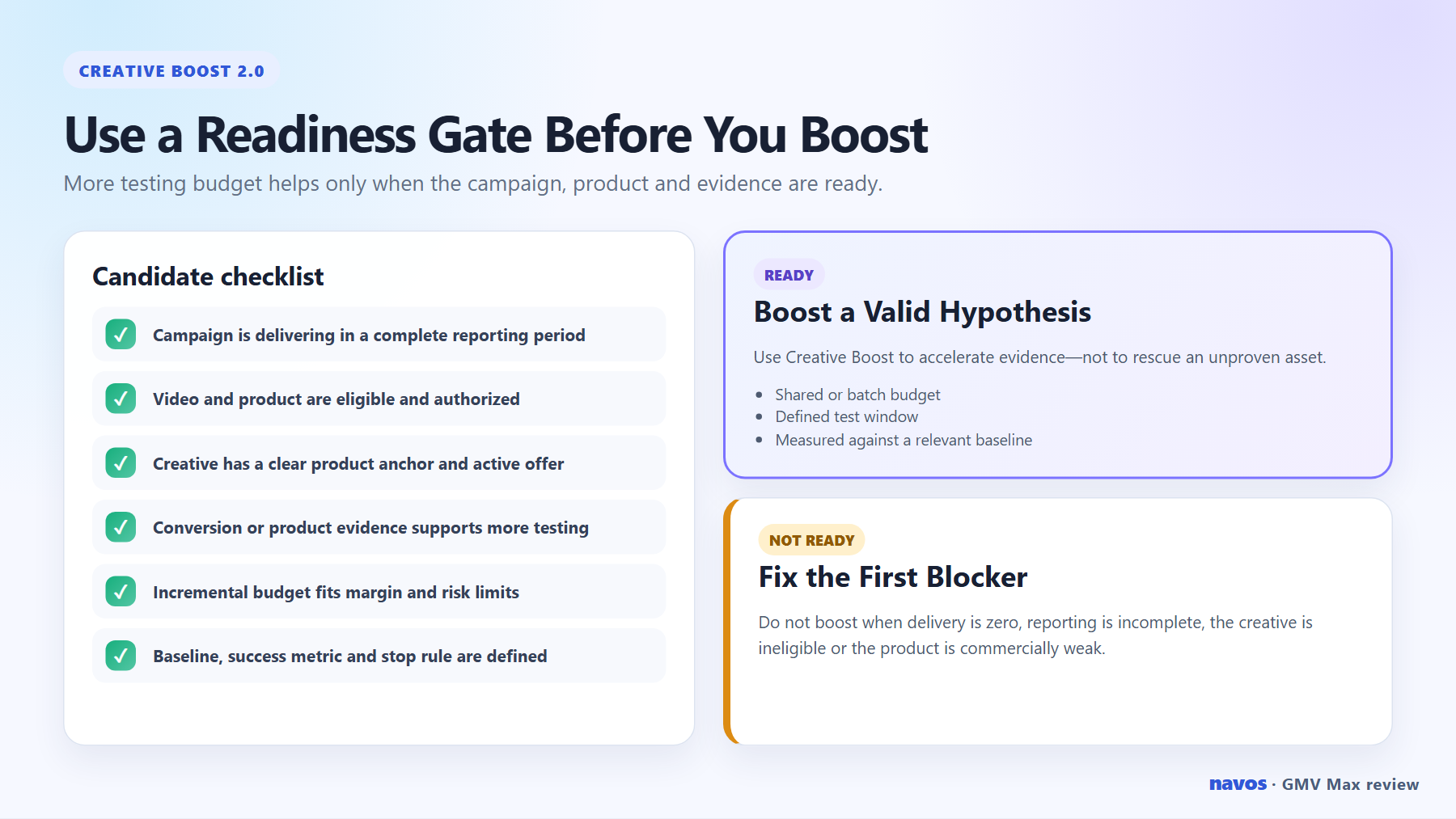
Use Creative Boost when the account has a valid reason to accelerate learning or exposure—not simply because a creative looks good.
A reasonable candidate should pass most of these checks:
- The campaign is delivering and the reporting period is complete.
- The video and product are eligible and properly authorized.
- The creative has a clear product anchor and matches the active offer.
- There is enough conversion or product evidence to justify additional testing.
- The business can tolerate the incremental budget without violating margin limits.
- The test has a defined start time, end time, success metric, and stop rule.
- The result will be compared with a relevant baseline.
Avoid Creative Boost when:
- the campaign has zero delivery;
- the report excludes GMV, orders, ROI, or creative identifiers;
- the product is out of stock or commercially uncompetitive;
- the creative is ineligible;
- the only positive signal is CTR;
- the team has no scale, iterate, or stop threshold.
Boosting an unvalidated asset does not create a stronger test. It only makes the uncertainty more expensive.
If the campaign is still in its launch or learning phase, follow this ad launch and optimization framework before increasing creative-testing spend.
6. Our 8-Minute Navos GMV Max Diagnosis
To see how AI-assisted analysis could support GMV Max decisions, we provided Navos with an authorized campaign export covering July 22–29, 2026.
The export represented a campaign-performance snapshot rather than a complete commerce dataset. Because product-level GMV, orders, ROI, and Creative Exploration fields were not included, Navos focused on what the available evidence could reliably support: validating data quality, identifying delivery constraints, and defining the additional inputs required for deeper optimization.
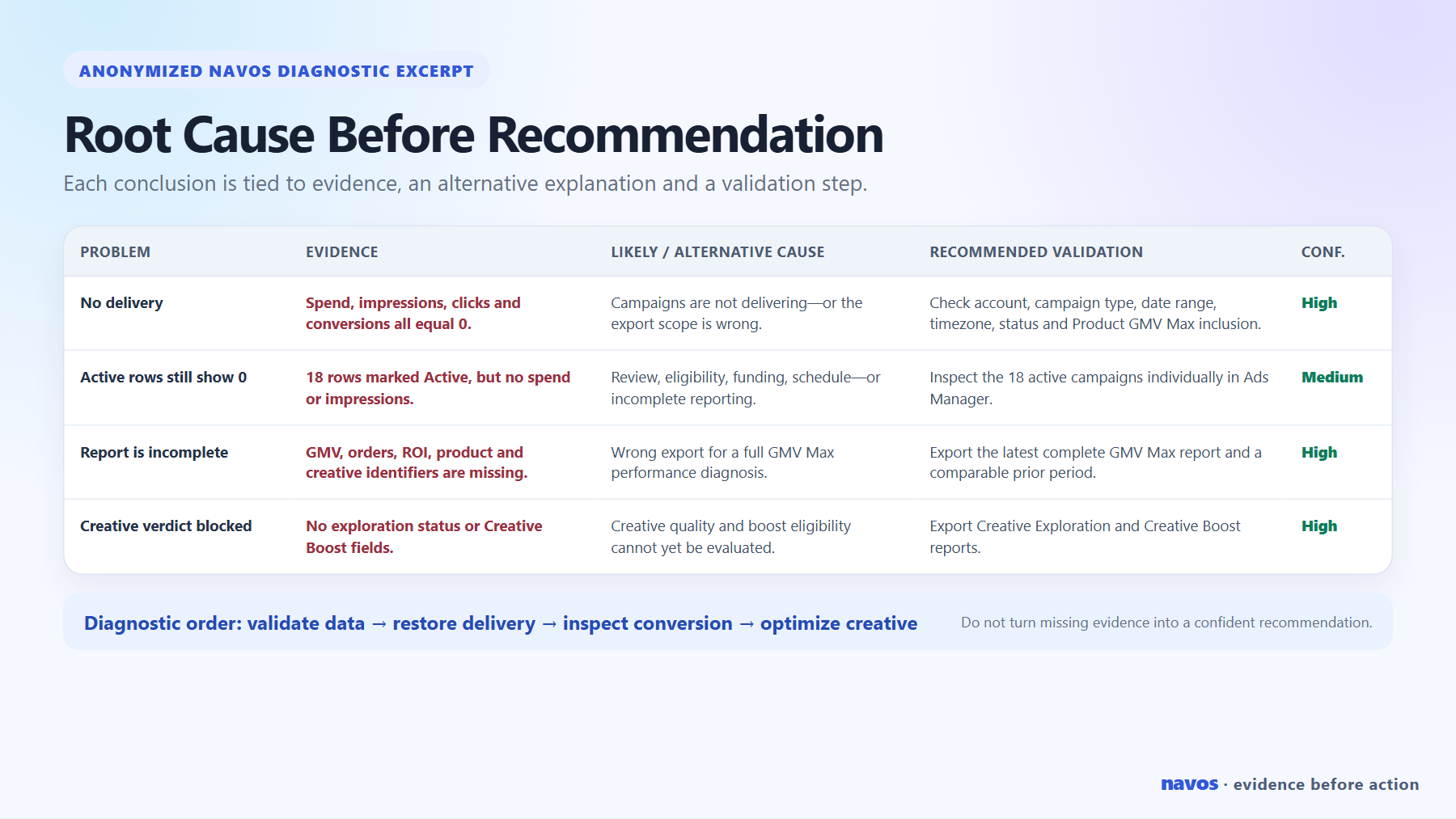
Navos processed the workbook in approximately eight minutes, reconstructed the full worksheet structure, and analyzed 4,701 campaign rows across 24 columns. Instead of filling evidence gaps with assumptions, it separated verified findings from pending validation and produced a prioritized diagnostic plan.
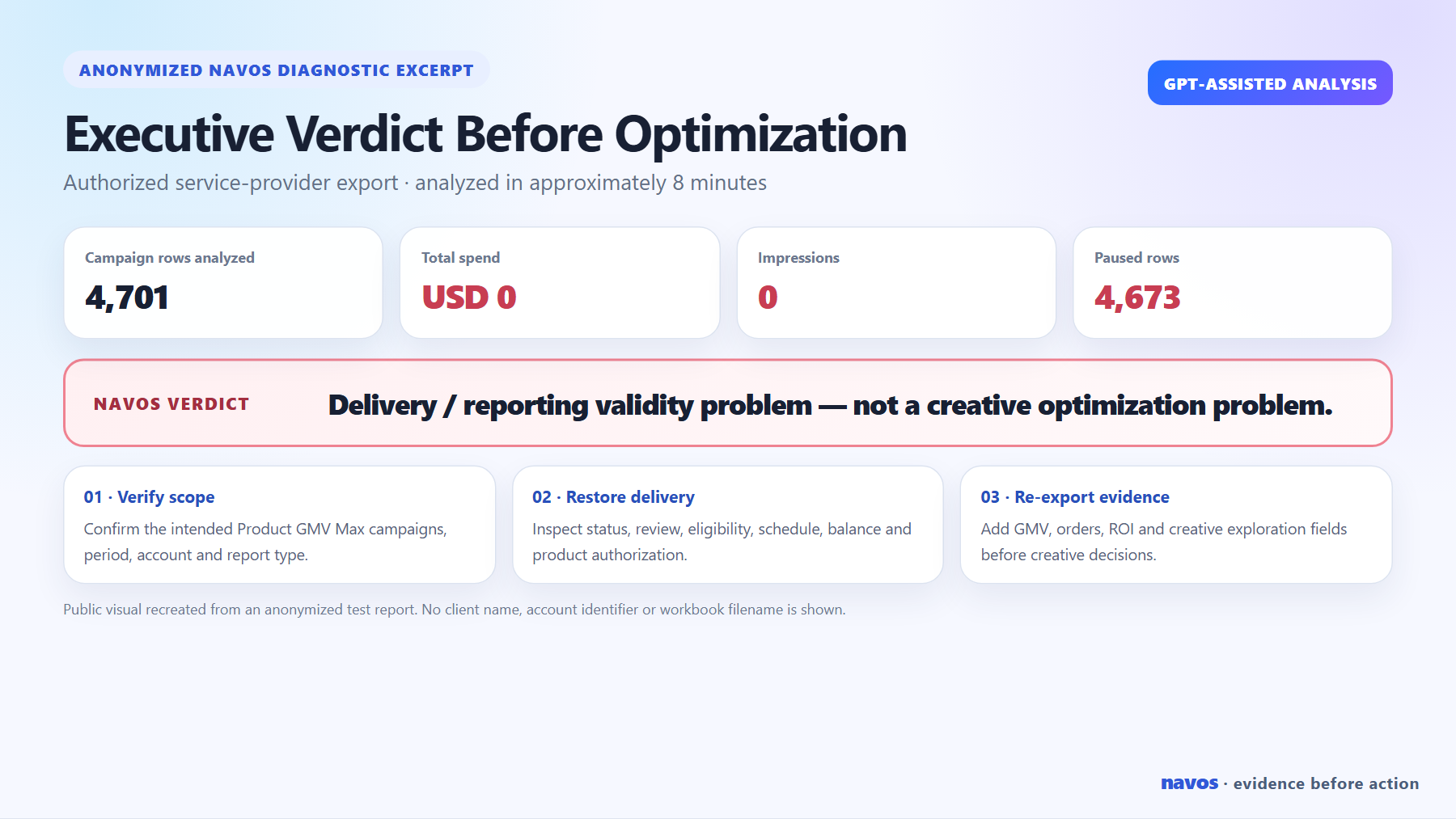
What Navos verified
- Total spend was USD 0.
- Impressions, destination clicks, and conversions were all 0.
- 4,673 campaign rows were paused.
- 18 rows were marked Active, but they also produced no spend or impressions.
- The export did not verify that the campaigns were Product GMV Max campaigns.
- GMV, orders, ROI/ROAS, product identifiers, creative identifiers, Creative Exploration status, and Creative Boost fields were missing.
The decision Navos made
Navos did not label the account’s creatives as weak. It did not recommend increasing budget or activating Creative Boost. It classified the immediate issue as a delivery or reporting-validity problem.
That distinction matters. If a campaign has no impressions or spend, creative CTR and conversion quality are not yet the first problem to solve.
The report then mapped the likely causes:
- campaigns may be paused or outside their schedule;
- active campaigns may still be under review or ineligible;
- shop or product authorization may be missing;
- the account, filter, date range, or report type may be wrong;
- funding or balance may be insufficient;
- the export may include historical campaigns instead of the intended active GMV Max scope.
Each hypothesis was paired with an alternative explanation, validation step, and confidence level.
7. Why the Navos Result Was Useful Even With Incomplete Data
The value was not access to exclusive merchant performance data. The value was the analysis discipline applied to the available evidence.
This is one practical example of how AI is used in advertising to organize performance evidence, identify the first constraint, and support human decision-making.
Navos separated four layers that are often mixed together:
- Data validity: Is this the correct report, period, account, campaign type, and attribution scope?
- Delivery: Are eligible campaigns receiving impressions and spending?
- Conversion: Are clicks becoming orders and GMV?
- Creative optimization: Which creatives should be explored, iterated, boosted, scaled, or replaced?
Skipping the first two layers creates bad recommendations. A team might replace creatives when the real issue is authorization, lower an ROI target when the wrong report was exported, or boost a video before any product-level conversion evidence exists.
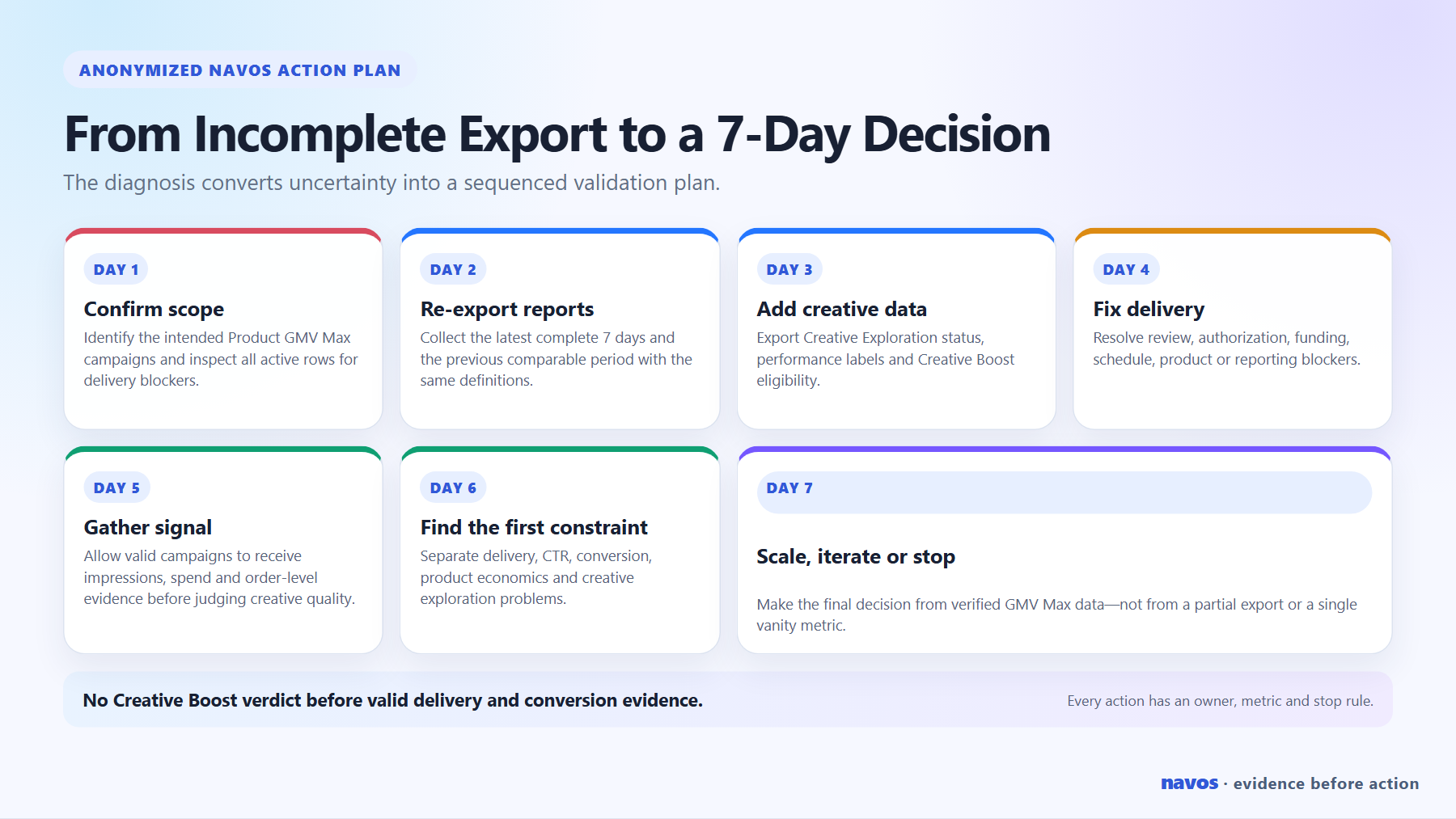
Navos also converted the diagnosis into a seven-day action plan:
- identify the intended Product GMV Max campaigns;
- inspect the 18 active campaigns for delivery blockers;
- export the latest complete seven-day GMV Max report;
- export the previous comparable period using the same timezone and attribution;
- export Creative Exploration and Creative Boost data;
- fix delivery causes;
- wait for sufficient signal before making creative decisions;
- make the final scale, iterate, or stop decision from verified GMV Max data.
For a team facing thousands of campaign rows, this is more useful than another generic list of GMV Max best practices.
8. A Practical GMV Max Diagnostic Order
Use the following order before changing budget or creative strategy.
Step 1: Validate the report
Confirm:
- account and shop;
- Product GMV Max or LIVE GMV Max;
- latest complete period;
- comparison period;
- timezone and attribution;
- campaign, product, and creative identifiers;
- spend, GMV, orders, ROI, CTR, CVR, and cost per order.
Step 2: Confirm delivery
If spend and impressions are zero, inspect status, schedule, review, authorization, account balance, product eligibility, and reporting scope.
Do not diagnose creative quality yet.
Step 3: Inspect the exploration funnel
Measure:
- eligible creative supply;
- Exploring, Explored, and Ineligible counts;
- explored rate;
- Outstanding, Performing, and Underperforming distribution;
- concentration of spend, GMV, and orders by creative and product.
Step 4: Identify the first performance constraint
- Low delivery: inspect budget, ROI target, eligibility, authorization, and creative supply.
- Low CTR: improve the hook, opening, clarity, creator fit, or demonstration.
- Acceptable CTR but weak CVR: inspect price, offer, product page, reviews, shipping, and product-market fit.
- Orders but weak ROI: inspect target ROI, margin, discounts, commissions, returns, and cost structure.
Step 5: Select Creative Boost candidates
Choose only creatives with a clear hypothesis and measurable test design. Define the budget, duration, comparison baseline, success threshold, and stop rule before launch.
Step 6: Turn winners into new variations
Do not only increase spend on one winning video. Extract repeatable elements:
- first-second hook;
- problem framing;
- creator type;
- product demonstration;
- proof or objection handling;
- offer;
- CTA;
- length and pacing.
Build new variations so the creative system continues producing evidence.
9. What Data Should You Give an AI GMV Max Analyst?
An AI diagnosis becomes more useful when the input package includes:
- latest complete seven-day Product or LIVE GMV Max report;
- previous comparable seven-day report;
- product-level GMV, orders, spend, ROI, CVR, and cost per order;
- creative ID, creator, authorization status, and product anchor;
- Exploring, Explored, Ineligible, Outstanding, Performing, and Underperforming status;
- Creative Boost eligibility and performance;
- campaign budget, target ROI, status, schedule, and attribution window;
- inventory, pricing, discount, commission, shipping, and return context.
If a field is unavailable, the analysis should mark it as missing rather than silently estimate it. Every recommendation should distinguish verified account data, TikTok platform guidance, analytical inference, and the additional evidence still required.
Frequently Asked Questions
What changed in TikTok GMV Max in 2026?
The Creative Exploration upgrade allows product-level learning to carry across campaigns, simplifies creative statuses, adds quality labels, and introduces Product GMV Max exploration metrics, benchmarks, and recommendations. Creative Boost 2.0 adds more scalable testing controls and reporting.
What do Exploring, Explored, and Ineligible mean?
Exploring means the creative is still gathering signals. Explored means it has completed evaluation and can receive a quality label. Ineligible means it cannot enter exploration until an authorization, policy, availability, exclusion, or activity issue is resolved.
Does an Outstanding label guarantee future ROI?
No. It is a useful performance signal, not a permanent guarantee. Product economics, competition, inventory, seasonality, fatigue, and offer changes can affect future results.
Does Creative Boost 2.0 guarantee more orders?
No. Creative Boost increases testing or exposure opportunities; it does not guarantee orders or ROI. Use it with an eligible creative, a valid test hypothesis, and clear budget and stop rules.
Why is my GMV Max campaign not spending?
Possible causes include a restrictive ROI target, insufficient or ineligible creative supply, missing authorization, campaign or product review, schedule, budget, balance, product availability, or incorrect report scope. Start with delivery diagnostics before changing creative strategy.
Can Navos analyze GMV Max without direct account access?
Navos can analyze authorized exports and organize the available evidence into a structured diagnosis. The strength of the conclusion depends on the supplied fields. Without product, GMV, order, ROI, and creative-level data, it should provide a data-readiness and validation plan rather than pretend to complete a full performance audit.
Final Verdict
Creative Boost 2.0 is useful, but the bigger GMV Max improvement is the decision framework around it. Advertisers can now distinguish learning, completed evaluation, blocked assets, and creative quality more clearly.
The correct operating order is:
validate the data → restore delivery → inspect conversion → diagnose creative exploration → select boost candidates → scale or iterate.
In our test, Navos completed the first stage in approximately eight minutes, prevented an unsupported Creative Boost recommendation, and turned an incomplete campaign export into a prioritized validation plan.
Turn your campaign exports into a decision. Download Navos for Windows or macOS from the official website, open the desktop app, and use its GPT-assisted analysis workflow to organize your authorized GMV Max data, evidence gaps, and next actions.