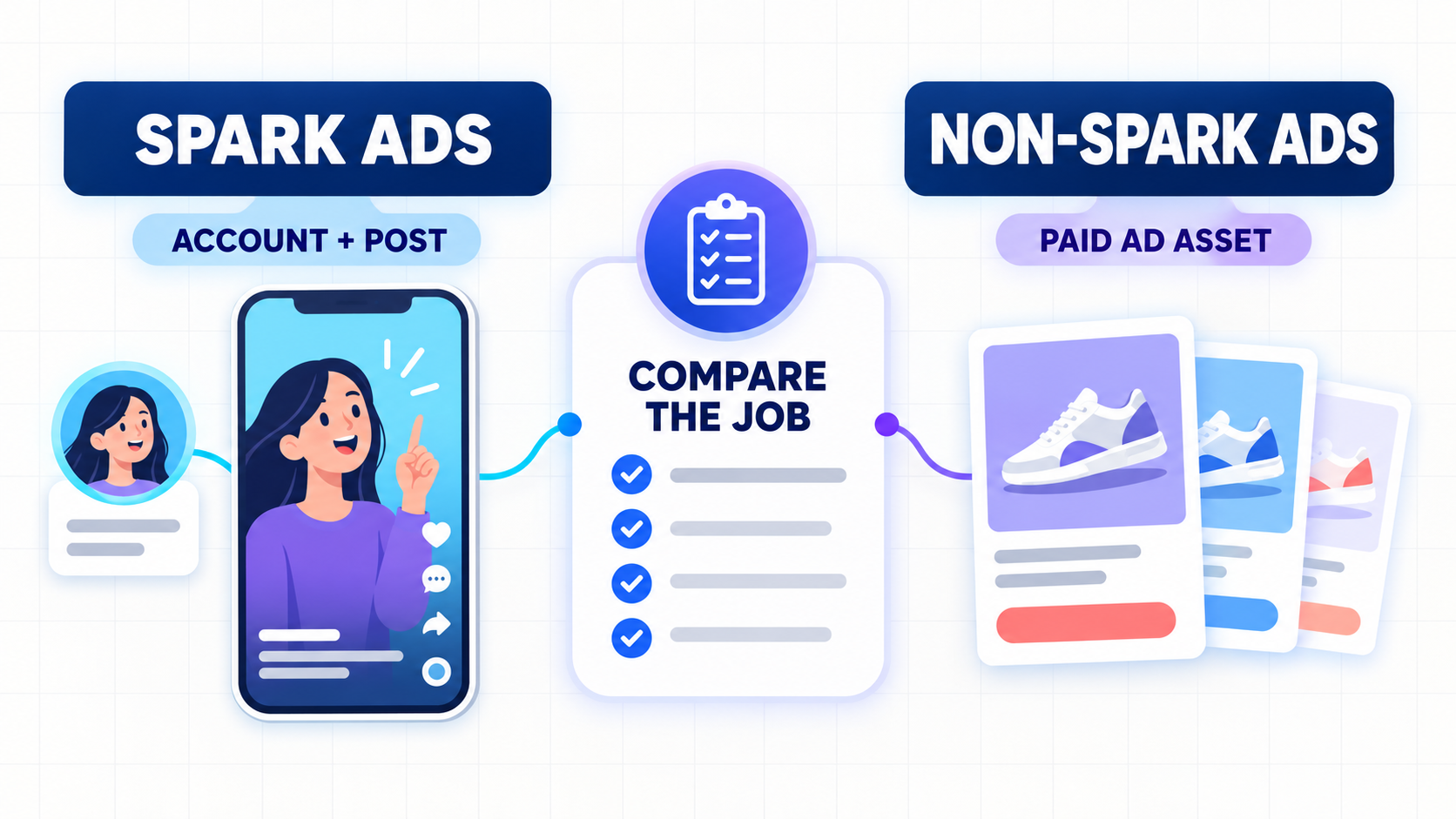
A Spark Ad and a non-Spark Ad can promote the same product with a similar video in the same feed. That does not make them interchangeable.
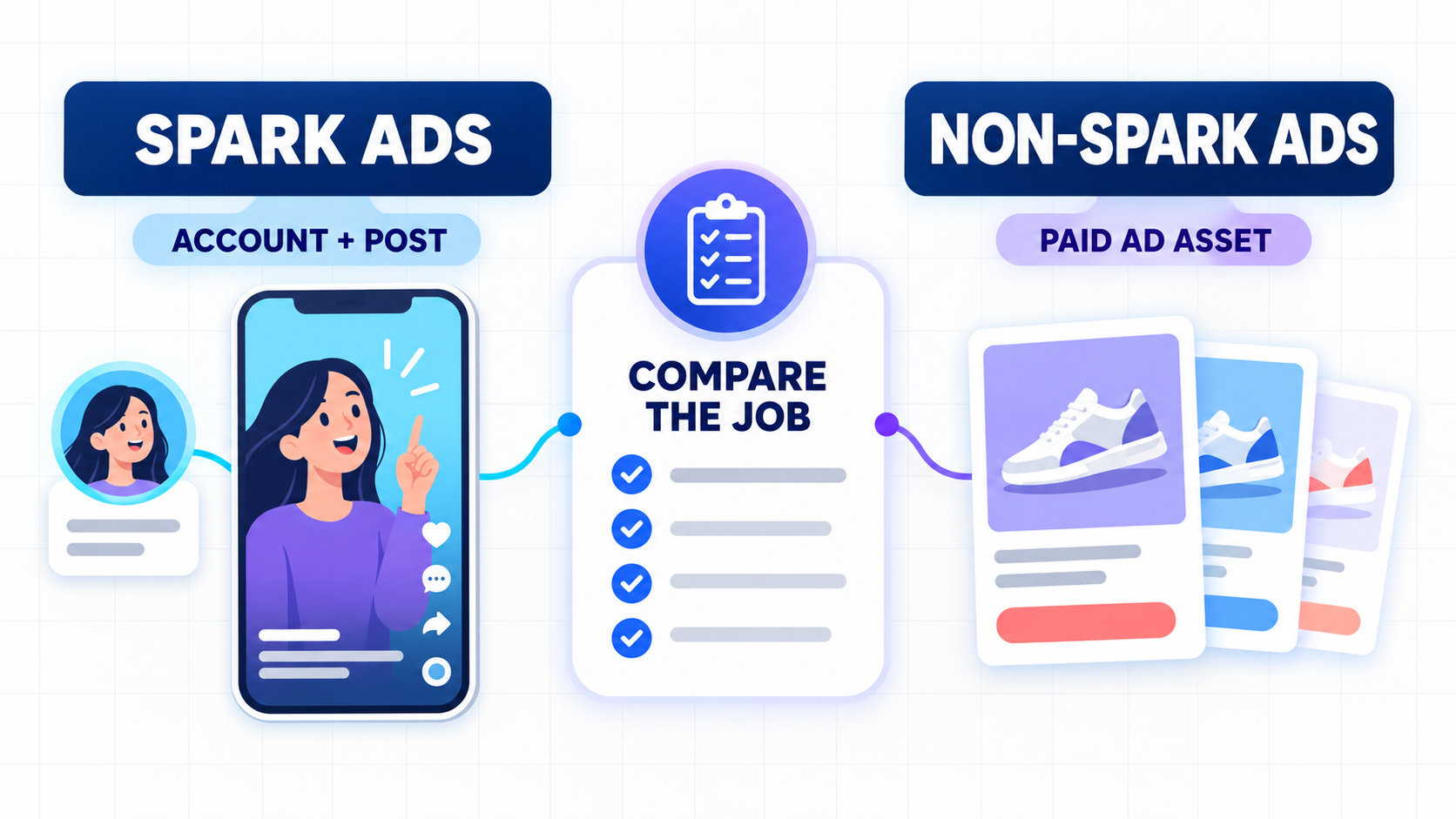
The difference starts with the object being promoted. Spark Ads deliver through a TikTok account and post: the creative may come from an eligible existing brand post, a creator post authorized by post code, or a new post pushed from Ads Manager to a linked account. Where the advertiser's current setup still supports a non-Spark route, the ad runs as a paid ad asset through the available non-Spark settings—for example, Custom Identity in an account where that option remains available. That choice affects permissions, editing, engagement, measurement, and testing—but it does not tell you which ad will win.
That distinction matters because format comparisons often mix three separate questions:
- Which route fits the campaign's operational needs?
- Which creative is stronger?
- Which ad produced the better business result under comparable conditions?
This guide separates those questions, explains seven practical differences, and provides a scorecard that does not turn a platform average into an account promise.
This guide focuses on the United States. Identity routes, campaign objectives, and interface availability can vary by market and account, so confirm the current options in Ads Manager before launch.
The Short Answer
Spark Ads usually fit work that depends on a TikTok identity and post, post-linked interactions, and engagement associated with that post. An eligible existing creator or brand post is one route; Push Spark can publish a new post under a linked account.
A non-Spark route can fit campaign-specific paid creative and controlled asset versions—provided the account, market, objective, and current identity setup support it.
If the job is simply “get the best CPA,” the format label cannot answer it. You need a matched test.
Choose by the job, not by a universal winner
Start with the campaign requirement:
- Need to amplify a creator post that already has useful context? Spark is the natural candidate.
- Need several controlled paid-only versions of a claim, offer, or CTA? A supported non-Spark route may be easier to manage.
- Need to know which produces more purchases? Build comparable pairs and measure the same outcome.
The best format supports the job and the account's real constraints.
Account for TikTok's current identity transition
As of October 2026, TikTok says it is phasing out Custom Identity—the route its Help Center identifies for non-Spark Ads—while current Help Center pages still document non-Spark support in some workflows. Availability can therefore differ by account, market, objective, and interface. Verify the option in Ads Manager before planning a non-Spark test.
For this article, “non-Spark” means that currently available ad-asset route, not a guarantee that every legacy identity option still appears in every account.
Comparison guides often call these “regular” or “standard” TikTok ads. This article uses non-Spark because the exact identity route now depends on the advertiser's current setup.
Spark Ads vs Non-Spark Ads at a Glance
Decision factor | Spark Ads | Non-Spark ad-asset route |
Starting point | An eligible existing post or a new post pushed to a linked TikTok account | An ad asset created or uploaded for paid delivery |
Identity | The linked or authorized TikTok identity behind the post | Depends on the account's current identity and campaign setup |
Permission dependency | Requires the applicable linked-account access or creator/post authorization. For Push Spark, the linked account must allow publishing and management of new videos; separate usage-rights checks still apply | Does not use a creator's existing post in the same way, but asset and usage rights still matter |
Editing | Inherits post-level constraints | Can support more controlled asset versioning, subject to the current workflow |
Interaction | Preserves post-linked interaction paths | Follows the configured paid-ad experience |
Engagement | Promotion engagement can accumulate on the original post | Does not add paid interaction to an existing organic post |
Testing style | Tests a post, identity, and paid distribution together | Can make paid-only variant isolation easier when available |
The table describes workflow differences, not expected performance. A polished non-Spark asset can beat a weak Spark post. A creator post can beat a brand asset. Neither result proves that the format caused the difference.
1. Creative Source and Identity
Spark Ads run through a TikTok account and post
A Spark Ad runs through a TikTok account and post. TikTok documents three main sourcing routes: pull an eligible post from a linked or authorized account, use a creator's authorized post code, or push new content from Ads Manager so it publishes under a linked account.
That makes the post more than a video file. The creative carries an identity, a publishing context, and a route back to the account and post experience. If an existing post already demonstrates the product clearly, sounds native to the creator, or has useful audience discussion, paid distribution can extend that object instead of rebuilding it as a separate ad asset.
This is why the source-post decision should come before the media plan. Do not choose a post only because it has a high view count. Check whether its hook, proof, offer, comments, claims, music, and creator permissions make sense for paid use.
If the team still needs concepts before it has a viable source post, start with a structured bank of TikTok Shop video ideas, then decide which concepts belong in an organic-post workflow and which belong in a paid-only asset workflow.
Non-Spark identity options depend on the current account setup
A non-Spark workflow begins with the ad asset rather than an existing post. That can be useful when the creative was designed for a campaign, has no organic-post history, or needs several controlled versions.
The identity attached to that workflow should not be assumed from an old screenshot or tutorial. TikTok's ongoing identity changes mean the available route can differ by account, market, objective, and interface state. Treat “Can we create this non-Spark ad as planned?” as a launch check, not as a settled platform constant.
If the identity and existing post are part of the creative proposition, Spark belongs on the shortlist. If the asset itself is the test object and the account supports the route, start by evaluating non-Spark.
2. Creator Authorization and Rights
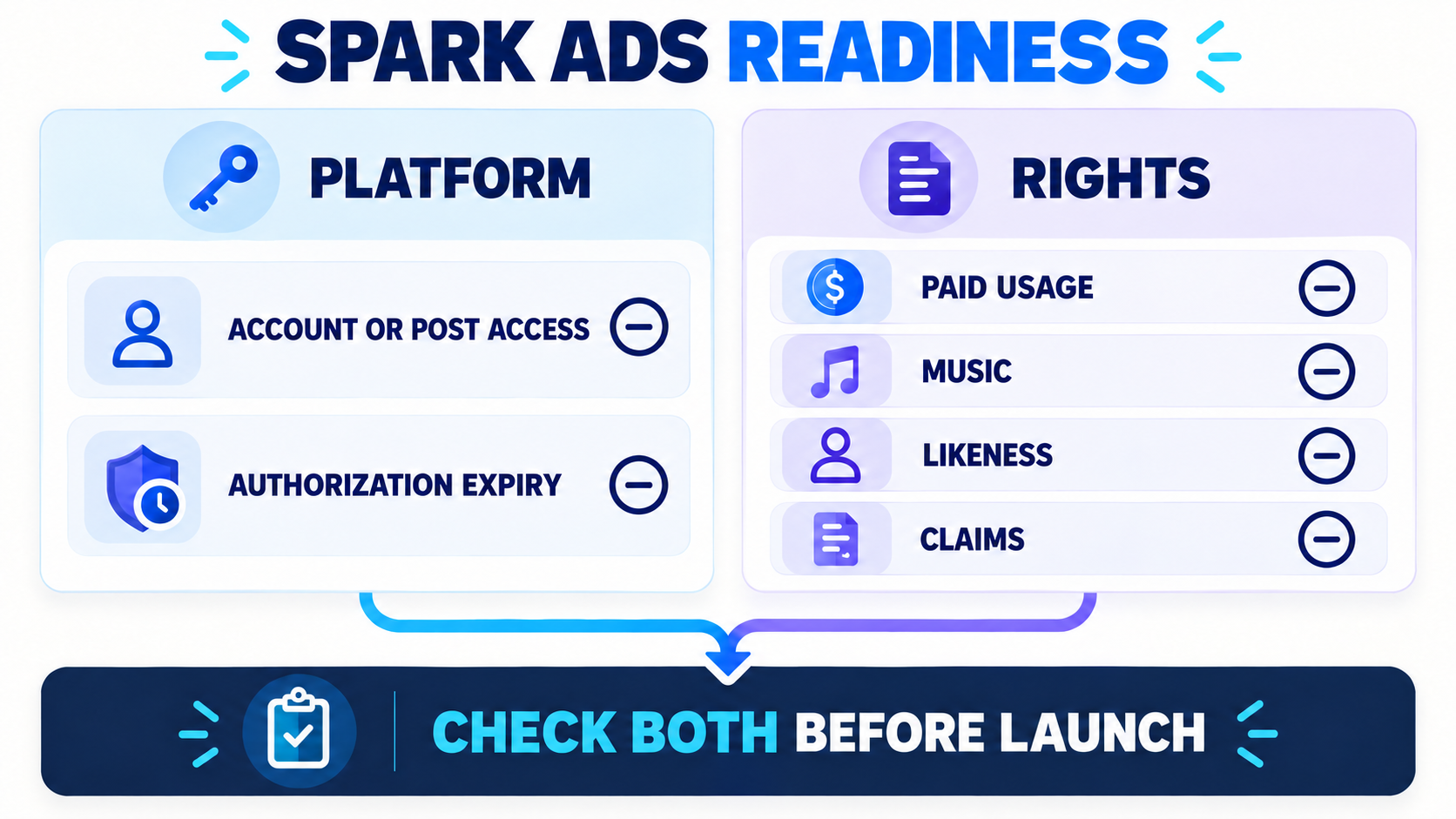
Platform authorization and commercial rights are separate checks
When a brand uses a creator's post as a Spark Ad, the ad account needs the appropriate in-product authorization. Depending on the workflow, this can involve an authorized account relationship or a post code with a defined permission window.
That proves the in-product permission path. Do not infer from it alone that music, edits, likeness, territory, term, or claims are cleared. An applicable creator or TikTok One agreement may cover some of those rights, so retain that agreement as separate evidence and read its actual scope.
A valid authorization does not, by itself, answer every commercial question. The team may still need to confirm:
- The countries where paid use is permitted.
- The start and end dates for paid media.
- Whether editing, cutdowns, subtitles, or new CTAs are allowed.
- Whether the music can be used in the planned paid context.
- Whether likeness, testimonial, product-claim, and category requirements are covered.
- Whether the creator can remove, privatize, or materially change the source post.
Keep the platform authorization record and the commercial rights record together, but do not treat them as the same evidence.
Expiry and permission status are launch dependencies
Spark setup or a scheduled flight can be blocked when authorization is missing, expired, or does not cover the ad end date. Unsupported or ineligible source posts can also block the workflow.
Add these fields to the campaign handoff:
- Source post ID.
- Authorizing account.
- Authorization status.
- Authorization end date.
- Paid-usage territory and term.
- Music-rights status.
- Claims-review status.
- Owner for renewal or replacement.
Non-Spark assets do not require permission to promote someone else's existing post in the same way, but they are not rights-free. If a paid-only asset includes a creator, licensed footage, music, testimonials, or regulated claims, the underlying permissions still need to be documented.
For creator-post Spark Ads, readiness depends on active platform authorization plus the commercial, music, likeness, and claims evidence required by the applicable agreement. A brand's own linked-account post follows a different authorization path, but asset-rights and policy checks still apply.
3. Editing and Caption Control
Spark editing depends on how the post enters the workflow. For a pulled or code-authorized post, TikTok says the caption cannot be edited after authorization. Push Spark Ads are different: text can be set during ad setup before the new post is published to the linked account. In neither case should a live Spark caption be treated as a freely mutable ad-copy field.
If a claim, price, date, or offer in an existing post is wrong, the safe response may be to select or publish a corrected source post rather than assume the original can be rewritten inside the ad workflow.
This constraint can be a benefit. It protects continuity between the post a user encounters and the post the creator or brand actually published. It can also slow a team that expects to change copy every few days.
A non-Spark ad-asset workflow can provide a cleaner versioning model: duplicate an asset, change one planned element, label the version, and preserve the prior control. The exact options still depend on the current interface and campaign setup, but the team versions the paid asset rather than an existing post.
Before choosing Spark, ask:
- Is the caption accurate for the full paid flight?
- Will the offer or price expire before the authorization does?
- Can the video stand without extra context from an organic thread?
- If the post becomes unsuitable, is a replacement already approved?
The trade-off is straightforward: Spark protects post continuity, while a supported non-Spark route can make controlled paid-only versioning easier.
4. User Interaction Paths
Spark Ads preserve interaction paths connected to the post and its identity. TikTok says CTA and ad-caption taps go to the landing page, while profile-photo or nickname taps and swipes can open the video owner's profile; follow and sound controls open their corresponding TikTok experiences. That can be valuable when the profile, creator relationship, related content, or comment discussion strengthens the product story.
It can also create a mismatch. A strong ad cannot compensate for a profile that tells a different story, a comment section dominated by unresolved objections, or a source post whose context conflicts with the current offer.
A non-Spark ad generally routes those surfaces to the configured landing or app-install destination. That can keep the journey focused on the CTA, but it does not carry the same post-and-profile context.
Audit both routes from the viewer's perspective:
- What happens after a tap on the CTA?
- What identity and profile context can the viewer inspect?
- Does the destination match the promise in the video?
- Are comments helping, distracting, or exposing an unanswered concern?
- Is the offer still accurate everywhere the viewer can go?
The surrounding context belongs in the media decision. Spark helps when that context gives the viewer more confidence; it becomes a liability when the context creates friction the team is not prepared to manage.
5. Where Engagement Accumulates
TikTok attributes engagement generated through Spark promotion to the original organic post. That continuity is one of Spark's clearest operational advantages: paid distribution can add visible activity to the same post instead of creating a disconnected paid object.
But visible activity is not the same as incremental profit.
A Spark post can collect likes, comments, shares, follows, or profile visits while producing a weaker landing-page conversion rate than another ad. A non-Spark ad can generate fewer visible social signals but produce more purchases. Which result matters depends on the objective.
Use three separate buckets:
- Paid delivery: spend, impressions, frequency, CPM.
- Traffic and commerce: link clicks, landing-page views, purchases, CPA, attributed revenue, ROAS.
- Post-linked social context: likes, comments, shares, follows, profile visits, and the quality of discussion.
Do not add those buckets together into a made-up “overall score” unless the business has explicitly defined and validated how each signal should be valued.
If building useful activity on the original post is part of the objective, Spark has a clear role. Still, report that activity separately from conversion efficiency.
6. What Each Format Lets You Measure
Compare shared paid metrics first
The cleanest comparison starts with fields both ads share:
- Spend.
- Impressions.
- CPM.
- Link clicks and link CTR.
- Landing-page views.
- CPC.
- Purchases or the selected optimization event.
- Conversion rate.
- CPA.
- Attributed revenue and ROAS, when revenue and attribution definitions are available.
Use the same formula for both rows. For example:
CPM = spend / impressions × 1,000
Link CTR = link clicks / impressions
CPC = spend / link clicks
Landing-page CVR = purchases / landing-page views
CPA = spend / purchases
ROAS = attributed revenue / spend
If a denominator is zero or a field is missing, return
N/A; do not silently convert it to zero.Keep Spark-specific social context in a separate layer
Spark can provide context that a paid-only object does not replicate: the original post's engagement history, comments, creator identity, and profile journey. Those signals may help explain why a post earns attention, but they should not be substituted for a purchase or revenue metric.
The distinction is especially important when a team says, “The Spark Ad got more engagement.” Ask which engagement, from which reporting surface, during which period, and whether it changed the business outcome that the campaign was meant to produce.
Do not collapse every signal into one winner score
A composite score can hide the decision instead of clarifying it. Consider these two outcomes:
- Spark has the lower CPM and more post engagement, but the higher CPA.
- Non-Spark has the higher CPM, but a stronger landing-page conversion rate and lower CPA.
There is no honest universal winner without a stated objective. A reach campaign, a creator-amplification campaign, and a purchase campaign can make different choices from the same table.
For adjacent commerce measurement, the same discipline applies when evaluating TikTok Shop Ads and GMV Max ROI: platform delivery signals and business outcomes should stay connected but not confused.
Compare shared metrics against the stated objective, then use Spark-specific social signals as an additional diagnostic layer—not as a substitute for the outcome.
7. Testing and Operational Control
Spark tests a post, its identity, visible context, and paid distribution together. That bundle can make the creative work, but it also makes causality harder to isolate. A supported non-Spark route can make paid-only variants easier to control, but neither route is inherently more scientific.
Platform or agency averages do not predict one account. They can also hide selection bias: if Spark receives the strongest creator posts while non-Spark receives unproven assets, the test begins with a creative-quality difference—not clean evidence of a format effect.
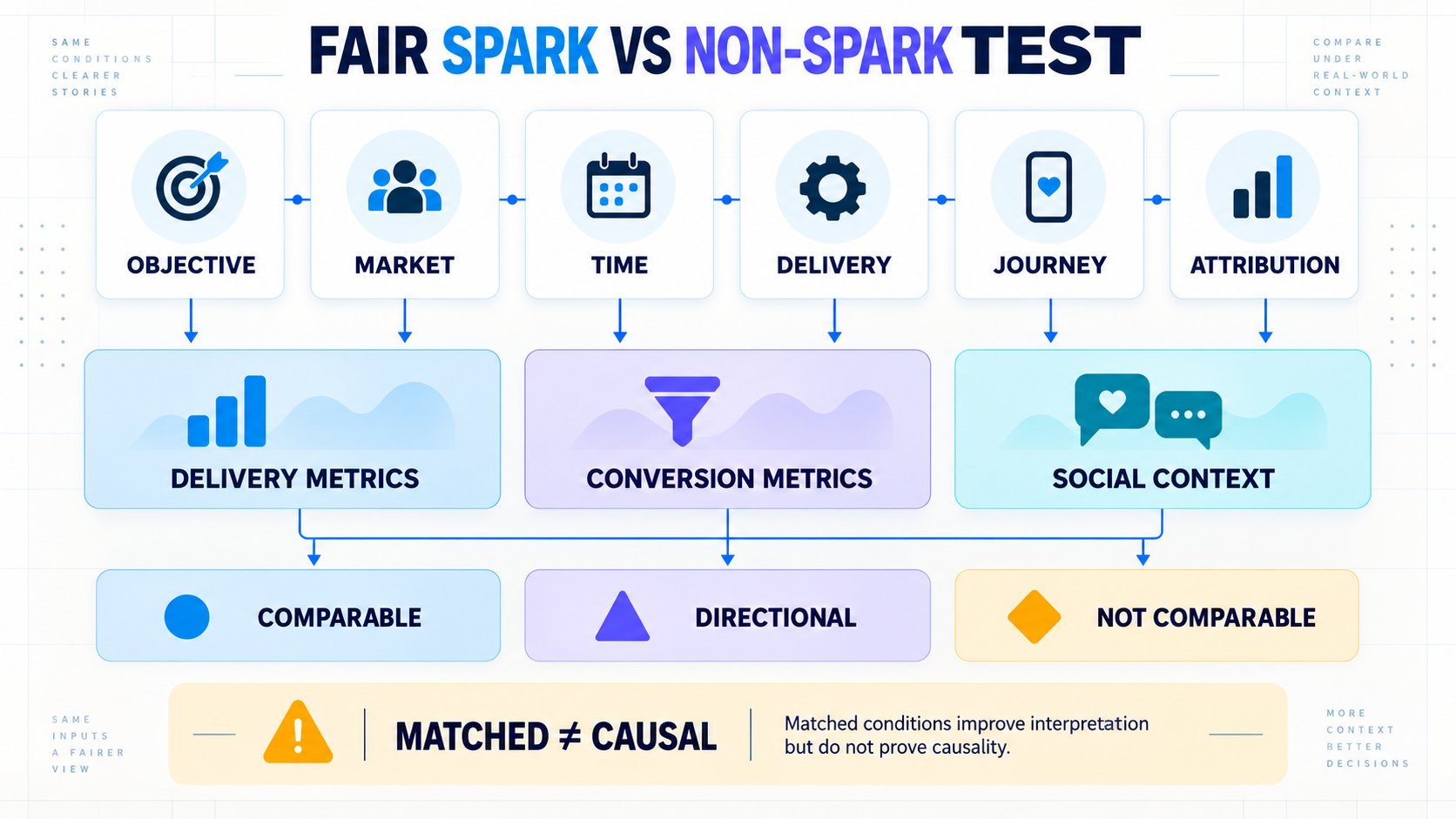
Before calling one format the winner, confirm six comparison gates:
- Objective: Same campaign objective and optimization event.
- Market: Same country and a comparable audience strategy.
- Time: Same date range, timezone, and full-day coverage.
- Delivery: Comparable bid strategy, budget opportunity, and delivery status.
- Journey: Same offer and landing-page route.
- Attribution: Same conversion definition and attribution setting.
Passing all six gates makes the comparison more interpretable, but it does not by itself establish causality, incrementality, equivalence, or statistical significance. Audience labels and aligned settings also do not prove identical users, randomized assignment, or equal auction opportunity. If any gate fails, treat the comparison as directional only.
A Spark post may already have a stronger creator, proven hook, native delivery, or active discussion; a paid-only asset may have more deliberate conversion editing. Record those differences before interpreting the result.
Use Spark to amplify a suitable post, use a supported non-Spark route to isolate paid-asset changes, and use a matched test only when the six gates pass. Before launching variants, TikTok ad research tools can help organize references. Treat those references as hypotheses, not evidence that a format will win.
A Fair Spark vs Non-Spark Scorecard
Use one row per ad and one comparison row per matched pair.
Layer | Metrics or evidence | Decision it supports |
Delivery | Spend, impressions, CPM, delivery status, frequency if available | Did both ads receive a fair opportunity to deliver? |
Attention | 2-second/6-second views, completion milestones, link CTR | Did the creative earn and hold attention? |
Traffic | Link clicks, landing-page views, CPC | Did attention turn into a site visit? |
Conversion | Purchases or chosen event, CVR, CPA, attributed revenue, ROAS | Did the journey produce the campaign's business outcome? |
Social context | Likes, comments, shares, follows, profile visits, comment themes | Did the post-linked experience add useful audience response? |
Operations | Authorization expiry, rights status, editability, owner, replacement readiness | Can the team sustain the format safely? |
Tag each conclusion as Evidence (supplied fact), Inference (plausible explanation that needs a test), or Unknown (missing field or unresolved dependency). Then choose one next test that changes a single variable. Changing the format, offer, audience, and landing page together cannot explain which change produced the result.
Minimum inputs for a reviewable comparison
Do not begin with a screenshot of two CPA values. Build three linked inputs so another analyst can reproduce the calculation and understand the creative difference.
Input | Minimum fields | Why it matters |
Performance export | pair_id, ad_id, format, objective, market, start/end date, timezone, currency, attribution setting, spend, impressions, link clicks, landing-page views, purchases or the chosen event, attributed revenue | Supports the six shared formulas and exposes mismatched reporting conditions |
Creative and permission manifest | Hook, proof, offer, CTA, duration, identity, source-post ID/status, authorization status/expiry, paid-usage rights, music/claims status, landing-page route, known pair differences | Separates a format change from creative, identity, rights, or journey changes |
Data dictionary | Field definition, source, unit, formula, null meaning, reporting timezone, currency, conversion event, attribution rules | Prevents two similarly named columns from being treated as the same metric |
Keep raw counts in the export and calculate rates from those counts. If landing-page views are missing, for example, landing-page CVR should remain
N/A; an analyst should not infer the missing denominator from clicks.How Navos Turns Spark vs Non-Spark Data Into an Actionable Comparison
Navos brings performance data, creative context, permission status, and metric definitions into one structured workflow. For this reproducible example, we ran
Compliance Check → Diagnose Creative Performance in Navos Square with a performance CSV covering four Spark/non-Spark pairs, a creative and permission manifest, and a data dictionary. Synthetic inputs allowed the formulas and missing-value handling to be checked without exposing advertiser or creator data.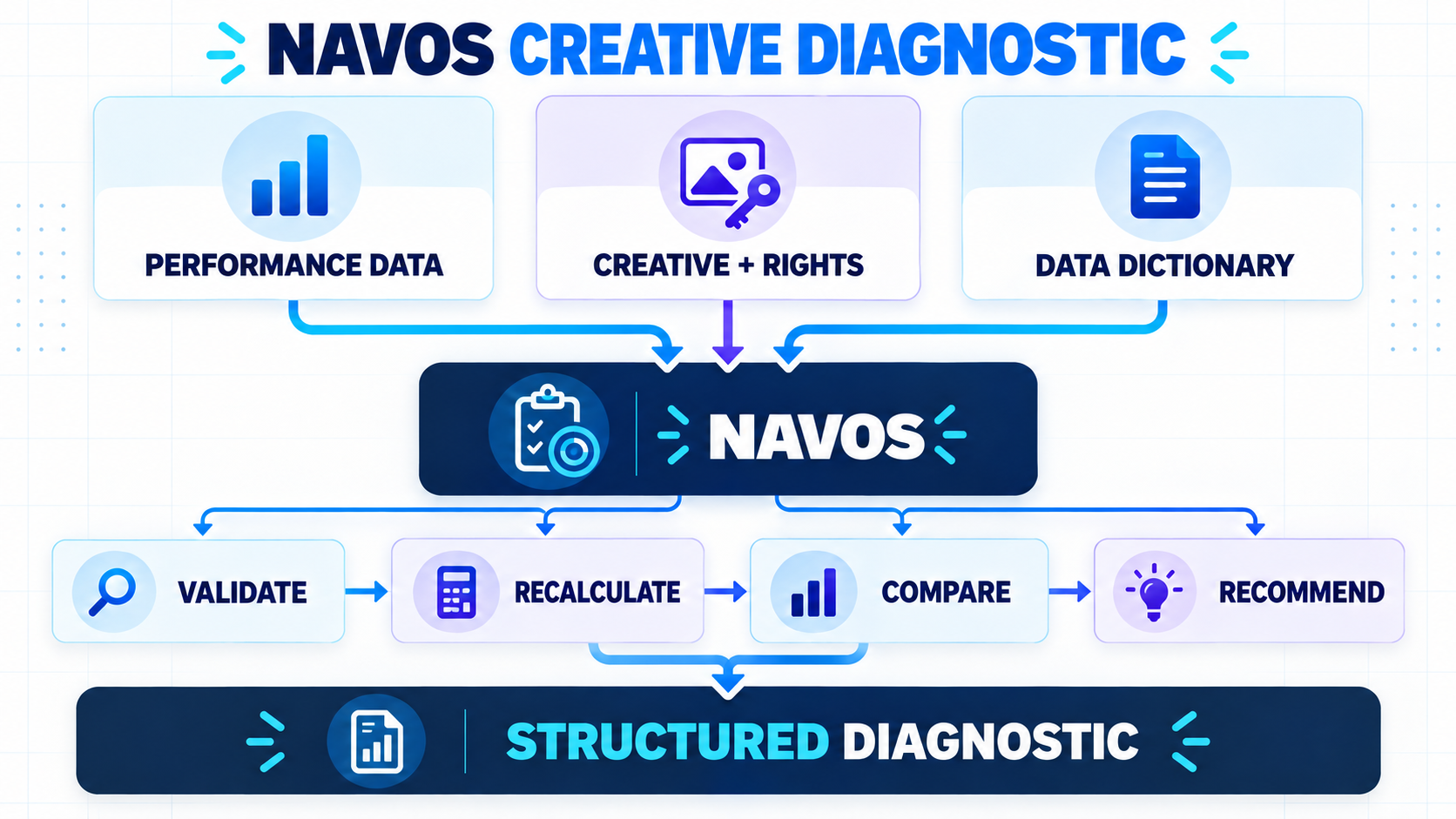
With these three inputs, Navos:
- Checked row counts, dates, timezone, currency, attribution settings, missing values, and pair comparability.
- Recalculated CPM, link CTR, CPC, landing-page CVR, CPA, and ROAS from the supplied raw fields.
- Preserved a missing landing-page-view denominator as
N/Ainstead of converting it to zero.
- Separated comparability, metric availability, and launch readiness into distinct decision layers.
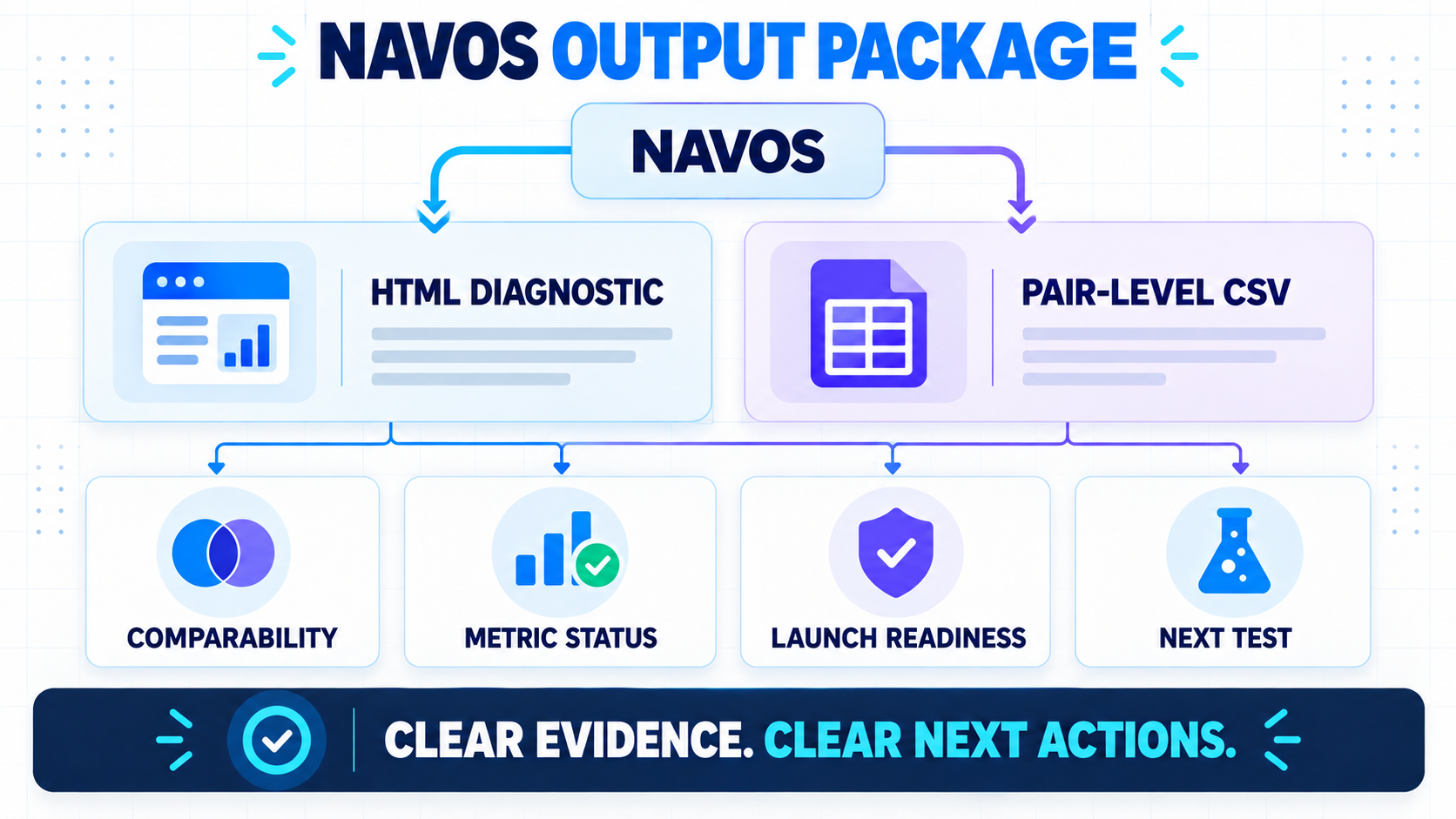
- Returned a downloadable HTML diagnostic and pair-level CSV with findings and recommended next actions.
The final pair-level CSV preserved the intended calculation logic across all 48 derived-metric cells: 47 numeric values matched the source formulas, and the remaining cell—PAIR-03 Spark landing-page CVR—was correctly preserved as
N/A because its denominator was missing, with zero mismatches.The four supplied pairs show how Navos translates different evidence patterns into clear next actions:
Synthetic pair | What Navos surfaced | Recommended next action |
PAIR-01 | Non-Spark had the lower CPA ($18.00 vs $25.56) and higher ROAS (4.17x vs 2.93x), while Spark had stronger reported paid-attributed social interaction | Conversion and social signals pointed in different directions; keep the layers separate and test for the stated objective |
PAIR-02 | Spark had higher per-impression video-view rates at every supplied milestone, from 2 seconds (59.60% vs 52.98%) to 100% completion (13.64% vs 8.23%); CPA was numerically close at $39.60 vs $40.50 | Define an equivalence margin, variance requirement, and sample-size plan before treating the CPA result as equivalent |
PAIR-03 | Spark had a numerically lower CPA ($20.00 vs $22.31) and higher ROAS (3.75x vs 3.36x), but landing-page CVR was N/A because its landing-page views were missing | Keep the missing denominator visible and request it before completing the post-click comparison |
PAIR-04 | Creative and scope differences made the comparison directional; the workflow also surfaced an expired authorization and a missing paid-usage-rights record before launch | Renew the authorization, document the rights evidence, align the test conditions, and then run a new matched comparison |
From Three Inputs to a Decision-Ready Package
Navos combines metric recalculation, evidence-gap detection, and test planning in one workflow. The HTML diagnostic gives teams a readable view of pair quality, metric status, launch dependencies, and recommended actions. The pair-level CSV preserves the underlying fields for analyst handoff and follow-up testing.
This makes it easier to move from disconnected exports to a documented decision: identify what is comparable, surface missing evidence, and define the next controlled test.
Test scope: This example demonstrates the supplied-file workflow: it structures inputs, recalculates metrics, preserves missing values, separates comparison quality from launch readiness, and returns reviewable artifacts. Live account access, authorization and rights approval, and causal or statistical conclusions remain separate checks.
Where enabled in your workspace, open Navos Square, choose
Compliance Check → Diagnose Creative Performance, and provide a performance export, a creative and permission manifest, and a data dictionary. Navos will organize the inputs into a structured diagnostic and pair-level output so the team can see what is comparable, what needs attention, and what to test next.Decision Matrix
If your primary need is… | First format to evaluate | Why | Required check |
Amplify a strong creator or brand post | Spark | Preserves the source post and identity context | Authorization, rights, post suitability, expiry |
Build engagement on the original post | Spark | Promotion engagement can accumulate on that post | Confirm engagement is part of the objective |
Test tightly controlled paid-only variants | Non-Spark, where supported | Asset-level versioning can be easier to isolate | Confirm the current account/identity route |
Run a campaign-specific offer not suitable for an organic post | Non-Spark, where supported | Keeps the offer inside a paid-asset workflow | Claims, rights, dates, landing-page match |
Compare purchase efficiency | Matched test of both | Format label alone cannot answer the question | Pass all six comparability gates |
Operate beyond a creator authorization window | Non-Spark or a replacement Spark post | Avoids dependency on an expired source-post permission | Confirm all asset rights and current account support |
If the campaign operates inside a broader automated setup, review the creative rules of that setup separately. A format choice does not replace campaign-level planning; the current TikTok GMV Max Creative Boost 2.0 workflow is one adjacent example.
Common Comparison Mistakes
Calling a strong creator post a format win
If the hook, creator, proof, comments, or offer differ, the test did not isolate format. Record the differences.
Comparing different time windows
A launch weekend and a quiet weekday are not a clean pair. Match dates, full-day coverage, and timezone.
Treating authorization as complete rights clearance
A valid platform permission does not automatically document commercial usage, music, likeness, edits, territory, or term.
Treating social engagement as sales
Likes and comments do not replace landing-page and purchase evidence when conversion is the objective.
Ignoring failed or limited delivery
An ad that barely delivered did not receive a fair test. Check delivery before reading CPA.
Mixing attribution definitions
ROAS and CPA are not directly comparable across different conversion events, attribution windows, or revenue definitions. When those definitions differ, label the comparison directional.
Asking for a single permanent winner
The right choice changes with the creator, product, market, objective, and campaign. Keep that context with the result.
Frequently Asked Questions
What is the main difference between a Spark Ad and a non-Spark Ad?
A Spark Ad delivers through a TikTok account and post. It can pull an eligible linked-account post, use an authorized creator post, or push a new post from Ads Manager to a linked account. In this guide, a non-Spark Ad means a paid ad asset delivered through the non-Spark settings currently available in the account, such as Custom Identity where that option remains supported. Exact options can vary by account and setup.
Are Spark Ads always better than non-Spark Ads?
No. Spark can be a better operational fit for creator identity, original-post engagement, and post-linked context. Performance still depends on the creative, audience, objective, offer, delivery, landing page, and attribution. Use a matched test for an account-level answer.
Do you need creator permission to run a Spark Ad?
Yes, when using a creator's post, the advertiser needs the appropriate in-product authorization. The team should also document the separate commercial and rights permissions required for the planned paid use.
Can you edit the caption of an authorized Spark Ad post?
Not for a pulled or code-authorized post after authorization. For a Push Spark Ad, text can be configured during setup before the new post is published. Confirm the current workflow in Ads Manager before launch.
Do likes and comments from a Spark Ad stay on the original post?
TikTok states that engagement generated through Spark promotion is attributed to the original organic post. That visible engagement should still be interpreted separately from purchases, revenue, and incrementality.
Which metrics should you compare?
Start with aligned spend, impressions, CPM, link CTR, CPC, landing-page views, conversion rate, CPA, and ROAS. Keep post-linked social signals in a separate layer, and use the same attribution rules for both ads.
Can a brand test both formats?
Yes, where the account and campaign setup support both. Match the objective, market, time window, audience approach, bid strategy, offer, landing page, and attribution. Document the creative differences so the result is not over-explained.
Final Recommendation
Choose Spark when the TikTok account, post, identity, and engagement context add value and the relevant account or creator authorization covers the full flight. Choose a supported non-Spark route when paid-only assets and controlled versions better fit the job.
For a performance decision, use a matched pair, pass the six comparison gates, and keep paid outcomes separate from social context. Export the shared performance fields and add the creative and authorization manifest. Then download Navos and run
Compliance Check → Diagnose Creative Performance in Navos Square. The Skill turns those inputs into a structured diagnostic and pair-level CSV, helping your team identify what is comparable, what needs attention, and what to test next. Final launch and rights decisions follow your normal account and approval process.The useful answer is not “Spark always wins” or “non-Spark always wins.” It is a documented decision that another analyst can review when the creator, offer, market, or campaign changes.