TikTok competitor ad analysis should leave your team with a specific filming decision: which buyer question to address, what to show, which claims need evidence, and what to test first. A folder of popular videos does not answer those questions on its own.
We tested that handoff with a Navos pet-grooming research task. The final dataset contained 25 candidate videos; nine remained after scope and data checks. Three selected videos informed three creative directions. We then expanded one direction into a 25-second production brief.
The result was useful after multiple rounds of correction. Navos organized the material and proposed filming structures, but its early report also inferred spending, overstated what demonstrations proved, and mixed unsuitable records into the sample. Those issues changed what we could responsibly recommend.
This article shows the reviewed workflow, the corrections that mattered, and a brief you can adapt to your own product.
How to analyze competitor TikTok ads
Start with one decision, such as: “What should our next grooming-tool demonstration show?” Then work through five steps:
- Define the comparison set. Record the product type, intended market, source, date, and paid-ad status. Keep uncertain items separate.
- Check the material. Open the video and inspect the opening, product demonstration, claims, offer, and call to action. Record which parts you actually verified.
- Separate evidence from interpretation. A visible action, an advertiser's statement, and your explanation of why it might persuade someone are different things.
- Adapt the idea to your product. Specify original footage and copy, the facts you need to confirm, and the limitations the filming must preserve.
- Choose one test. Change one element in otherwise identical creative, then evaluate it using your own account data.
If you still need a discovery source, start with our TikTok ad spy tools guide. This article focuses on the work after discovery.
TikTok's official Top Ads documentation describes selected ads authorized for display. It also explains that its frame-level performance graphs use an index from 0 to 100 within a video. That index is not an absolute click-through rate or a competitor's return on ad spend.
What we tested—and how much we verified
This is a Navos-authored evaluation of a Navos workflow, with editorial review of the returned files. It is not an independent vendor comparison or a paid campaign experiment. The research was collected for a US-focused pet-grooming task on September 23, 2026.
The final report included structured analysis, a commerce CSV, three video breakdowns, and three proposed creative directions. We checked the file calculations and source references, then opened all three referenced video files and spot-checked key frames. Audio, complete transcripts, and every second of footage were not independently verified. We therefore omit unverified spoken quotations and precise narration timestamps.
The source's market label did not establish each video's actual delivery region. Brands and landing pages remained unverified. These are category references, rather than a completed audit of named competing brands.
Final candidate records | Count | Treatment |
Retained grooming-tool references | 9 | Used for the reviewed sample |
Records with unresolved metric anomalies | 3 | Kept outside the summary |
Outside the scope or insufficiently confirmed as relevant | 12 | Kept outside the summary |
Explicitly excluded dryer | 1 | Kept outside the summary |
Total unique video records | 25 | Counted by video ID |
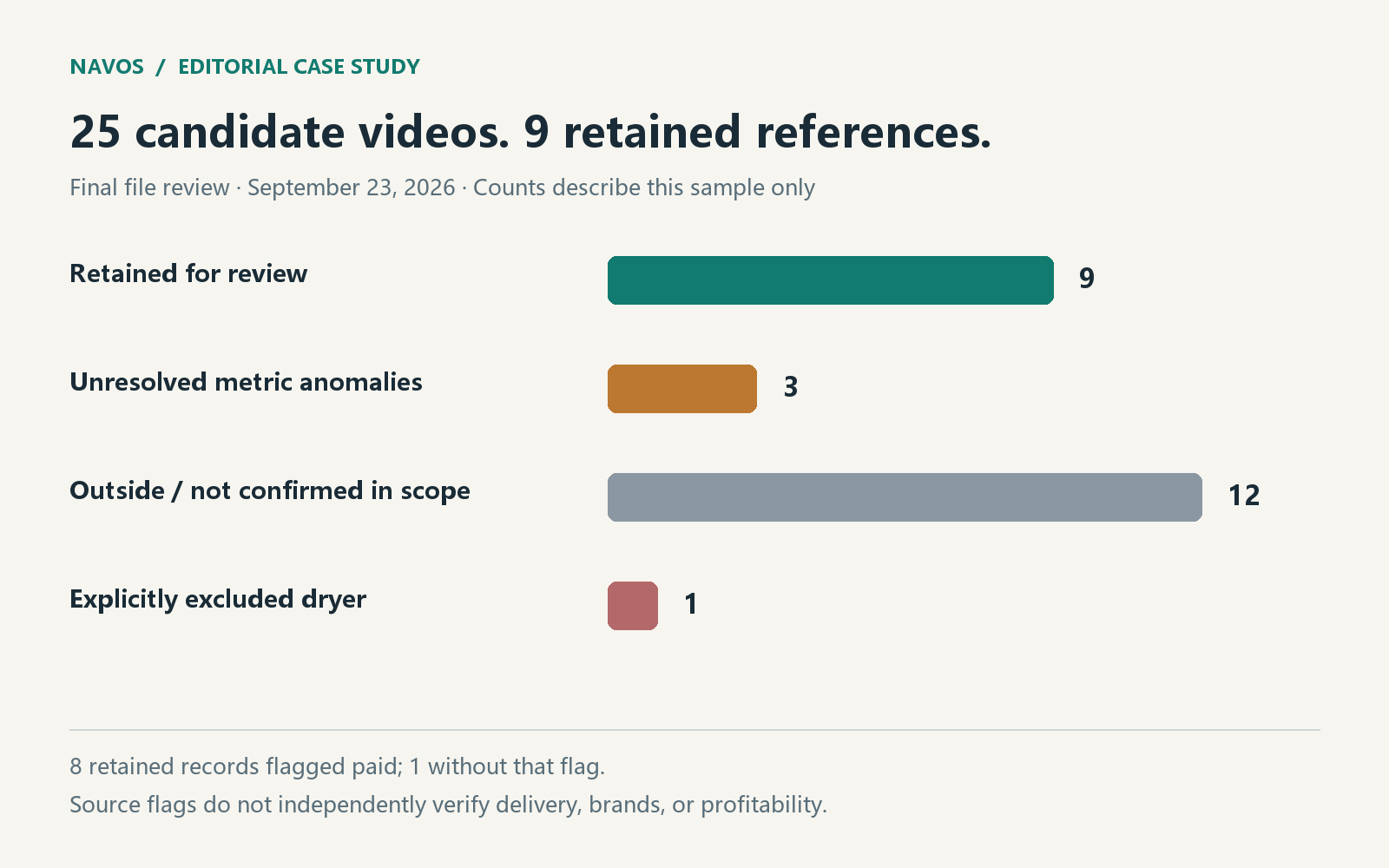
Eight retained records carried the source's paid-ad flag; one did not. An absent flag does not establish that the video was never promoted. Of the three videos selected for closer inspection, two carried that flag and one had unconfirmed paid status.
This filtering mattered. Some exported records had more likes than views, without a verified common measurement window. We did not guess which field was wrong or interpret the discrepancy as untapped potential. We also removed a combined sales KPI because the underlying reporting windows were not established. Correct addition would not make those values comparable.
Three videos: useful observations, limited conclusions
The question for each clip was not “Why did this win?” We had no verified evidence that it won. We asked which visible element could support an original, testable production choice.
1. A cat, a green brush, and a claim about comfort
The roughly 50-second reference shows a bright green brush being used on a black cat. At the opening, visible mist appears near the brush and on-screen text includes a claim about removing fur without pain. The contrasting brush color makes the tool easy to distinguish in the sampled frames.
That supports a narrow creative observation: the product and the grooming action are visually legible. It does not establish how the mist is produced, whether it changes the fur, or whether the product is painless. The text is an advertiser claim, not a verified product fact.
Adaptation: film a close view of your own tool being used as instructed, while keeping the animal's behavior visible. Let the footage show what happened during that session. Avoid promising that every pet will enjoy it or adding sound effects that imply a reaction you did not record.
2. A short grooming demonstration with hair already on the table
The roughly 12-second reference shows a dog on a grooming surface. Loose hair is already visible at the beginning; a green grooming tool appears during the sampled middle section.
The visible hair creates a strong impression of a result. Its presence at the opening also sets a boundary: we cannot attribute the whole pile to the tool or the interval shown. A dramatic frame can be persuasive while leaving the cause of the result unresolved.
Adaptation: record a continuous interval using your own suitable product and show only the material actually collected during that interval. Establish the starting condition. Do not prepare a larger pile to make the result look better. The useful idea is a clear demonstration, not a guaranteed quantity of removed hair.
3. Two tools shown in sequence
In the roughly one-minute reference, a sampled early frame shows a blue brush. A later frame shows a wooden-handled tool with loose hair visible on the dog's coat.
The change of tool creates a comparison the viewer can understand. It does not make the footage a controlled superiority test. Earlier grooming can change what is available for the next tool to collect, and different tools may require different techniques.
Adaptation: explain how two tools are used, following each tool's instructions. Describe the task each performs only when your product information supports it. Keep a sequential demonstration separate from a claim that one tool removes more hair under comparable conditions.
Reference | Buyer question to explore | Evidence your own video needs | Conclusion to avoid |
Cat and green brush | What does the grooming process look like? | Visible handling and an authentic recorded session | Every pet will be comfortable |
Short demonstration | What happens during actual use? | Starting condition, continuous action, actual result | All hair in the scene came from this tool |
Two tools | How do their uses differ? | Correct use and confirmed product purpose | The second tool is inherently superior |
What Navos contributed—and what needed correction
The useful part of the returned report was its structure. It brought sample records, source references, creative observations, and proposed filming directions into one reviewable package. That made it easier to see which idea depended on which example.
The first output was not ready to hand directly to a production team. Four types of correction were especially consequential:
Problem in the earlier output | Reviewed decision | Why it matters to the next creative |
Estimated competitor spending derived from sales and ROAS fields | Removed the estimate | The brief does not need an unsupported budget story |
Out-of-scope products, overlapping records, and unexplained metric anomalies | Rebuilt the sample with explicit inclusion rules | The reference set stays about the intended task |
Animal behavior and visible mist treated as proof of product effects | Separated observations, advertiser claims, and hypotheses | A filming idea does not become an unsupported product promise |
Competitor wording and a suggestion to prepare extra loose hair | Replaced them with original copy and a genuine recorded result | The brief can be adapted without manufacturing evidence |
We also corrected a source reference that pointed to a file without the cited video ID. A source label is useful only if a reviewer can find the relevant record behind it.
For this task, Navos produced a useful analysis and planning artifact with review. We did not measure time saved or overall extraction accuracy, and we did not establish automatic reliability across other categories. Use the workflow when someone can inspect the source material and product facts before acting on the recommendations.
Turn the references into three original creative directions
The reviewed Navos report proposed three directions. The following table expresses them as production questions, with the evidence each would need before release.
Direction | Proposed idea | Requirement before filming | First test variable |
Show the grooming experience | A close view of an actual session helps buyers understand handling | Confirm suitability and instructions; record real behavior | Opening text only |
Show a continuous demonstration | A visible starting point and actual collected result make the process easier to judge | Use the correct tool on a suitable coat; preserve the real result | Opening text only |
Explain different tool uses | Showing correct use can clarify why a buyer might need a particular tool | Verify each tool's purpose; avoid an unfair performance comparison | Opening text only |
We would develop the continuous demonstration first for this case. It can answer a concrete question using footage a team can inspect. It also requires fewer assumptions than a comfort promise or a superiority comparison. That is a production choice, not a claim that this direction will convert better.
A 25-second production brief
Status: an editorial expansion of the Navos direction, not an unchanged AI output or an ad already tested in market.
Audience: people trying to understand how the particular grooming tool is used.
Message: see the starting condition, the action, and the result of one recorded interval.
Before the shoot: confirm the exact product, suitable coat types, instructions, and destination product page. Use your own footage, with a capable handler. Stop the session if the animal becomes distressed. Do not force a fixed quantity of hair or a particular reaction to complete the shot list.
Time | Picture | Copy or audio | Production note |
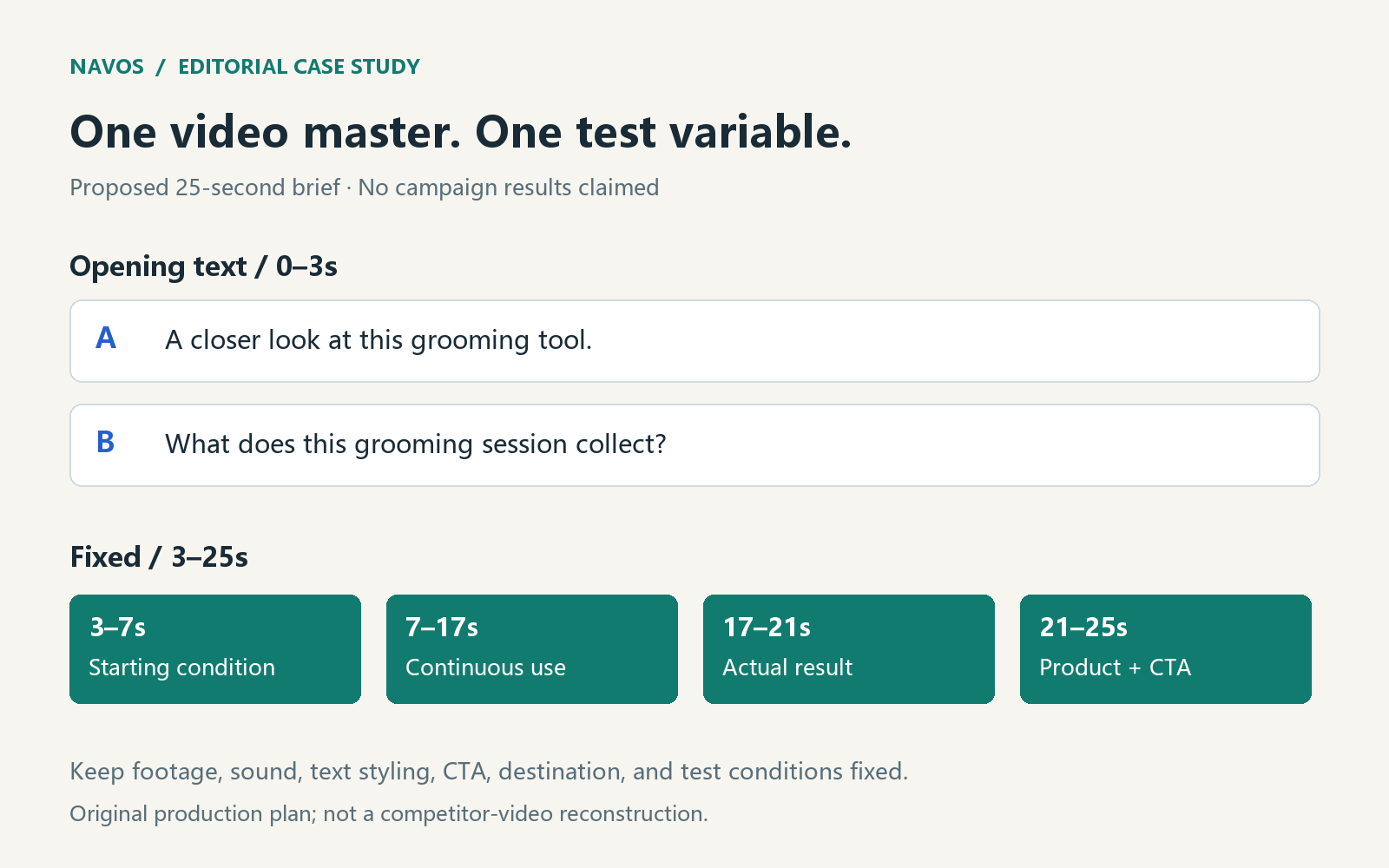
0–3 seconds | Tool and the actual grooming setup in a close frame | Opening text A or B, below | Same opening footage for both versions |
3–7 seconds | Show the starting condition of the area and tool | Recorded room sound; no result claim | Make existing loose hair visible rather than hiding it |
7–17 seconds | Record an uninterrupted interval of appropriate use | Actual handling sound, if captured | No extra hair added; retain the source recording |
17–21 seconds | Show what that interval actually collected | “Result from this recorded session” | Show a small result honestly; do not substitute another take's collection |
21–25 seconds | Product in frame and one next action | “See the tool and usage details” | Destination must show the same product and accurate instructions |
Opening A: “A closer look at this grooming tool.”
Opening B: “What does this grooming session collect?”
Use the same video master. Replace only the opening text; keep its duration, font, size, placement, sound, body footage, CTA, and destination unchanged. These are original lines written for this brief, not quotations from the reference videos.
Price, discount, suitability promises, and quantified performance claims are deliberately absent until the corresponding product facts are confirmed. A conditional brief is still useful: it tells the team exactly what to verify before creating a publishable asset.
Test the hypothesis in your own account
The first question is whether the opening message changes the response to the same demonstration. It is not whether competitor research has already proved the product will sell.
TikTok's split-testing guidance specifies one variable per test. If your campaign setup supports a suitable creative split test, use it to compare these two versions. An ordinary campaign that distributes delivery unevenly between assets is not automatically a controlled experiment.
Before launch, record:
- Primary metric: for a destination-click experiment, use the account's defined destination CTR consistently. Keep the numerator, denominator, reporting window, and attribution settings documented.
- Fixed conditions: audience, optimization goal, placements, bid strategy, destination, offer, and the video outside the opening text.
- Decision rule: agree the planned duration, spending ceiling, and evidence threshold before results arrive. Base them on your account's baseline and test design; this case supplies no universal budget or sample-size shortcut.
- Business guardrails: check whether any click improvement is accompanied by acceptable downstream conversion quality and cost. A stronger click response alone does not prove higher profit.
If the planned test cannot distinguish the versions, record an inconclusive result. Do not keep checking small fluctuations until one version happens to look better. If tracking fails, the product page changes, or delivery breaks the design, resolve the issue before interpreting the creative result.
For an existing campaign that is deteriorating, our TikTok creative fatigue guide covers the separate task of deciding whether creative fatigue is the likely problem.
A reusable analysis worksheet and prompt
For each reference, keep one row with: source and capture date; market evidence; paid-status evidence; verified video positions; observed action; advertiser claim; your hypothesis; unknowns; and the original shot that could test it.
Do not fill an empty field with a plausible guess. An unavailable landing page means the offer-to-page handoff is unverified. Unreadable audio means the spoken claim is unverified. Neither requires inventing a complete story.
You can adapt this prompt for the Competitor Creative Insight task where it is available in your Navos workspace:
Analyze these competitor-reference videos for one production decision: [decision]. Our product facts are [confirmed facts]. Our intended market is [market]. First state which video, audio, text, and destination content you can actually inspect. Separate observations, advertiser claims, hypotheses, and unknowns. Keep source references attached to each factual statement. Flag duplicates, unrelated products, and incompatible metric windows. Do not estimate competitor spending or infer profitability. Propose three original directions, then expand one into a timed filming brief using only supported product claims. Specify one first-round test variable, fixed elements, and facts we must confirm before production.
To try the workflow, download Navos Desktop and bring a small reference set plus your own product information. Start by checking one returned observation against its source before expanding the assignment.
Frequently asked questions
Can public TikTok ads tell me which competitor is profitable?
No. Public creative and engagement signals can support research, but they do not establish spend, margin, returns, attribution, or profit. A third-party commercial field also needs a documented definition and reporting window before you use it in a calculation.
How many videos do I need for a useful analysis?
Use enough relevant material to answer the decision you defined. Our three inspected references supported three production ideas; they did not establish category-wide creative rules. For broader conclusions, expand the set across confirmed brands, formats, markets, and dates, and document the selection method.
What should I do when AI cannot verify a detail?
Leave it unknown, provide readable evidence you are authorized to use, or remove the detail from the brief. Do not convert a title, caption, or generated transcript into proof that the full video was inspected.
Can I reuse the competitor's script?
Use the reference to identify a buyer question or a way to demonstrate something. Write original copy, film your own product, and substantiate your own claims. In this case, the most useful output was a clearer filming decision—not a replica of someone else's ad.