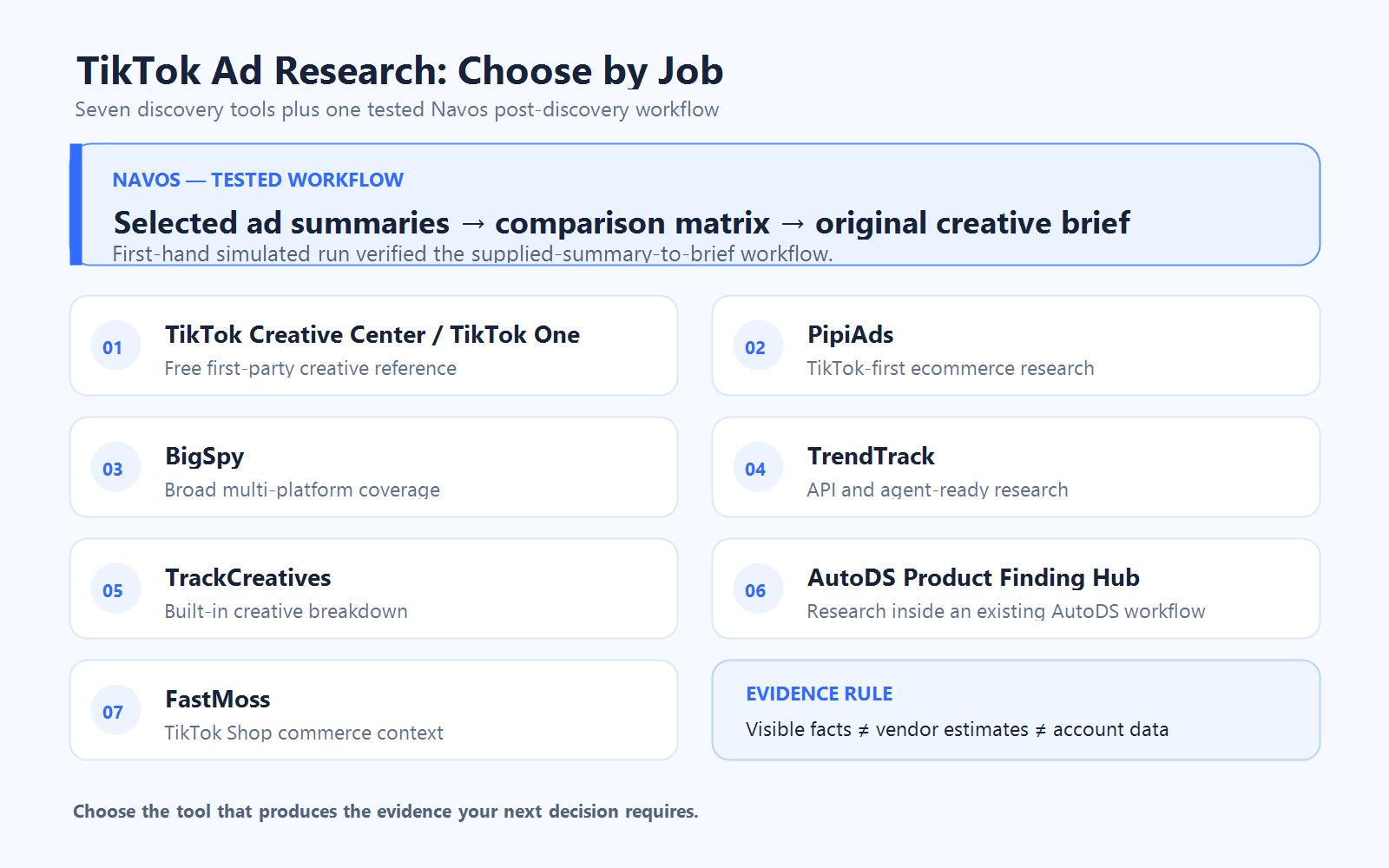
The best TikTok ad spy tool depends on what you need to do next. TikTok Creative Center is the strongest free, first-party starting point. PipiAds suits TikTok-first ecommerce research, while BigSpy is better for teams comparing ads across multiple networks. TrendTrack supports API-based research, TrackCreatives adds creative breakdowns, AutoDS Product Finding Hub fits existing AutoDS workflows, and FastMoss adds TikTok Shop commerce context.
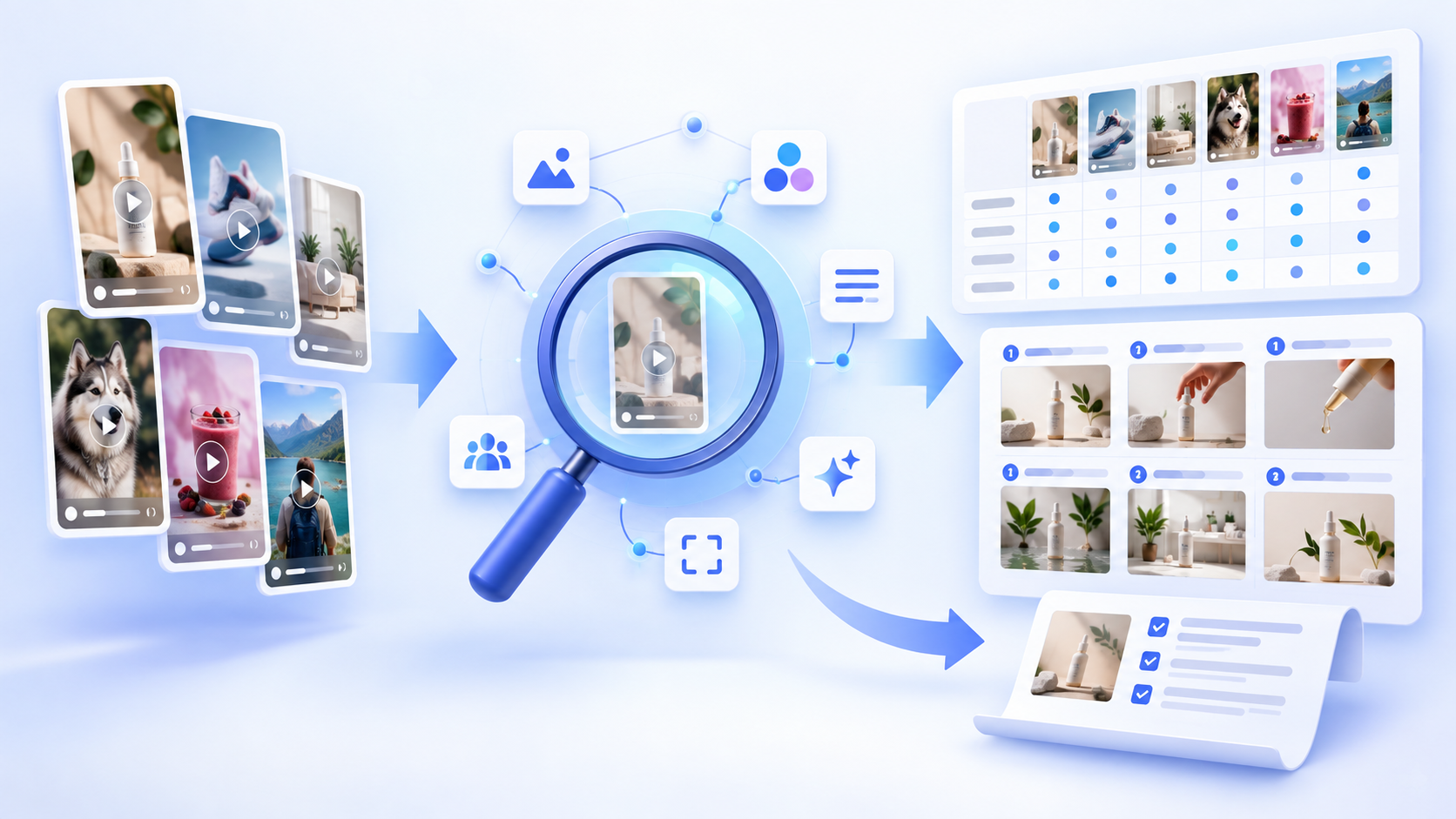
After discovery, the Navos AI marketing assistant adds the next layer: its Competitor Creative Insight workflow can turn a selected set of ad summaries into a structured comparison and original creative brief. We tested that workflow for this article.
The important caveat is that an ad library can show you creative evidence, not business truth. Public engagement, ad longevity, and vendor-estimated spend or ROAS do not prove that an ad is profitable. This guide compares seven tools by job, access, price, and evidence limits, then shows how to turn the examples you collect into an original creative brief.
The Best TikTok Ad Spy Tools and Navos Workflow at a Glance
Tool | Best for | TikTok scope | Starting access or price* | Key evidence note |
Navos (tested workflow layer) | Turning selected ad summaries into a comparison and original brief | Post-discovery analysis of user-supplied ad summaries | Navos Desktop; Skill appeared in the tested workspace | First-hand simulated run verified the supplied-summary-to-brief workflow |
TikTok Creative Center / TikTok One | Free first-party inspiration | Selected Top Ads plus trend and creative resources | Free public access | Not a complete record of every TikTok ad |
PipiAds | TikTok-first ecommerce research | TikTok ads, TikTok Shop, Spark Ads, advertisers, and landing pages | Trial listed with 500 credits and 0 detail credits; Basic promo $49/month | Many commercial metrics are vendor estimates |
BigSpy | Broad multi-platform coverage | TikTok plus nine other listed platforms | Growth listed at $159/month | Free access does not establish TikTok coverage |
TrendTrack | API and agent-ready research | TikTok library search, details, and advanced queries | From $42/month when billed yearly | Confirm the plan's TikTok allowance, API access, and credit policy |
TrackCreatives | Built-in creative breakdown | Search, monitoring, frame extraction, and hook/body/CTA analysis | From $29/month | Scores and “winning” labels are vendor analysis |
AutoDS Product Finding Hub | Existing AutoDS dropshippers | Ads Spy for TikTok, Facebook, and Instagram | $14.97/month or $131.64/year | Separate paid add-on for AutoDS users; no direct import from Ads Spy |
FastMoss | TikTok Shop commerce context | Ads alongside products, shops, creators, and commerce signals | Paid plans; verify current pricing | Estimated cost is described as algorithmic; verify other estimated-field methods |
- Pricing and access were checked on September 10, 2026. Promotions, billing terms, regional pricing, credits, and feature allowances can change. Confirm the current checkout and plan details before buying.
Navos is shown as the tested workflow that follows discovery; the seven numbered entries below cover the ad-discovery and creative-research tools themselves.
No single tool is best at every job: free first-party reference, ecommerce depth, multi-platform coverage, API access, creative breakdown, dropshipping research, and TikTok Shop context require different trade-offs.
How We Selected These Tools
We started with a simple qualification rule: a tool needed current first-party documentation for a TikTok-specific ad-discovery or creative-research surface. We then compared every option across the same six dimensions:
- TikTok source and coverage
- Search and filtering
- Creative inspection or analysis
- Ecommerce or TikTok Shop context
- Access and public pricing
- The main evidence limitation
This is a job-based comparison, not a composite leaderboard. A free first-party library and a paid multi-platform database solve different problems. The right choice is the one that produces the evidence your next decision requires without asking you to treat modeled data as fact.
Except for the separate Navos workflow test later in this article, we did not purchase and test the paid plans. Product and pricing details come from each provider's public product, help, or pricing pages as checked on September 10, 2026. Vendor performance claims were not independently verified.
Before choosing a platform, define the competitors, markets, time window, creative elements, and decisions you need to study. Our competitor research framework can help you set that scope before you start collecting ads.
1. TikTok Creative Center / TikTok One — Best Free First-Party Option
TikTok Creative Center should usually be your first stop. It is a free, public resource from TikTok, and basic access does not require a login. Its Top Ads area lets you search by brand or product keyword and filter by region, industry, campaign objective, language, format, and likes. Reach and CTR sorting can help narrow a large collection into examples worth reviewing.
TikTok currently surfaces creative-research resources through both Creative Center and TikTok One, so the Top Ads entry point may appear under either name as the product navigation evolves.
The first-party source is the main advantage. You are looking at TikTok's own creative-reference environment instead of a third-party reconstruction. That makes it useful for early inspiration, format research, and checking whether a pattern appears across several ads.
Its scope is also the reason not to treat it as a complete competitor monitor. Top Ads is a selected collection of ads that met TikTok thresholds and received advertiser authorization for display. An absent ad does not prove that a competitor is inactive, and a featured ad does not automatically prove profitability.
Choose TikTok Creative Center when you want a no-cost starting point, first-party context, or examples to support a broader process for finding TikTok creative trends.
Best fit: solo marketers, early-stage sellers, and teams validating whether they need a paid library.
2. PipiAds — Best for TikTok-First Ecommerce Research
PipiAds is built around TikTok-heavy advertising and ecommerce research. Its public product pages describe search across ads, advertisers, landing pages, TikTok Shop, Spark Ads, ecommerce platforms, scripts, hooks, countries, languages, CTAs, formats, dates, and interaction ranges. That combination can be useful when a broad keyword search is not enough and you want to move between an ad, advertiser, offer, and product angle.
Full library browsing requires an account, and deeper access is controlled through subscriptions and credits. On September 10, 2026, PipiAds showed a trial with 500 credits and no detail credits, a Basic promotional price of $49 per month, and Advanced at $99 per month. Because pricing is dynamic, treat those figures as a dated reference rather than a permanent promise.
The main caution is metric interpretation. Spend, orders, conversions, audience, and related commercial fields may be vendor estimates. Use them to create a research queue, not to calculate a competitor's profit or set your own budget. A visible offer, spoken hook, landing page, or posting date is a different evidence class from a modeled spend figure.
Best fit: TikTok-first ecommerce teams that need detailed filters and want to connect creative, advertiser, landing-page, and product research.
3. BigSpy — Best for Broad Multi-Platform Coverage
BigSpy is a better fit when TikTok is one part of a wider paid-social program. Its public materials list ten platforms, including TikTok, which gives cross-channel teams a single place to compare creative approaches across different networks.
That breadth matters for agencies and brands that do not want one research tool per channel. A concept may appear first in a Meta ad, evolve on TikTok, and then surface in another network. A broader library makes that pattern easier to investigate.
The plan boundary needs attention. The public comparison page available during our research showed the Free plan as Facebook-only and the Growth plan, listed at $159 per month, as the first tier with TikTok-specific access. Verify the live checkout and exact TikTok allowance before purchase. BigSpy also notes that some original source-post links may be unavailable.
Best fit: agencies, media teams, and brands that value multi-network coverage more than TikTok-only depth.
4. TrendTrack — Best for API and Agent-Ready Research
TrendTrack stands out when the research needs to feed a repeatable system rather than end in a browser bookmark. Its public API documentation describes TikTok library search, item details, advanced queries, and shop-scoped discovery. Available query fields include text, ad or organic type, status, media type, language, country, hashtag, handle, date, views, engagement, and days running.
That structure can support internal dashboards, scheduled research, agent workflows, or a consistent weekly creative intake. Returned TikTok API items use credits, so estimate how many records your searches will return before choosing a plan.
On September 10, 2026, the pricing page listed Starter at $42 per month, Pro at $63, and Business at $105 when billed yearly. Monthly and quarterly selectors were also present. Several pricing sections emphasize Meta features, so confirm the exact TikTok allowance, API access, and credit policy for your chosen tier.
Best fit: teams that need structured data, API access, or a research workflow connected to other systems.
5. TrackCreatives — Best for Built-In Creative Breakdown
TrackCreatives combines ad discovery with a more explicit creative-analysis layer. Its TikTok product page describes Creative Center search, competitor-profile monitoring, frame-by-frame AI analysis, hook/body/CTA breakdowns, hashtag and sound signals, and browser capture through a Chrome extension.
This can reduce the gap between “we found an interesting ad” and “we understand the creative components worth testing.” Instead of saving a video with a vague note, a team can organize the opening hook, proof sequence, offer, and call to action as separate elements.
Plans were listed from $29 per month on September 10, 2026. The evidence caveat is especially important here: a hook score, creative score, or “winning” label is the vendor's analysis. It can help prioritize review, but it does not prove that the same structure will work for your product, audience, offer, or account.
Best fit: creative strategists who want discovery and structured creative breakdown in one interface.
6. AutoDS Product Finding Hub — Best for AutoDS Dropshippers
AutoDS Product Finding Hub places Ads Spy inside a broader dropshipping product-research environment. AutoDS documentation says Ads Spy covers TikTok, Facebook, and Instagram, with filters for keywords, likes, linked products, CTA, interaction, recency, and days live.
The strongest reason to choose it is workflow proximity. If your team already works in AutoDS, combining ad examples with its product-research environment may be more convenient than adding a separate intelligence platform.
Product Finding Hub is a separate paid add-on. On September 10, 2026, AutoDS listed it at $14.97 per month or $131.64 per year, with no free trial. It also states that products cannot be imported directly from Ads Spy, so do not assume the discovery view is a one-click sourcing workflow.
Best fit: current AutoDS users who want social-ad research beside their existing product-discovery process. Teams comparing a wider stack can also review these TikTok Shop tools for sellers.
7. FastMoss — Best for TikTok Shop Commerce Context
FastMoss is designed for teams that want more than an ad-only view. Its current ad-library surface places TikTok ads alongside product, shop, creator, and commerce context. Publicly described filters and fields include platform, CTA, landing page, video duration, resolution, impressions, engagement, likes, shares, estimated cost, estimated conversions, and ROAS-related values, plus competitor and similar-ad discovery.
That context can be useful for TikTok Shop operators deciding which products, offers, shops, creators, and creative patterns deserve closer investigation. It does not remove the need to classify the evidence correctly.
FastMoss explicitly describes estimated cost as algorithmic and recommends using it for market-level trend reading rather than precise budget decisions. Your own Ads Manager and commerce records remain the decision source for first-party performance. Pricing varies by plan, billing term, and region, so verify the current plan before purchase.
Best fit: TikTok Shop sellers and analysts who want ad examples connected to broader commerce research.
What TikTok Ad Spy Data Can—and Cannot—Prove
The biggest research mistake is putting every field in the same mental bucket. Separate the data before drawing a conclusion.
Evidence class | Examples | Safe use |
Visible public facts | Creative frames, spoken copy, CTA, advertiser name, date, landing page, and public engagement when shown | Describe what the ad contains and build a review set |
Vendor-modeled values | Estimated spend, sales, conversions, audience, or ROAS | Compare broad signals or create a research queue, with the estimate clearly labeled |
Editorial inference | Likely audience problem, funnel stage, hook type, or reason an ad stayed live | Form a hypothesis to test, not a performance claim |
Account-only truth | True spend, targeting, attribution, incrementality, margin, refunds, and profit | Use first-party account and business data |
An ad running for a long time may be worth studying, but longevity alone does not reveal its budget, margin, attribution settings, or strategic role. High public engagement can come from entertainment value without producing qualified buyers. An estimated ROAS number may be useful for sorting, yet it should never override verified account data.
Use ad spy tools to answer questions such as:
- Which hooks repeatedly appear in this category?
- What proof formats do advertisers show on screen?
- Which offers and CTAs are common?
- How does the opening frame differ by audience or product angle?
- Which patterns deserve an original test?
Do not use them to claim that a competitor is profitable, that you know its targeting, or that copying one ad will reproduce its results.
From Selected Ad Summaries to an Original Brief: Our Navos Test
Ad discovery leaves most teams with a second problem: a folder of links and screenshots is not yet a creative plan. The useful next step is to extract comparable fields, mark uncertainty, find patterns, and turn those patterns into original hypotheses.
We tested that handoff with the Competitor Creative Insight Skill in the Navos AI marketing assistant.
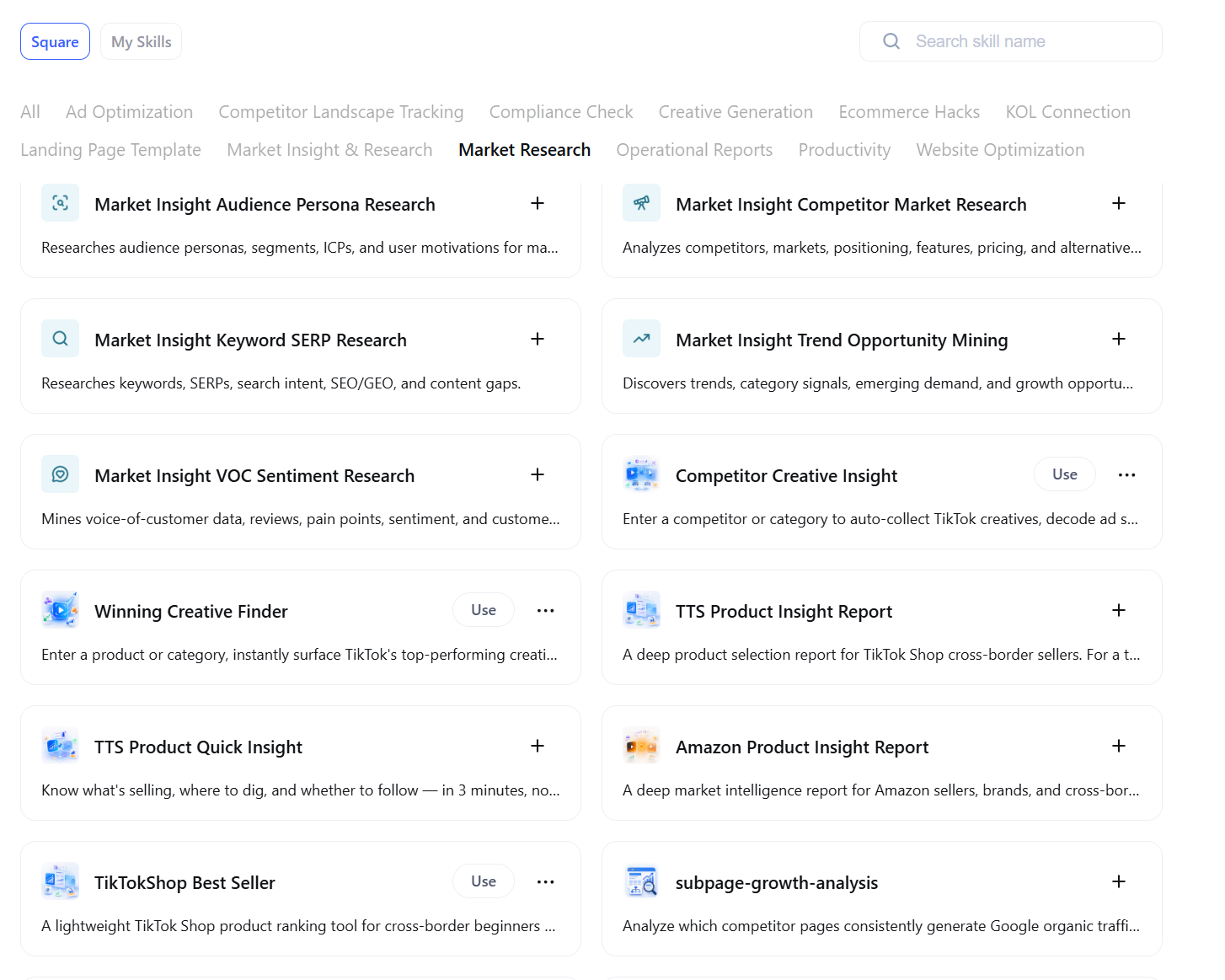
In the Navos Desktop workspace used for this test, we opened Square, chose Market Research, and selected Competitor Creative Insight.
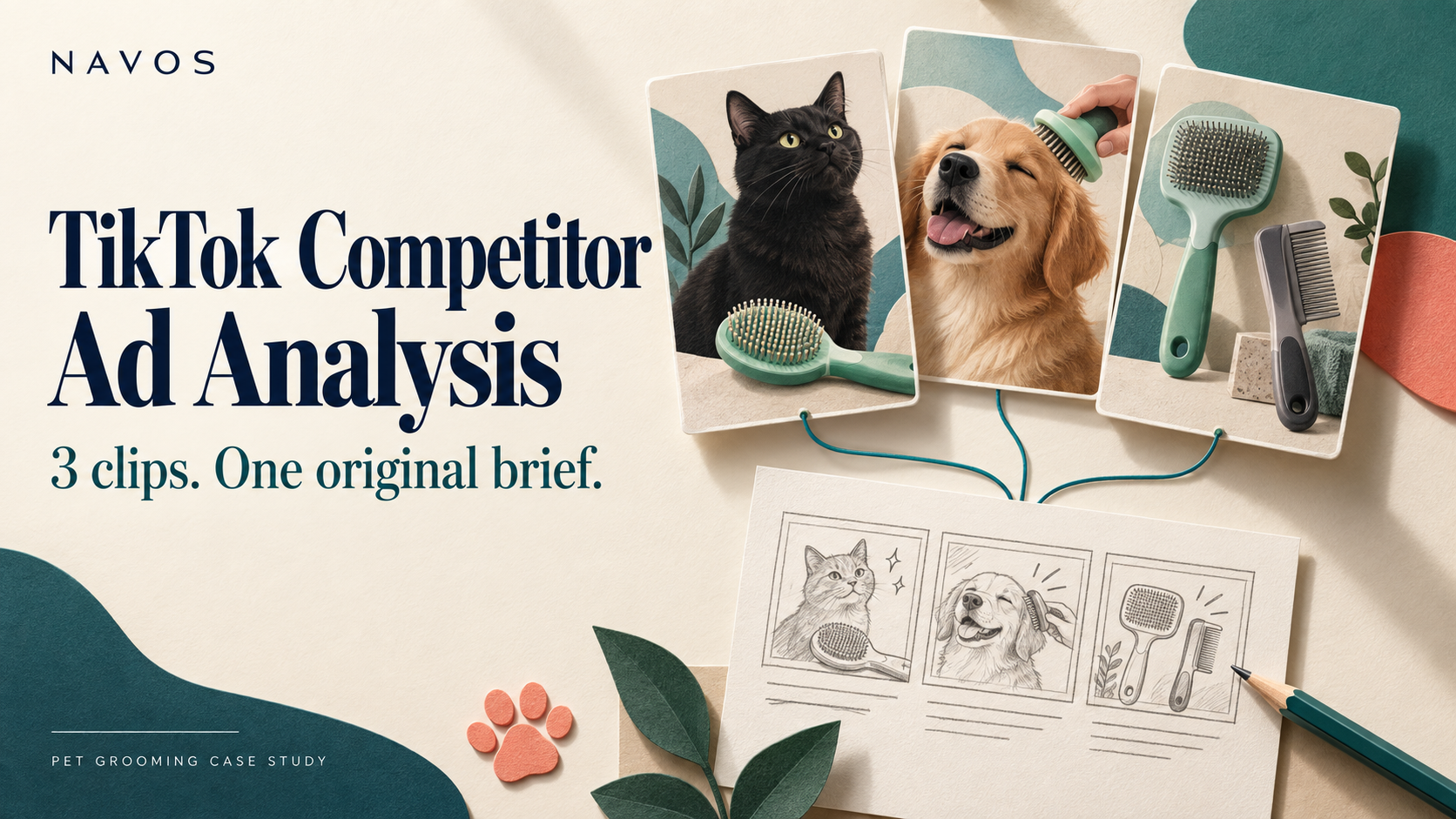
For a clean, reproducible test on September 10, 2026, we intentionally supplied three fictional US ad summaries for a fictional $29.99 insulated travel tumbler. Live TikTok ads, public URLs, accounts, stores, and performance data were outside this test's scope.
In that simulated run, Navos returned an HTML artifact containing:
- Seven extracted fields per supplied ad: hook, audience problem, product promise, proof type, visual sequence, offer, and CTA
- Separate Observed, Inferred, and Unknown labels for each field
- A 12-dimension comparison matrix
- Three proposed recurring creative patterns
- Three original creative hypotheses
- A six-shot, 15-second TikTok brief
- A 10-item pre-launch evidence and claim-verification checklist
In this test, Observed meant input-reported: the detail appeared in a fictional summary supplied to the Skill. It did not mean that Navos had watched or verified an original live video. Inferences and unknowns remained separate so a proposed creative direction could be reviewed without turning an assumption into a product or performance claim.
The matrix made the three supplied summaries scannable side by side across 12 creative dimensions; the preceding extraction tables preserved the evidence labels for each input.
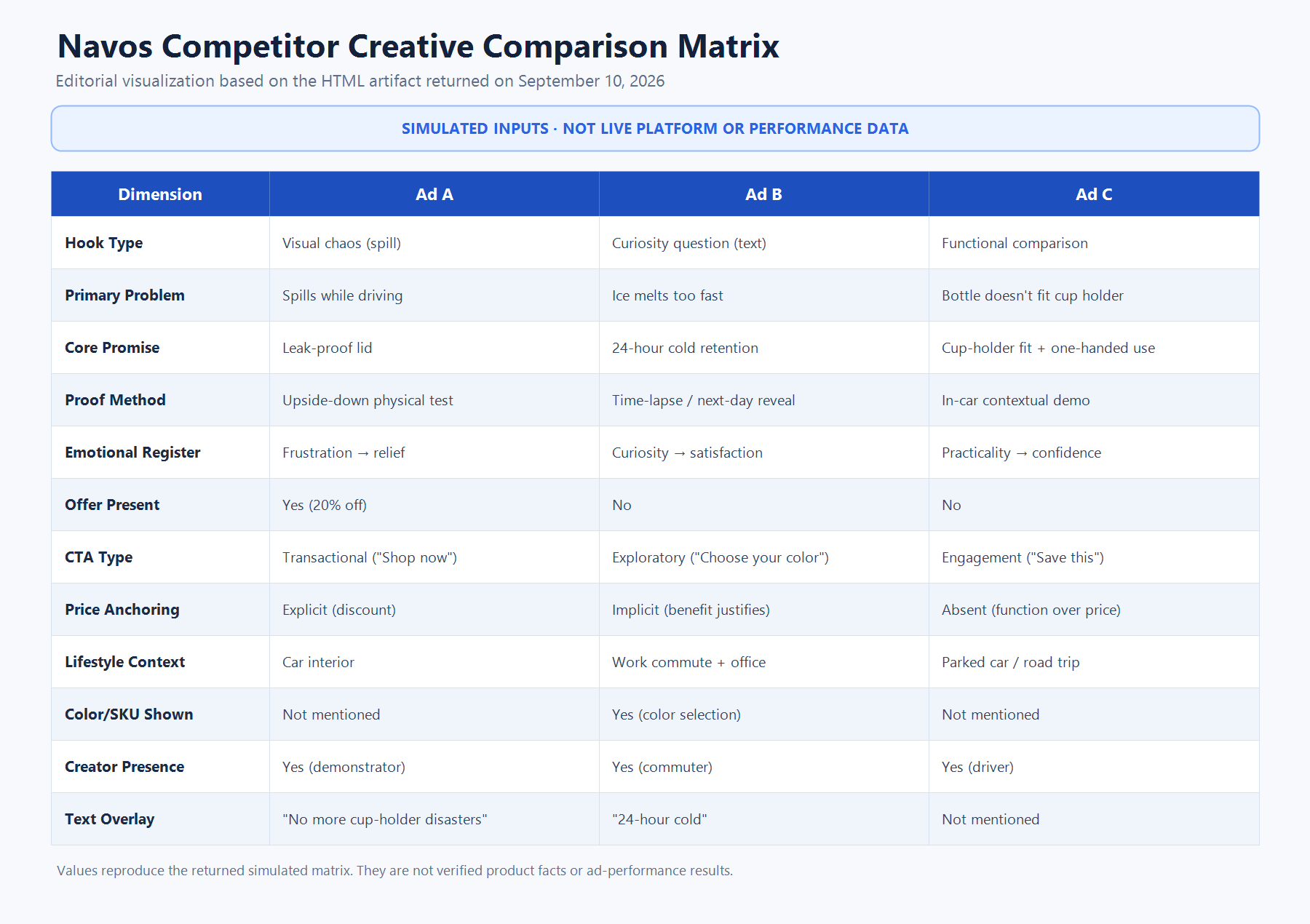
The following section reframed repeated elements as three original test hypotheses instead of instructions to copy a competitor asset.
One practical output was a draft production handoff. The six-shot brief translated the three supplied fictional summaries into a timed sequence, while the checklist flagged price, discount, inventory, fit, product-performance, and policy statements for verification before launch. That is a more defensible use of competitor research than reproducing another brand's assets or treating a vendor's “winner” label as proof.
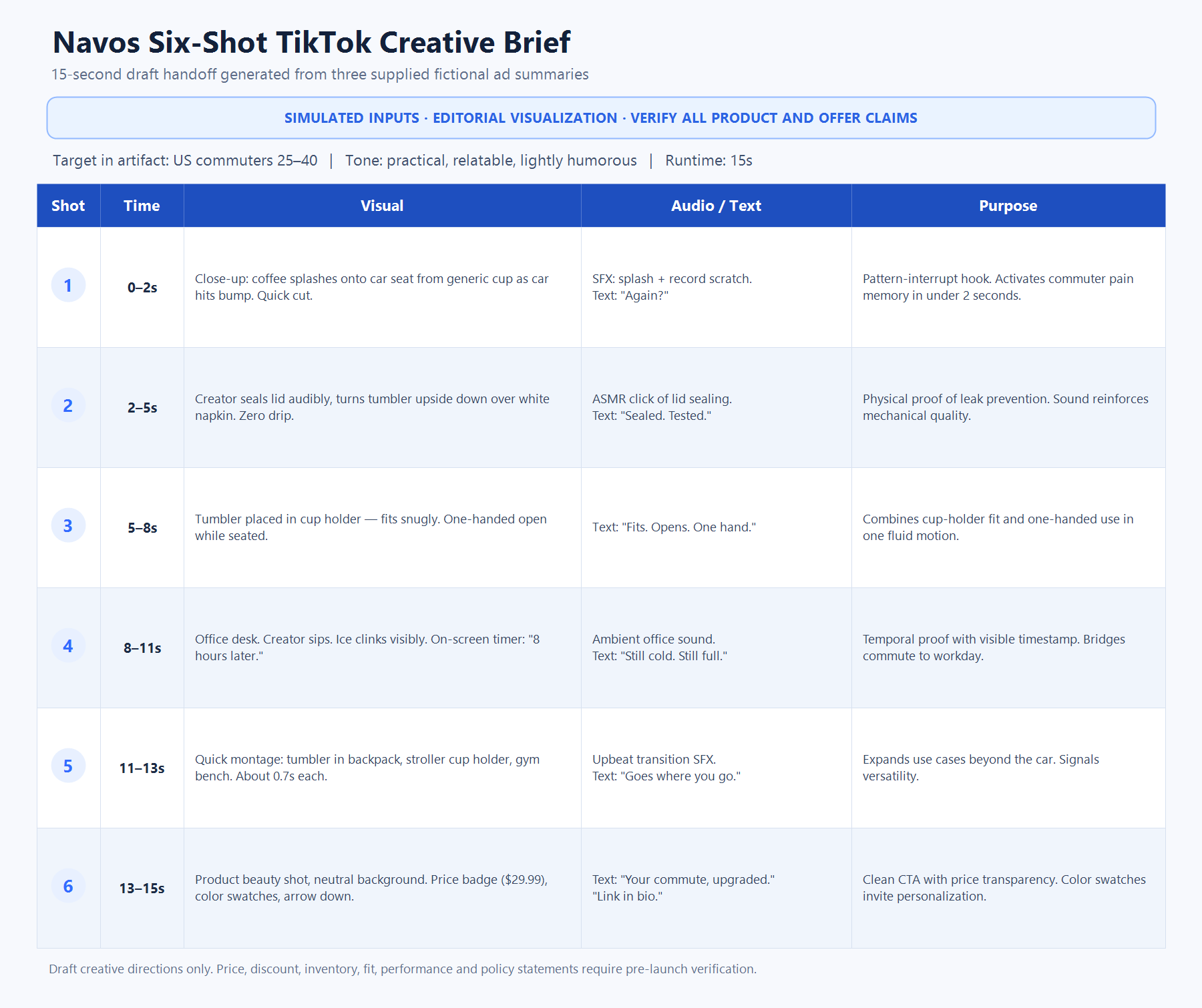
The evidence from this simulated run supports a supplied-summary analysis and briefing workflow. Live discovery, account data, and other input types were outside the test scope. To explore the same workflow, download Navos Desktop; in the workspace used for our test, Competitor Creative Insight appeared under Square → Market Research.
Which TikTok Ad Spy Tool Should You Choose?
Use your next required output as the decision rule:
- You need a free official reference: start with TikTok Creative Center / TikTok One.
- You need TikTok-first ecommerce filters: compare PipiAds plans and credit limits.
- You need a multi-platform ad library: evaluate BigSpy's paid TikTok access.
- You need an API or agent workflow: verify TrendTrack's TikTok allowance and credit model.
- You need built-in hook and frame analysis: consider TrackCreatives, while treating scores as hypotheses.
- You already use AutoDS: Product Finding Hub may keep product and ad research closer together.
- You need TikTok Shop commerce context: evaluate FastMoss, keep every vendor-estimated field clearly labeled, and treat its estimated-cost field as algorithmic.
- You already have selected ad summaries and need a structured brief: where Competitor Creative Insight is available in your Navos workspace, use the post-discovery analysis workflow tested here.
Also consider the cost of the process around the subscription. A large database is less useful if your team cannot save evidence consistently, identify duplicates, record the market and date, or explain why an example matters. A smaller, disciplined research set often supports better decisions than hundreds of unsorted “winning ads.”
If the next step is production, compare the brief against your product evidence before using any AI ad generators. The research tool can suggest a direction; your team still owns factual accuracy, originality, platform compliance, and testing.
Frequently Asked Questions
What is the best free TikTok ad spy tool?
TikTok Creative Center / TikTok One is the best free starting point for most teams because it is a public, first-party TikTok resource with Top Ads search and filters. Its coverage is curated rather than complete, so a missing ad does not prove that a competitor is not advertising.
Can TikTok ad spy tools show real spend or ROAS?
Third-party tools may display estimated spend, conversions, sales, or ROAS, but those fields should be treated as modeled values unless the source explicitly provides verified first-party account data. Use your own Ads Manager, store, attribution, and margin data for budget and profitability decisions.
Can I see every ad a competitor is running on TikTok?
No tool should be assumed to provide a complete record. Coverage depends on the source, market, collection method, plan, time window, advertiser authorization, and whether an original post remains available. Use multiple queries and record the scope of what you actually found.
Are TikTok ad spy tools legal to use?
Researching publicly available ads and reusing another advertiser's protected assets are different activities. Follow each platform's and tool's terms, respect copyright, trademarks, privacy, and applicable advertising rules, and create original work instead of copying scripts or visuals. Seek qualified legal advice for a specific jurisdiction or use case.
How is Navos different from a TikTok ad database?
Based on the test described here, Navos served as an analysis and creative-brief layer for summaries supplied by the user. It organized input-reported details, inferences, and unknowns, then produced a comparison and an original brief. Our test focused specifically on the post-discovery, supplied-summary-to-brief handoff; live collection and account-data workflows were outside its scope.
Turn Ad Examples Into Evidence, Not Imitation
The best TikTok ad spy tool is the one that supports your next decision with the right evidence. Start with first-party creative references when they are enough. Pay for deeper filters, cross-platform coverage, APIs, analysis, or commerce context only when your workflow needs them.
Then separate what you saw from what a vendor estimated and what your team inferred. Use the patterns to propose an original test, verify every product and offer claim, and measure the result in your own account.
When you are ready to turn a selected research set into a comparison matrix and creative handoff, download Navos Desktop. Look for Square → Market Research → Competitor Creative Insight; this was the path in the workspace used for our test.