
TikTok trends move fast, but finding a trend worth following is harder than finding a viral video. For e-commerce sellers, the real challenge is knowing which creative patterns are relevant to your product, still working in your target market, and repeatable enough to turn into your next batch of videos.
This guide breaks down a practical framework for finding, validating, and turning TikTok creative trends into content you can actually test.
Why You Should Find TikTok Creative Trends
A competitor posts a video around #dryskin and gets tens of thousands of views. You create another video using the same hashtag, same sound, and a similar hook — and it gets a few hundred plays. Same tag, same format, completely different result.
This happens because most sellers copy the surface of a trend without identifying what actually made it work. They see a viral video, replicate its hashtag or hook, and expect the same outcome. But a single viral video is just one outcome. The repeatable asset underneath it is a creative pattern — a structure, angle, or expression that can be adapted to different products.
The same trend produces different results for different products because product fit matters. A format that works for a $30 premium hand cream may not work for a $3 value alternative — even within the same category. What you're looking for isn't the biggest video; it's the creative pattern that connects a specific audience problem to your specific product.
The goal of trend research for e-commerce isn't to know what's popular. It's to find content opportunities that are relevant to your product, provable with recent data, and repeatable enough to test multiple times.
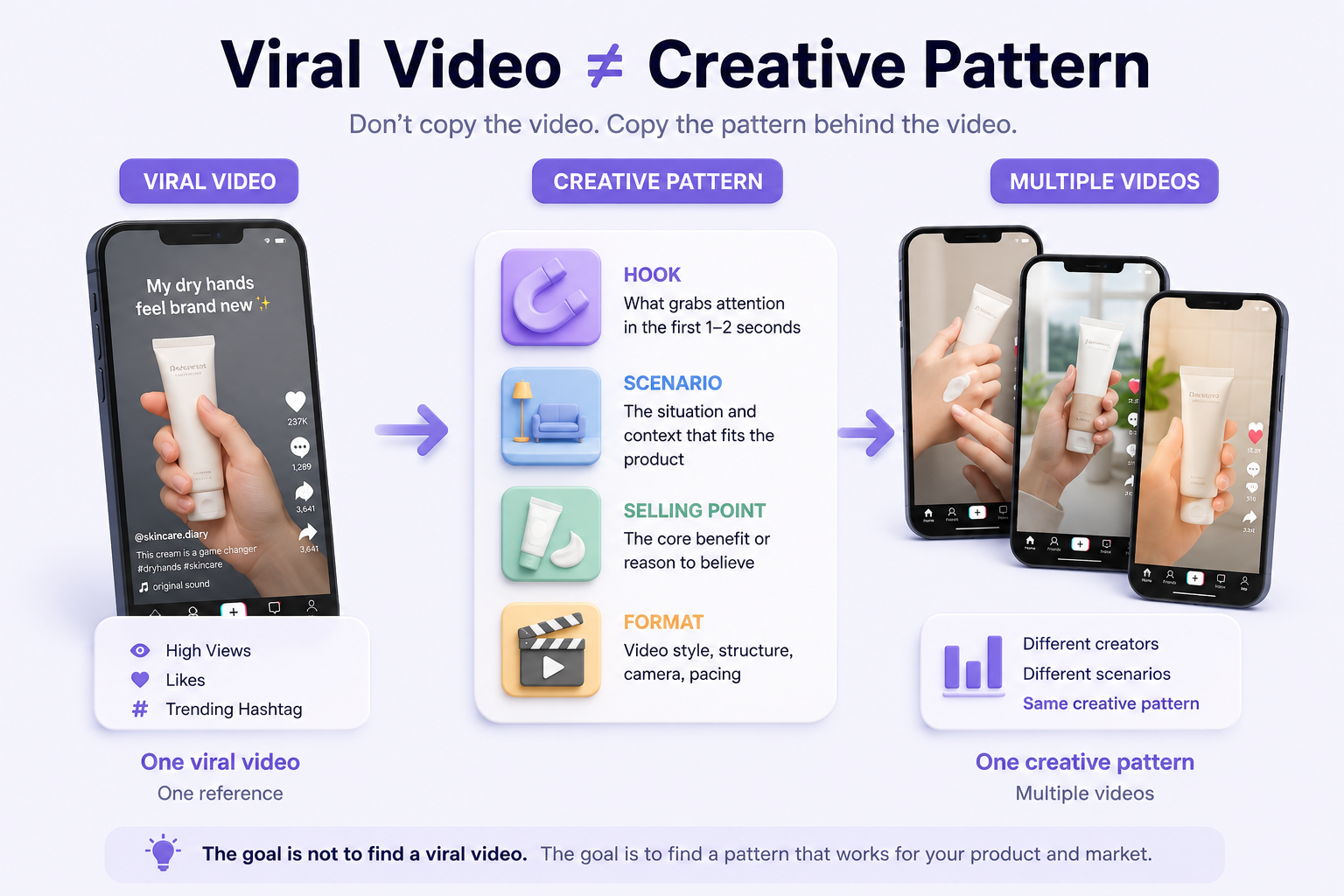
Don't chase viral videos. Identify the creative patterns behind them.
What Kind of Creative Trends Are Worth Finding?
View count alone is a bad filter. A video with a million views may be driven by a creator's existing audience, a sound trend unrelated to the product, or a moment that has already passed. Instead, evaluate every trend against five criteria:
① Product Fit
Does the trend connect to your product's attributes, core selling points, or usage scenario? A hand cream fits naturally into a "dry hands rescue" narrative. It does not fit naturally into a dance trend. The tighter the fit, the less you have to force the product into the content.
② Recency
Prioritize content from the last 30 days. TikTok's creative environment shifts quickly — formats saturate, audience expectations change, and seasonal demand moves. A video that performed well six months ago tells you what worked; recent content tells you what is working now. If your goal is to decide what to shoot next week, old data has limited decision value.
③ Market Fit
If you sell on TikTok Shop US, analyze US content. A trend that performs in Southeast Asia or Latin America may not transfer to American audience behavior, language, or purchase intent. Market mismatch is one of the most common reasons a "proven" trend fails when replicated.
④ Multiple Creative Directions
A useful trend should generate more than one video idea. Look across content types — traffic-driving content, organic commerce content, and ad creatives — because each pool reveals different angles. A single viral video gives you one reference; a pattern across dozens of videos gives you a direction.
⑤ Repeatability
Can you produce a second, third, and fourth video on this angle without repeating yourself? A trend that only supports one execution is a stunt. A trend that supports variations in hook, scenario, and selling point is a content strategy.
The best trend isn't the biggest one. It's the one that fits your product, your market, and your content goals.
Note: This is why a default view of US market + last 30 days is a sensible starting point for trend analysis. It narrows the data to what is recent and geographically relevant, which are the two filters that most directly affect whether a trend is worth testing now.
How to Find the Right Creative Trends
Most sellers start with "what's trending on TikTok" and get generic results with no connection to their product. A good trend query starts with the product and builds outward:
Product → Product Attributes → Market → Time Range → Content Type → Creative Pattern
The most important layer is product attributes — the things your product actually is and does. For a shea butter hand cream, that means: moisturizing, repair for dry/cracked hands, shea butter as a key ingredient, scent and texture, and frequent hand washing. Each attribute is a search entry point ("dry cracked hands," "shea butter," "hand cream texture") that surfaces trends tied to what the product does — not generic "hand cream" content.
A useful trend analysis prompt — whether manual or AI — needs five inputs:
- Product & attributes — what it is, what it does, key ingredients or features
- Market — the target country (e.g., US)
- Time range — last 30 days
- Content types — hot content, organic commerce, ad creatives
- Output — distinct creative directions with hooks, scenarios, and repeatable patterns, backed by real videos
A reusable prompt:
Analyze TikTok creative trends for [product + key attributes]
in the [US] market over the last 30 days.
Identify patterns across:
- High-performing content (hooks, formats, themes)
- Organic commerce (what drives natural sales)
- Ad creatives (conversion-focused structures)
For each direction, output the creative pattern, hook, scenario,
selling point, and representative real videos. Prioritize trends
that fit the product's core attributes and support multiple videos.
Using Navos's EC Creative Trend Discovery Skill, this research can be turned into a repeatable workflow. Instead of manually searching through TikTok videos and comparing creative patterns, the Skill analyzes recent content across different content pools, identifies patterns relevant to your product, and surfaces representative videos to support the analysis. This makes it easier to move from broad trend discovery to specific creative directions you can actually test.
"Find me TikTok trends" is not a brief. The more precisely you define product, attributes, market, time window, and output, the more actionable the result.
Real Example: From TikTok Data to Creative Ideas
We ran a trend analysis for a real TikTok Shop product: a Natural Shea Butter Hand Moisturizer at $2.80 per unit, US market, last 30 days. The result was 288 videos across three pools:
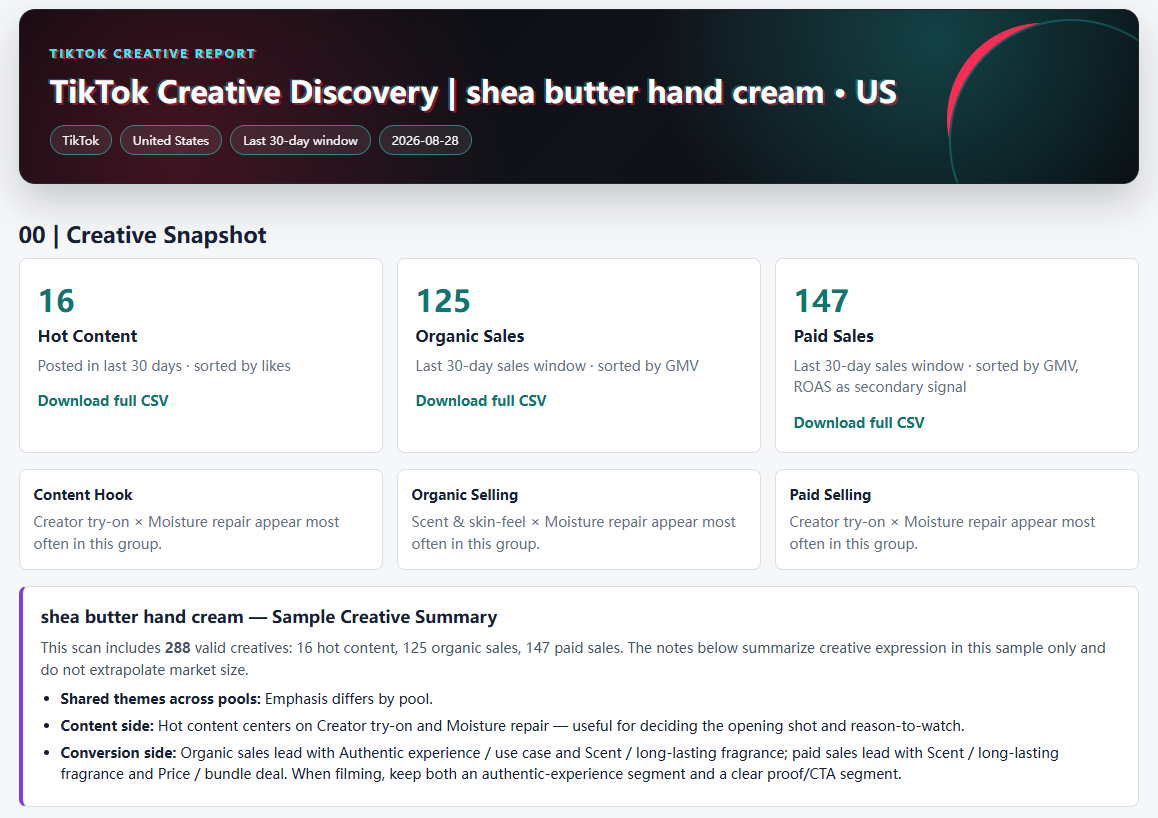
Pool | # Videos | What It Tells You |
Hot content (by likes) | 16 | What captures attention — hooks, themes, first frames |
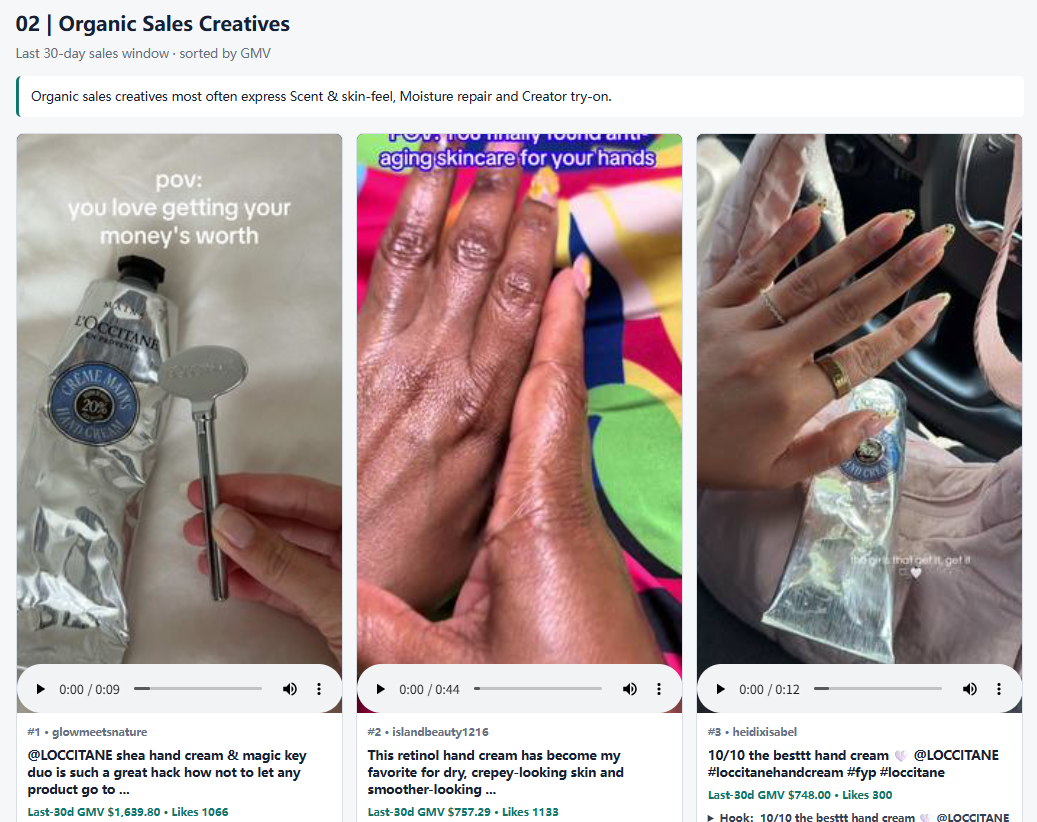
Organic commerce (by GMV) | 125 | What sells naturally — authentic angles, usage scenarios |
Ad commerce (by GMV/ROAS) | 147 | What advertisers scale — proven structures, price framing, CTAs |
Each pool answers a different question. Looking only at viral videos misses the selling patterns in organic and ad content; looking only at ads misses the hooks that earn attention in the first place.
The key filter: Popular ≠ Relevant
The hottest videos in the pool were premium-brand content — Trader Joe's guava hand cream (237K plays) and a Loewe Tomato Leaves unboxing (189K plays). These earned attention, but they don't translate to a $2.80 shea butter product. The audience came for the brand aesthetic, not the product benefit.
The patterns that did fit came from less flashy videos:
- A shea butter real-person review (178K plays) — genuine testing, not brand worship
- A video targeting people who wash their hands frequently (125K plays) — a direct product-use scenario for dry hands caused by repeated washing
- The top organic GMV video generated $1,639.80 in GMV from a simple "no waste" hack: pairing L'Occitane shea hand cream with the brand's Magic Key tube squeezer to get every last drop out of the tube
- One $15 competitor appeared repeatedly across the ad pool, with its strongest creatives sharing a consistent structure: dry-hand problem → formula claim → before/after proof → CTA
The premium unboxings were popular. The dry-hand repair, real-person demo, and value-framing patterns were relevant — and that's what made them worth following.
Three repeatable patterns
After filtering the 288 videos through product fit, three patterns emerged:
Pattern | Structure | Best For |
Real-person repair demo | Pain point first → apply → texture/absorption proof | Traffic content & ads |
Scent & texture experience | Scenario → sensory description (smell, feel) → showcase | Organic commerce & reviews |
Value & bundle conversion | Purchase reason → value proposition → price/multi-pack CTA | Ad creatives |
None of these are copies of a specific video. They are structures — each proven by multiple videos across the pools, each adaptable to the product's $2.80 price point and core selling points. That is the difference between chasing a viral hit and identifying a creative trend.
Turn Creative Trends Into Your Next Video
A trend is only valuable when you can turn it into multiple videos you can actually test. The output of trend research should be a set of video concepts built from this chain:
Trend → Creative Angle → Hook → Demo → Proof → CTA
Take the "real-person repair demo" pattern for the shea butter hand cream:
- Angle: Deep care for dry, cracked hands at an affordable price
- Hook: "Still dealing with dry, cracked hands?" (close-up visual)
- Demo → Proof → CTA: Apply on camera → show absorption and result → product in frame with price
One pattern is not one video. The same trend branches into multiple testable concepts by varying:
- Hooks — question, visual shock, identity statement ("as a nurse…")
- Scenarios — bedside table, gym bag, office desk, winter morning
- Selling points — repair, scent, value bundle, ingredient story
Each combination is a separate video. That is the repeatability principle from Section 2 in action: a creative trend should produce a batch of content to test, not a single imitation.
You don't copy the video. You copy the logic behind the video.
Publish, measure, and scale what works. Trend research doesn't end with a report — it ends with content decisions.
Conclusion: Find Trends You Can Actually Use
- Find trends that fit your product, not just trends with high views. A million-view video means nothing if the creative pattern doesn't connect to what you sell.
- Use recent, market-specific data to understand what's working now. Last 30 days, target market — not last year's viral hits from another country.
- Look for repeatable creative patterns, then turn them into testable video concepts. A trend that only supports one video is a stunt. A pattern that supports variations is a strategy.
With the right workflow, trend research doesn't have to mean scrolling through thousands of TikTok videos. Navos helps turn trend research into a repeatable content workflow — from researching recent TikTok content and identifying product-relevant creative patterns to turning those patterns into actionable video directions.