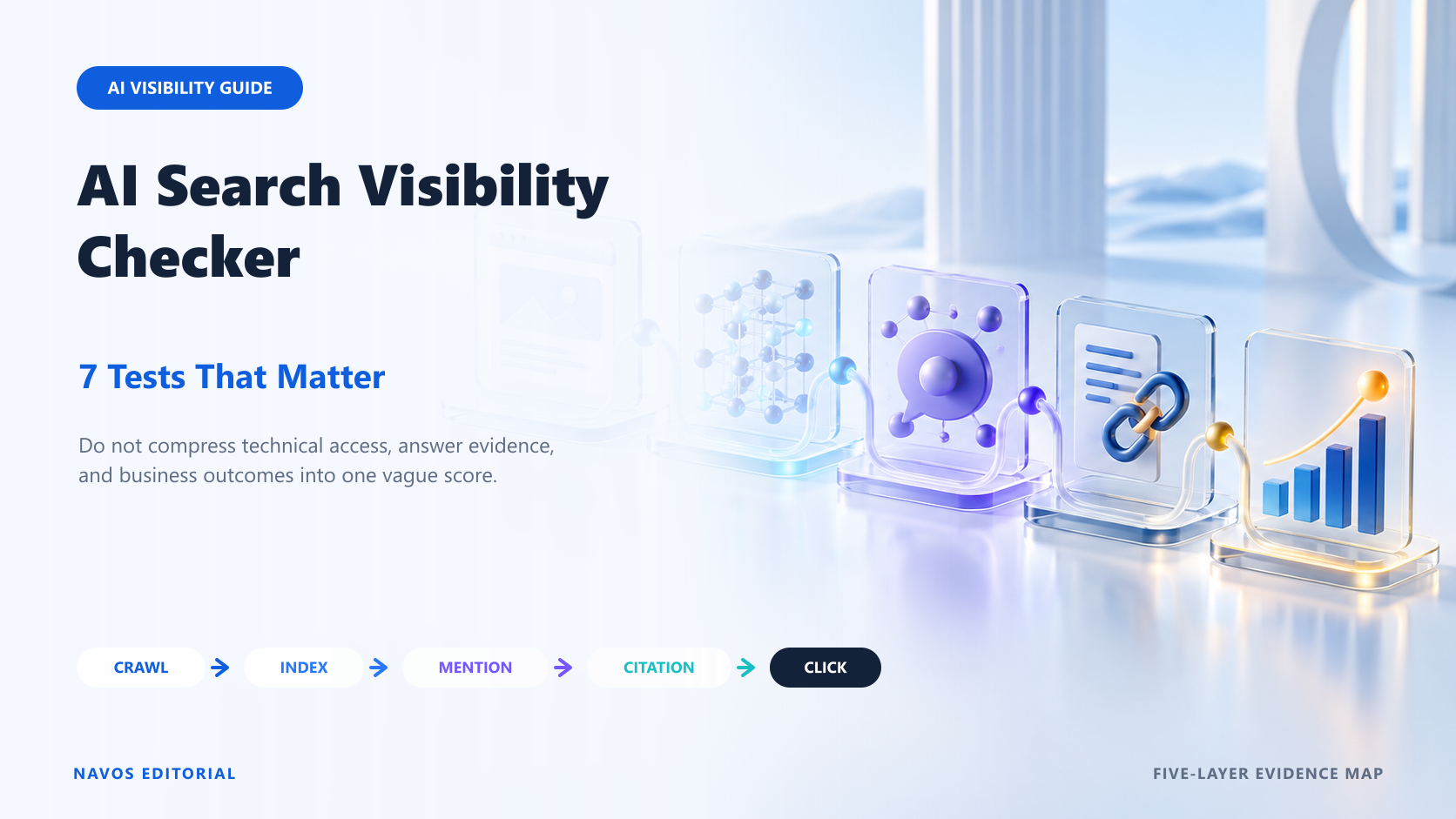
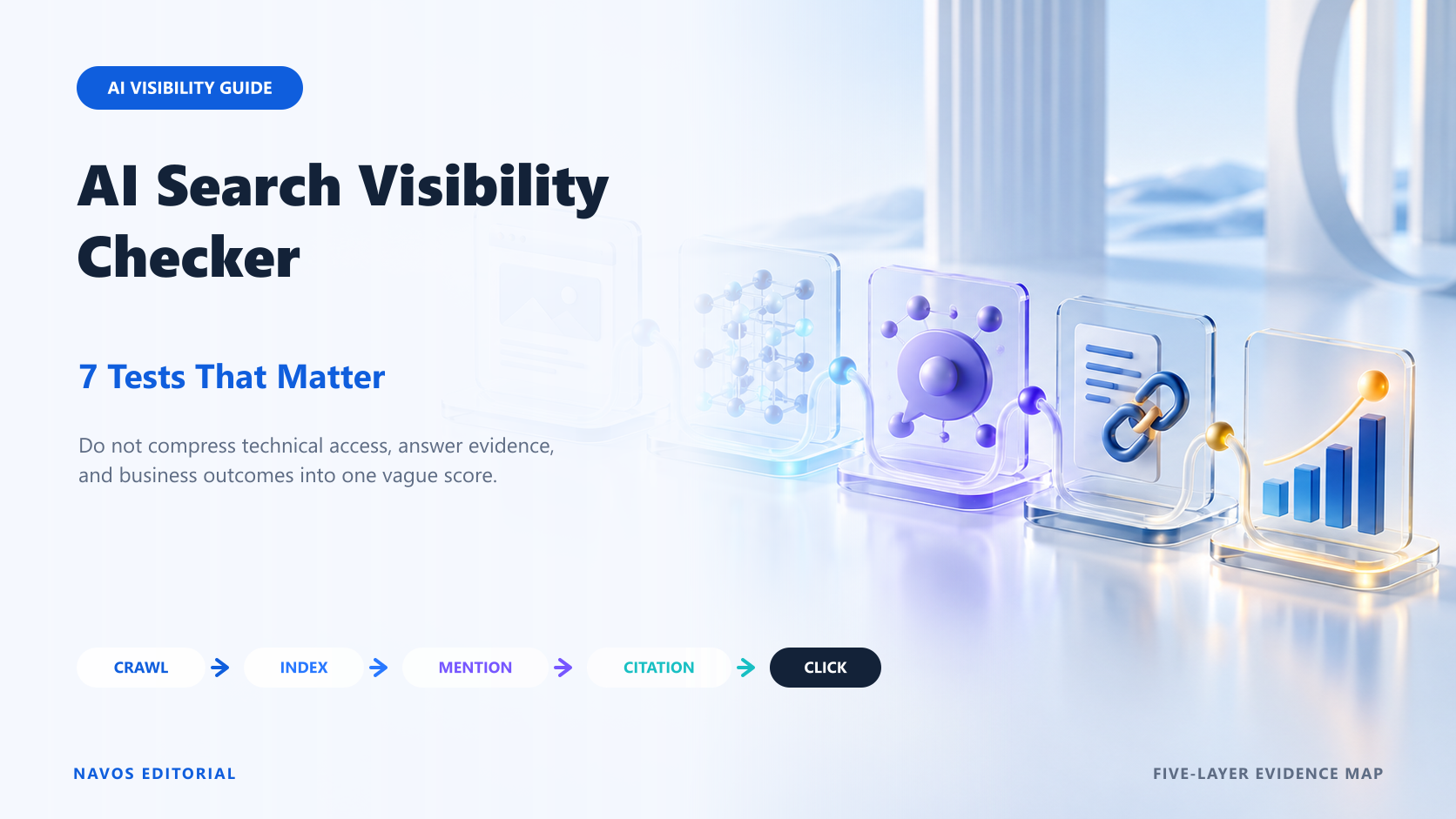
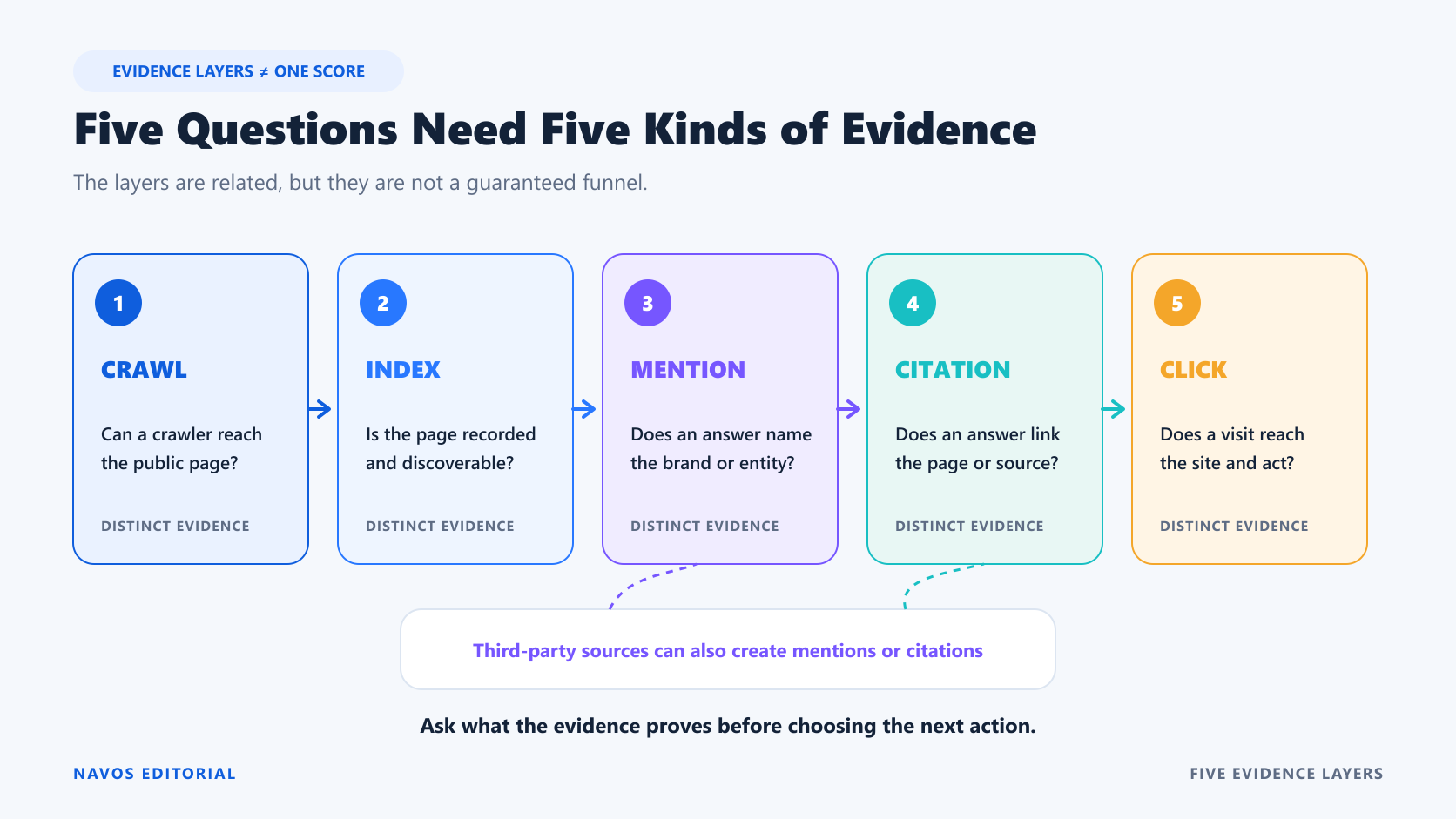
An AI search visibility checker is useful only when it separates five evidence layers: crawler access, index evidence, brand mentions, linked citations, and visits to the site. The layers are related, but none automatically produces the next.
A single score can hide those distinctions. One checker may inspect robots rules and structured data, another may run live prompts, and a third may blend technical checks with citations and traditional SEO signals. Use any grade as a starting point. Use the seven tests below to learn what was actually measured, what remains unknown, and what action the evidence supports.
What an AI Search Visibility Checker Should Answer
Before accepting a grade, ask a simpler question: what happened during the test?
A useful report identifies the URL, engine, prompt, market, language, date, and account conditions. It also preserves the evidence: the blocking directive or response for a crawler finding, or the answer, linked URL, prompt, and time for a citation finding.
The five outcomes that are often collapsed into one score
Crawl: Can a named automated user agent retrieve the page without a robots block, login, firewall, challenge, or error?
Index: Is the page eligible for the relevant search or retrieval system, and is there evidence it was discovered?
Mention: Does a generated answer name the brand, product, or website? A mention may appear without a source link.
Citation: Does the observed answer attach a source or clickable link to a page?
Click: Did a person follow the link and complete a useful action? This requires authorized first-party measurement.
Treat them as separate evidence layers, not a guaranteed funnel. Crawl and index checks usually concern a URL you control; a mention or citation may instead come from a retailer, publisher, directory, or other third party. A page can be crawlable but not indexed, mentioned without an owned-page citation, or cited without producing a visit.
A useful checker shows evidence, not just a grade
A score can help a team prioritize only when its inputs and method are clear. At minimum, the report should disclose:
- which URLs it inspected;
- which user agents or engines it tested;
- whether it ran live prompts or only inspected the page;
- which market and language applied;
- when the observations were collected;
- how each score was calculated;
- which findings were direct observations, tool-derived scores, interpretations, or unavailable.
Without those details, a score change is hard to interpret: the page, prompt set, engine coverage, or formula may have changed.
This is the same evidence discipline used in evidence-first market research: define the decision, preserve the source and date, and keep facts separate from estimates and inference.
The 7 Tests That Matter
The seven tests below do not need to be compressed into one score. Keeping them separate makes the report easier to audit and the next action easier to choose.
1. Public URL and HTTP accessibility
Start with the page a customer or automated system can request. Record the requested URL, final URL after redirects, response status, content type, and whether useful content appears in the returned page.
A browser visit and an automated request may receive different results. Cookies, challenge pages, regional blocks, or client-side rendering can hide the main content. A checker should therefore state how and when it fetched the page instead of reporting a generic “accessible” label.
Useful evidence includes:
- requested URL, final destination, and canonical URL;
- response status and redirect chain;
- whether authentication or a CAPTCHA appeared;
- whether the main text and key product facts were readable;
- test time, user agent, and region where known.
Keep intermittent errors in the record. A repeat can show whether a failure is stable or transient; it should not erase the first observation.
2. Search-crawler access and robots directives
The second test asks what evidence exists about a named crawler's access to the relevant path. Permission for one user agent does not automatically apply to another.
Current official documentation distinguishes OAI-SearchBot, used for OpenAI search, from GPTBot, which relates to training controls. Googlebot supports Google Search, including its generative AI features. Google-Extended is a standalone
robots.txt product token—not a separate HTTP user-agent string—and controls certain training and grounding uses outside Google Search. It does not control inclusion in Google Search or act as a ranking signal. Bing publishes its own crawler guidance.Record the exact user agent, applicable robots rule, page-level directive, retrieval method, and response. Separate a robots-rule observation, a simulated user-agent request, and first-party server-log evidence; a manual request does not prove that the real crawler visited. A crawler can be allowed in
robots.txt yet receive a 403 from a CDN, WAF, bot-management rule, JavaScript challenge, geo rule, or login. That difference between declared permission and successful retrieval belongs in the report.3. Index eligibility and discoverability
Crawl access and index evidence are different layers. An accessible page may carry a
noindex directive, point to another canonical URL, or duplicate another page.When authorized, Google Search Console and URL Inspection provide property-specific evidence a public checker cannot replace. Bing site owners can use Bing Webmaster Tools. Evidence for other AI systems may be more limited.
Treat
site: searches as public observations, not complete index inventories. Finding a URL in a traditional search engine also says nothing conclusive about whether every generative system retrieved it.A good report separates:
- technical eligibility;
- first-party index evidence, when authorized;
- public search observation;
- unavailable evidence.
If first-party access is unavailable, the report should say so rather than inventing a green check.
4. Prompt-set quality and repeatability
AI visibility is query-dependent. A brand may appear for its own name but not for a category or purchase-comparison question. Use prompts tied to real customer decisions.
Start with a small, documented set that covers distinct intent:
- Branded: a question that explicitly includes the brand name.
- Category: a non-branded question about the product or service category.
- Problem: a question written around the buyer’s pain point.
- Comparison: a question asking for options or tradeoffs.
- Decision: a question that would precede a purchase, trial, or consultation.
For each prompt, preserve the wording, engine, interface or API, market, language, account state, visible model, and timestamp. Match those conditions before comparing brands.
Generated answers can vary with time, model, context, location, personalization, and source freshness. Repeat the documented set and report frequency within that set rather than converting one snapshot into an “AI rank.”
A one-pass audit can verify whether prompts and observation fields were controlled. It cannot establish repeatability; that requires multiple scheduled observations under the same documented conditions.
5. Brand mentions versus linked citations
A mention and a citation answer different questions.
A brand mention means the answer named the brand or product. It may reflect model knowledge, retrieved web content, or context already present in the conversation.
A linked citation means the observed answer attached a source or URL. Record the exact destination: an owned page, retailer, publisher, or unrelated domain carries a different meaning.
A checker should capture at least:
- prompt;
- answer excerpt sufficient to understand the context;
- brand mention: yes/no;
- citation: yes/no;
- linked domain and exact URL;
- whether the citation supports the nearby statement;
- observation date and engine.
Also label the context: listed, recommended, compared, criticized, or merely named. A third-party page that mentions the brand is not the same outcome as a link to the brand’s own page.
6. Competitor visibility under the same conditions
Use the same prompts, engines, language, market, time window, repetition rule, and inclusion criteria for every brand.
Define the comparison set before collecting answers. Choose alternatives for the same buyer decision; do not mix retailers, manufacturers, publishers, marketplaces, and software tools without explaining the categories.
A practical comparison matrix can include:
Field | What to record |
Prompt and intent | Exact question and its buyer stage |
Engine and time | Where and when the answer was observed |
Mention | Whether the brand appeared |
Citation | Whether a link supported the appearance |
Destination | Brand-owned, retailer, publisher, directory, or other |
Context | Recommended, compared, criticized, or simply named |
Evidence quality | Direct capture, partial evidence, or unavailable |
Report the observed denominator—for example, “Brand A appeared in four of ten documented prompts”—instead of labeling a small sample as market-wide share of voice.
7. Referral traffic and on-site outcomes
The seventh test uses your own website data: did identifiable AI-origin visits occur, and did they support a useful outcome?
Use authorized first-party analytics to inspect identifiable referrals and campaign parameters. OpenAI says ChatGPT automatically adds
utm_source=chatgpt.com to referral URLs from ChatGPT search results. That parameter helps identify tagged click-through traffic; it does not measure unclicked mentions or citations, and it does not prove engagement, conversion, or revenue. Other platforms may behave differently, and not every visit will be identifiable.Separate the funnel:
- identifiable sessions from AI or answer-engine sources;
- engaged visits;
- product, pricing, or key-content views;
- signup, lead, trial, or purchase events;
- revenue or qualified pipeline where measurement is authorized.
Combine answer observations with first-party behavior data, but keep them as separate evidence types. Missing referral data may reflect no click, an unrecognized referrer, or lost attribution; a recorded visit still needs its own conversion analysis.
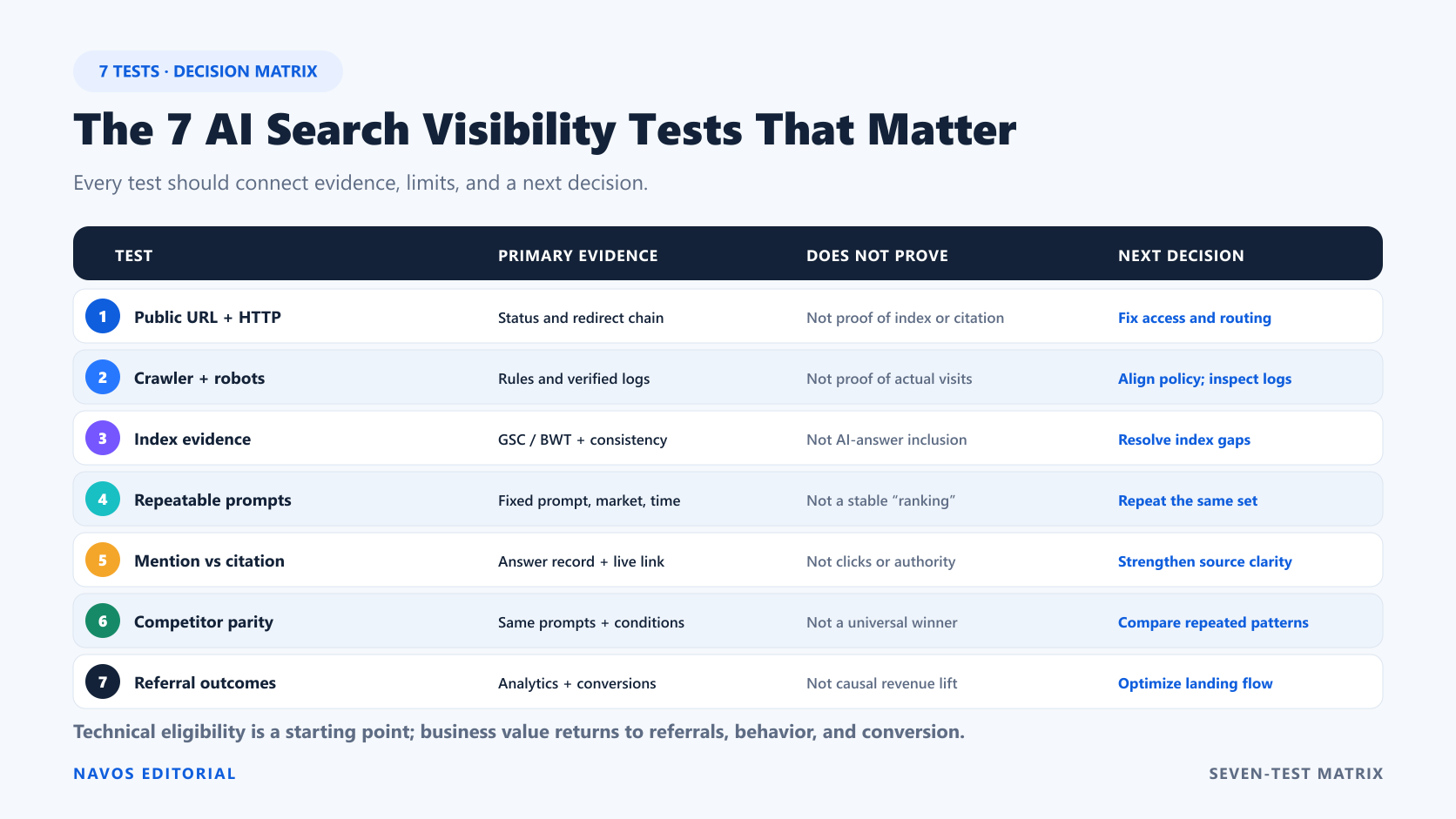
What Each Test Can—and Cannot—Prove
The following table prevents a common reporting error: treating an early technical pass as evidence of a later commercial outcome.
Test | It can support | It cannot prove |
Public URL access | The tested request reached usable content | Index inclusion or citation |
Crawler access | A named crawler was permitted and/or retrieved the page | Recommendation or rank |
Index evidence | The page was eligible or observed in a specific system | Appearance in every AI answer |
Prompt observation | The brand or URL appeared under recorded conditions | Stable cross-user ranking |
Citation capture | A specific answer linked to a specific URL | Cause, reach, or conversion |
Competitor comparison | Relative observations within one controlled prompt set | Market-wide share of voice |
First-party analytics | Recorded visits and actions under the site’s measurement setup | Every untracked AI exposure |
Technical eligibility does not guarantee an AI citation
Technical access removes a blocker. It does not force an engine to select the page. Relevance, quality, freshness, source diversity, query intent, system design, and other factors can affect retrieval and answer composition.
This is why an access audit should end with “eligible for the next test,” not “visible in AI.”
A citation snapshot is not a stable ranking
Traditional rank tracking usually refers to a defined query, location, device, and search result position. Generated answers do not always present a stable ordered list, and their sources can change between runs.
Instead of inventing a rank, report the observable unit: mention, citation, destination, context, prompt, engine, and time. Repeat the test if the decision requires evidence of consistency.
Referral traffic is not the same as revenue
A referral session is a visit, not a sale. Review engagement, conversion quality, cost, and value using the same discipline you would apply to any other acquisition channel.
If the business cannot identify meaningful actions after the click, improving a third-party visibility score may not be the highest-priority project.
Why AI Visibility Scores Disagree
Two checkers can disagree because they measure different systems.
Different engines, prompts, locations, dates, and account states
One tool may query assistants, another may inspect technical eligibility, and a third may blend citations with SEO authority signals. Model version, account history, locale, personalization, search access, and collection time add more variation. Compare the test specifications before treating two scores as a before-and-after measure.
Static audits and live-answer monitors measure different things
A static audit can find response errors, robots directives, canonical problems, or inaccessible content. A live-answer monitor observes mentions and citations for defined prompts, but those results vary and need repeated samples. Both are useful; neither should be labeled as the other.
Proprietary formulas hide different assumptions
A composite score may weight crawlability, schema, content, authority, mentions, citations, and traffic in any combination. Ask for the formula and raw findings. Treat an unreproducible grade as a workflow aid, not an industry standard.
Read Official Guidance Before Acting on a Score
Official documentation does not reveal every retrieval signal, but it prevents basic category errors. The guidance below was rechecked on October 9, 2026.
Google: foundational SEO still applies
Google Search Central says established SEO practices still apply to AI Overviews and AI Mode. To be eligible as a supporting link, a page must be indexed, eligible to appear in Google Search with a snippet, and included in Search generative AI features through Search Console. Meeting those conditions does not guarantee crawling, indexing, or serving. Helpful, reliable, non-commodity content and a clear technical structure remain the priority; third-party checkers do not expose Google’s internal ranking or AI systems.
Google Search Console: measure generative-AI impressions directly
As of August 31, 2026, Google had rolled out its Search generative AI control and Generative AI performance report worldwide. The dedicated report documents impressions from AI Overviews and AI Mode by page, country, device, and date. It is a first-party impression view for the verified property, not a per-answer citation log or proof of stable rank, click, conversion, or visibility in another engine.
For a broader view of this shift, see how AI is used in advertising.
OpenAI: OAI-SearchBot and GPTBot have separate purposes
OpenAI documents OAI-SearchBot and GPTBot as independent controls: the former relates to surfacing websites in ChatGPT search, while the latter relates to training. A publisher can allow one and disallow the other. Allowing OAI-SearchBot supports eligibility for discovery; it does not guarantee indexing, a mention, or a citation. A crawler audit should name the user agent, URL path, and blocking layer, including any firewall response that differs from
robots.txt.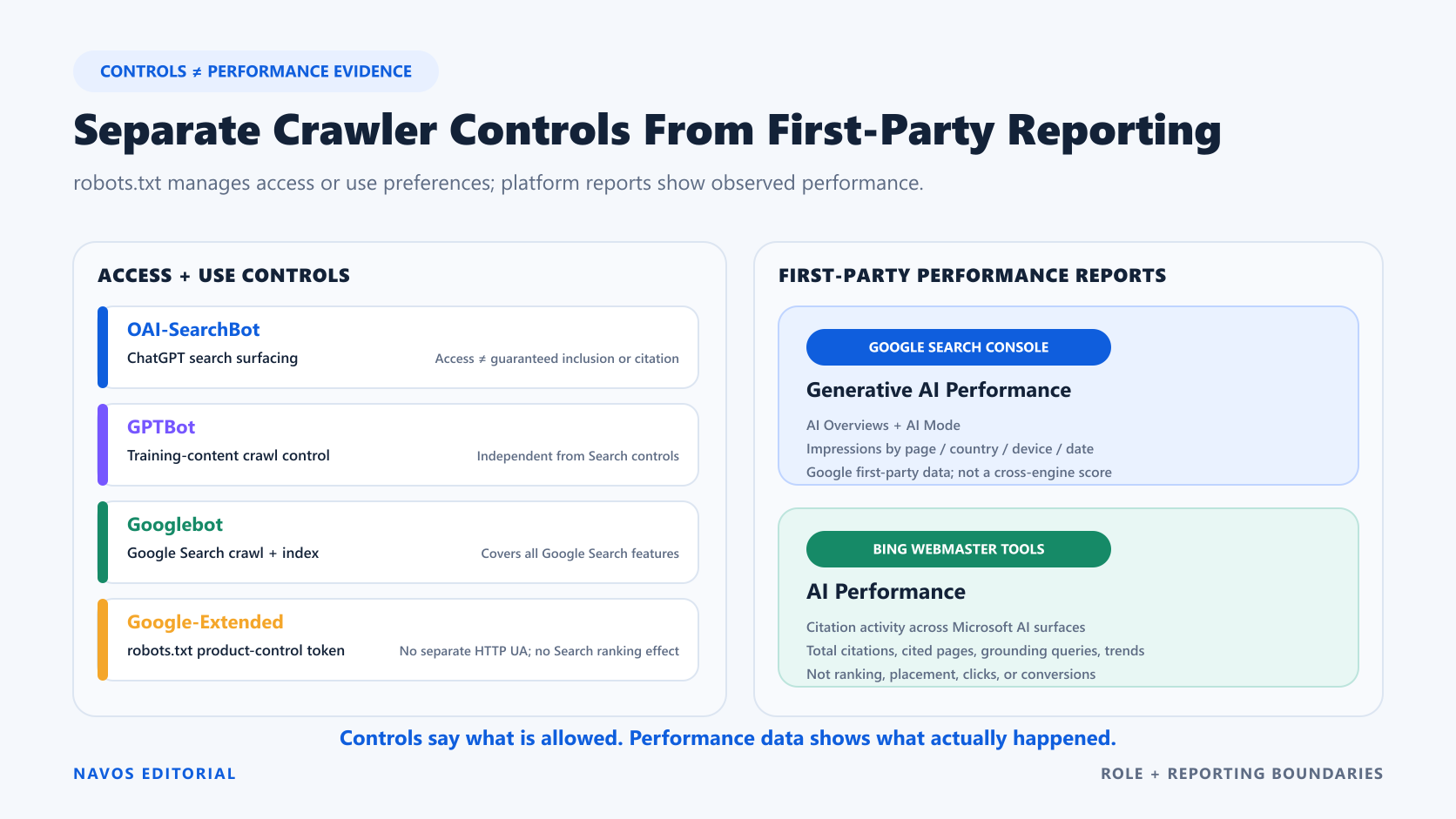
Bing: crawl, index, and quality systems remain the foundation
Bing’s webmaster guidance connects discovery, crawling, indexing, and content quality with Bing and Copilot experiences. Those foundations support eligibility for grounding and citations, but they do not guarantee either outcome and do not create a universal GEO score.
Bing Webmaster Tools AI Performance: first-party citation evidence when available
Bing Webmaster Tools' AI Performance reporting can show citation activity, cited pages, sampled grounding queries, and trends across supported Microsoft AI experiences. In June 2026, Microsoft also added preview views for Intents, Topics, Citation Share, and Compare. Treat these as first-party observations for the covered Microsoft and partner surfaces and time ranges. Citation Share is not a ranking, traffic share, quality score, or market-wide competitor leaderboard. If the site owner has not authorized the account data, keep that layer unmeasured instead of substituting a public
site: query.No file or schema type guarantees an AI citation
No file, schema type, heading pattern, or paragraph length guarantees selection by every AI system. Google prioritizes effective SEO and useful, original content over supposed GEO hacks. Test whether a recommendation improves the source for real readers instead of adding repetitive content for a score.
Turn Findings Into a Decision
A useful report ends with a prioritized action, not a pile of scores.
Fix access blockers first
Resolve confirmed response errors, unintended robots blocks, authentication barriers, canonical mistakes, and index directives before rewriting copy. Document the original state and retest the same URL.
Do not loosen security controls across an entire site merely to improve a checker score. Scope changes to the intended public content and involve the appropriate engineering or security owner.
Improve source clarity and entity consistency
If engines can access the page but the brand is described inconsistently, improve the source itself. State what the company or product is, who it serves, where it operates, and which claims can be verified. Keep names, product facts, author information, dates, and contact details consistent across relevant owned pages.
Add structured data only when it accurately represents visible content. A markup block should not introduce a claim the reader cannot find on the page.
Repeat prompt observations before calling a pattern
Use the same prompt set, comparison brands, market, language, engines, and logging fields. Collect multiple observations across a defined period. Preserve negative results and engine failures rather than rerunning until the preferred brand appears.
Define the threshold before reviewing the result. For example: “We will call this a recurring citation only if the same owned URL is cited in at least three of five scheduled observations for the same prompt and engine.” That threshold is a study rule, not a universal industry benchmark.
Measure qualified traffic and conversion separately
Use first-party analytics to evaluate identifiable AI-origin visits. Compare engagement and conversion with other sources, while keeping attribution limitations visible.
The final decision may be to fix a page, improve a source, expand a prompt test, or stop spending time on a score that has no observable connection to customer behavior.
How Navos Turns a Visibility Check Into a Decision Trail
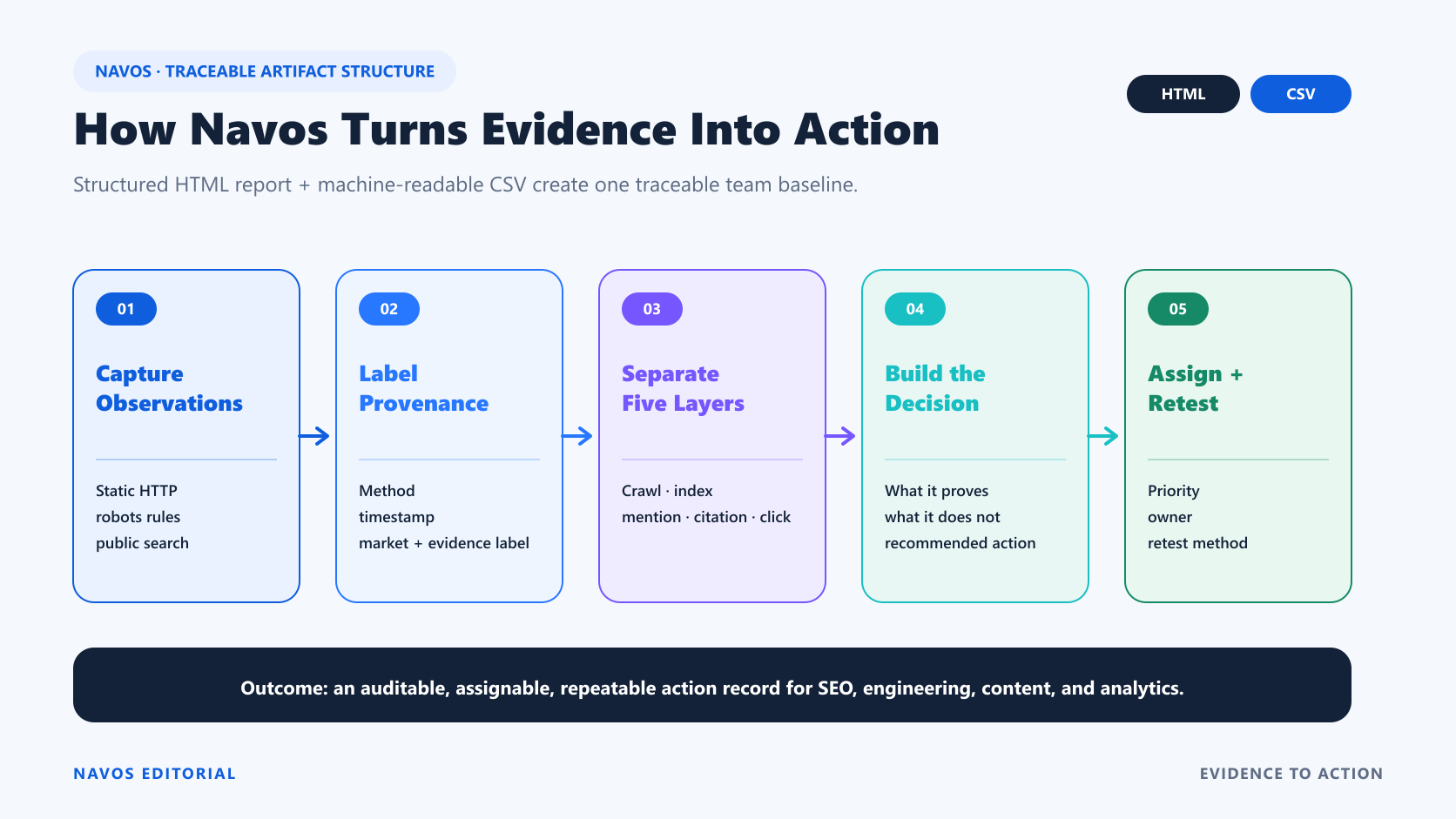
We ran Square → Website Optimization → Webpage AI Health Check in Navos on one public URL with a defined US market, English language, and five buyer-intent prompts. The run produced two connected deliverables: a structured HTML report for decision-making and a machine-readable CSV observation log for auditability and repeat tests.
That combination is the important part. The HTML made the findings, priorities, owners, and retest methods easy to review. The CSV preserved the individual observations behind the report—including the prompt, prompt type, collection method, evidence label, provenance, execution state, and timestamp where available. A team can discuss the report, then return to the observation-level record when it needs to verify a claim or compare a later run.
Five evidence layers remained visible
Navos organized the analysis around crawl, index, mention, citation, and click. Each layer kept its own evidence status and method, so a technical access observation was not promoted into an answer-level citation claim, and a public search observation was not treated as a complete first-party index inventory.
This produces a more decision-ready baseline than an unexplained composite score. The report shows what was observed, which source supports it, which connected source should be added for the next question, and who owns the follow-up. Missing coverage stays identifiable instead of being silently converted to zero and mixed into a grade.
Navos output | What it made usable |
Run scope | One documented record of the URL, target market, language, prompt set, and collection context |
Evidence coverage | A clear separation of crawl, index, mention, citation, and click evidence |
Observation log | Portable CSV rows with method, provenance, evidence labels, and timestamps where available |
Prompt plan | Five preserved buyer-intent prompt types that can be repeated under matched conditions |
Action queue | Prioritized findings with owner, next action, and retest method |
The Artifact preserved a finding that a one-number checker could hide
Two time-stamped requests to the same public page returned different delivery states. Navos retained both observations rather than letting the later request overwrite the earlier one. It kept the cause unassigned until the network context could be verified, then routed the next step to a controlled regional delivery retest and canonical/hreflang review.
That turns an ambiguous technical signal into a concrete operating decision. Engineering knows what delivery behavior to reproduce. SEO knows which canonical and locale signals to inspect. Analytics and growth teams know which first-party or answer-level evidence should be connected before commercial impact is evaluated.
From one audit to a repeatable team workflow
The resulting Artifact supports a simple operating loop:
- define one public URL, market, language, and decision;
- preserve the raw observation and its provenance;
- keep technical, answer-level, and first-party business evidence separate;
- assign the finding to the right owner;
- rerun under documented conditions and compare like with like.
For teams exploring what Navos is, this is the practical value of the Webpage AI Health Check: it converts a vague question—“Are we visible in AI search?”—into a traceable evidence map and an action queue that SEO, content, engineering, and analytics teams can share.
To build the same kind of baseline for one public page, download Navos and run Webpage AI Health Check. Open Square → Website Optimization, enter the URL, target market, language, and prompt set, then keep the exported HTML and CSV for the next comparison.
Frequently Asked Questions
Can an AI visibility checker guarantee a citation?
No. A checker can identify technical blockers, inspect a page, or observe answers under defined conditions. It cannot guarantee that an AI system will cite the page for every user or future query. Treat guarantees as marketing claims that require unusually strong evidence.
Does blocking GPTBot remove a site from ChatGPT Search?
Not by itself. OpenAI documents GPTBot and OAI-SearchBot as separate controls. OAI-SearchBot is the relevant user agent for ChatGPT search visibility. Review the exact user agent, URL path, and infrastructure response before drawing a conclusion.
Does llms.txt guarantee AI visibility?
No. A file can provide information in a particular workflow only when a system chooses to use it. It does not override crawl blocks, index decisions, relevance, quality, or answer selection. Google’s current guidance says its AI Search features do not require special AI text files.
Can a page rank in Google but remain absent from an AI answer?
Yes. A traditional result and a generated answer are different outputs. The prompt, intent, retrieval process, answer structure, location, time, and system can change which sources appear. A Google position also does not establish visibility in ChatGPT, Claude, Gemini, or Perplexity.
How often should AI visibility be checked?
Match the cadence to the decision. Retest after a material technical or content change, after an engine or policy change, or on a stable schedule when the business needs trend evidence. Daily checks can create noise when the site and prompt set rarely change; one annual check can miss important shifts.
Which metric proves business value?
No single visibility score proves it. Combine documented prompt-level mentions and citations with authorized referral, engagement, conversion, and revenue data. If the business outcome cannot be measured, state that limitation rather than substituting a third-party score.
Treat the Checker as an Evidence Tool, Not an Oracle
The strongest AI visibility audit is not the one with the most impressive grade. It is the one that makes every finding traceable and tells the team what to do next.
Keep crawl, index, mention, citation, and click evidence separate. Record the conditions behind each observation. Fix verified blockers before chasing speculative tactics. Then use repeated tests and first-party outcomes to decide whether the work produced a meaningful change.
That approach may feel less dramatic than a single score. It is also far more useful when a team needs to defend a decision, repeat a test, or explain what the evidence does—and does not—show.
Learn what an AI visibility score actually proves—from crawler access and citations to referral traffic—before acting on an audit.