A useful TikTok ad creative brief gives a creator enough direction to film: one audience situation, one message, the shots that support it, the claims they can use, and a clear next step for the viewer.
Copy the template below, then use the three filled examples to handle a price you know, a price you do not know, and a product benefit you cannot yet prove. Each example includes a planned shot sequence and a decision about what still needs approval.
The products and prices in these examples are fictional teaching inputs. The examples adapt a reviewed Navos report for this guide; they are not live ads or measured campaign results.
Original AI-generated editorial illustration of the fictional teaching products.
Copy the TikTok Ad Creative Brief Template
Copy this table into a document for each product and version. Separate supplied facts from creative hypotheses. For anything unknown, record who will check it and what decision depends on it.
Field | What to fill in |
1. Product and sources | SKU, variant, brief version, date, specification source, and source owner |
2. Audience situation | One situation the ad addresses; state whether it comes from research or is a creative hypothesis |
3. Creative job | What the viewer should understand or do after watching |
4. Core message | The single idea the video needs to communicate |
5. Opening | First visual, exact opening overlay, and optional spoken hook |
6. Proof shots | What to film; which claim each shot supports; source or test required |
7. Claim permissions | Exact wording, supporting evidence, reviewer, and approval status |
8. Exclusions | Unsupported wording, misleading visual implications, and claims held for evidence |
9. Offer and CTA | Confirmed price or offer, exact CTA, destination URL, and date checked; use a non-price close when needed |
10. Deliverables | Planned placement; ad format separately; aspect ratio, duration, captions, variants, raw clips, and export format |
11. Creative freedom and rights | What the creator can adapt; what stays fixed; music, footage, likeness, paid usage, and disclosure requirements |
12. Review and handoff | Named owner and reviewer, due date and time zone, revision round, unresolved questions, and release status |
For field 10, keep these two choices separate:
- Planned placement: TikTok In-Feed / another placement / to be confirmed.
- Ad format: Spark Ads / Non-Spark Ads / to be confirmed.
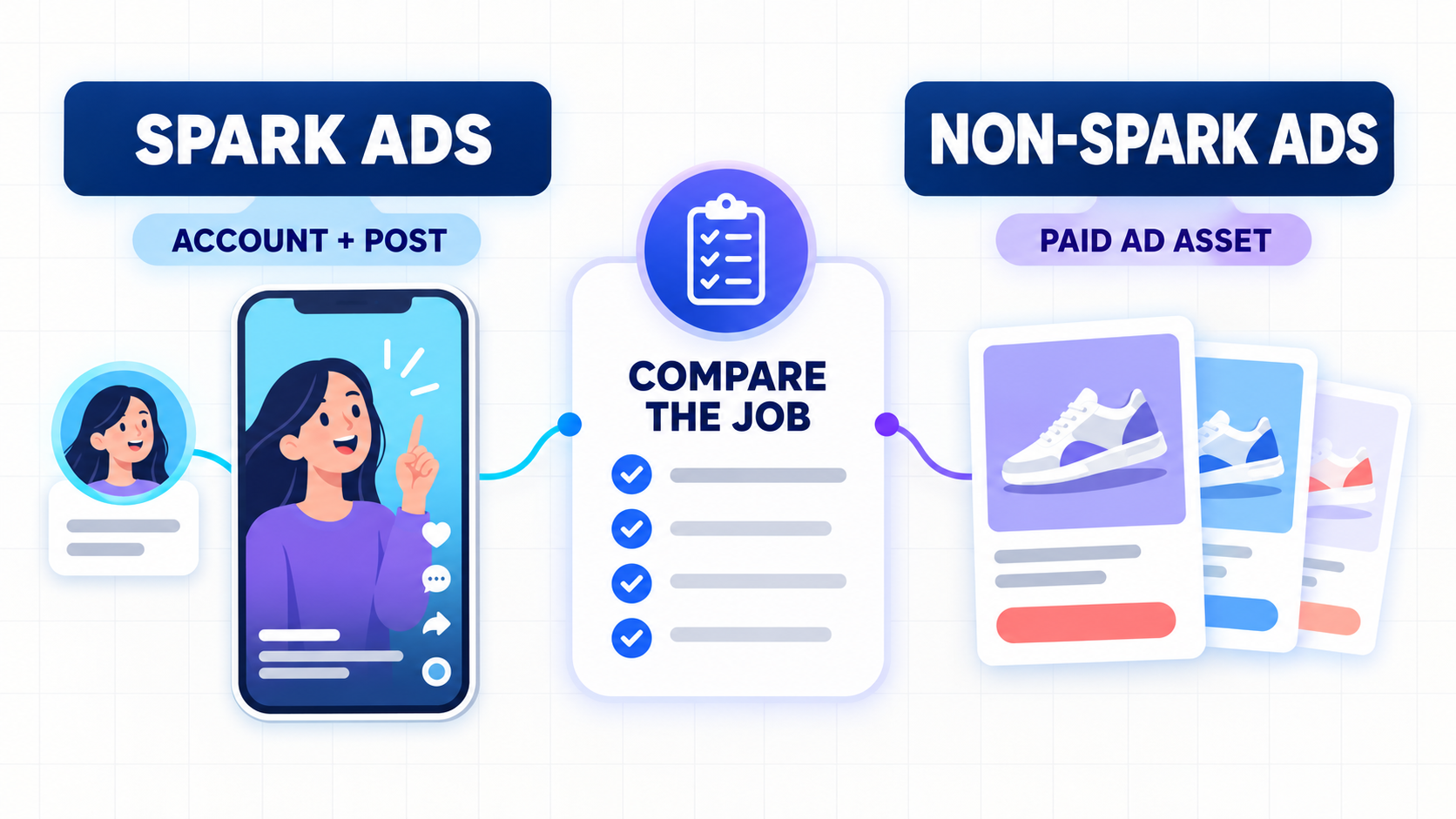
Spark Ads is an ad format, so choosing it does not replace the placement decision. For the practical differences in identity, authorization, and publishing setup, see the Spark Ads vs. Non-Spark Ads comparison.
The examples here use a planned 30-second, 9:16 video. That is a production choice for this exercise. TikTok's Creative Codes recommends vertical creative, room for interface elements, and a hook-body-close structure; it does not make this particular 30-second plan a universal requirement.
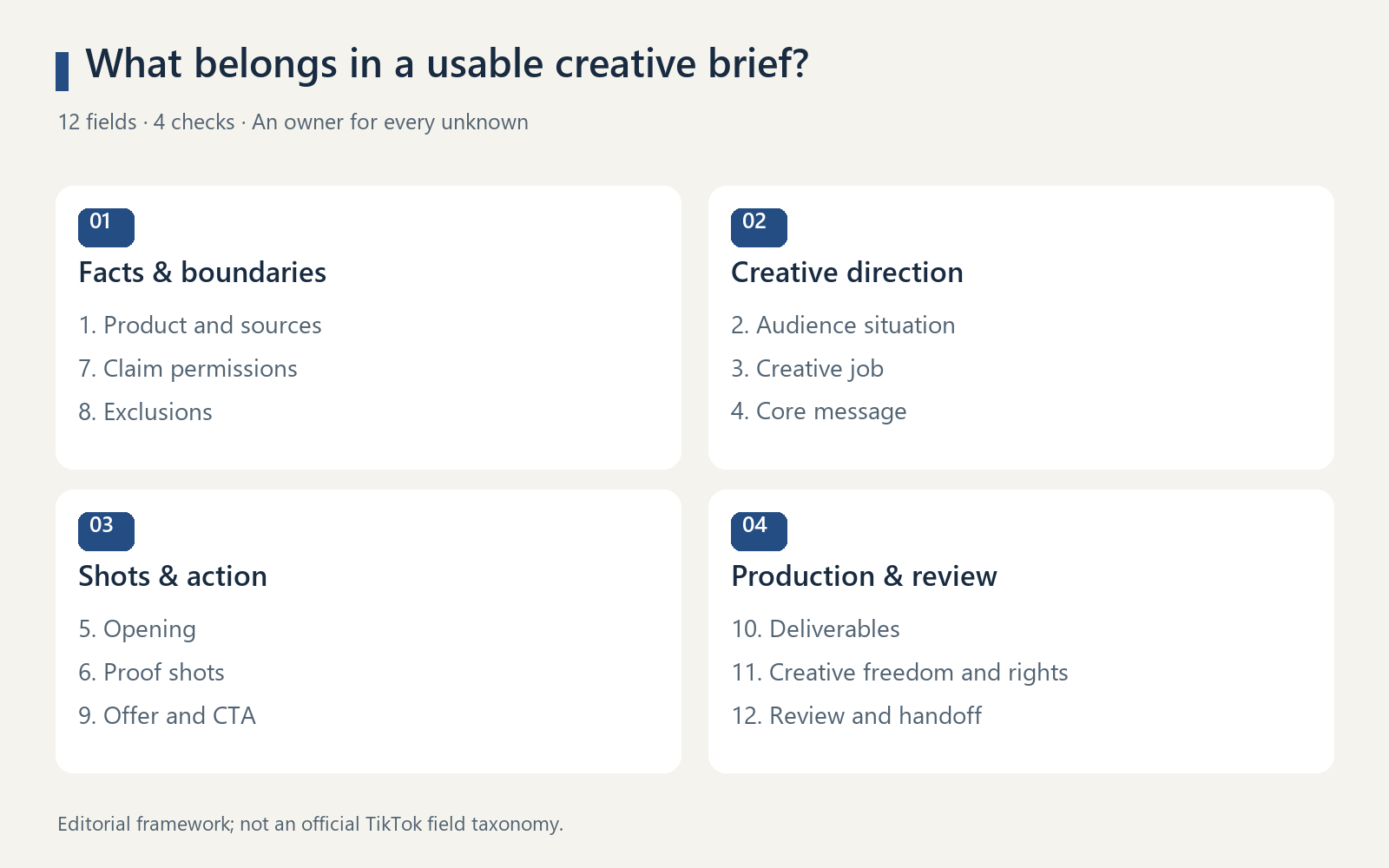
Use the groups to check completeness, then keep the detailed table as the working brief.
Turn the Fields Into Filming Decisions
Choose one audience situation and one message
“Show every benefit” gives a creator little help. “Show three clothing categories going into three different packing cubes” gives them an action to film.
If the buyer situation has not been researched, label it a hypothesis. You can explore the idea that travelers want separate clothing categories without claiming that a customer survey proved it.
Competitor ads can suggest ways to present a message, but they cannot establish facts about your product. Use TikTok competitor ad analysis for creative references, then return to your own specifications and evidence before writing claims.
Decide what each shot can prove
A close-up can show a zipper. A verified specification can support capacity. Neither proves that a bottle keeps drinks cold for 24 hours.
Write the claim, source, planned shot, and limitation together. A planned shot is still a task: it only becomes evidence after someone captures and checks the actual result. Review the implication of the image as well as the words. An inverted bottle or a dramatic ice test may suggest performance even when the overlay stays neutral.
Keep the offer and the destination aligned
A supplied price can go into a draft, but it needs a current source before release. Never fill a blank offer field with an invented discount, shipping promise, or urgency message.
If the price is unknown, use a non-price close such as “See how it works.” Check the final destination before approving that line: it should actually show what the viewer is being invited to see.
Give creators room to perform
Lock product facts, required shots, claim boundaries, disclosures, and the approved offer. Let the creator adapt phrasing and delivery within those limits.
Ask for countable deliverables: one edited video, two opening overlays, captions, and named raw clips. Include the agreed usage scope and revision process.
Document | Question it answers |
Creative brief | What should this video communicate, demonstrate, and avoid? |
Script | What words appear or are spoken, and in what order? |
Shot list or storyboard | What will the viewer see at each point? |
Example 1: Packing Cubes With a Supplied Price
Simulated facts: Three polyester packing cubes, each with a zipper and mesh top. Dimensions: 30 × 20 × 10 cm, 25 × 18 × 8 cm, and 20 × 15 × 6 cm. The exercise price is US$24, with no discount, gift, or free-shipping offer.
Brief field | Filled example |
Product and source | Fictional packing-cube set; the exercise specification is the only source. Real SKU and source documents are not supplied. |
Audience situation | Creative hypothesis: a traveler wants clothing categories kept separate while packing. |
Creative job | Show the three sizes being used to sort clothing. |
Core message | Three sizes for sorting clothes. |
Opening | Place three cubes side by side. Overlay: “Three sizes for sorting clothes.” |
Proof shots | Show all three sizes, separate clothing into categories, and show zippers and mesh tops. Confirm the sample against the specification before filming. |
Claim permissions | Within the exercise: quantity, material, zipper, mesh top, dimensions, sorting use, and US$24. Real-world approval remains open. |
Exclusions | Waterproofing, compression, load capacity, measured space or time savings, universal suitcase fit, and airline approval. |
Offer and CTA | Record US$24 in the brief; no promotional add-ons. Draft close: “Check the details below.” The actual destination is not supplied. |
Deliverables | Planned In-Feed placement; Spark/Non-Spark choice open. One 30-second 9:16 hands demo, captions, two opening-overlay versions, and raw demonstration clips. |
Freedom and rights | Adapt clothing colors and delivery; keep quantities, dimensions, claims, and CTA meaning fixed. Asset and paid-usage permissions remain open. |
Review and handoff | Product owner checks specifications and price; producer checks sample and footage; media owner checks destination. Names and dates remain unassigned. Preparation only; not ready for release. |
Planned shots — editorial adaptation, not recorded footage
Time | Visual | Overlay or copy direction |
0–3s | Place all three cubes side by side | “Three sizes for sorting clothes.” |
3–10s | Show zippers and mesh tops in close-up | “Zippers and mesh tops” |
10–20s | Put different clothing categories into separate cubes | “Sort clothes by category” |
20–26s | Close the cubes and show the set | “Three sizes” |
26–30s | Hold on the set, with room for the final CTA | “Check the details below.” |
The price belongs in the brief even if the video does not display it. Recording the commercial input and choosing an overlay are separate decisions.
Example 2: Cable Clips Without a Confirmed Price
Simulated facts: Six silicone cable clips with adhesive bases, for cables 3–5 mm in diameter. Clean and dry the surface before application. Price, offers, shipping, returns, suitable surface types, adhesive strength, durability, reuse, and removal residue are unknown.
Brief field | Filled example |
Product and source | Fictional six-piece cable-clip set; exercise specification only. No listing, sample, or test result supplied. |
Audience situation | Creative hypothesis: a desk user wants a dedicated position for frequently used cables. |
Creative job | Demonstrate preparation and placement using compatible cables. |
Core message | Show how six adhesive-backed clips arrange 3–5 mm cables on a prepared surface. |
Opening | Show loose cables on a desk. Hook: “Six clips, one clean desk.” Here “clean” describes the intended tidy scene, not a cleaning function. |
Proof shots | Clean and dry the demonstration surface, show the adhesive base, verify cable diameter, and film placement on a confirmed suitable surface. |
Claim permissions | Within the exercise: six clips, silicone, adhesive bases, 3–5 mm range, and the preparation step. |
Exclusions | Every-surface compatibility, permanent adhesion, reuse, residue-free removal, and invented prices or offers. |
Offer and CTA | Price and offer unknown. No price overlay. Draft close: “See how it works.” Destination still needs checking. |
Deliverables | Planned In-Feed placement; ad format open. One 30-second 9:16 hands demo, captions, and raw preparation/placement clips. |
Freedom and rights | Adapt desk styling and pacing; keep preparation and compatibility boundaries fixed. Usage permissions remain open. |
Review and handoff | Product owner confirms a suitable surface and sample; ecommerce owner confirms listing details; producer checks rights. Names and dates remain unassigned. Preparation only; not ready for release. |
Planned shots
Time | Visual | Overlay or copy direction |
0–3s | Show the desk and loose cables | “Six clips, one clean desk.” |
3–10s | Clean and dry the surface | “Clean and dry the surface first” |
10–20s | Show the base and place clips; insert cables checked at 3–5 mm | “For 3–5 mm cables” |
20–26s | Show the arranged cables from the same angle | “Six silicone clips” |
26–30s | Hold on the arrangement | “See how it works.” |
The team can develop this concept while price is unknown. Before filming, it still needs a suitable surface and a sample. Before release, it needs a verified destination and permissions. “Non-price brief” does not mean “everything else is approved.”
Example 3: A Bottle Without Performance Evidence
Simulated facts: A 500 ml double-wall stainless-steel bottle with a screw cap. Care instruction: “Hand wash.” Exercise price: US$22, with no discount. Temperature retention, leak resistance, drop resistance, dishwasher compatibility, BPA status, and food-contact evidence are not supplied.
Brief field | Filled example |
Product and source | Fictional 500 ml bottle; exercise specification only. Physical sample and supporting documents not supplied. |
Audience situation | Creative hypothesis: a shopper wants to understand a bottle's capacity, construction, cap, and care instructions. |
Creative job | Present the supplied specifications without suggesting untested performance. |
Core message | 500 ml capacity, double-wall stainless-steel construction, and a screw cap. |
Opening | Show the bottle upright. Hook: “500 ml. Double-wall steel. Simple.” |
Proof shots | Show the exterior and cap operation; obtain a specification source for capacity and construction; display the exact care instruction. |
Claim permissions | Within the exercise: supplied capacity, material/construction, cap type, “Hand wash.”, and US$22. |
Exclusions | “Cold for 24 hours,” leakproof, drop-proof, dishwasher-safe, BPA-free, certification badges, and visuals implying a passed test. |
Offer and CTA | US$22 in the brief; no discount claim. Draft close: “Learn more below.” Destination not supplied. |
Deliverables | Planned In-Feed placement; ad format open. One 30-second 9:16 hands demo, captions, and raw cap/specification shots. |
Freedom and rights | Adapt background and pacing. Do not add ice-timer scenes, inverted-bottle demonstrations, or stronger care wording. Permissions remain open. |
Review and handoff | Product owner checks specifications and care instructions; reviewer checks claims; media owner checks destination. Names and dates remain unassigned. Preparation only; not ready for release. |
Planned shots
Time | Visual | Overlay or copy direction |
0–3s | Present the bottle upright | “500 ml. Double-wall steel. Simple.” |
3–10s | Show its exterior from two angles | Identify the supplied construction; no temperature promise |
10–20s | Open and close the screw cap; show an approved specification reference | “500 milliliters. A screw-top lid.” |
20–26s | Show the bottle alongside the care instruction | “Hand wash.” |
26–30s | Return to an upright product view | “Learn more below.” |
Keep the care instruction as supplied. Changing “Hand wash.” to “hand wash recommended” makes it optional; changing it to “hand wash only” adds exclusivity. Neither is a faithful copy of the input.
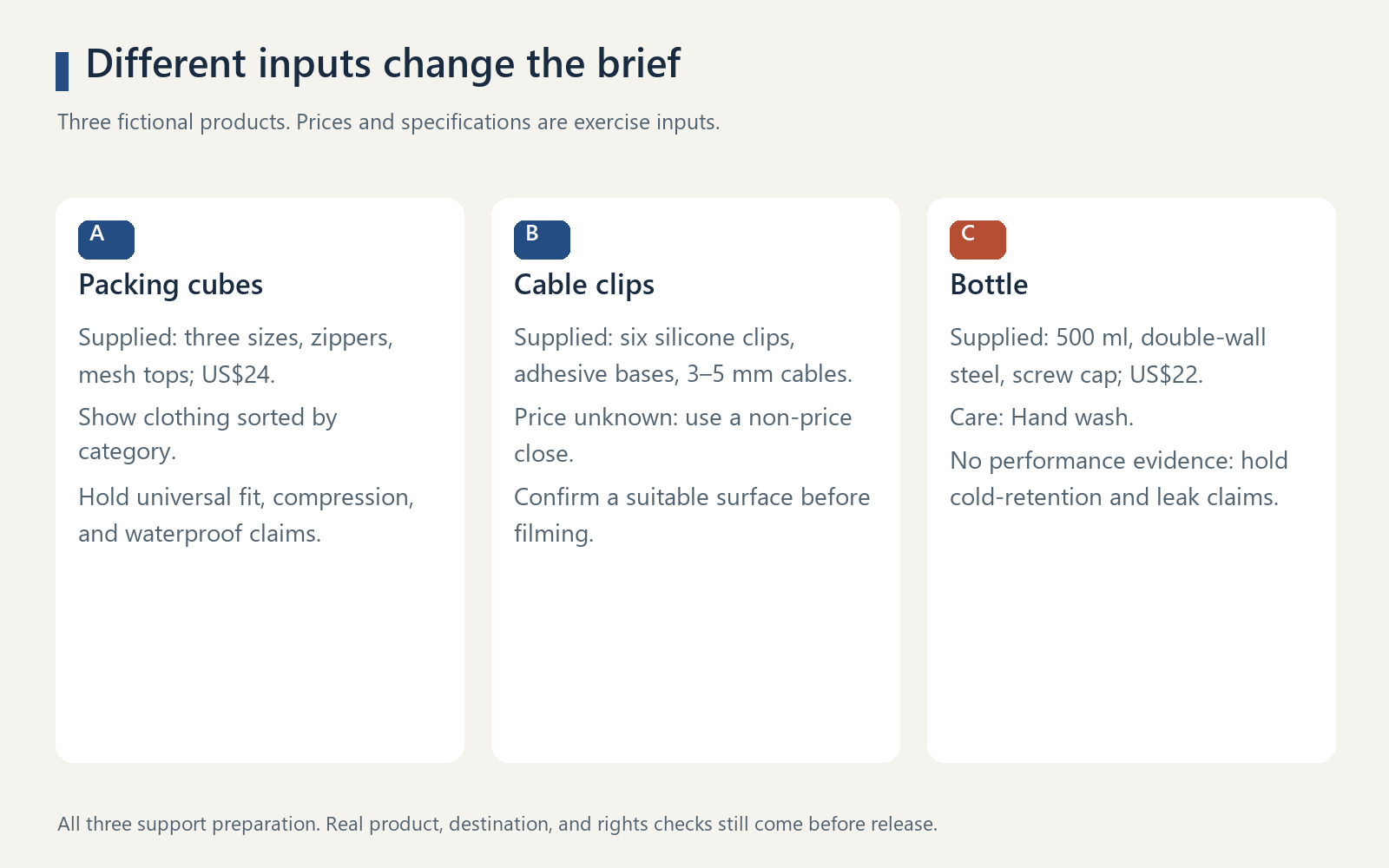
Different evidence gaps change the brief. All three cases still need real-product approval before release.
Audit the Claim, Its Source, and Its Visual Implication
Use this short review table before approving the script. “Supported in the exercise” means consistent with fictional input; it does not mean verified for a real product.
Proposed claim | Available support | Brief decision |
“Three sizes for sorting clothes.” | Simulated dimensions and intended sorting use | Retain in the exercise; check the real sample and source before production |
“Fits every standard suitcase.” | No fit evidence | Hold; show the three sizes without a universal fit promise |
“For 3–5 mm cables.” | Simulated specification | Retain in the exercise; verify the actual sample and compatible setup |
“Works on every surface with no residue.” | No surface or removal evidence | Hold both claims; do not imply them through the demonstration |
“500 ml. Double-wall steel.” | Simulated specification | Retain in the exercise; request the real specification |
“Cold for 24 hours and never leaks.” | No temperature or leak test | Hold; keep the video to supported specifications and cap operation |
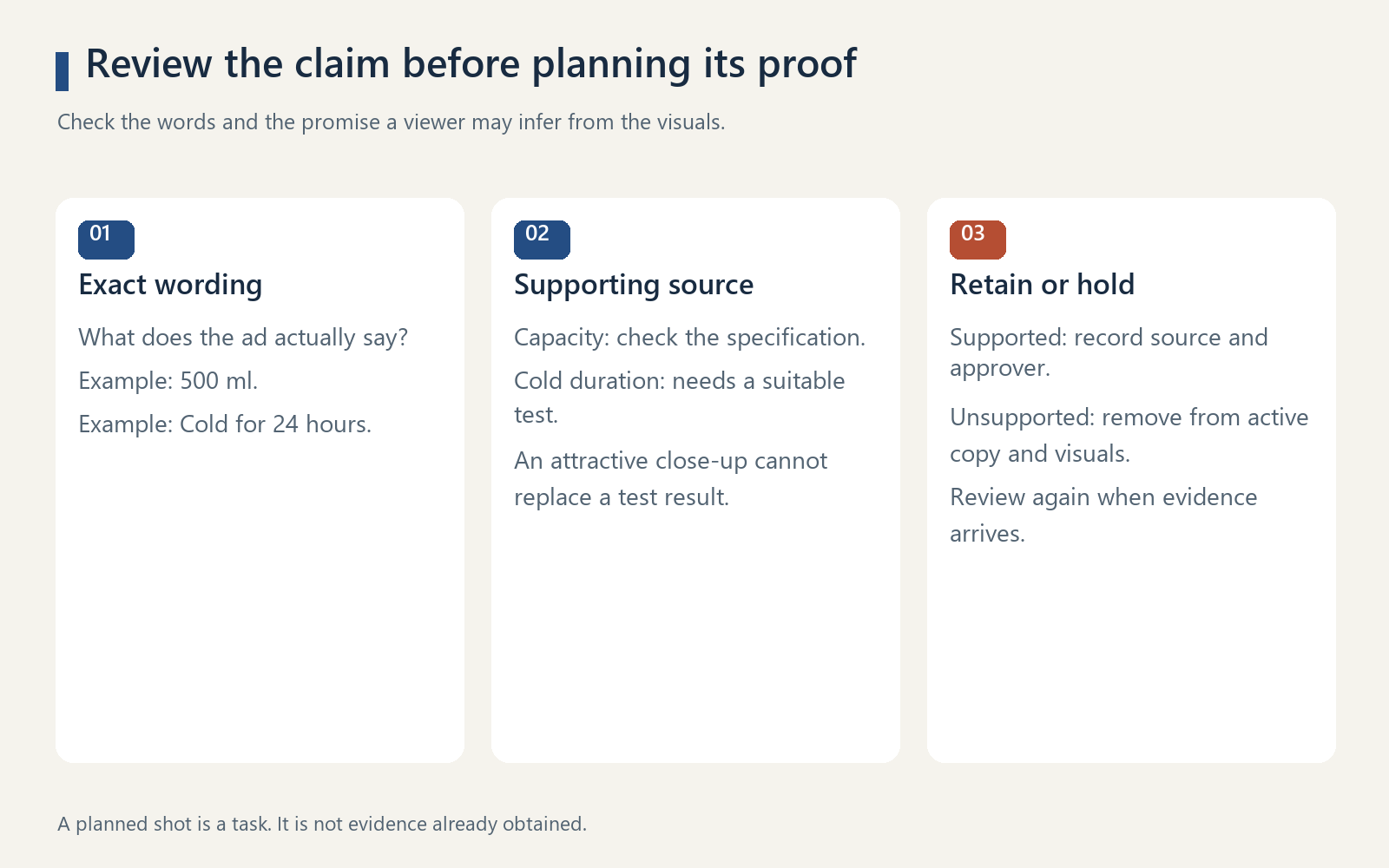
A close-up supports what is visible. A performance promise needs evidence suited to that promise.
What the Navos Brief Exercise Produced
For this guide, we reviewed three successive Navos HTML reports supplied for the same three-product exercise. The final report brought together a blank template, three briefs, timed shot plans, a claim audit, a missing-information list, and a plan for testing one opening-overlay change.
The useful part was the connected handoff: reviewers could trace a line of copy to a product input, see the shot intended to support it, and identify what still needed an owner. For cable clips, the brief remained usable without an invented price. For the bottle, missing performance evidence became an explicit restriction on words and visuals.
Human review mattered. The initial report and its revisions needed corrections before the material was suitable for this guide:
Review issue | How the final direction changed |
Unsupported suitcase-fit wording | Replaced with “Three sizes for sorting clothes.” |
Fictional inputs described too confidently | Kept separate from verified real-product facts |
Care wording drift | Preserved “Hand wash.” |
A phrase held in the audit but still appearing in active copy | Aligned the script and audit; kept retired wording out of current copy |
The examples above are edited for readability and teaching, with the placement and ad-format fields separated. They are not an unedited transcript of a single successful run. No videos were filmed or launched in this exercise, and it did not measure production time, conversion, or ad performance.
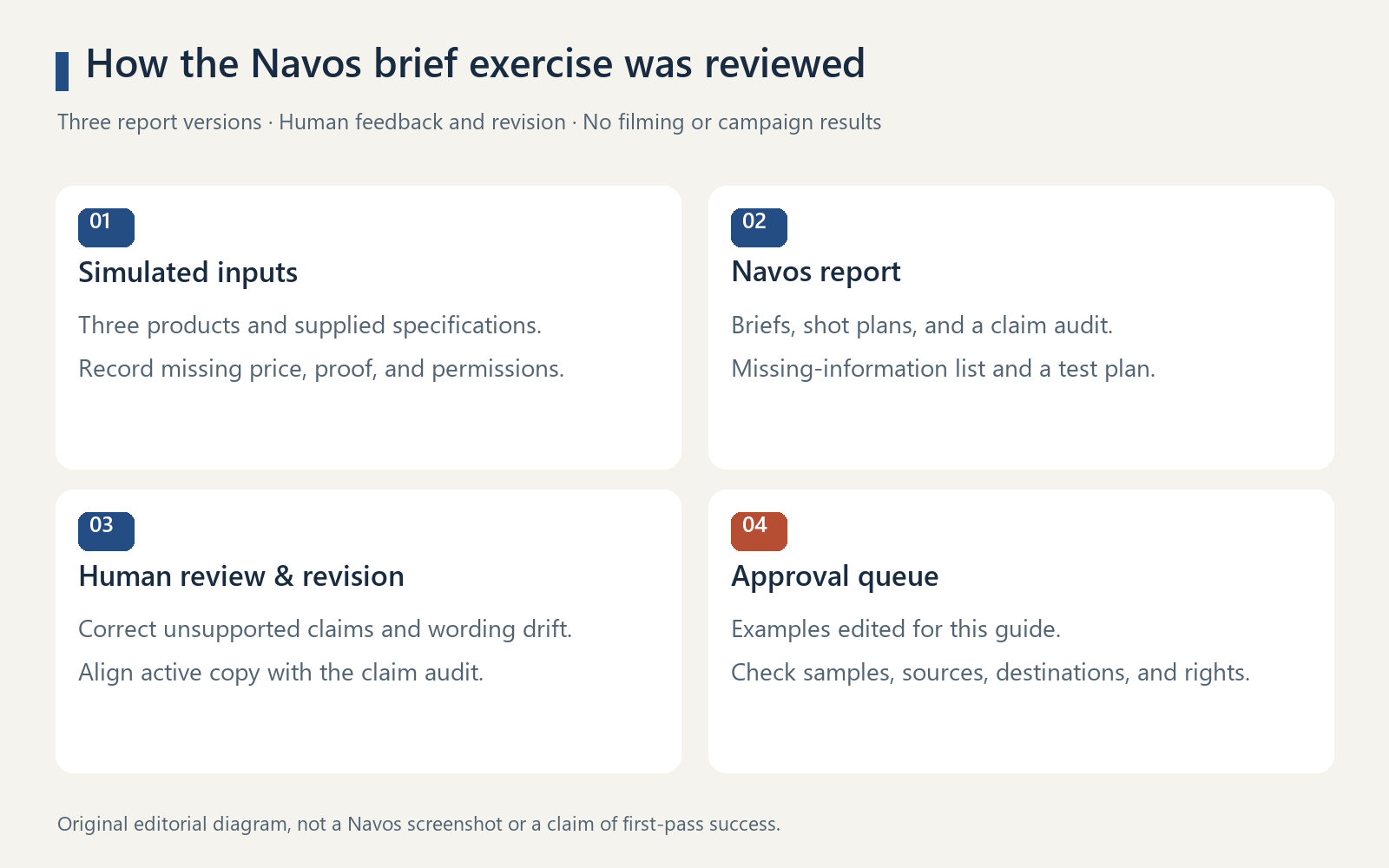
Editorial diagram of the reviewed workflow; not a Navos interface screenshot.
To prepare a similar task, copy this starter prompt and add your source material:
Build a TikTok ad creative brief using only the product facts I provide. Separate supplied facts, creative hypotheses, and unknowns. Produce a brief, a timed shot plan, a claim-to-source table, and a missing-information list with owners. Do not invent prices, offers, test results, permissions, or URLs. Keep unsupported claims out of hooks, voiceover, overlays, and visual directions. Distinguish “ready to prepare” from “ready to release.” After revision, check that active copy and the claim audit agree.
Keep your sources beside the output while reviewing it. If you want to use Navos for this workflow, download Navos Desktop and bring the completed fact sheet into your creative task.
Check the Handoff, Then Test One Change
Before filming, confirm the sample, usable evidence, shooting permissions, and production owner. Before release, also confirm the current offer, working destination, disclosure and paid-usage requirements, final copy, and approver.
Open item | Work that can continue | Decision that must wait | Responsible role |
Price or offer | Non-price concept and shot plan | Price, discount, and offer-led CTA approval | Ecommerce owner |
Performance evidence | Specification-led concept | Performance claims and demonstrations | Product reviewer |
Sample or suitable setup | Storyboard and production planning | Filming and evaluation of the result | Producer and product owner |
Destination | Draft CTA | Final CTA and release | Media or ecommerce owner |
Rights and disclosure | Creative references | Use of the affected assets and publication | Rights/disclosure reviewer |
For the packing cubes, a controlled opening-overlay comparison could use:
- A: “Three sizes for sorting clothes.”
- B: “Three packing cubes. Zippers and mesh tops.”
Change only that opening overlay. Keep the first visual, voiceover, body, runtime, captions outside the opening, CTA, audience, placement, and delivery conditions as consistent as the testing setup permits.
Before launch, choose the primary metric, its exact reporting definition, a review window, and the evidence needed to make a decision. If the available setup cannot support a reliable comparison, record an inconclusive result. This brief contains no winning variant.
After a live campaign has established a baseline, the TikTok creative fatigue guide can help you examine declining results before deciding whether to refresh the creative.
Frequently Asked Questions
What should a TikTok ad creative brief include?
Include product facts and sources, one audience situation, one message, the opening, required shots, permitted and excluded claims, the offer and CTA, deliverables, rights, reviewers, and unresolved questions. Name the person responsible for each open item.
Is a creative brief the same as a script?
A brief defines the decisions and boundaries. A script supplies words and sequence. A storyboard or shot list shows the visual plan. A small project can keep all three in one document, as long as those roles remain clear.
Can I brief a creator before confirming the price?
Yes. Develop a non-price concept and leave the offer field open. Do not invent a sale, shipping promise, or urgency message. Check the final product page before approving the CTA and release.
How much creative freedom should a creator have?
Let the creator adapt delivery, pacing, and nonessential styling. Fix product facts, required demonstrations, disclosures, claim exclusions, and the approved offer. Agree on usage and revision terms before filming.
Can AI help write a brief without inventing claims?
Explicit source boundaries and an audit table make the output easier to check. They do not remove the need for review. In this exercise, the Navos reports needed feedback and revision; the final brief still required real-product, destination, and permissions checks before release.
Copy the template for your next product, fill the facts first, and give every remaining question an owner. To bring that fact sheet into an AI-assisted creative task, get Navos Desktop.