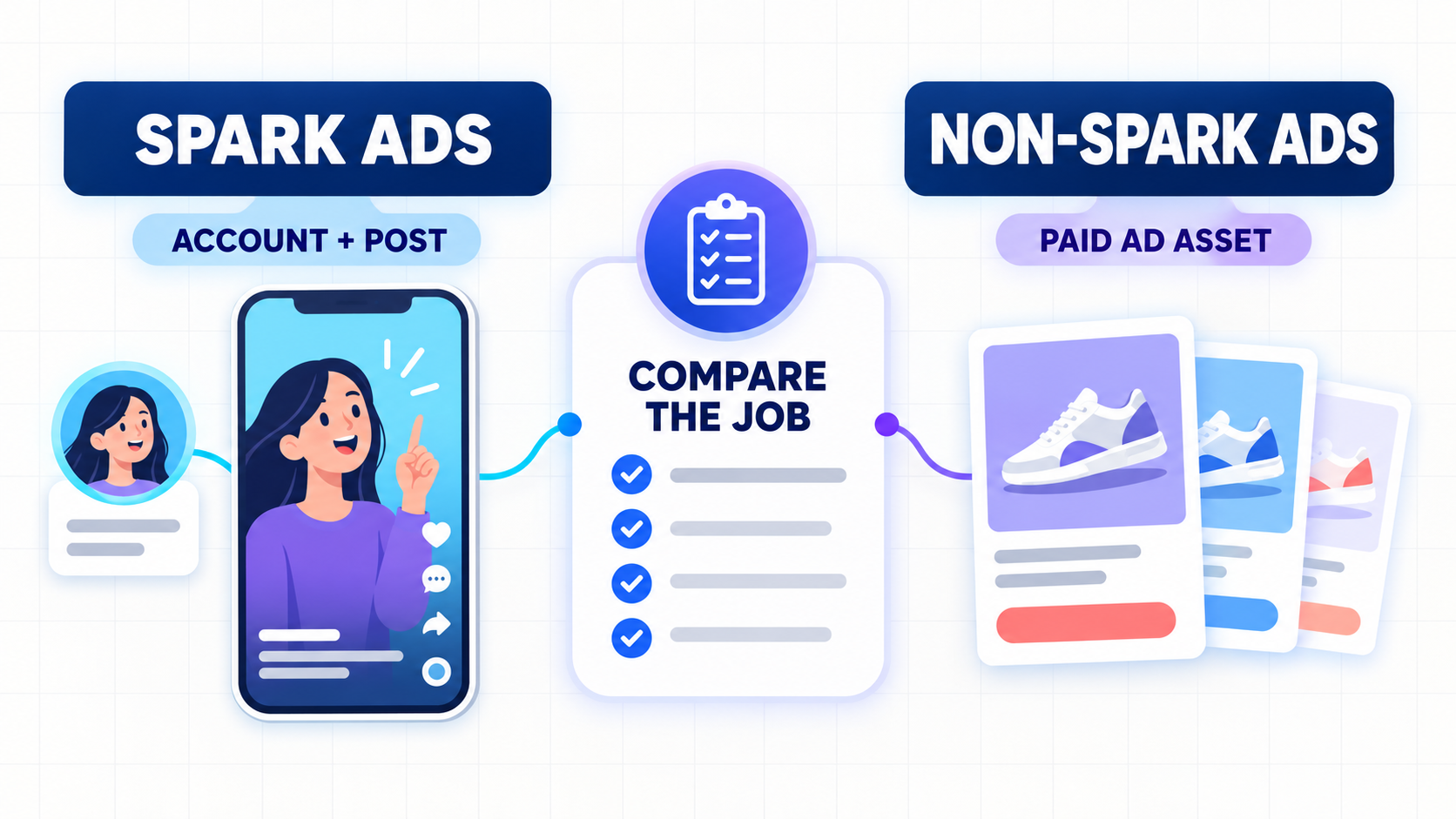

The best TikTok Shop product research tool depends on the decision you need to make.
In our test, Navos TTS Product Scout was best for AI-guided product decisions, FastMoss exposed the deepest product-level TikTok Shop data, TikTok Creative Center was the best free official starting point, PiPiADS was strongest for ad and creative validation, and Minea was most useful when the research needed to extend beyond TikTok.
That distinction matters because finding a product with sales is not the same as finding a product worth entering. Navos stood out by converting market signals into a structured entry verdict, differentiation strategy, risk review and seven-day validation plan.
To make the comparison practical, we used the same question across the tools:
Is a portable neck fan still an attractive product for a new seller in the United States, or is the category already saturated?
We tested the exact query
portable neck fan where the product supported keyword search, recorded what a logged-in or public user could actually access, and separated first-hand observations from platform claims.The short answer: demand is real, but a generic neck fan is a crowded offer. The opportunity is in a differentiated product, a clearer use case and a better content angle—not in copying the current best seller.
The Best TikTok Shop Product Research Tools at a Glance
Tool | Best for | What we verified | Access or pricing observed | Main trade-off |
Navos TTS Product Scout | AI-guided product decisions | An eight-minute report with a TEST verdict, positioning, risks, unit economics and a seven-day validation plan | Usage-based credits; this report used 4,536 credits, worth about $4.31–$4.51 at the displayed top-up rates | It synthesizes a decision rather than offering the largest raw-data table |
FastMoss | Deep TikTok Shop data | Relevant US products, seven-day sales and GMV, shops, affiliates, videos, LIVE sessions and product details | Annual plans shown from $47/month, billed yearly | The most useful detail and longer trend windows can require a paid plan |
TikTok Creative Center | Free official trend and creative research | Official access to trends, keywords, products and high-performing ad examples | Free and public; login optional for additional personalization | It is not a complete TikTok Shop sales, GMV or seller database |
PiPiADS | Ad and creative validation | Detailed ad filters, a limited historical sample and eight visible TTS Product rows in the free account | Monthly plans shown from $49; deeper access was gated | Free access was insufficient for a complete US 30-day product verdict |
Minea | Cross-platform product validation | Product, shop and TikTok ad workflows in a logged-in account | Monthly plans shown from $49 | Exact-query relevance was weak in our limited-access test, and useful TikTok detail was paid |
There is no universal winner because these tools solve different parts of product research. A raw-data platform can reveal what is selling, but it may still leave you to decide whether the apparent winner is seasonal, saturated, defensible or profitable.
How We Tested These Tools
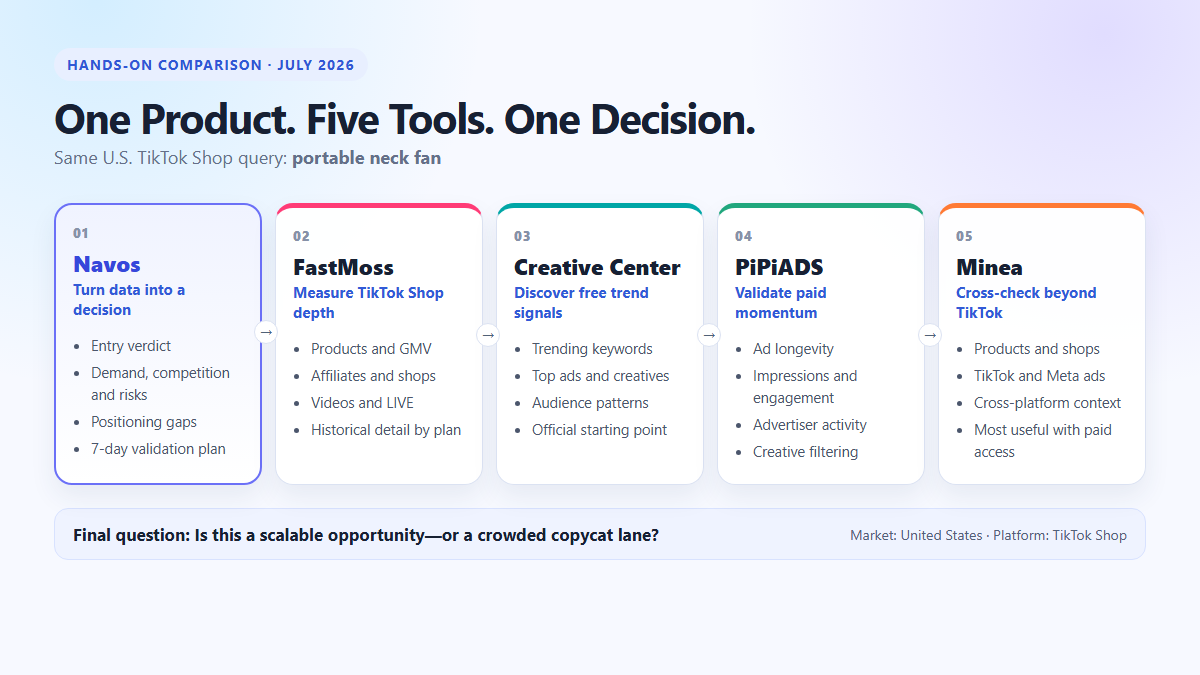
We used a repeatable research setup:
- Target market: United States
- Commerce context: TikTok Shop
- Product query:
portable neck fan
- Test date: July 28, 2026
- Preferred research window: the latest complete 30 days, compared with the previous 30 days where accessible
- Decision question: Is the product still gaining momentum, and is there enough room for a differentiated new entrant?
We evaluated each tool on nine practical dimensions:
- Trend discovery
- TikTok Shop data depth
- Competition and saturation analysis
- Product, shop, creator and creative coverage
- Source transparency
- Time to a useful insight
- Decision support
- Ease of use
- Pricing and value
This was not a laboratory benchmark of every paid feature. FastMoss was tested with accessible product and detail data. Navos produced a complete report. PiPiADS and Minea were tested through logged-in, limited-access accounts. TikTok Creative Center was assessed from its current official public research surfaces and documentation.
Prices and access rules change, so confirm the live plan page before buying. More importantly, treat every third-party sales or GMV figure as a platform estimate unless the tool explicitly proves otherwise.
For a broader comparison of research methods and evidence sources, see our guide to the best AI tools for market research.
1. Navos TTS Product Scout — Best for AI-Guided Product Decisions
Navos is the best fit when the research question is not simply “What is selling?” but “Should we enter, what should we sell, and what needs to be validated first?”
What happened in our test
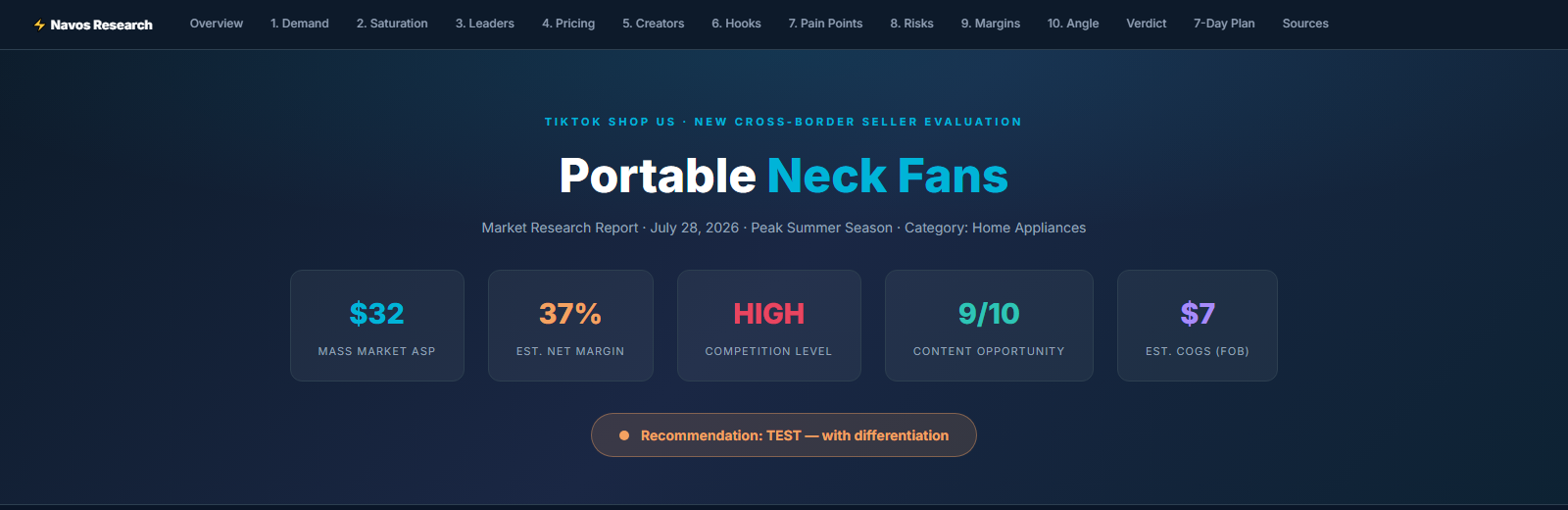
Navos generated a full portable-neck-fan research report in approximately eight minutes. The output did not stop at a list of products or a market-size paragraph. It covered:
- demand and seasonal timing;
- growth versus saturation;
- product and price tiers;
- shop, creator, video and livestream signals;
- customer pain points;
- feature and positioning gaps;
- logistics, return, compliance and IP risks;
- wholesale cost and unit economics;
- content hooks and demonstration formats;
- a final
TESTverdict;
- a seven-day validation plan with scale, pivot and exit criteria.
The report’s conclusion was more useful than a generic “winning product” label. It found that the commodity tier was already crowded and proposed a more defensible angle: a quieter fan with an honest battery-performance promise, adjustable fit and a stronger replacement guarantee. It also identified a potential premium gap for thermoelectric cooling.
You can review the portable neck fan research report used in this comparison.
Why Navos stood out
Navos stood out because it did not stop at raw product signals. It connected demand, saturation, customer pain points, unit economics, and risk to a concrete entry recommendation.
The report separated public signals, estimates and AI inference, then linked the evidence to a specific recommendation. That is valuable for operators who do not want to spend hours moving between spreadsheets, ad libraries, product pages and note-taking tools before reaching a usable conclusion.
In supported workflows, Navos can combine official TikTok data connections with public evidence and AI analysis. This specific report did not present unconfirmed live sales or GMV as verified API data; it labeled directional fields so that they could be checked before an inventory decision.
Navos is especially helpful for:
- founders and small ecommerce teams;
- cross-border sellers evaluating a new category;
- product marketers who need a positioning brief;
- teams that need risks and next steps documented, not just data exported;
- users who want to turn research into a test plan quickly.
Pricing and value
The report used 4,536 credits. Based on the credit packs displayed during our test, that represented approximately:
- $4.31 at $19 for 20,000 credits;
- $4.45 at $49 for 50,000 credits;
- $4.51 at $199 for 200,000 credits.
This is a usage-based estimate, not a monthly subscription price, and complex tasks may consume different amounts. It is also not an apples-to-apples comparison with a recurring analytics platform: FastMoss is designed for repeated manual exploration, while Navos is designed to compress analysis into a decision-ready artifact.
Limitation
Navos should not be presented as the largest TikTok Shop database. In this run, some live TikTok Shop performance fields were directional rather than independently confirmed. Its strength is transparent synthesis, scenario analysis and action planning. For major inventory commitments, validate the most important sales, concentration and margin assumptions with specialized data tools and your own supplier economics.
Verdict: Choose Navos when you need an entry recommendation and validation plan, not just a product leaderboard.
2. FastMoss — Best for Deep TikTok Shop Data
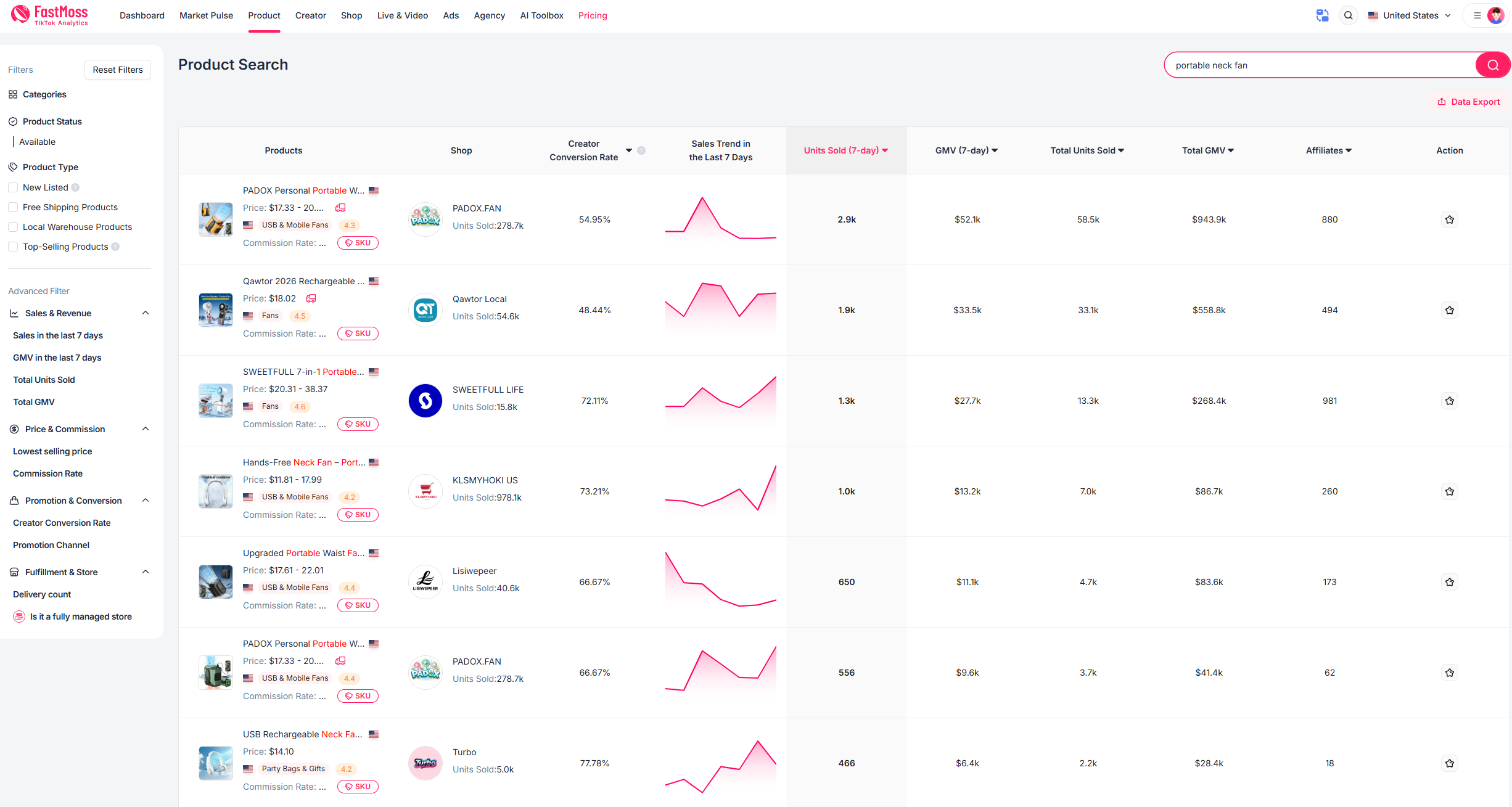
FastMoss produced the strongest directly usable TikTok Shop dataset in the same-product test.
The US search for
portable neck fan returned relevant products and exposed product, price, shop, seven-day trend, units sold, GMV, creator conversion rate and affiliate counts. The first five visible products displayed:Product | 7-day units | 7-day GMV | Total units | Total GMV | Affiliates |
PADOX portable fan | 2.9K | $52.1K | 58.5K | $943.9K | 880 |
Qawtor rechargeable fan | 1.9K | $33.5K | 33.1K | $558.8K | 494 |
SWEETFULL portable fan | 1.3K | $27.7K | 13.3K | $268.4K | 981 |
Hands-free neck fan | 1.0K | $13.2K | 7.0K | $86.7K | 260 |
Upgraded portable waist fan | 650 | $11.1K | 4.7K | $83.6K | 173 |
These are FastMoss-displayed figures captured on July 28, 2026, not audited TikTok Shop financial records.
What the product detail added
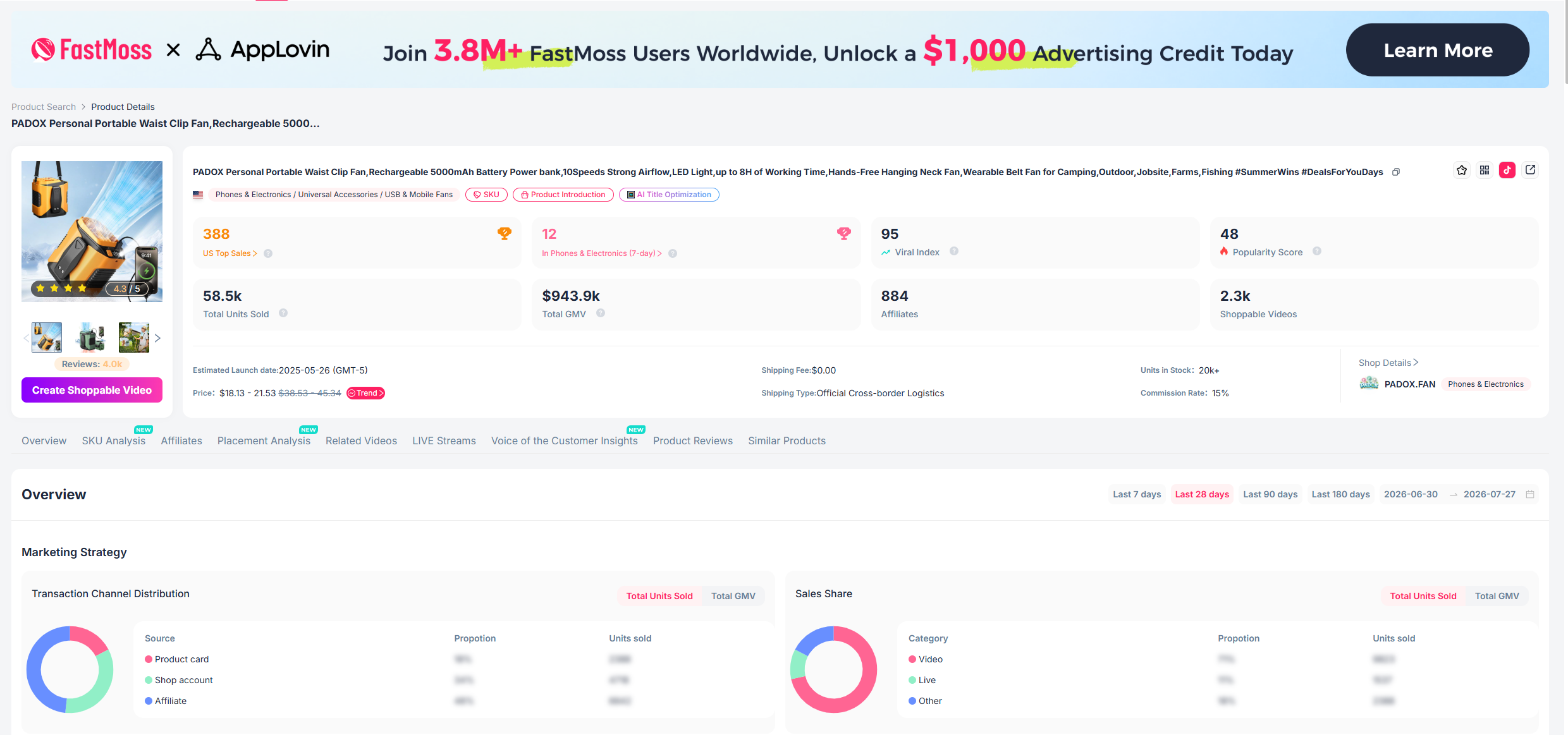
The leading PADOX listing also showed:
- 58.5K total units and $943.9K total GMV;
- about 884 affiliates;
- 2.3K shoppable videos;
- 4.0K reviews;
- 20K+ displayed stock;
- a 15% commission rate;
- a current displayed price of roughly $18.13–$21.53;
- a Viral Index of 95 and Popularity Score of 48.
FastMoss also exposed creator, related-video and LIVE evidence. The first visible affiliate showed 12.5K units and $170.6K GMV. The first fully visible related-video row showed 2.2K units in 28 days, 11.8M views and a 2.34 ROAS. The LIVE section listed 199 sessions in total.
This depth makes FastMoss useful for:
- shortlisting products and shops;
- reviewing price bands and recent sales;
- identifying creator and affiliate concentration;
- studying shoppable videos and LIVE activity;
- monitoring competitors after launch.
The important interpretation
The same data that proved demand also warned us about saturation.
A product supported by hundreds of affiliates, thousands of shoppable videos, thousands of reviews and almost two hundred LIVE sessions is not an untouched opportunity. A seller entering with the same form factor, the same claims and the same creative angle would face a mature content and distribution system.
Pricing and limitation
The annual-billing page we captured showed Basic at $47/month, Pro at $72/month and Ultimate at $91/month, billed yearly. The live FastMoss pricing page should be checked for current terms.
Some deeper 28-day trends, channel distributions and SKU panels were locked in our session. We therefore did not calculate a precise month-over-month growth rate.
Verdict: Choose FastMoss when you need the deepest hands-on TikTok Shop product, shop, creator, video and LIVE research of the five tools tested.
3. TikTok Creative Center — Best Free Research Tool
TikTok Creative Center is the best free official starting point for product themes, keywords and creative patterns.
TikTok describes Creative Center as a free public hub for trends, ad examples, best practices and creative tools. Its research surfaces include trending content, product inspiration, keyword insights and Top Ads. According to TikTok’s Top Ads documentation, users can filter high-performing authorized ads and inspect performance moments frame by frame.
Use Creative Center to answer questions such as:
- Is the product theme visible in current TikTok culture?
- Which keywords and hooks appear in ads?
- Which video structures attract attention?
- What does the first three seconds of a strong creative do?
- Which benefits are demonstrated rather than merely claimed?
For a portable neck fan, that means looking beyond the product name. Search for adjacent use cases such as commuting, outdoor work, travel, heat relief, running and hands-free cooling. Those themes can reveal better positioning and creative language than an exact product query alone.
Why it is not enough by itself
Creative Center is an inspiration and creative-research environment, not a complete TikTok Shop sales database. It does not replace product-level seller concentration, sales, GMV, affiliate, inventory or margin analysis.
Top Ads also contains advertiser-authorized creatives rather than every high-performing ad on TikTok. Treat it as a valuable sample, not a census of the platform.
Verdict: Start with TikTok Creative Center when the budget is zero or when you need an official view of trends and creative patterns. Pair it with a commerce-data tool before making an inventory decision.
4. PiPiADS — Best for Ad and Creative Validation
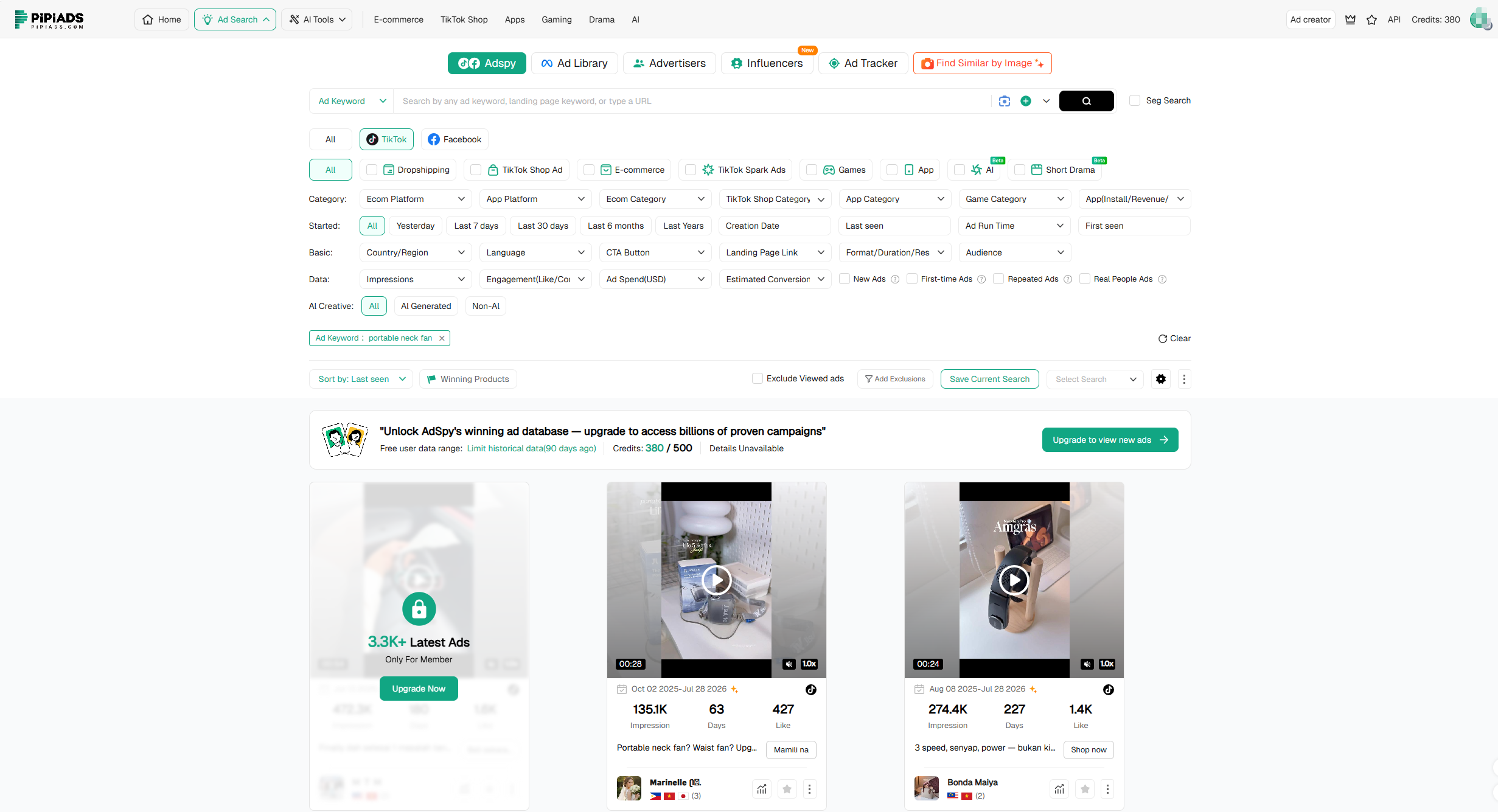
PiPiADS is built around ad discovery. Of the tools in this comparison, it exposed the most detailed ad-oriented filter set in our limited account.
The interface included filters for:
- TikTok Shop ads;
- country and language;
- creation date and run time;
- impressions and engagement;
- estimated ad spend and conversion;
- new, first-time and repeated ads;
- AI-generated versus non-AI creative;
- advertisers, influencers and ad tracking.
In a broad search, we could see historical portable-fan-related cards with visible impressions, duration and likes. We did not use those cards as US demand evidence because they were outside the unified US/English/latest-30-day filter.
When we applied the strict US, English and latest-30-day setup, the free result area showed no accessible relevant records while indicating that more recent ads were available to members. That result means the free sample was insufficient; it does not prove that no relevant ads existed.
PiPiADS also included a dedicated TTS Products area with product, sold, GMV, sales trend, ads, impressions/spend and influencer fields. The free account exposed eight rows before the upgrade boundary, but exact-query relevance was weak in that small sample.
Best use case
PiPiADS is most useful after you have a product hypothesis. Use it to examine:
- whether paid creatives keep running;
- how many advertisers are testing the angle;
- what hooks and demonstrations recur;
- whether the market relies on one viral ad or many variations;
- which creators and advertisers are associated with the product.
Pricing and limitation
The pricing screen captured during testing showed monthly plans starting at $49, with an Advanced plan at $99. Because PiPiADS relies heavily on dynamic member access, confirm the current PiPiADS pricing page and feature limits before subscribing.
Verdict: Choose PiPiADS when ad longevity, creative patterns and paid validation matter more than a complete product-selection workflow.
5. Minea — Best for Cross-Platform Product Validation
Minea is broader than a TikTok Shop-only tool. Its logged-in interface covers products, shops, Meta ads, TikTok ads, tracking and AI-assisted ad analysis.
That cross-platform scope is useful when the product may be validated through several channels. A seller can use Minea to ask whether a product angle appears only on TikTok or is also gaining traction across paid social and independent ecommerce stores.
What happened in our test
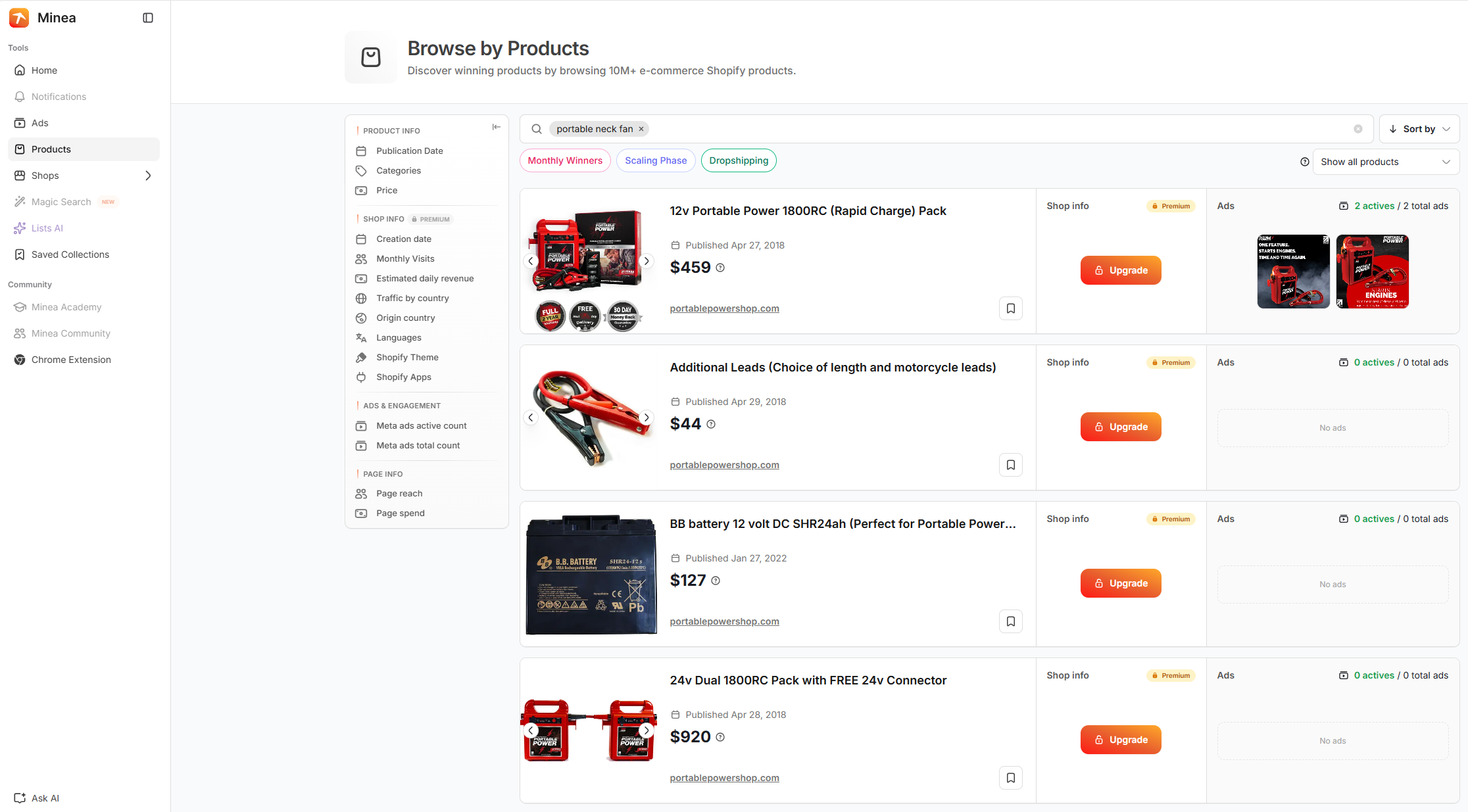
The exact
portable neck fan query in Browse by Products returned portable power products and batteries rather than neck fans. Basic product information was visible, but deeper shop and ad intelligence required an upgrade.The TikTok Ads workflow accepted the query, yet useful result cards were also gated in the tested account. As a result, Minea did not complete the same US TikTok Shop product verdict under limited access.
That does not make Minea a poor platform. It means its value is difficult to judge from the free experience, and its broader product database did not match this exact phrase well in our session.
Pricing
Minea’s current pricing page showed:
- Starter: $49/month;
- Premium: $99/month;
- Business: $199/month.
Quarterly discounts were also displayed. Check which plan includes the TikTok datasets and usage limits needed for your workflow.
Verdict: Choose Minea when cross-platform product and ad validation is more important than TikTok Shop-specific depth. Test exact-query relevance before committing to a plan.
Same Product, Five Different Results
The unified test demonstrated why a single “best tool” answer is misleading.
Tool | What it told us about portable neck fans |
Do not enter the commodity tier with a generic offer. Test a quieter, better-positioned product with honest battery claims and clear validation criteria. | |
FastMoss | The category has meaningful displayed sales and extensive creator, video and LIVE activity—but also heavy competitive and content saturation. |
TikTok Creative Center | Use official trend, keyword and ad inspiration to validate the language, hooks and demonstrations around the product theme. |
PiPiADS | The workflow is suited to ad and creative validation, but the limited account did not expose enough current US data for a standalone verdict. |
Minea | Cross-platform validation is possible, but the accessible exact-query results were weak and meaningful TikTok detail required paid access. |
FastMoss and Navos were the most complementary pair.
- FastMoss answered: What products, shops, creators and content are performing?
- Navos answered: Is the entry attractive, where is the gap, what could go wrong and what should we test next?
That distinction matters because a high-sales product can still be a bad product for a new seller.
Trending Product or Saturated Product?
A trending product shows current demand. A viable product opportunity shows current demand plus room for a new entrant to win.
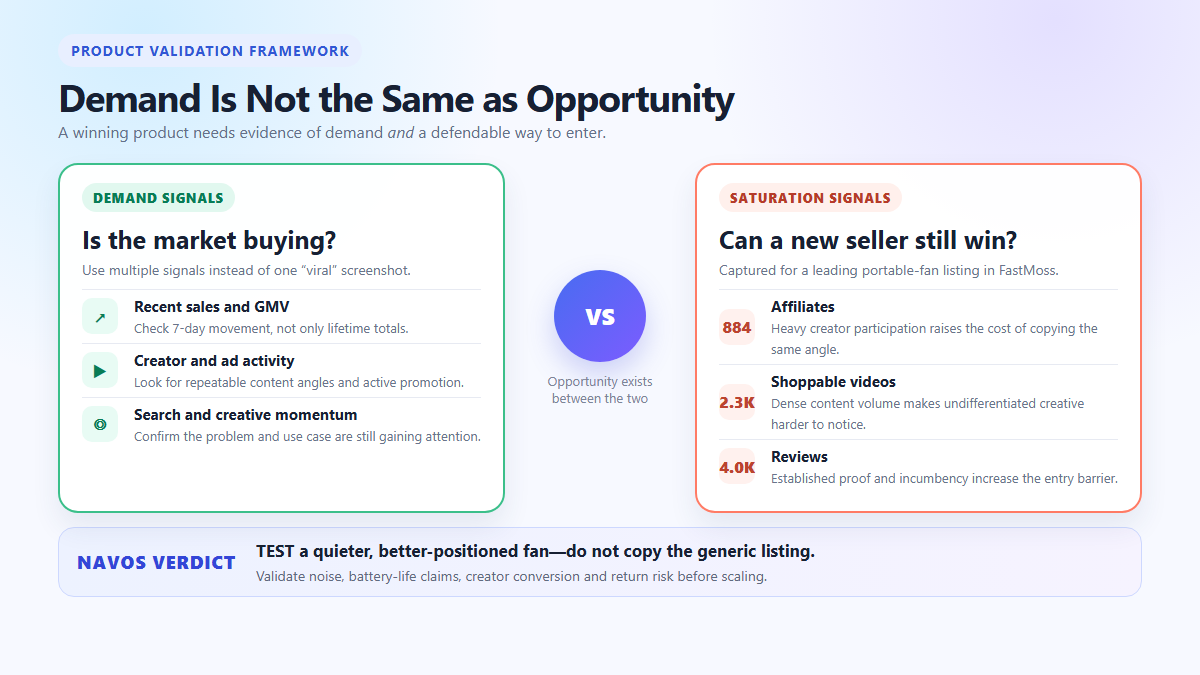
Use the following checks before calling anything a winning product:
1. Compare recent performance with lifetime performance
Lifetime GMV can hide a decline. Prioritize seven-day or 30-day movement, new listings, recent creator activity and current ad velocity.
2. Measure seller and creator concentration
If one shop or one creator drives most of the result, the opportunity may depend on an advantage you cannot copy. If hundreds of affiliates already promote the same listing, the category may be easy to discover but hard to enter.
3. Count the content burden
Thousands of shoppable videos and active LIVE sessions indicate a working content engine. They also raise the amount of creative production required to compete.
4. Look for a specific customer problem
“Portable cooling” is broad. “A quiet fan for commuting,” “hands-free cooling for outdoor workers,” and “a neck fan that does not exaggerate battery life” are more defensible.
5. Rebuild the economics
Do not rely on displayed GMV. Add product cost, freight, platform fees, affiliate commission, returns, replacements, discounts and paid-media costs. A popular product with fragile margins is not a winning product.
6. Run a limited validation
Test a small inventory batch, several hooks and multiple creators before scaling. Decide the success, pivot and exit thresholds in advance.
For the portable neck fan, our conclusion was:
The market is active, but the generic offer is saturated. A differentiated product may justify a controlled test; a copycat launch does not.
Which TikTok Shop Product Research Tool Should You Choose?
Choose based on your main bottleneck:
- Choose Navos if you need a structured recommendation, differentiation angle, risk review and test plan.
- Choose FastMoss if you need detailed TikTok Shop product, shop, creator, video and LIVE data.
- Choose TikTok Creative Center if you need a free official source for trends, keywords and creative inspiration.
- Choose PiPiADS if your main question is whether ad creatives and advertisers are sustaining paid momentum.
- Choose Minea if you want to compare product and ad signals across TikTok, Meta and independent ecommerce stores.
If you can use only one paid tool, choose the tool that matches the decision you make most often. A high-volume product researcher may benefit most from FastMoss. A founder making occasional category-entry decisions may get more value from a usage-based Navos report.
The Recommended Product Research Workflow
The strongest workflow combines official signals, specialized data and decision support.
Step 1: Frame the decision
Define the market, product, time window, customer and decision threshold. Avoid prompts such as “Find a winning product.” Ask whether a specific category is growing, saturated and economically viable for a specific seller.
Step 2: Scan official trend and creative signals
Use TikTok Creative Center to examine trend language, keywords, hooks and ad formats. Save the patterns that appear repeatedly.
Step 3: Validate product-level performance
Use FastMoss to inspect recent sales, GMV, shops, creators, affiliates, videos and LIVE activity. Separate recent momentum from lifetime totals.
Map direct, indirect and search competitors before assuming the leading listing is the only benchmark. Our competitor research guide provides a repeatable framework.
Step 4: Validate paid creative
Use PiPiADS to review ad longevity, creative repetition, advertiser density and regional variations. Use Minea if cross-platform evidence is important.
Step 5: Turn evidence into a decision
Use Navos to synthesize the market evidence, identify a defendable product angle, model the risks and create a validation plan.
Run product research with Navos to turn a broad category question into a structured action brief.
Step 6: Validate with a controlled market test
No research tool can prove future product-market fit. Confirm the final decision with supplier quotes, samples, compliance checks, creator outreach, limited inventory and real conversion data.
Frequently Asked Questions
What is the best TikTok Shop product research tool in 2026?
FastMoss was the strongest for deep TikTok Shop data in our test. Navos was strongest for converting evidence into an entry decision and validation plan. TikTok Creative Center was the best free official starting point.
Is there a free TikTok Shop product research tool?
TikTok Creative Center is free and public. It is useful for trends, keywords, products and creative inspiration, but it does not replace product-level sales, GMV, seller and saturation analysis.
How accurate are TikTok Shop analytics tools?
Accuracy varies by source and metric. Treat third-party sales and GMV as estimates unless independently verified. Use several signals, check capture dates and validate major inventory decisions with actual supplier and store data.
Can a tool find guaranteed winning products?
No. A tool can reveal demand, momentum, competition and content patterns. It cannot guarantee margin, product quality, creator fit, compliance or future demand. “Winning product” should mean a product that passes a controlled validation process, not one with a high historical GMV.
What metrics matter most for TikTok Shop product research?
Prioritize recent units and GMV, growth direction, seller concentration, creator and affiliate concentration, price and commission, content volume, ad longevity, reviews, return risk, logistics and contribution margin.
Should I use more than one tool?
Usually, yes. One tool rarely covers official trends, sales, creators, ads, cross-platform evidence and decision planning equally well. A practical stack is TikTok Creative Center for free trend research, FastMoss for commerce data, PiPiADS for ads and Navos for synthesis.
How do I know whether a trending product is already saturated?
Compare recent growth with the number and concentration of sellers, affiliates, shoppable videos, LIVE sessions and ads. Strong demand combined with dense competition and no clear customer or feature gap usually indicates saturation.
Final Verdict
The five tools serve different jobs:
- Navos TTS Product Scout: best for AI-guided product decisions
- FastMoss: best for deep TikTok Shop data
- TikTok Creative Center: best free official research tool
- PiPiADS: best for ad and creative validation
- Minea: best for cross-platform validation
For the portable neck fan, the evidence did not support a broad “go” decision. It supported a controlled test of a differentiated offer.
That is the standard a useful TikTok Shop product research workflow should meet. It should not merely show what sold yesterday. It should help you understand why it sold, whether the advantage is repeatable, how crowded the opportunity is and what evidence you need before risking inventory.
Turn product data into a decision. Download Navos for Windows or macOS from the official website, open the desktop app, and use TTS Product Scout to evaluate demand, saturation, positioning, risks, and the next validation steps for your TikTok Shop product idea.