
The best AI tool for market research depends on the evidence you need. Qualtrics and quantilope support structured consumer studies. Similarweb and Semrush analyze digital demand and competitors. Brandwatch focuses on public conversations, Browse AI collects custom web data, and ChatGPT supports exploratory synthesis. Navos General Market Insight turns a market question into a structured action brief.
There is no universal winner: survey data, modeled traffic, social posts, website behavior, and AI synthesis answer different questions. Start with the research decision, then choose the evidence source.
Editorial note: We reviewed this comparison on July 20, 2026 using official product documentation and tested Navos hands-on in its current desktop client. We did not run a standardized test of all ten products. Verify current features, access, and pricing before buying.
Some entries are specialist research or data platforms rather than general-purpose AI assistants. The numbered order supports readability, not a universal ranking.
AI Market Research Tools at a Glance
Tool | Best for | Main evidence source | Pricing / access | Main limitation |
Navos — General Market Insight | Connecting a market-research question to a structured marketing action brief | Sources vary by run and are disclosed in the report’s source appendix, including unavailable and inferred evidence | Download Navos for Windows or macOS, then open the Skill in the desktop app | Some conclusions use proxy data or AI inference when direct sources are unavailable |
Qualtrics | Enterprise market, product, UX, and brand research | Human panels, synthetic respondents, customer data, and structured studies | Request a demo | More platform than many small teams need |
quantilope | Automated quantitative and qualitative research methods | Survey responses and consumer panels | Contact sales | Designed for structured research, not broad web intelligence |
Similarweb | Digital market size, demand, audience, and competitor behavior | Direct measurement plus modeled digital data | Try for free / sales-led plans | Estimates digital behavior; it does not replace primary consumer research |
Semrush Traffic & Market | Competitor traffic, channels, audiences, and market dynamics | Modeled website and digital market data | Paid app; public page listed $289/month when reviewed | Strongest for digital competition, not survey or qualitative research |
Brandwatch | Social listening, brand perception, and online consumer conversations | Public online conversations plus uploaded first-party data | Request a demo | Online conversations can overrepresent vocal or highly active users |
Crayon | Always-on B2B competitive intelligence and sales enablement | Competitor websites, news, reviews, internal sales and deal data | Request a demo | Built for competitive programs, not general consumer research |
Browse AI | Collecting and monitoring custom web data | Websites selected by the user | Self-serve signup and enterprise services | Collects data but does not provide a complete research methodology or analysis layer |
Hotjar | Understanding behavior and feedback on your own website | Heatmaps, recordings, surveys, and feedback from owned traffic | Self-serve plans | Describes your site visitors, not the whole market |
ChatGPT | Fast desk research, source discovery, and synthesis | Public web sources, uploaded files, and connected sources when enabled | Free and paid plans; usage limits vary | Can be wrong or miss evidence; it is not a proprietary market dataset |
How We Chose These Tools
We evaluated each tool against four questions:
- What job does it do? Survey research, competitor tracking, demand analysis, web collection, or synthesis should be clearly defined.
- Where does the evidence come from? Panels, first-party data, modeled traffic, public websites, social posts, and synthetic data have different biases.
- Can you audit the method? Important claims should be traceable to sources, samples, dates, or collection rules.
- Can the output support a decision? A useful tool should clarify the next choice or test—and its own limitations.
Most teams need more than one evidence source. One tool may collect responses, another monitor competitors, and a third synthesize the decision.
If you are still defining the process, start with what market research is and this practical guide to competitor research.
1. Navos General Market Insight — Best for Turning a Market Question Into a Structured Action Brief
We tested the General Market Insight Skill in the current Navos PC client on July 20, 2026. The question was practical: should a new cross-border seller enter the U.S. TikTok Shop pet-supplies market, and which subcategories deserve further testing? We did not use the discontinued Navos web 1.0 product.
What we asked Navos to do
We asked the Skill to compare the latest complete 90-day period with the previous 90 days for U.S. Pet Supplies. The brief requested subcategory rankings, products and brands, price bands, demand signals, pain points, competitive gaps, opportunities, risks, confidence levels, and sources.
Navos mapped the request to its Pet Supplies category and generated a structured report rather than a single chat response.
What the report produced
The generated report combined an entry verdict, market context, a subcategory scorecard, competitor and price tables, consumer insights, channel recommendations, risks, opportunity cards, and a source appendix showing which data sources were retrieved, unavailable, or inferred.
The report rated its confidence as B, meaning it used multiple sources but still had evidence gaps. It drew on APPA data, Amazon taxonomy, an internal Navos GMV Max benchmark, public sources, and AI inference, while disclosing failed or unavailable sources.
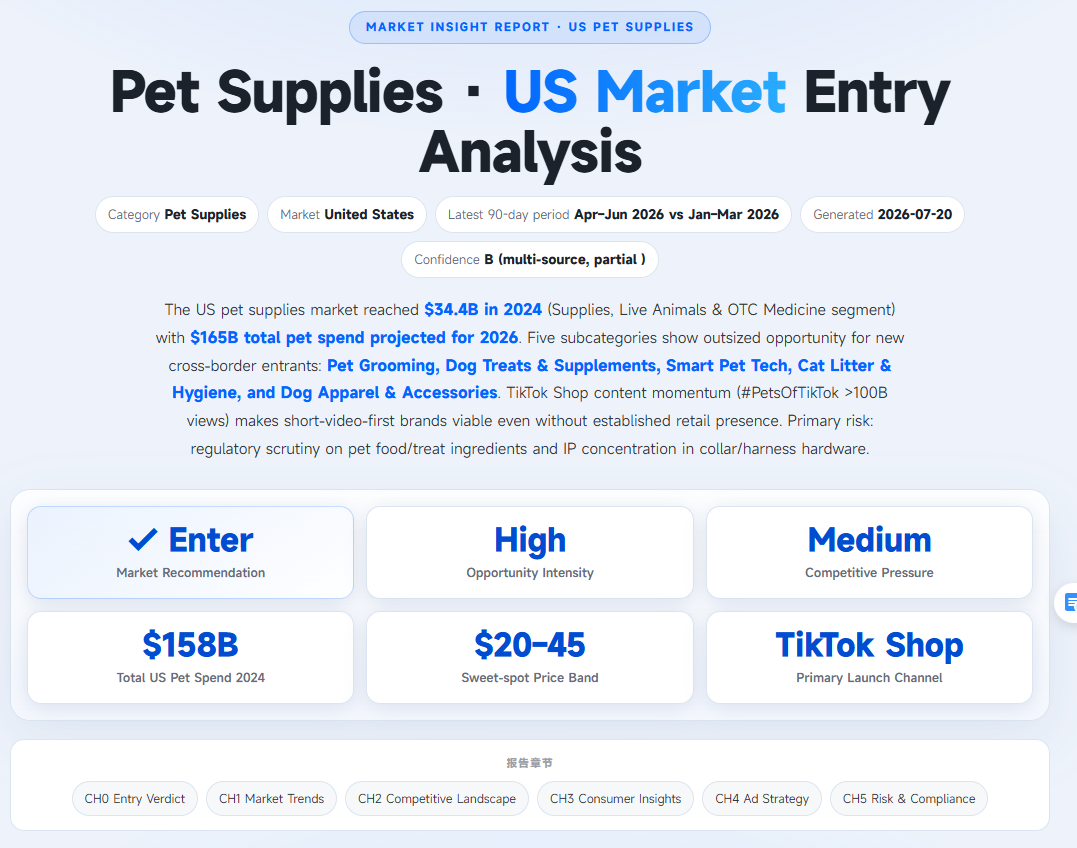
The desktop Skill generated a structured report and displayed its confidence level. Our human review corrected the cover's $158B year: APPA reports that figure for 2025, not 2024.
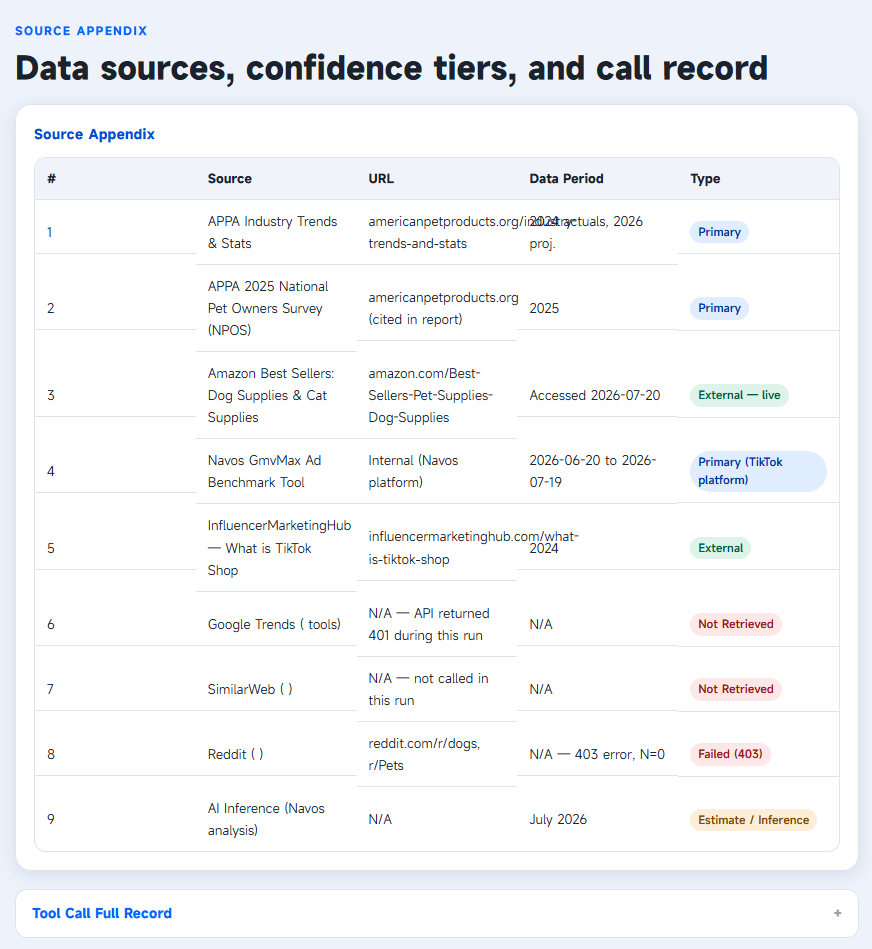
The source appendix makes successful, failed, unavailable, and inferred evidence visible for human review.
What worked well in our test
The strongest feature was evidence transparency. The report separated primary, external, failed, not-retrieved, and AI-inference sources. When Reddit returned HTTP 403 and no review corpus was available, it marked customer pain points Data not available. It also disclosed that Google Trends was not retrieved, Similarweb was not invoked, no TikTok ad account was connected, and direct TikTok Shop sales data were unconfirmed.
What required human correction
The report was useful as a hypothesis generator, but it was not ready to support a launch decision without review.
First, it mislabeled APPA's
$158 billion U.S. pet-industry expenditure figure as 2024. APPA reports that the market reached $158 billion in 2025 and projects $165 billion for 2026. The same year correction applies to the report's $34.4 billion supplies-segment figure.Second, several subcategory-growth labels and price bands were based on Amazon taxonomy, public market context, and AI inference—not measured changes in TikTok Shop GMV. The three launch ideas should therefore be called opportunity hypotheses, not “validated opportunities.”
Third, the internal GMV Max benchmark used adjacent industry proxies rather than pet-supplies data. It can demonstrate that Navos connected an internal tool, but it should not be used to justify a pet-supplies budget allocation without the metric definitions, sample, market coverage, and category-level evidence.
Our verdict
Navos turns a broad question into a reviewable research brief with sources, missing data, hypotheses, risks, and next actions. It works best for first-pass decision framing; a human must still verify facts and replace proxy evidence before investing.
Best for: Growth, ecommerce, and product-marketing teams that need a reviewable market-research brief and a clear next-test plan.
Try the workflow: Download Navos for Windows or macOS, then open the General Market Insight Skill in the desktop app.
2. Qualtrics — Best for Enterprise Research Programs
Qualtrics Market Research combines market, product, UX, brand, and audience research. Its documentation covers human panels, synthetic respondents, customer data, qualitative and quantitative studies, and methods such as conjoint and MaxDiff.
It fits organizations that run research repeatedly and need shared methods, participant management, governance, analysis, and an institutional archive. AI assists with study design, analysis, synthesis, and retrieval of past work.
Key strengths: Advanced research methods, enterprise governance, human and synthetic research options, and a centralized knowledge base.
The platform may be excessive for a small team running a one-off scan. Synthetic responses can support early exploration, but important decisions may still need validation with real customers or human panels.
Best for: Enterprise research and insights teams that need a governed, repeatable research system.
3. quantilope — Best for Automated Advanced Research Methods
quantilope automates structured consumer research, including study setup, data cleaning, analysis, charting, tracking, and advanced methods. Teams can use it for concepts, pricing, brand tracking, preference measurement, or segmentation without building every analytical step manually.
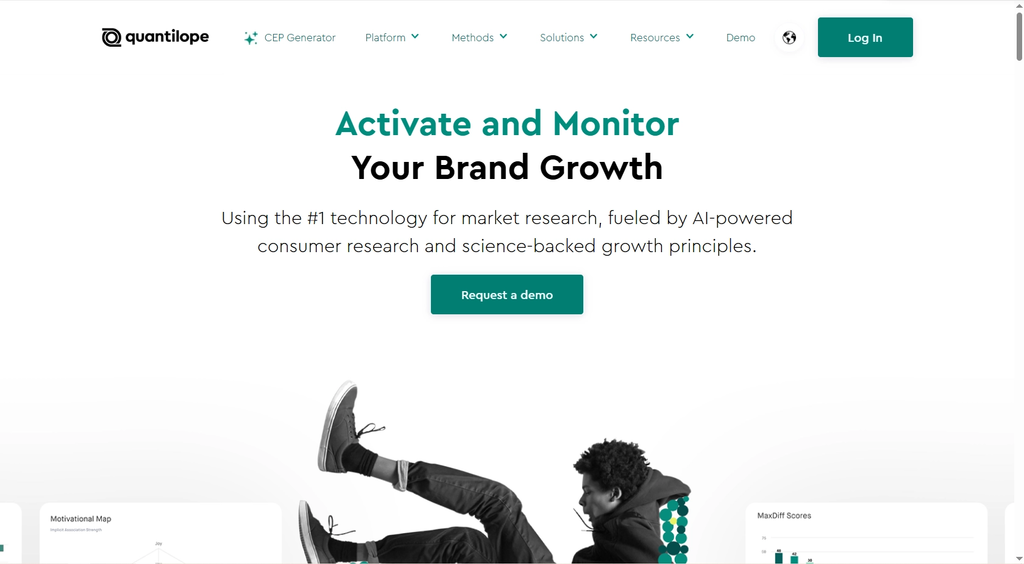
Key strengths: Automated advanced methods, live survey results, consumer-panel access, and one workflow from study setup to reporting.
It is designed for survey and panel research, not web traffic intelligence, social listening, or continuous competitor monitoring. Public pricing is not listed; the pricing page directs buyers to contact sales.
Best for: Research and insights teams that want advanced methods without a heavily manual workflow.
4. Similarweb — Best for Digital Market and Audience Intelligence
Similarweb Market Intelligence analyzes digital market size, demand, competitors, geography, audiences, and trends. It is most useful when a category is visible through websites, apps, search, referrals, or audience overlap.
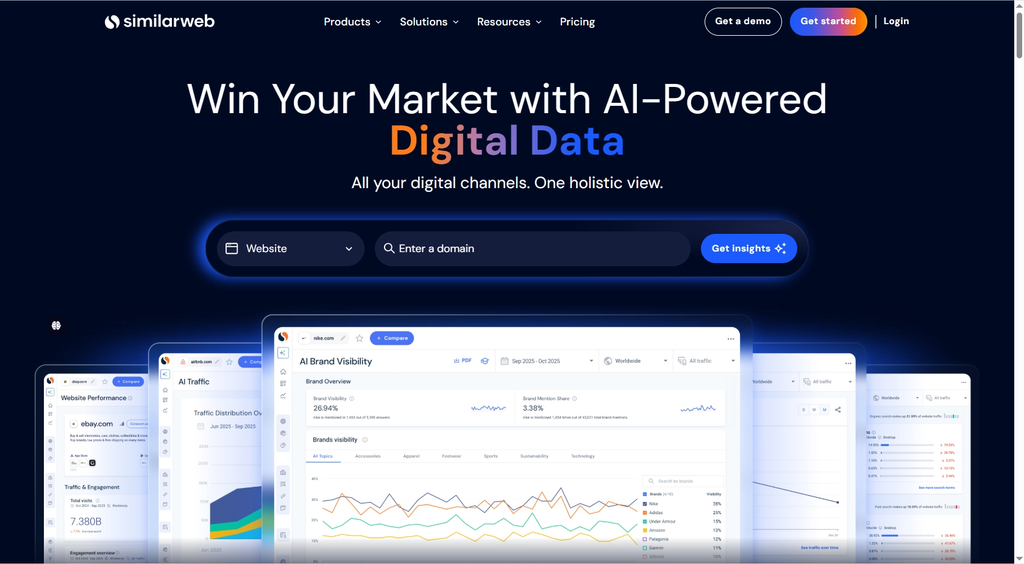
Key strengths: Competitor traffic benchmarking, geographic comparisons, audience overlap, demand trends, and category monitoring.
Teams can compare regions, identify rising competitors, and estimate how users move across a digital category. Similarweb combines direct measurement with modeled data, so competitor figures are estimates—not exact analytics. It also cannot explain offline behavior or why customers make a decision.
Best for: Strategy and growth teams evaluating digital categories, competitors, audiences, and regions.
5. Semrush Traffic & Market — Best for Competitor Traffic and Channel Analysis
Semrush Traffic & Market combines competitor traffic estimates, audience insights, benchmarking, and market trends across organic, paid, referral, social, email, and display channels.
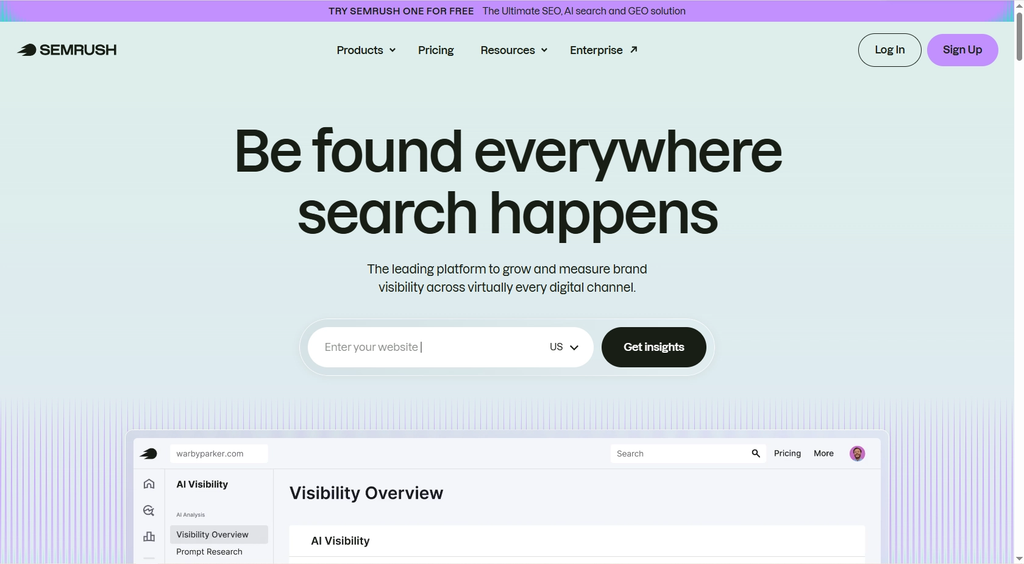
Key strengths: Multi-domain benchmarking, traffic-channel comparisons, audience analysis, and a close connection to SEO and content workflows.
It fits acquisition questions: Which competitor is gaining traffic? Which channels and pages drive growth? Where do audiences overlap? The estimates do not reveal exact conversions, revenue, satisfaction, or offline performance, so use them as one evidence layer rather than a complete study. The official app page listed $289 per month on July 20, 2026; verify current pricing before purchase.
Best for: SEO, content, growth, and competitive-research teams focused on digital acquisition.
6. Brandwatch — Best for Social Listening and Consumer Conversations
Brandwatch Consumer Research analyzes public online conversations and uploaded first-party data. Its AI features support insight generation, image analysis, classifiers, alerts, and reporting.
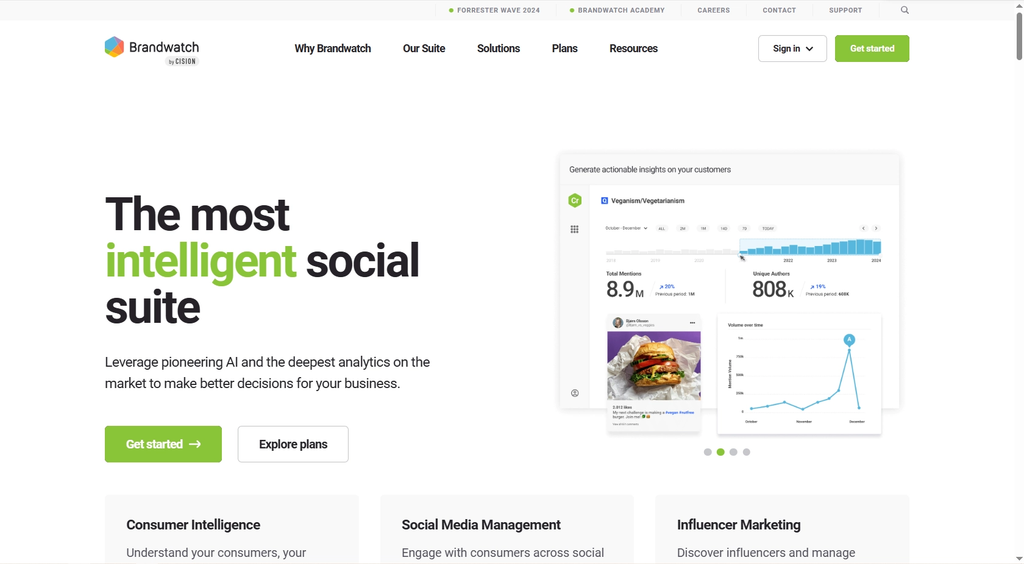
Key strengths: Social listening, trend detection, image analysis, custom classification, alerts, and first-party data enrichment.
It fits questions about brand perception, complaints, emerging topics, campaign reactions, cultural trends, and reputation risk. Public conversation is not representative of the whole market: active users, extreme opinions, platform demographics, spam, and private discussions can distort the picture. Validate important findings with sales, survey, behavioral, or customer data.
Best for: Brand, communications, consumer-insights, and social teams studying public conversation.
7. Crayon — Best for Continuous B2B Competitive Intelligence
Crayon monitors competitor websites, pricing, news, reviews, and support content, then combines those signals with internal deal and sales information. It can summarize important changes and distribute them through battlecards, alerts, newsletters, and sales plays.
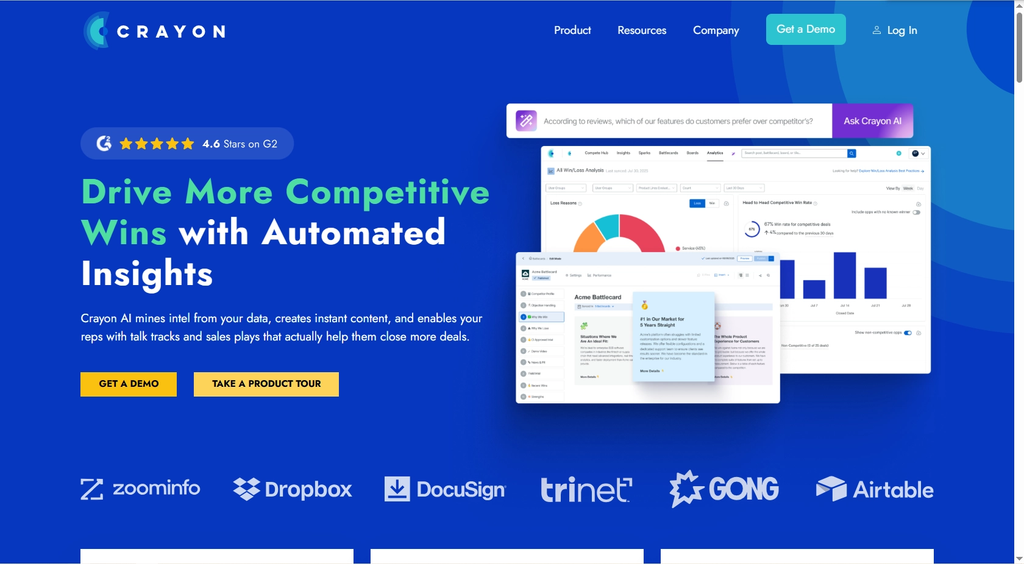
Key strengths: Continuous monitoring, AI summaries, importance scoring, battlecards, and connections between market signals and sales evidence.
Crayon fits an ongoing B2B competitive program better than a one-time market report. It does not replace consumer panels, market sizing, or general research, and its buying path is sales-led.
Best for: B2B product marketing, competitive intelligence, and sales-enablement teams.
8. Browse AI — Best for Collecting Custom Web Data Without Code
Browse AI turns websites into structured datasets through point-and-click extraction and monitoring. Users can schedule collection, track changes, and export results to spreadsheets, APIs, webhooks, or other apps.
Key strengths: No-code extraction, scheduled monitoring, change alerts, structured exports, and support for multi-page workflows.
It is useful when public information—such as prices, listings, reviews, jobs, locations, or website changes—is not available as a ready-made dataset. Browse AI collects the data but does not prove the sample is representative or the conclusion is valid. Teams still own research design, quality checks, website terms, robots rules, privacy, copyright, and legal compliance.
Best for: Teams that need a repeatable custom web dataset but do not want to maintain scraper code.
9. Hotjar — Best for Website Behavior and Visitor Feedback
Hotjar combines heatmaps, session recordings, surveys, and feedback to show what visitors do and say on your website. Its AI survey analysis can classify sentiment, tag responses, and summarize open text.
Key strengths: Behavior and feedback in one view, page-level diagnosis, and AI-assisted analysis of open-ended survey responses.
Use it to find hesitation, confusing messages, abandonment points, and recurring feedback themes. The evidence comes from people who reached your site, so it does not represent the whole market, non-visitors, or competitor audiences. Privacy and consent settings also require careful implementation.
Best for: Product, UX, ecommerce, and conversion teams researching their existing website audience.
10. ChatGPT — Best for Exploratory, Source-Backed Desk Research
ChatGPT search and deep research can gather, compare, and synthesize public web information. Search fits quick factual questions; deep research supports multi-step, cited reports.
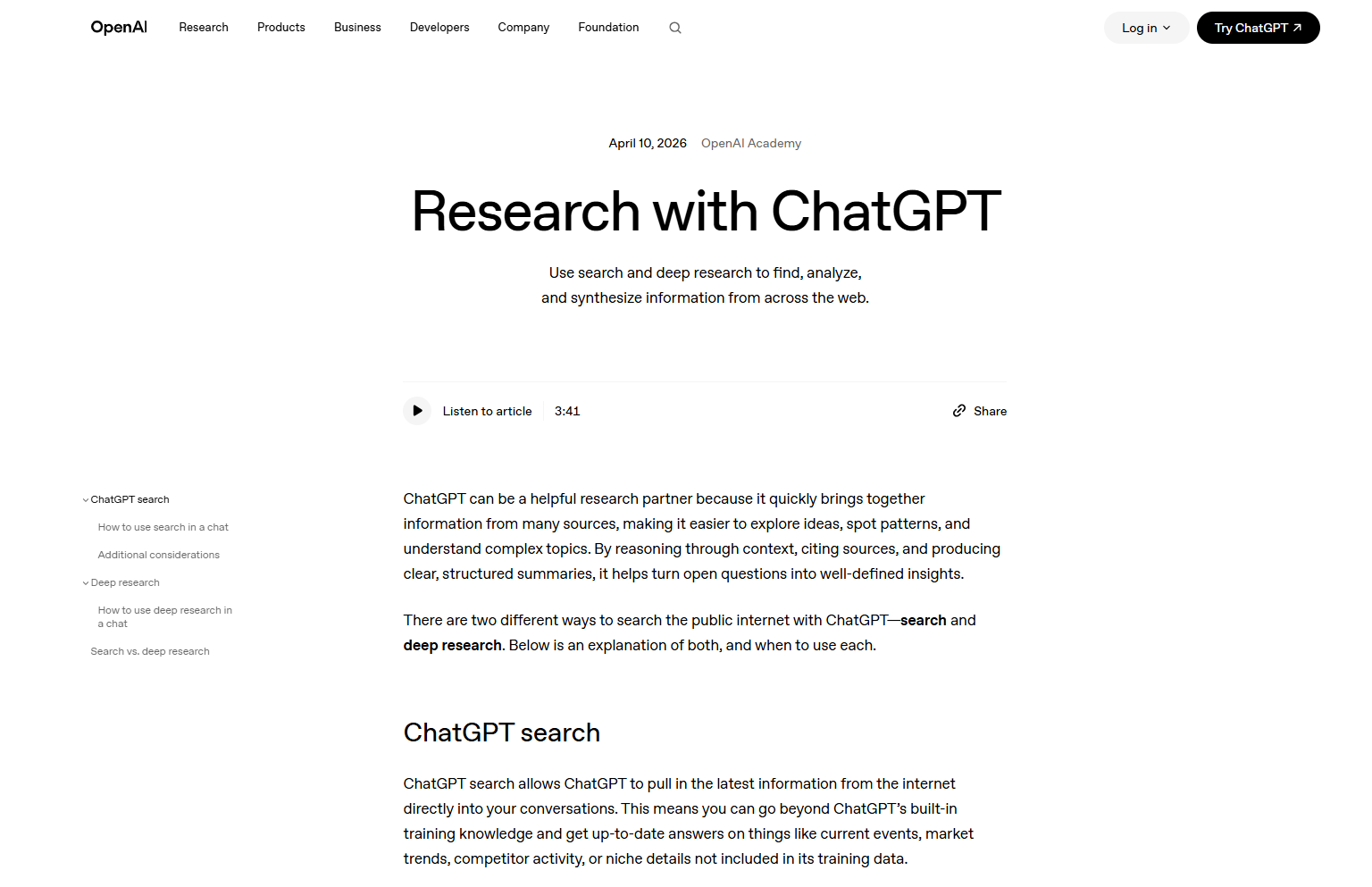
Key strengths: Natural-language research planning, web synthesis, citations in supported outputs, and flexible briefs, tables, and follow-up analysis.
ChatGPT helps define research questions, find sources, compare claims, summarize documents, identify gaps, and draft decision memos. It is useful early in a project before selecting a specialist dataset or primary method. However, it can still be wrong or incomplete. Check important facts, quotations, data, and sources; it is not a proprietary panel or proof of market behavior.
Best for: Fast desk research and synthesis when a human will review the evidence.
Which AI Market Research Tool Should You Choose?
Choose based on the evidence you need:
- Structured consumer evidence: Choose Qualtrics or quantilope for surveys, concept tests, pricing, preference studies, and brand tracking.
- Digital market intelligence: Choose Similarweb or Semrush for competitor traffic, audiences, channels, demand, and regional comparisons. Treat the results as modeled estimates.
- Public consumer conversation: Choose Brandwatch for perception, trends, campaign reactions, and reputation signals.
- Ongoing B2B competitor monitoring: Choose Crayon for continuous updates, battlecards, alerts, and sales enablement.
- Custom public-web datasets: Choose Browse AI to collect prices, listings, reviews, or website changes; your team still owns sampling and validation.
- Owned website behavior: Choose Hotjar to connect visitor behavior with feedback on specific pages and journeys.
- Market-to-action research brief: Choose Navos General Market Insight to turn a market question into a structured, reviewable brief with sources, risks, evidence gaps, and next actions.
- Exploratory desk research: Choose ChatGPT for flexible source discovery and synthesis. Verify cited evidence before making decisions.
A Practical AI-Assisted Market Research Workflow
A strong workflow combines tools instead of forcing one product to answer every question. Consider a US TikTok Shop seller evaluating a new category.
Step 1: Define the decision
Write one decision statement: Should we test this category in the US, for which segment, and with what leading claim? Then list the evidence that could change the answer.
Step 2: Collect digital market signals
Use Similarweb or Semrush for competitors, traffic, search demand, and channel mix. Use Browse AI for custom price, product, review, or listing data.
Step 3: Study the customer voice
Use Brandwatch for public conversation, Hotjar for your own visitors, or Qualtrics or quantilope for structured primary research. Record each sample's limitations.
Step 4: Synthesize the evidence
Use ChatGPT or Navos General Market Insight to organize the market definition, demand, competitors, audience needs, positioning, risks, and recommended test. Link every important conclusion to a source or dataset.
Step 5: Run a small validation test
Do not jump from an AI summary to a full launch. Test the weakest assumption with real users, a landing page, a small survey, a controlled campaign, or limited inventory.
How to Verify AI-Generated Market Research
Before using an AI research output in a decision, check five things:
- Source: Can you open the original source rather than only reading the AI summary?
- Date: Is the evidence recent enough for the category?
- Market: Does it cover the country, audience, platform, and time period you care about?
- Method: Is the number based on analytics, estimates, a survey, social posts, synthetic respondents, or generated text?
- Contradiction: What credible evidence would challenge the conclusion?
AI makes weak research faster as easily as it makes strong research faster. The quality of the output still depends on the question, sources, method, and human review.
Frequently Asked Questions
What is the best AI tool for market research?
There is no single best tool. Qualtrics and quantilope fit structured consumer research; Similarweb and Semrush fit digital intelligence; Brandwatch fits social listening; Browse AI collects web data; and ChatGPT supports synthesis. Choose the evidence type first.
Can ChatGPT conduct market research?
ChatGPT can plan desk research, search public sources, compare evidence, and draft cited reports. It cannot replace proprietary analytics, representative samples, interviews, or human verification.
Which AI tools use current market data?
Similarweb, Semrush, Brandwatch, Crayon, Browse AI, and Hotjar collect or model current signals differently. ChatGPT can access current web information when search or deep research is enabled. Check the source, update frequency, country, and plan limits.
What is the best free AI tool for market research?
Free access is best for exploration, not a complete study. ChatGPT search can synthesize public sources, while trials from specialist tools can help assess fit. Check current limits on official pricing pages.
How do I prevent AI from fabricating market research?
Require source links, open the originals, separate facts from estimates, label assumptions, and validate important conclusions with primary or first-party data. Confidence is not evidence.
Turn the Research Into a Decision
A useful market research report should end with a choice, a test, and a list of unresolved risks—not another folder of charts.
Use the General Market Insight Skill in the current Navos desktop app to turn a market question into a reviewable research brief and next-test plan.
Next step: Click
Download Navos, choose Windows or macOS, and open the Skill in the desktop app.