
The fastest way to do useful market research is to start with a decision, not a broad topic. Define the market, product, channel, time period, and evidence you need; then collect demand, competitor, customer, pricing, and risk signals before deciding what to do next.
This guide shows that workflow in practice. We use the General Market Insight Skill in the current Navos Desktop app to evaluate one specific question:
Should a cross-border seller enter the U.S. TikTok Shop wireless-earbuds market, and which product angle deserves further testing?
You will see how to frame the question, write a research prompt, review the generated evidence, and turn the report into a go, test, or stop decision. The workflow is useful for ecommerce operators, product marketers, founders, and growth teams that need an actionable market brief rather than another generic industry overview.
Market Research at a Glance
Step | What you do | What you should produce |
1. Define the decision | Specify the product, market, channel, period, and decision | One focused research question |
2. Choose the evidence | List the demand, customer, competitor, price, and risk signals you need | A research checklist |
3. Run Navos | Use the General Market Insight Skill with a structured prompt | A multi-section market report |
4. Validate the report | Check sources, dates, estimates, failed calls, and confidence levels | A verified evidence table |
5. Make the decision | Convert findings into a test plan with owners and thresholds | Go, test, or stop recommendation |
Market research combines existing evidence with original customer research. The U.S. Small Business Administration recommends examining demand, market size, location, saturation, pricing, and competitors, while also using direct methods such as surveys and interviews when you need audience-specific evidence. Navos can accelerate the secondary-research and synthesis stages, but it does not replace speaking to real customers or validating a product in market.
Step 1: Turn a Broad Topic into a Decision Question
“Research wireless earbuds” is too broad. It does not define which market matters, what period to study, which sales channel to prioritize, or what decision the report should support.
A useful research question contains five elements:
- Product: wireless earbuds
- Market: United States
- Channel: TikTok Shop
- Time period: the latest complete 90 days versus the previous 90 days
- Decision: whether to enter the market and which product angle to test
This scope prevents the report from mixing unrelated regions, platforms, and customer segments. It also gives you a standard against which to reject irrelevant data.
Before running any tool, write down the decision that will change because of the research. For this case, the output must help answer:
- Is there enough demand to justify a product test?
- Which features and price bands appear most relevant?
- Which brands and products define the current competitive set?
- What complaints or unmet needs could create a viable product angle?
- What compliance, intellectual-property, logistics, or margin risks could block entry?
- What evidence is verified, estimated, inferred, or still missing?
If a finding cannot influence one of these questions, it probably does not belong in the final brief.
Step 2: Open Navos Desktop and Select General Market Insight
Download and open Navos Desktop. In the current PC client, select the General Market Insight Skill. This is the Skill used for structured market-entry and opportunity analysis; the discontinued Navos web 1.0 experience is not used in this workflow.
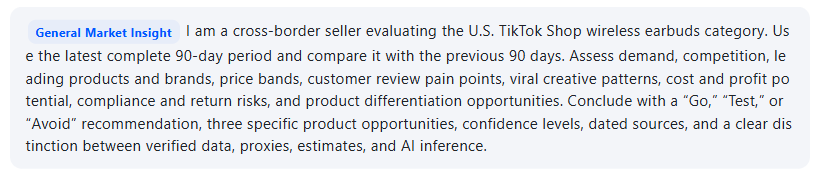
The Skill works best when you provide a decision-ready brief. Include the market, platform, comparison period, required outputs, source rules, and confidence requirements in the first prompt. This reduces follow-up questions and makes the resulting report easier to audit.
Step 3: Use a Prompt That Demands Evidence
We used the following prompt for the case study:
Analyze the U.S. TikTok Shop wireless earbuds market using the latest complete 90-day period and compare it with the previous 90 days. Identify demand signals, leading products and brands, key features, price bands, customer pain points, competitive gaps, content and channel patterns, compliance risks, and three launch opportunities for a cross-border seller. Cite every external source and its date, clearly label verified data versus estimates or AI inference, assign a confidence level to each major conclusion, and produce a structured HTML report with a source appendix.
The prompt does four important things:
- Sets a comparison period. A single snapshot cannot show whether demand is rising, stable, or falling.
- Requests decision inputs. It asks for price, competition, pain points, risks, and opportunities rather than a generic market summary.
- Requires evidence labels. Verified data, estimates, and AI inference should never be presented as equivalent.
- Requests a source appendix. Every material claim should be traceable to a source and date.
If you already have product references, competitor URLs, customer-review exports, or internal sales data, attach them to the prompt. First-party inputs can make the analysis more relevant, but they still need a clear date range and definition.
Step 4: Audit the Navos Report Before Trusting It
An AI-generated market report is a research starting point, not automatic proof. Review the report in four passes before acting on it.
1. Check the source appendix
Open every source used for a major market-size, demand, pricing, legal, or competitor claim. Confirm that the page exists, supports the statement, and has an appropriate publication or access date.
2. Separate facts from estimates
Mark each conclusion as one of the following:
Evidence label | Meaning | How to use it |
Verified | Directly supported by a cited primary or reliable source | Can support a decision, subject to scope and date |
Proxy | Related data used because direct category data was unavailable | Directional only |
Estimate | A calculated or modeled value | Test sensitivity before relying on it |
AI inference | A reasoned hypothesis without direct measurement | Convert into a validation question |
Not available | The required source or dataset was not retrieved | Do not fill the gap with a confident claim |
3. Read the tool-call record and limitations
If a source failed, returned no usable data, or was not called, the report should say so. Treat missing review data, platform sales data, or official regulatory sources as unresolved evidence gaps.
4. Verify high-risk claims independently
Market-entry decisions can involve electrical certification, wireless-device rules, trademarks, patents, batteries, product safety, and platform policies. Check these items against current official sources and qualified specialists before committing inventory. A market-research report is not legal, compliance, or intellectual-property advice.
Step 5: Read the Wireless-Earbuds Case as a Decision Brief
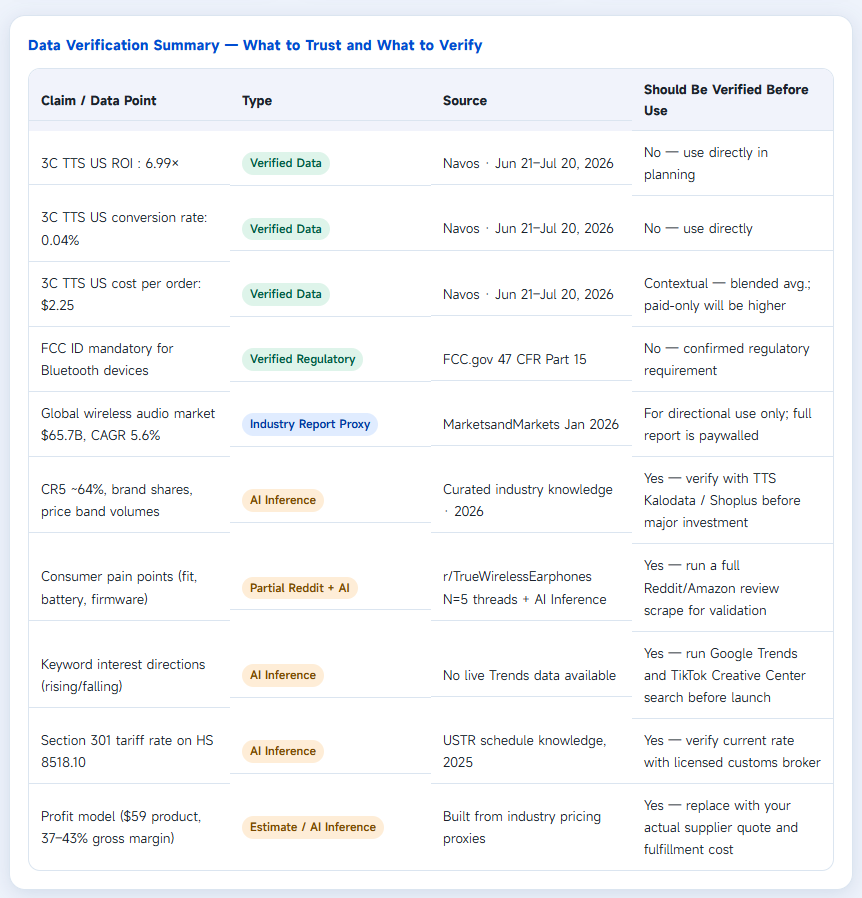
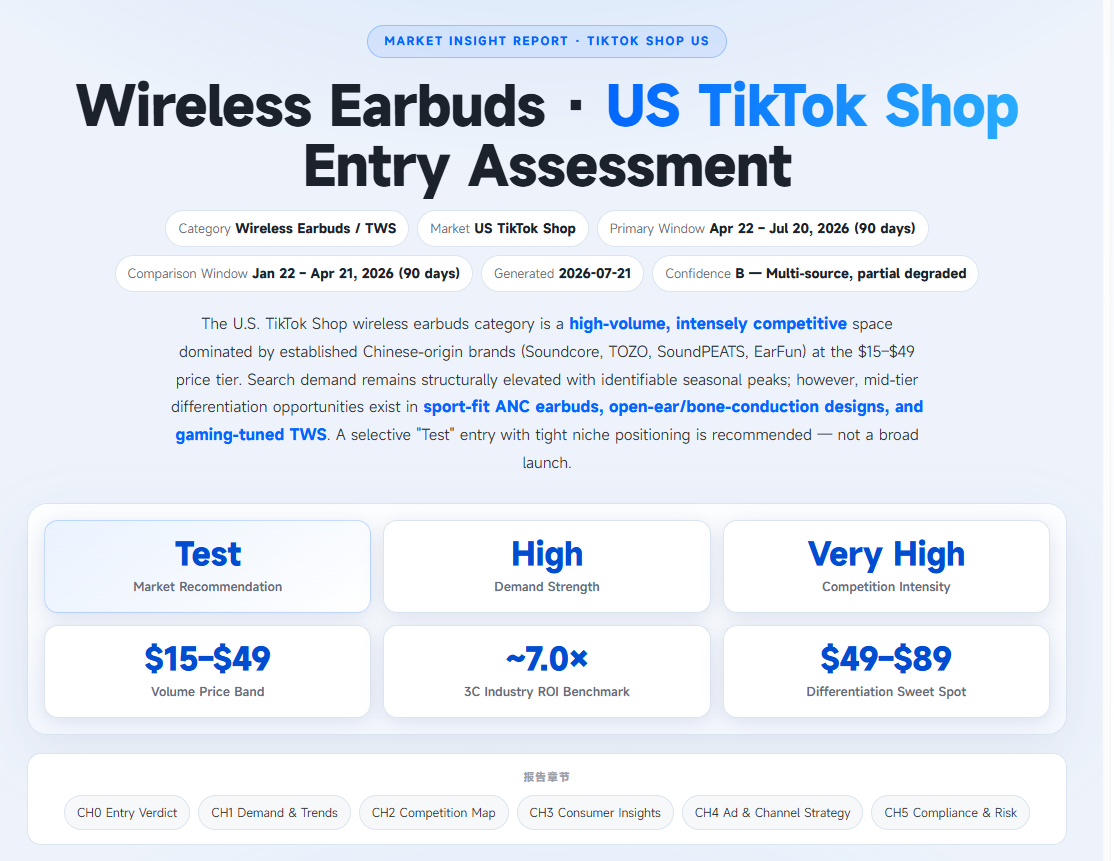
The completed Navos report compared April 22–July 20, 2026 with the previous 90-day period. It organized the research into demand, competition, customer evidence, advertising benchmarks, compliance, risks, and launch opportunities. The report assigned an overall confidence level of B — multi-source, partially degraded because several external sources were unavailable or incomplete.
Demand and trend signals
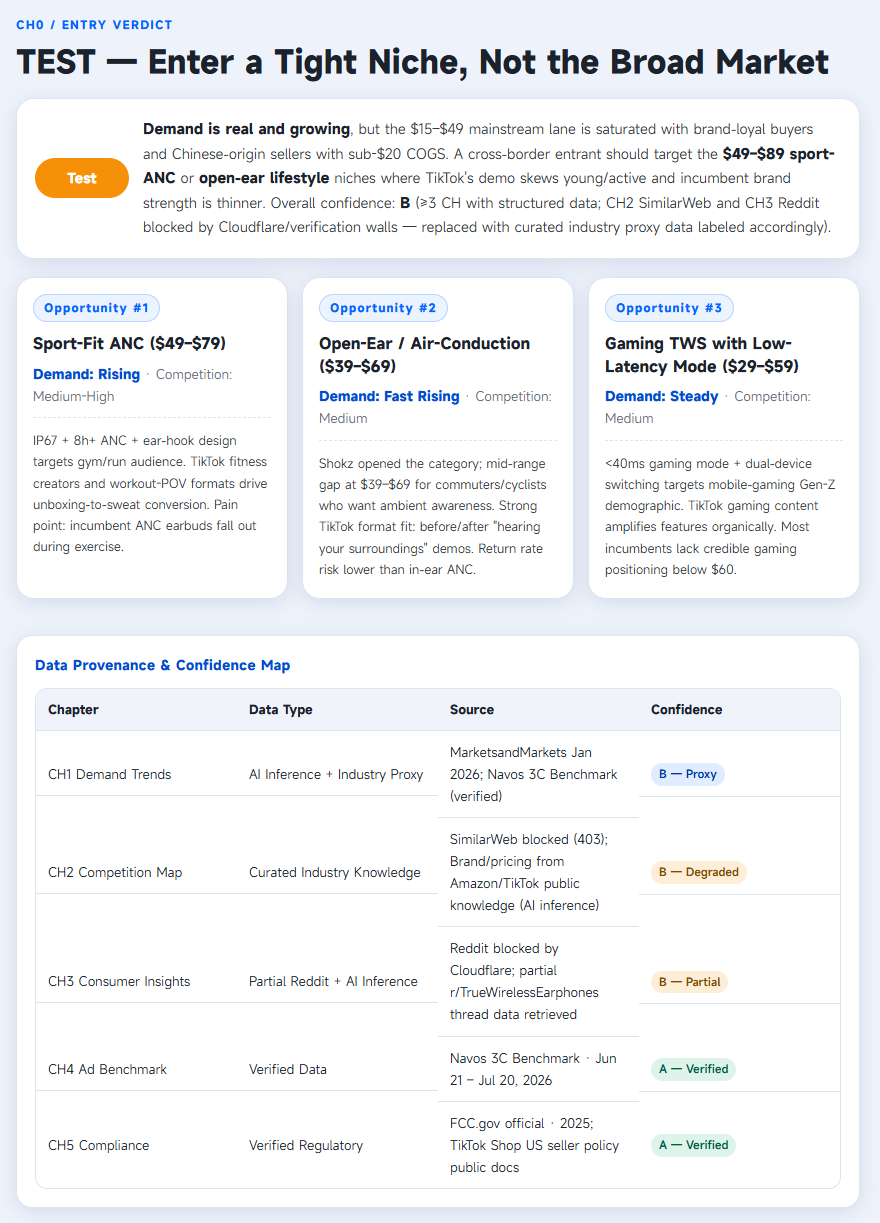
The report described wireless-earbuds demand as high, but it did not retrieve live Google Trends data or direct TikTok Shop category sales. Its estimated search-interest increase and the directional labels for ANC, open-ear, budget, and gaming earbuds were therefore AI inference rather than measured search or sales growth.
One external industry proxy was independently traceable: MarketsandMarkets projected the global wireless-audio-device market to grow from $65.68 billion in 2026 to $91.16 billion by 2032, a 5.6% CAGR, and identified TWS as the fastest-growing product segment. This supports the broad category context, but it does not establish the size or growth of the U.S. TikTok Shop earbuds market.
The practical takeaway was not “demand is proven.” It was that the category was large enough to justify a narrower validation step, while direct platform demand still needed to be checked before inventory was scaled.
Leading products, brands, and price bands
The report identified Soundcore, TOZO, SoundPEATS, and EarFun as relevant competitors and described the $15–$49 range as the crowded volume tier. However, SimilarWeb was blocked during the run, and the price-band shares and competitor concentration figures came from curated industry knowledge and AI inference rather than verified TikTok Shop sales.
Navos suggested $49–$89 as a possible differentiation range. We treated that as a pricing hypothesis to test against current listings, conversion, contribution margin, and return rate—not as a proven market sweet spot.
The report also surfaced a current Navos 3C advertising benchmark of 6.99× ROI, 0.04% conversion rate, and $2.25 cost per order for June 21–July 20, 2026. Those numbers are category-level advertising context, not wireless-earbuds performance or a profitability forecast.
Customer pain points and buying criteria
Direct customer-feedback evidence was not sufficient in this run. Reddit access was partially blocked, and the report retrieved only five relevant thread fragments. Fit, comfort, battery life, firmware, connectivity, latency, and call quality therefore remained validation topics rather than verified pain-point conclusions.
Before selecting a product, the next research pass should mine a larger set of recent TikTok Shop, Amazon, and retailer reviews, group complaints by product type and rating, and record the number of reviews supporting each theme.
Competitive gaps
Navos generated three product hypotheses for further validation:
- Sport-fit ANC earbuds at $49–$79, positioned around secure fit, sweat resistance, and exercise use.
- Open-ear or air-conduction earbuds at $39–$69, positioned for commuters and cyclists who want environmental awareness.
- Low-latency gaming TWS at $29–$59, positioned around mobile gaming and dual-device switching.
These are test candidates, not validated product opportunities. Their demand and competition labels still depend on proxies and inference, so each needs listing checks, review evidence, supplier economics, and a controlled conversion test.
Risks and constraints
The report flagged five useful risk categories: fit-related returns, review-policy enforcement, FCC equipment authorization, patent and design exposure, and price compression. It also raised customs and tariff checks for China-origin products.
The FCC’s equipment-authorization rules provide a verified regulatory starting point: devices that intentionally emit radio-frequency energy generally require equipment authorization before they are marketed in the United States. Electrically identical trade models may be covered by an existing authorization, while material changes can require a permissive change or a new certification. Exact certification cost, timing, tariff treatment, and patent clearance still require confirmation from the supplier and qualified specialists.
The decision
Navos recommended Test — enter a tight niche, not the broad market. That conclusion is appropriate for the available evidence: the report produced a useful shortlist and exposed its evidence gaps, but it did not verify enough direct platform demand, customer feedback, or product economics to support a broad launch.
Step 6: Turn the Report into a Validation Plan
The report becomes valuable only when it changes what you test next. Convert each important conclusion into an owner, action, and measurable threshold.
Research finding | Next action | Evidence needed before scaling |
Broad demand appears sufficient for a niche test, but direct TikTok Shop sales were unavailable | Check current listings and run a small product-and-creative test | Platform-level impressions, clicks, conversion, and order data |
$49–$89 was suggested as a differentiation range | Test two price or bundle variants within a controlled campaign | Contribution margin, conversion rate, cost per order, and return rate |
Fit and comfort may influence returns | Mine a larger review corpus and test fit-focused messaging | Review counts by theme, size preference, and actual return reasons |
Sport-fit ANC, open-ear, and gaming TWS were shortlisted | Compare each concept against current leading offers | Customer preference, supplier feasibility, and willingness-to-pay evidence |
FCC, IP, battery, and tariff questions can block launch | Complete supplier-document and specialist checks before ordering | Valid authorization records, test reports, classification, and written clearance |
Set thresholds before the test begins. For example, define the minimum contribution margin, maximum return rate, minimum click-to-purchase conversion, and maximum cost per order you are willing to accept. Predefined thresholds make it harder to reinterpret weak results after money has already been spent.
What Navos Can and Cannot Replace
Navos can help teams:
- turn a broad idea into a structured market question;
- collect and synthesize available secondary evidence;
- compare demand, competitors, price bands, and market gaps;
- expose missing or failed data sources when the report is configured to do so;
- produce a reusable report and source appendix;
- translate findings into testable actions.
Navos cannot replace:
- statistically valid surveys or interviews with your target customers;
- first-party sales, conversion, return, and margin data;
- direct platform data that was not available to the run;
- laboratory testing or product-quality verification;
- professional legal, regulatory, compliance, or patent advice.
Use AI to accelerate the desk-research loop, then validate the highest-risk assumptions with primary research and a controlled market test. If you need a deeper explanation of research methods, see What Is Market Research?. For a dedicated competitive workflow, read How to Do Competitor Research.
Common Mistakes When Using AI for Market Research
Asking for “everything”
An undefined brief produces a broad report. Specify one product, market, channel, period, and decision.
Treating a proxy as direct market data
Search interest, marketplace rankings, hashtag views, and website traffic can indicate direction, but they are not interchangeable with verified sales or unit data.
Hiding failed sources
If a report could not retrieve customer reviews, official regulations, or platform data, keep that limitation visible. The missing evidence should become part of the next research task.
Accepting unsupported precision
An exact-looking number is not reliable unless the source, definition, geography, period, and calculation method are clear.
Ending with a report instead of a test
Every research project should end with a decision, owner, validation action, threshold, and review date. Otherwise, the report is information without operational value.
Frequently Asked Questions
What is the first step in market research?
Define the decision you need to make. A focused research question should specify the product or problem, target market, relevant channel, time period, and the evidence required to choose an action.
How do you conduct market research with AI?
Use AI to structure the question, gather and synthesize available secondary sources, compare market signals, and draft recommendations. Then audit every material source, separate verified facts from estimates, and validate the riskiest assumptions through primary research or a controlled test.
Which Navos Skill should I use for market research?
Use the General Market Insight Skill in the current Navos Desktop app for a structured market-entry or opportunity brief. Include the market, channel, comparison period, required analysis dimensions, source rules, and desired decision output in your prompt.
Can Navos verify customer pain points?
Only when the run retrieves usable direct customer-feedback evidence, such as reviews, surveys, interviews, or supplied first-party data. If those sources are unavailable, pain points should be labeled as hypotheses rather than verified findings.
How often should market research be updated?
Update the research when a decision changes, new first-party evidence arrives, important competitors or platform rules change, or market signals move materially. Fast-moving ecommerce categories may require a shorter review cycle than stable industries.
Run Your First Market Brief in Navos
Start with one decision you need to make this week. Open the General Market Insight Skill, paste a structured prompt, and require dated sources, confidence labels, limitations, and an action plan.
Explore the Navos AI Industry Consultant or download Navos Desktop to create your first market brief.
How to Do Market Research with an AI Agent: A Wireless Earbuds Case Study