Most e-commerce sellers know their product inside out. They can list every spec, every material, every dimension. But when it's time to write ad copy, they stare at a blank screen — because a spec sheet is not a sales pitch.
Product features tell customers what a product does. Ad copy needs to tell them why they should care. That gap is where many ads lose their impact — and where AI ad copy tools can help.
In this guide, we'll walk through how AI transforms raw product features into compelling ad copy, using a real example: a portable blender marketed to US professionals on TikTok Ads.
Why Product Features Alone Don't Sell
Here's a common scenario: a seller lists their product features — "USB-C rechargeable, 5000mAh battery, compact, easy to clean" — and pastes them straight into an ad. The result? A scroll-stopping... nothing. No click, no conversion, no sale.
The problem isn't the product. It's the messaging. Features are facts; benefits are feelings. A customer doesn't buy "5000mAh." They buy "portable power you can take anywhere." They don't buy "compact." They buy "fits in my gym bag."
There's a simple framework that bridges this gap:
Feature → Benefit → Selling Point → Ad Copy
Take the portable blender:
- Feature: USB-C rechargeable
- Benefit: Convenient charging with a commonly used cable
- Selling Point: Easy to recharge at home, at work, or while traveling
- Ad Copy: "USB-C charging. Compact design. Ready for wherever your day takes you."
The feature hasn't changed. But the message has shifted from a spec to a story — one that connects to a real moment in the customer's life.
From Product Features to Audience Insights and Selling Points
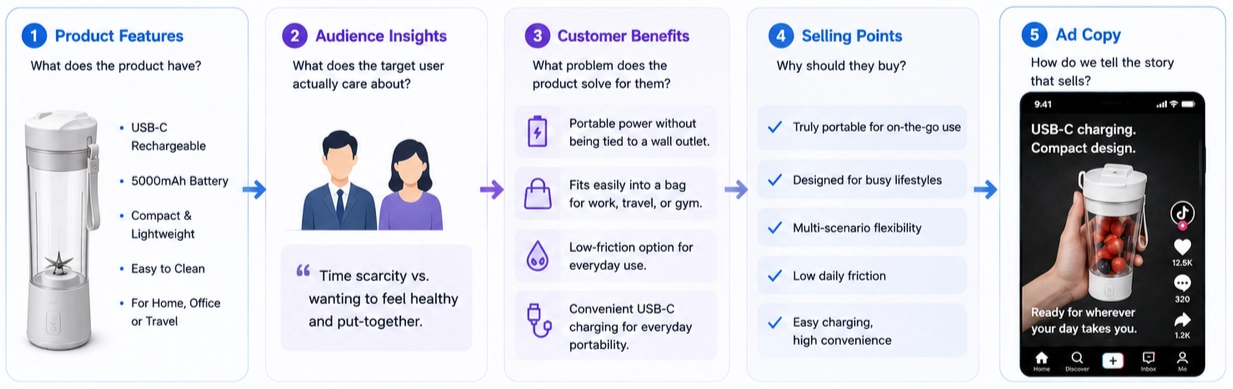
Before writing a single ad, you need to understand who you're talking to. The same product means different things to different people. AI helps bridge that gap by moving through four layers:
Product Features → What does the product have?
↓
Audience Insights → What does the target user actually care about?
↓
Customer Benefits → What problem does the product solve for them?
↓
Selling Points → Why should they buy?
Here's where AI does something humans often skip: it reads the product info and thinks about the audience at the same time.
In the portable blender example, Navos identified a core tension shared by busy professionals and fitness-conscious consumers: time scarcity vs. wanting to feel healthy and put-together.
That insight reframes every feature:
- 5000mAh battery → "Designed for portable use without being tied to a wall outlet."
- Compact size → "Fits easily into a bag for work, travel, or the gym."
- Easy to clean → "A low-friction option for everyday use."
- USB-C charging → "Convenient USB-C charging for everyday portability."
Each selling point now speaks directly to the audience's real-life friction. That's the foundation every great ad is built on.
How AI Turns Selling Points into Creative Angles
One product. Multiple audiences. Multiple reasons to buy. That's the principle behind creative angles — and where AI ad copywriting tools shine.
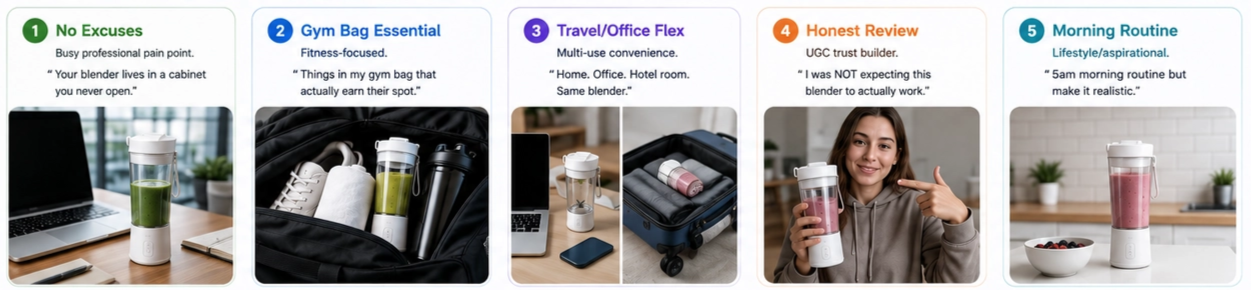
A creative angle is the lens through which you present a product. Same blender, five completely different stories:
- No Excuses — Busy professional pain point: "Your blender lives in a cabinet you never open."
- Gym Bag Essential — Fitness-focused: "Things in my gym bag that actually earn their spot."
- Travel/Office Flex — Multi-use convenience: "Home. Office. Hotel room. Same blender."
- Honest Review — UGC trust builder: "I was NOT expecting this blender to actually work."
- Morning Routine — Lifestyle/aspirational: "5am morning routine but make it realistic."
Let's zoom in on two.
Angle 1 — "No Excuses" targets the professional who wants to eat healthy but struggles to fit it into a busy schedule. The hook calls out the behavior of buying a blender that ends up forgotten in a cabinet. The messaging then focuses on portability, USB-C charging, and convenience for everyday use. The selling point isn't simply "portable" — it's a blender designed to fit into a busy schedule.
Angle 2 — "Gym Bag Essential" speaks to fitness-conscious consumers who want a convenient way to prepare drinks around their workouts. The hook uses a familiar TikTok format — "things in my gym bag that actually earn their spot" — and positions the blender as another practical item to carry. The selling point is convenience: a compact, rechargeable blender designed for use beyond the kitchen.
Same product. Same features. But the angle completely changes who the ad speaks to and why they should click.
One Product, Multiple Ad Copy Angles
Here's where creative angles become actual ads. Using the portable blender case, let's look at three distinct ad copies — each built for a different audience, each designed to give marketers a ready-to-edit starting point.
Angle 1 — Convenience Hook
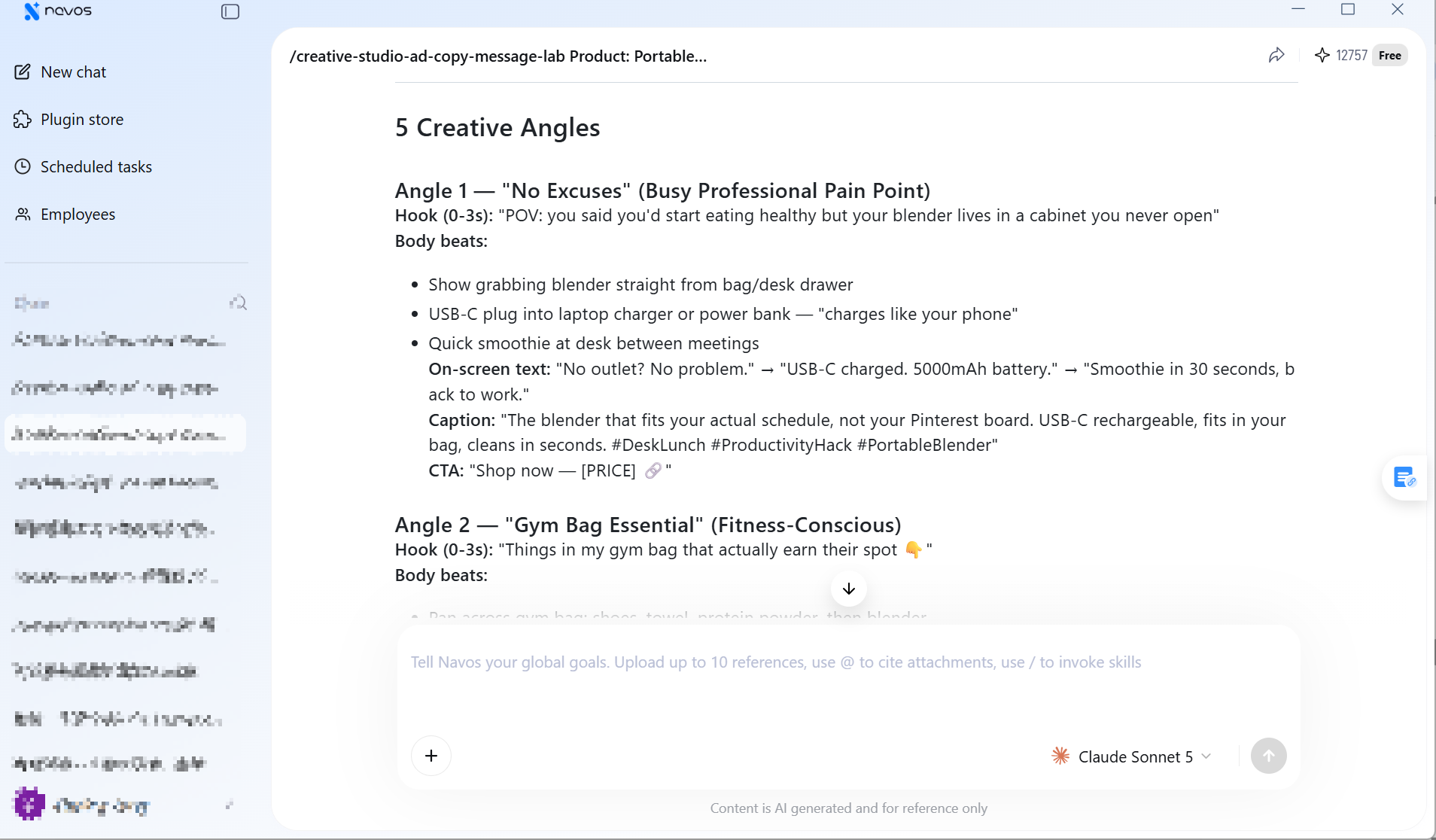
Hook (0–3s): "POV: you said you'd start eating healthy but your blender lives in a cabinet you never open"
Ad message: Grab blender from a desk drawer, plug USB-C into a laptop, quick smoothie between meetings. On-screen text: "USB-C charging. Ready for wherever your day takes you." → "USB-C charged. 5000mAh battery."
Caption: "The blender that fits your actual schedule, not your Pinterest board. USB-C rechargeable, fits in your bag, designed for easy cleaning."
CTA: "Shop now — [PRICE] 🔗"
Angle 2 — Fitness Hook
Hook (0–3s): "Things in my gym bag that actually earn their spot 👇"
Ad message: Pan across gym bag — shoes, towel, protein powder, then blender. Post-workout shake blended on the spot. Rinse under a sink, no cord tangle.
Caption: "A convenient option for preparing a post-workout drink wherever you are. Charges via USB-C, fits my gym bag, designed for easy cleaning."
CTA: "Get yours before leg day 💪 [link in bio]"
Angle 3 — Travel / Office Hook
Hook (0–3s): "Things that live in three places at once: my keys, my phone, and now... my blender"
Ad message: Quick cuts between home kitchen, office desk, and hotel room. Size comparison next to a water bottle. USB-C cable plugged into a laptop.
Caption: "Why buy 3 blenders when one fits everywhere? Compact, USB-C rechargeable, easy to clean. My travel + WFH + office essential."
CTA: "Tap to shop — learn more."
One product. Multiple audiences. Multiple reasons to buy. That's the power of AI-driven creative angles — and exactly what Navos produces in a single session.
From Creative Angles to Ready-to-Use Ad Copy
AI doesn't stop at finding the right angle. It converts each creative angle into a full set of ad components that provide a structured starting point for ad creation.
For each angle, an AI ad copy generator can produce:
- Hooks — The opening line that stops the scroll
- Primary Text — The main body copy for your ad
- Headlines — Short, punchy lines designed for ad headline fields
- Captions — Social-ready text with hashtags
- CTAs — Action-driven button text
Here's what that looks like in practice, drawn from the portable blender output:
Component | Example |
Headline | "Blend Anywhere. Charge Anywhere." |
Primary Text | "USB-C charging. Compact and ready to go. Fits in your bag." |
Caption | "A portable blender designed for busy days." |
CTA | Shop Now / Get Yours / Order Now |
The chain is simple:
Creative Angle → Hook → Ad Copy → CTA
Each step is connected. The angle defines the message. The hook grabs attention. The ad copy delivers the selling point. The CTA drives action. AI can support the entire chain — from creative angles to hooks, ad copy, and CTAs.
How Navos Helps Turn Product Information into Better Ad Copy
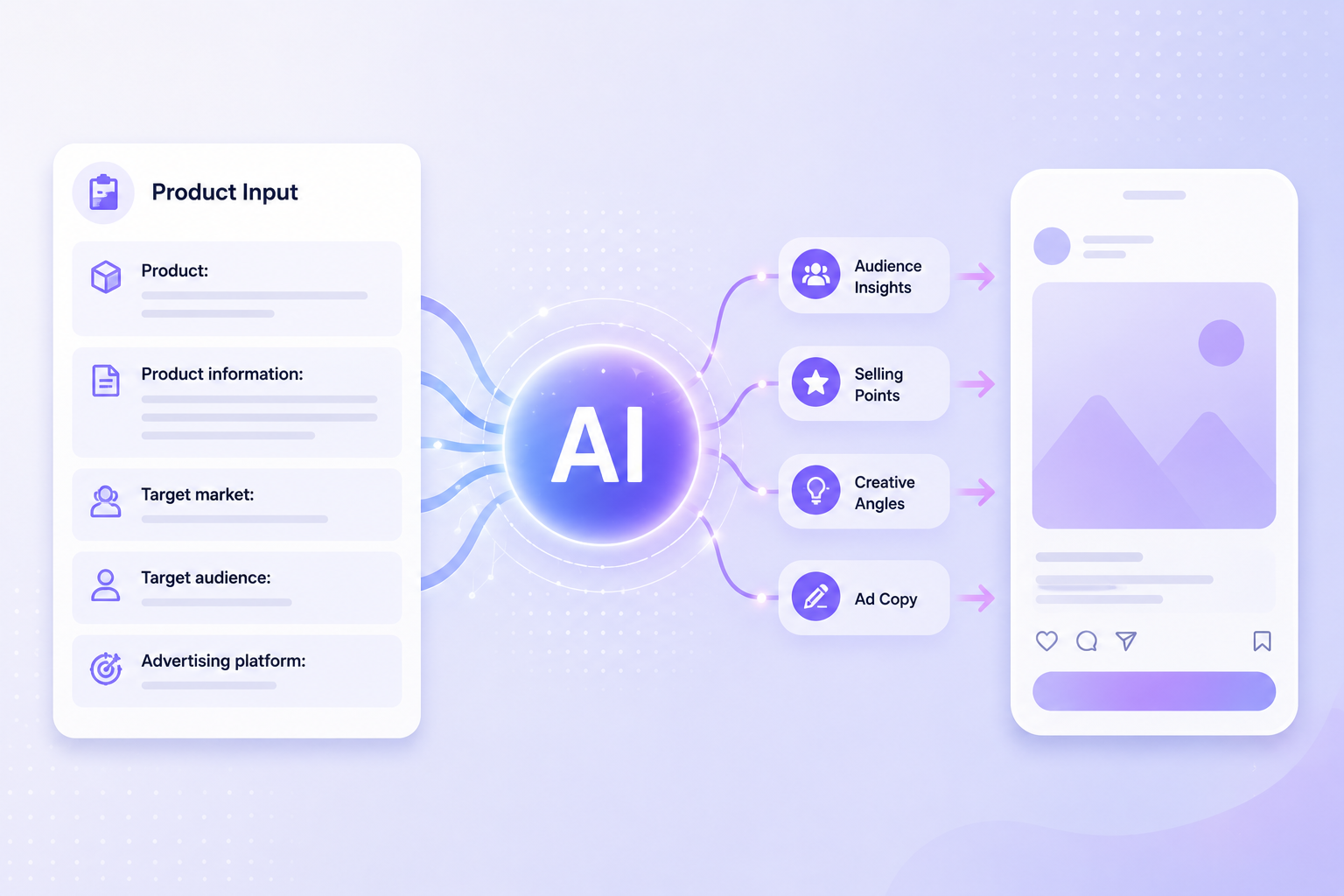
Navos is an AI marketing platform that helps e-commerce brands turn product information into ad-ready creative. Its Ad Copy & Selling Point Lab (powered by the creative-studio-ad-copy-message-lab skill) takes you from raw product specs to full ad copy packs in one workflow.
Here's how it works:
Step 1: Start with Product Information
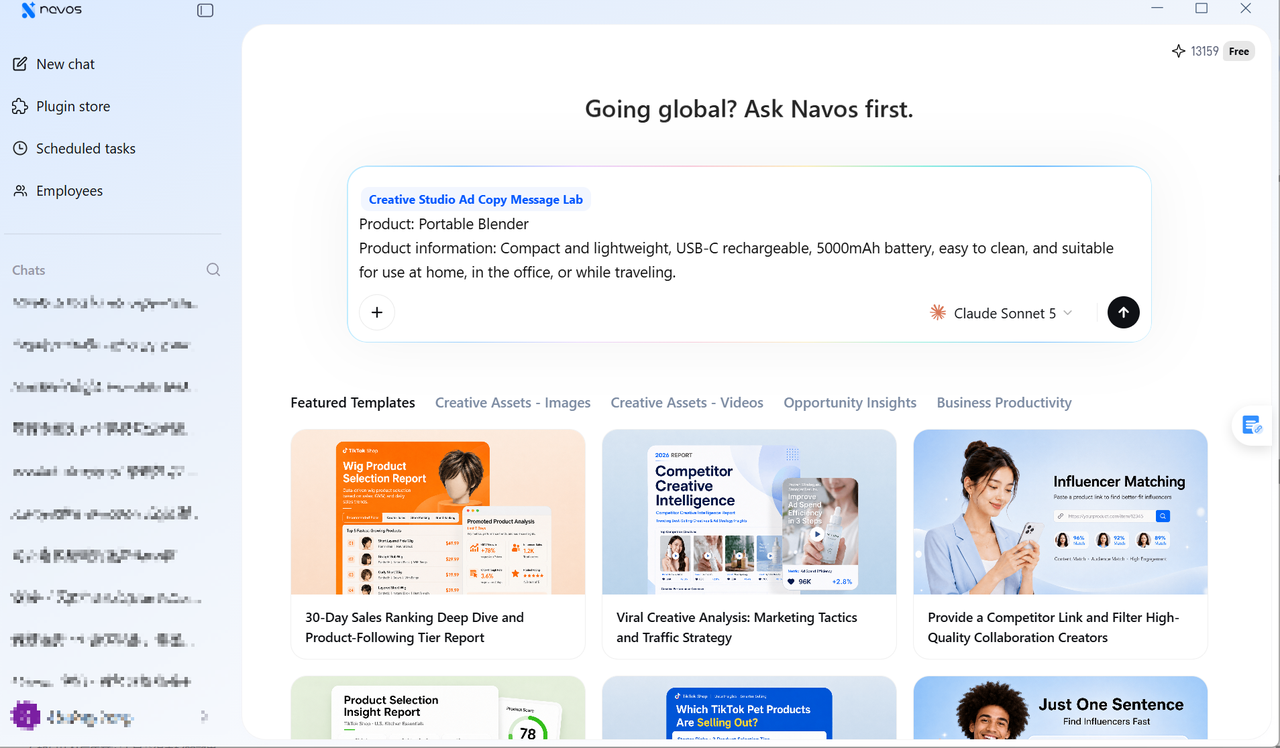
Input your product details, features, target market, audience, and advertising platform. For our example:
Product: Portable BlenderProduct information: Compact and lightweight, USB-C rechargeable, 5000mAh battery, easy to clean, suitable for home, office, or travelTarget market: USTarget audience: Busy professionals and fitness-conscious consumersAdvertising platform: TikTok Ads
Step 2: Discover Audience Insights
analyzes the product information alongside the target audience and surfaces potential audience insights that can inform the messaging. For the portable blender, it identified: "time scarcity vs. wanting to feel healthy/put-together."
Step 3: Find Selling Points
Each product feature is translated into a customer-facing selling point. "5000mAh battery" becomes "designed for portable use without being tied to a wall outlet." "USB-C rechargeable" becomes "convenient charging for everyday portability."
Step 4: Generate Creative Angles
produces multiple marketing angles — each targeting a different pain point or lifestyle scenario. The portable blender generated five angles: No Excuses, Gym Bag Essential, Travel/Office Flex, Honest Review, and Morning Routine.
Step 5: Create Ad Copy
Each angle is expanded into a full ad copy package: hooks, on-screen text, captions, headlines, CTAs, and short-form copy bank entries — each providing a structured starting point for TikTok ad creation.
The workflow helps marketers move from product information to structured ad copy ideas in a single session.
How to Get Better Results from AI Ad Copy Tools
The quality of AI-generated ad copy depends heavily on the quality of your input. Here's a simple formula:
Product + Features + Target Market + Audience + Platform
Compare these two inputs:
The first gives the AI nothing to work with. The second gives it much more relevant context — and the output reflects that difference.
The more relevant context you provide, the more specific and useful the generated copy can be. AI ad copywriting tools aren't mind readers. They're translators — and the better the input, the better the translation.
Frequently Asked Questions
What is AI ad copy?
AI ad copy refers to advertising copy generated or assisted by AI. Depending on the tool, it can help create headlines, hooks, captions, primary text, CTAs, and other campaign messaging.
Can AI turn product features into selling points?
Yes. AI can analyze product features in the context of a target audience and translate them into customer benefits and marketing angles. Tools like Navos can support this process — helping users identify relevant features, develop selling points, and turn them into ad copy.
What information should I give an AI ad copy tool?
At minimum: product name, key features, target audience, target market, and advertising platform. The more specific you are — including use cases, pricing, or promotional context — the more tailored the output. Navos structures this input into a guided workflow so nothing gets missed.
Final Takeaway
Better ad copy doesn't start with better writing. It starts with better product understanding.
The best AI ad copy tools don't just string words together. They follow a chain:
Product Features → Audience Insights → Selling Points → Creative Angles → Ad Copy
Each step builds on the last. Each step helps make the final message more relevant to the audience. Follow the chain, and you turn a spec sheet into a story that sells.
Navos helps streamline this process — from product information and audience insights to selling points, creative angles, and ad copy.