
TikTok Shop SEO is the process of making a product listing easier to find, understand, and trust. In practice, that means matching relevant buyer language to an accurate title, category, attributes, description, and image sequence—without adding claims the product evidence cannot support.
The fastest way to improve a listing is not to add more keywords everywhere. Start with a reliable SKU truth pack, align every public field with that evidence, and then improve how the product is described. Navos can bring those steps into one workflow by turning your current listing, product facts, image notes, and target customer into a structured audit, revised copy, a visual plan, and prioritized actions.
This guide covers the complete 2026 checklist for TikTok Shop product listing optimization in the United States, plus a hands-on Navos test using one commuter-backpack SKU.
TikTok Shop SEO Checklist at a Glance
Step | What to check | What good looks like |
1. Build a SKU truth pack | Specifications, materials, compatibility, care, package contents, approved claims | Every statement has a known source and owner |
2. Map buyer language | Product type, use case, feature, audience, and problem terms | Each relevant term has a natural place in the listing |
3. Rewrite the title | Product identity, differentiating facts, use case, and size where relevant | Clear, specific, readable, and free of promotion or repetition |
4. Verify category and attributes | Category path, brand, variations, dimensions, compatibility, and required fields | The product is classified accurately and all supported attributes are complete |
5. Improve the description | Key facts, benefits, use cases, care, package contents, and limitations | Scannable copy that answers purchase questions without inventing claims |
6. Plan the image sequence | Main image, angles, scale, features, use case, package contents, and detail shots | Images reduce uncertainty instead of repeating the same view |
7. Check consistency | Title, description, images, variants, and source facts | No conflicting size, material, capacity, care, or performance statements |
8. Prioritize and measure | Product Optimizer issues, search data, page behavior, orders, and returns | The team changes the highest-impact issue first and records what changed |
Use this as a pre-publish gate for a new SKU and as a repair workflow for an existing listing. If your team manages many products, Navos can convert the same inputs into a repeatable audit artifact instead of relying on scattered comments and one-off rewrites.
What TikTok Shop SEO Actually Means
TikTok Shop SEO has three connected jobs:
- Searchability: Help TikTok Shop and shoppers identify what the product is and when it is relevant.
- Conversion clarity: Help a shopper understand the product, its fit, and its use case quickly.
- Factual accuracy: Keep titles, descriptions, attributes, images, and variations consistent with approved product evidence.
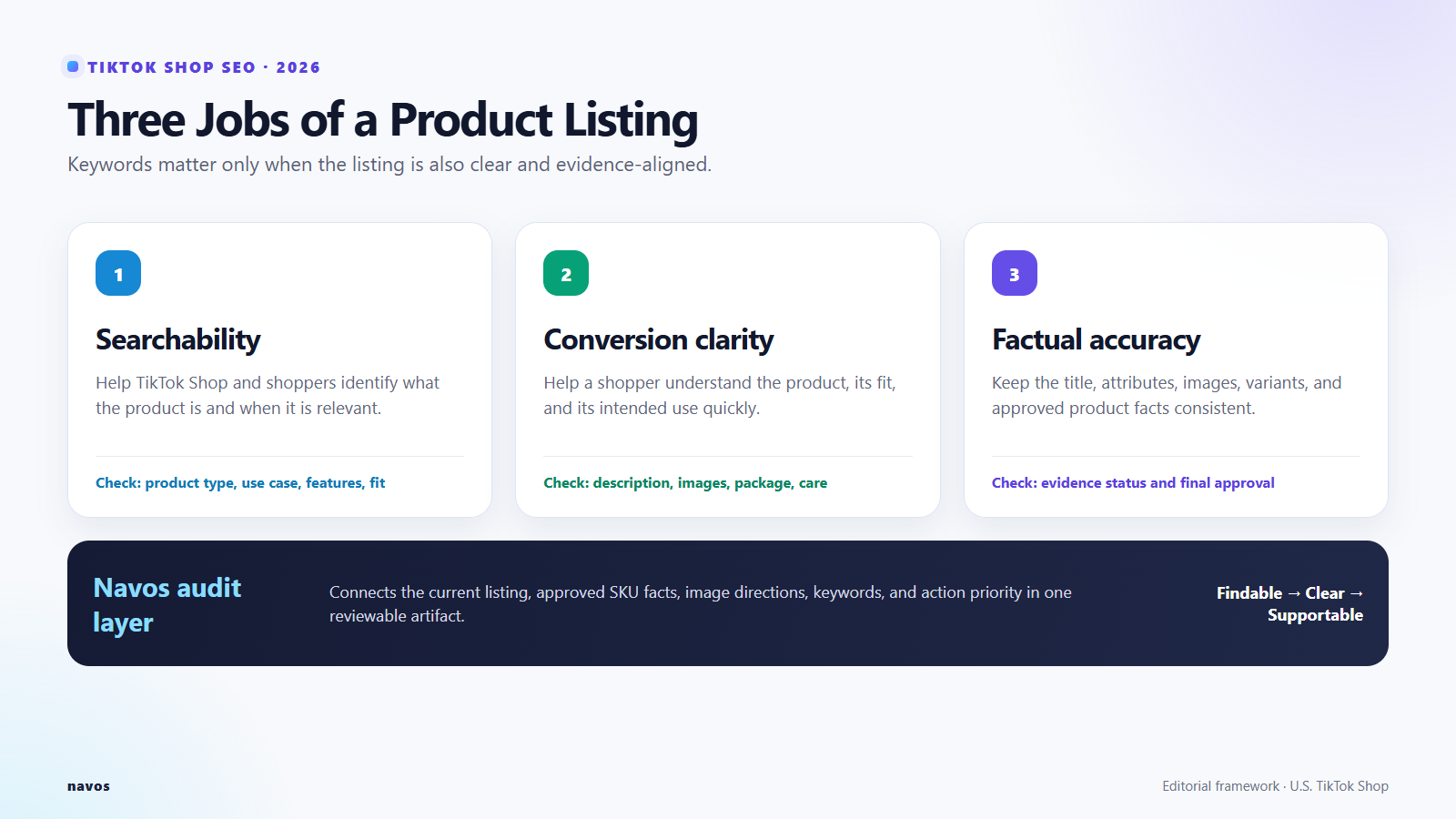
These jobs should not be collapsed into one score. A title may use relevant search terms while the images communicate another size. Persuasive copy may extend beyond the available product evidence. And an accurate listing may remain difficult to discover if it uses an internal name instead of language shoppers recognize.
That is why optimization should follow this order:
Product truth → buyer language → listing structure → visual proof → consistency check → measurement
This is also where Navos has an advantage over a blank writing tool. A dedicated listing workflow can preserve the source facts, diagnose the current page, generate revised fields, and show which changes should happen first. The output becomes a working document for ecommerce, creative, and approval teams—not just another paragraph of AI copy.
Build a SKU Truth Pack Before Choosing Keywords
The quality of a listing audit depends on the quality of its input. Before rewriting anything, create one compact source of truth for the SKU.
Include:
- Product name and SKU.
- Target market and intended customer.
- Primary use case.
- Materials and color.
- Dimensions and weight.
- Compatibility or fit limits.
- Components, pockets, closures, controls, or other visible features.
- Care instructions.
- Package contents.
- Required warnings or disclosures.
- Approved claims and the evidence behind them.
- Claims that must not be used.
- Current title, description, attributes, and product images.
Assign an evidence status to every material statement. A useful five-level system is:
Evidence status | Meaning | How to use it |
Supplied product fact | Directly provided by the seller or product owner | Use after owner approval |
Visually confirmed fact | Clearly visible in an approved product image | Use for visible design and component details |
Interpretation | A reasonable reading of the supplied material, but not a product fact | Label internally; do not turn it into a hard claim |
Evidence pending | The available source pack does not yet support the statement | Hold until evidence arrives |
Seller confirmation required | The fact is supplied but still needs final owner approval | Keep it in the review queue before publication |
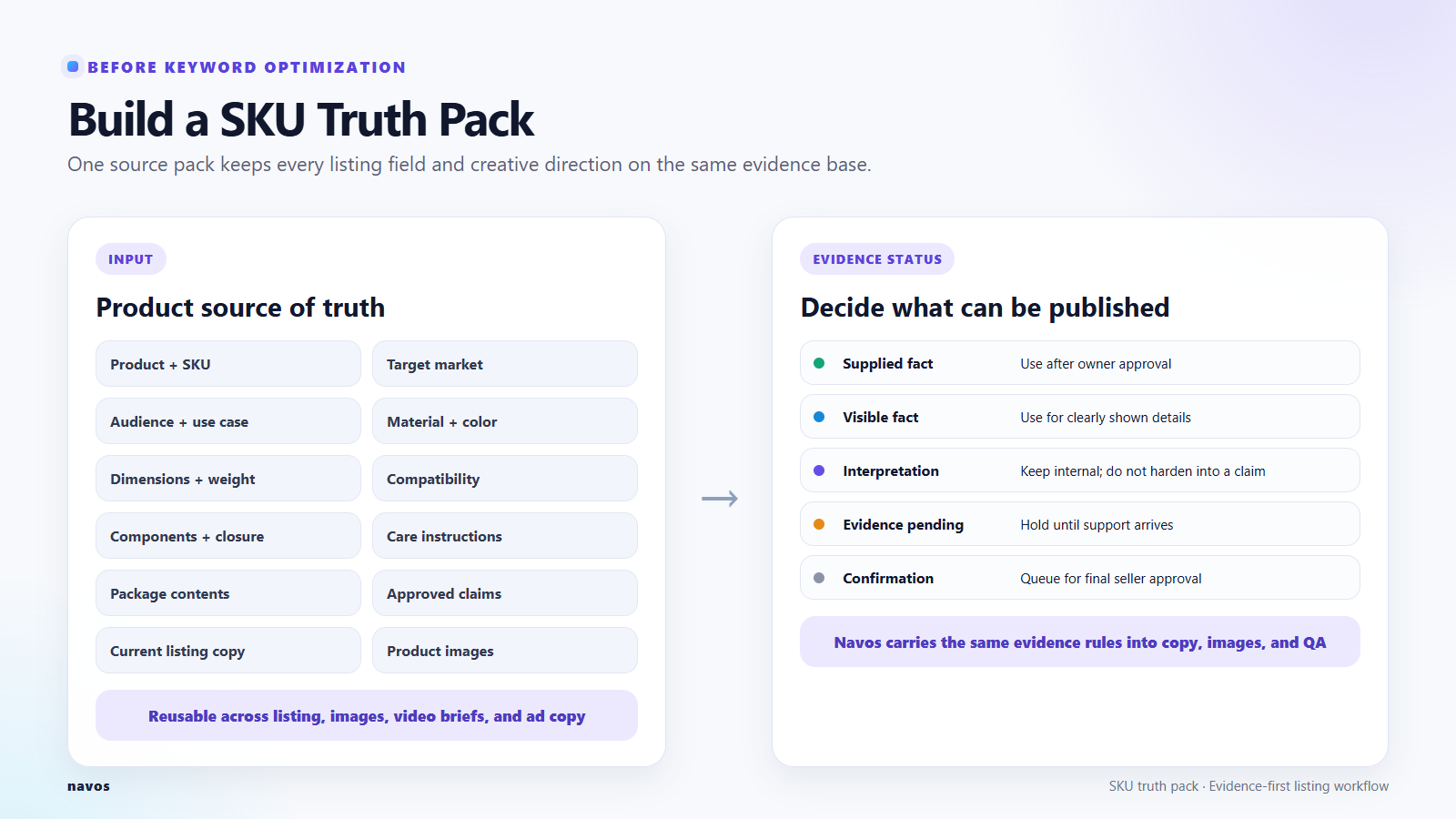
This step keeps the wording and the product evidence on the same track. Navos can use the truth pack as a constraint across the diagnosis, revised title, description, image directions, and final fact check. You can also reuse the same source pack for AI-assisted listing content, product videos, creator briefs, and ad copy.
1. Find Buyer-Language Keywords and Map Them to Listing Fields
Keyword research for TikTok Shop should begin with the language buyers use to identify the product, not a long list of loosely related phrases.
Start with five groups:
- Product type: what the item is.
- Use case: when or why someone uses it.
- Feature: a specific, supported characteristic.
- Compatibility or fit: the relevant size, device, body area, or environment.
- Audience or context: who the product serves, when that distinction is useful and supportable.
Use current Seller Center keyword recommendations, search suggestions, Product Opportunities, customer questions, and your own search-term or product-performance data where available. Product and competitor research may suggest additional language, but an external popularity signal does not make a phrase accurate for your SKU.
Then map each term to a field:
Keyword role | Best listing location | Example for a commuter backpack |
Core product term | Title, category, opening description | commuter backpack |
Compatibility | Title, attribute, description, image callout | fits devices up to 13 inches |
Supported feature | Title or description; image if visible | magnetic closure |
Use case | Title or description | office commute |
Material detail | Description and close-up image | water-based synthetic exterior incorporating recycled coffee grounds |
Color or variation | Attribute, variant, title if useful | coffee brown |
Do not force every term into the title. A field map keeps the listing readable and reduces repetition. Navos can turn a supplied keyword set into a structured map and check whether each phrase is supported by the SKU truth pack before it becomes public copy.
2. Write a Clear, Search-Relevant Product Title
A strong TikTok Shop product title answers four questions quickly:
- What is the product?
- What verified feature makes this version distinct?
- What fit, size, quantity, or use case matters to the buyer?
- Which terms are unnecessary, repetitive, promotional, or still awaiting evidence?
A practical title formula is:
Brand + core product type + verified feature or compatibility + use case + relevant variation
For example, a supported title from our test was:
RoastRoute Coffee Grounds Commuter Backpack – 13-Inch Laptop Sleeve, Magnetic Closure, Compact 36 cm Daypack, Coffee Brown
The title identifies the product and uses supplied facts for compatibility, closure, dimensions, use case, and color. Each term has a clear job instead of competing for attention.
How long should a TikTok Shop title be?
Current US TikTok Shop documentation gives several boundaries:
- The general product-listing guide allows 25–200 characters.
- The title-optimization guide recommends 40–150 characters.
- One add-product guidance passage recommends keeping the title at 80 characters or fewer.
Treat these as different layers of guidance, not one universal promise. A sensible working rule is to write the shortest title that clearly identifies the product and its highest-value supported details, then use the current Seller Center validator as the final technical check.
Avoid:
- Discounts, inventory messages, shipping promises, or urgency.
- Subjective claims such as “best,” “No. 1,” or “must-have.”
- Repeating the same product term or variant.
- Unverified certifications, material percentages, compatibility, capacity, or performance claims.
- Keyword strings that no shopper would read naturally.
3. Choose the Correct Category and Complete Product Attributes
TikTok Shop SEO is not limited to visible copy. Category and attribute data help define the product and prevent mismatches between what shoppers expect and what the page contains.
Check:
- The most specific accurate category available.
- Brand selection and any required authorization.
- Color, size, quantity, material, pattern, compatibility, and other supported attributes.
- Variation names that match the images and inventory.
- Dimensions and measurement units.
- Required safety, ingredient, age, or category disclosures.
Do not choose a neighboring high-volume category merely to chase exposure. Misclassification can create poor shopper expectations and platform issues. If an attribute is unknown, return to the product owner rather than guessing.
For a larger catalog, make category and attribute completeness part of the same Navos audit. The action list can separate copy improvements from missing data, so the marketplace operator knows which changes require a rewrite and which require a product or compliance owner.
4. Write a Description That Answers Purchase Questions
A useful description translates product facts into clear buying information. It should not duplicate the title sentence by sentence.
Use this structure:
- Opening summary: what the product is, its primary use case, and the most relevant supported distinction.
- Key features: concise bullets tied to real product facts.
- Fit and dimensions: compatibility, size, weight, or quantity where relevant.
- Use cases: specific situations the product is designed for.
- Care and package contents: what the buyer needs to know after purchase.
- Limitations or warnings: required information that affects fit or safe use.
Example opening:
The RoastRoute Coffee Grounds Commuter Backpack is a compact everyday bag made with a water-based synthetic exterior incorporating recycled coffee grounds. Designed for commuters carrying devices up to 13 inches, it weighs 0.74 kg (about 1.63 lb) and includes a dedicated device compartment, magnetic closure straps, and a drawstring main opening.
Notice what the paragraph does not say. It does not convert “incorporating recycled coffee grounds” into a specific recycled percentage. It does not call the bag waterproof, anti-theft, carbon-neutral, machine washable, or suitable for a larger laptop. Those claims require different evidence.
TikTok Shop guidance recommends a meaningful description rather than a thin fragment; the current US policy checklist uses 30 or more words as a best-practice reference. Length alone does not make the page useful. Organize the description into short paragraphs or bullets so a shopper can confirm fit, features, care, and package contents quickly.
5. Build an Image Sequence That Reduces Uncertainty
Product images do more than decorate the listing. They should answer questions that text cannot answer as quickly: shape, scale, texture, color, construction, fit, use, and what arrives in the package.
Current US guidance supports one to nine product images, recommends at least five high-resolution images, and uses 600 × 600 pixels as a minimum reference. The first image should present the product clearly on a white background without added text or logos. Additional images can show different angles and supported product details.
A practical sequence is:
- Hero image: full product, accurate color and shape, clean background.
- Alternate angle: side or back view that reveals construction.
- Scale or fit: the actual supported device, body, room, or use context.
- Feature detail: closure, control, pocket, texture, accessory, or material close-up.
- Dimensions: accurate measurement graphic using consistent units.
- Use case: product in the intended setting.
- Package contents: every included item, without extras that are not included.
- Care or limitation: where it materially affects purchase expectations.
Keep every visual aligned with the source facts. In our backpack audit, the supplied device limit was 13 inches, so the image plan called for an actual 13-inch device. Navos turned that fact into an explicit reshoot direction and paired it with a dimensions-and-weight graphic. This is more actionable than a generic suggestion to “improve product images.”
6. Check Evidence Alignment Across the Listing
Run a field-by-field consistency check before publication:
Compare | Questions to ask |
Title vs. product facts | Are material, size, quantity, compatibility, and performance accurate? |
Description vs. title | Do the two fields describe the same product and variation? |
Images vs. copy | Do visible components, scale, color, and package contents match the text? |
Attributes vs. variants | Are size, color, pattern, and quantity consistent across every option? |
Care instructions vs. claims | Does the page promise washability or resistance that the care guide does not support? |
Use case vs. evidence | Is the suggested use approved and represented accurately? |
Prioritize fact alignment before stylistic improvements. Compatibility, package contents, care, and variation accuracy matter more than replacing one adequate adjective or testing another lifestyle image.
This is one of the clearest Navos advantages in the workflow. The audit can compare the existing listing with the supplied evidence, carry approved facts into the revised copy, and preserve each material decision in a final fact table. The team gets a traceable reason for every important change.
7. Use Product Optimizer, Then Prioritize the Fixes
TikTok Shop's Product Optimizer can identify issues in titles, descriptions, images, missing attributes, and size-related information. Listing-quality tiers and product-level recommendations are useful inputs, but they still need operational priority.
Use this order:
- Resolve claims or fields that do not match the approved evidence.
- Correct product identity, category, compatibility, variants, and required attributes.
- Repair missing or misleading images.
- Rewrite the title around the core product term and verified differentiators.
- Improve description structure and purchase-question coverage.
- Add lower-priority keyword or visual tests.
For a large catalog, start with products that already have meaningful search volume, page views, or orders and where the team can act on the finding. Do not bulk-apply generated titles merely because bulk optimization is available. First define an approved title pattern and evidence rules for the category.
Navos complements Product Optimizer by converting the platform signal into a complete action artifact. The marketplace issue can be linked to revised copy, an image change, the responsible owner, and the product evidence that supports the decision.
Hands-On Test: What Navos Produced From One Product Listing
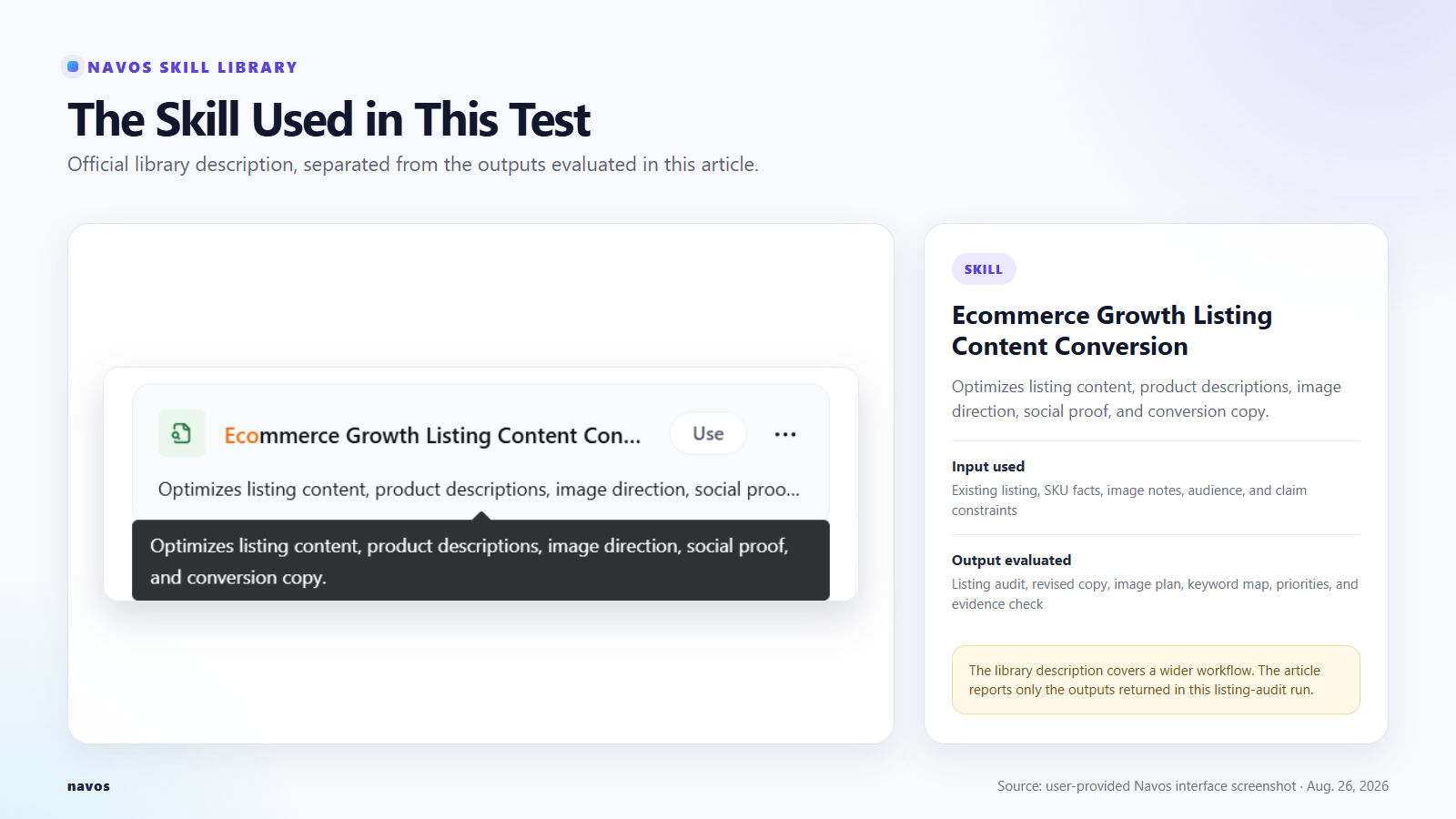
We tested the Navos
Ecommerce Growth Listing Content Conversion Skill on one US TikTok Shop listing for a coffee-brown commuter backpack.Skill detail | What it means |
Skill name | Ecommerce Growth Listing Content Conversion |
Navos library description | “Optimizes listing content, product descriptions, image direction, social proof, and conversion copy.” |
Used in this test | Auditing an existing listing and producing revised titles, a revised description, image directions, a keyword map, prioritized actions, and an evidence-status check |
The Skill description covers a wider conversion-content workflow. This article evaluates only the listing-audit outputs generated in the run described below.
Test input
The supplied material included:
- The current product listing.
- Product images and image notes.
- Target customer and use case.
- Exterior material, color, dimensions, and weight.
- Device compatibility.
- Closure type and pocket layout.
- Care instructions and package contents.
All of these facts came from the seller-side test input. They were not independently lab-tested during the audit.
Output and timing
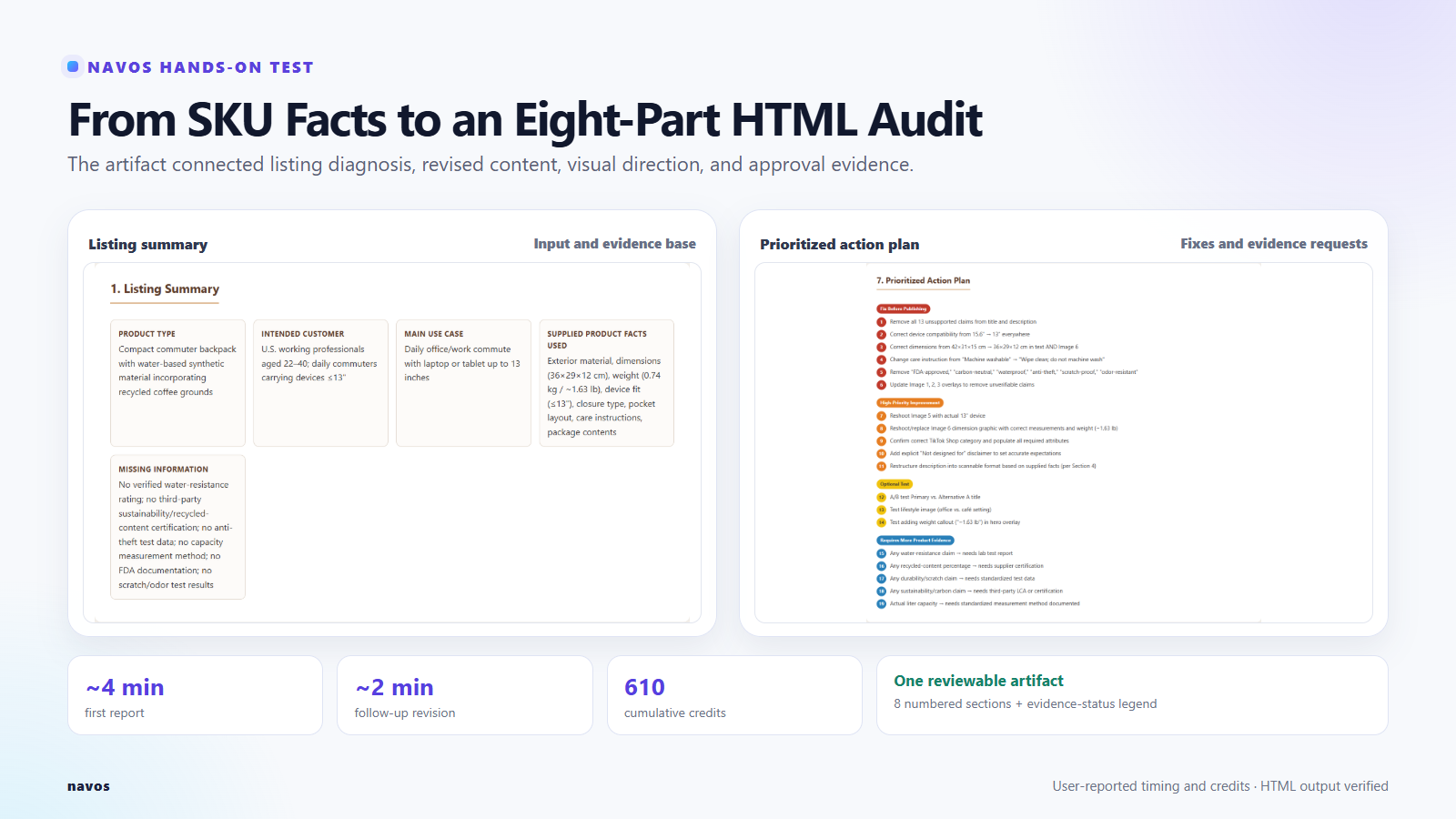
Navos produced an eight-part HTML audit:
- Listing summary.
- Diagnosis table.
- Three revised product titles.
- Revised description.
- Image optimization plan.
- Keyword map.
- Prioritized action plan.
- Final fact and compliance check.
The report also included an evidence-status legend so reviewers could distinguish supplied product facts, interpretations, evidence-pending items, and facts needing confirmation.
The first report took about four minutes. A follow-up revision took about two minutes. The reviewed workflow used 610 credits in total.
What the audit found
The audit flagged 13 statements that were absent from or inconsistent with the supplied facts. They covered material, environmental, resistance, security, device fit, capacity, certification, care, and use case.
Navos did not simply shorten the listing. It:
- Replaced the 15.6-inch device claim with the supplied 13-inch limit.
- Used the supplied 0.74 kg weight and converted it to about 1.63 lb for the US audience.
- Avoided inferring a capacity that had not been measured.
- Kept performance and certification language within the supplied evidence.
- Rewrote the title and description using supported product facts.
- Specified which images should be retained, replaced, or reshot.
- Turned the diagnosis into a prioritized action list.
- Preserved the support status of material claims in a final review table.
Why this is useful for an ecommerce team
The main advantage was the structure of the deliverable. One report connected the product evidence, current problems, revised listing, visual requirements, keywords, and approval questions. A seller can hand the artifact to a listing operator and creative team without rebuilding the logic in a spreadsheet, document, and chat thread.
The test did not measure ranking or conversion lift, so it should not be read as a performance guarantee. It demonstrates a faster and more reviewable route from raw SKU information to an approval-ready optimization plan. A final owner review remains necessary before public product claims are changed.
A Repeatable Navos Workflow for TikTok Shop Listing Optimization
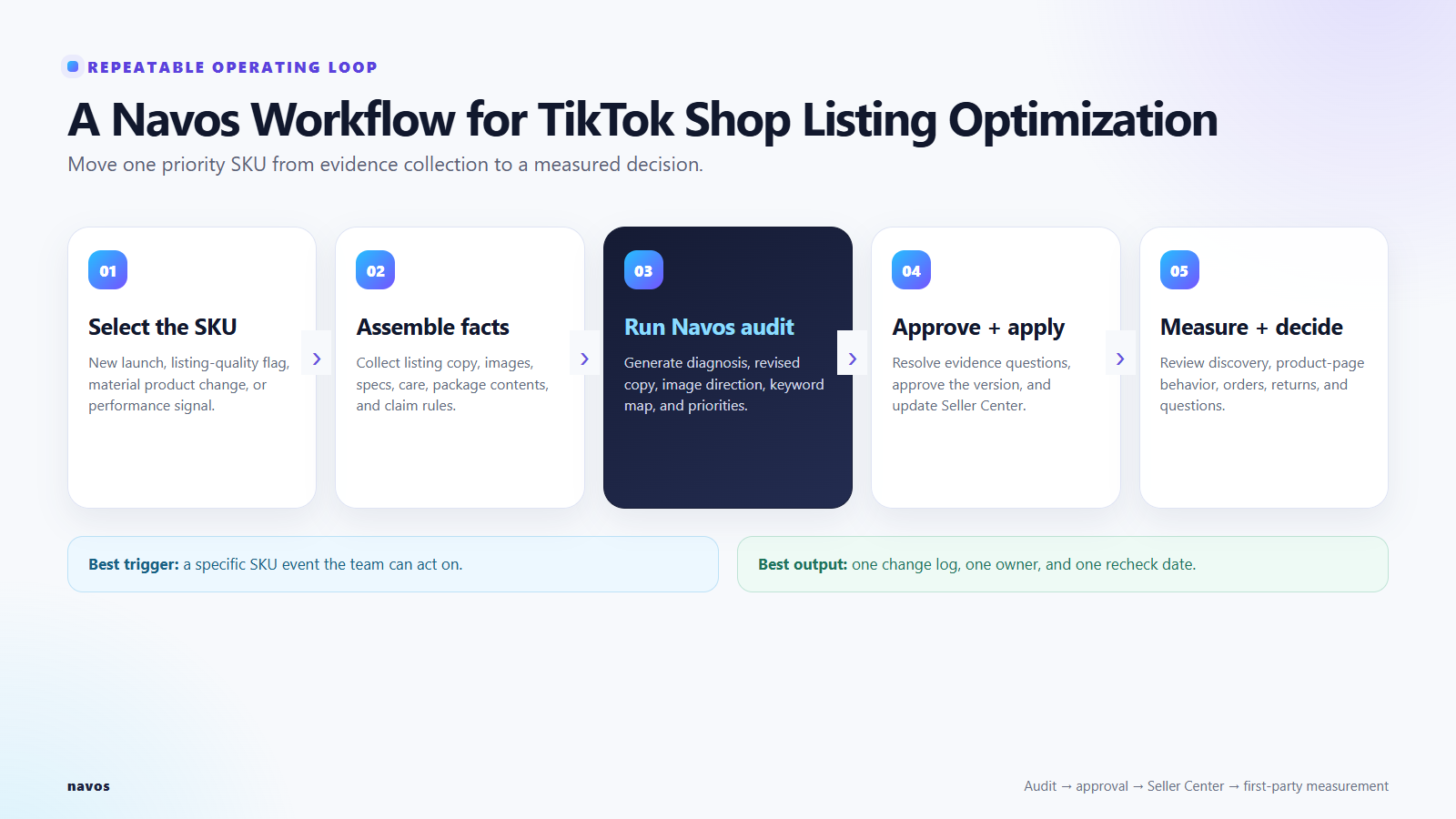
Use the audit as part of a controlled operating loop rather than a one-time rewrite.
Stage 1: Select the SKU
Choose a new product preparing for launch or an existing product with a clear reason for review: a listing-quality warning, a material SKU change, weak search discovery, product-page drop-off, repeated fit questions, or returns linked to expectation mismatch.
If the team is still deciding what to list, use product evidence and seller economics first. The Navos TikTok Shop product-research workflow helps separate a demand signal from a sourcing decision.
Stage 2: Assemble the truth pack
Collect the current listing, images, target market, audience, specifications, package contents, care instructions, required warnings, and approved or prohibited claims. Assign an owner to any missing field.
Stage 3: Run the Navos audit
Ask Navos for:
- A listing summary.
- A field-by-field diagnosis.
- Revised title options.
- A revised description.
- An image optimization plan.
- A keyword-to-field map.
- A prioritized action plan.
- A final evidence and compliance table.
This consistent request format makes reports easier to compare across SKUs and easier to hand off.
Stage 4: Approve and implement changes
Resolve evidence-pending items, approve the copy, create or replace the required images, and apply the selected changes in Seller Center. Record the date, affected fields, and previous version.
Stage 5: Measure and iterate
Review the relevant first-party data, connect the result to the changed field, and decide whether to keep, refine, or reverse the change. A broader TikTok Shop analytics workflow can help separate listing discovery, product-page behavior, orders, and post-purchase outcomes.
This process gives Navos a recurring operational role: launch readiness for new SKUs, repair for priority listings, and structured review after product or performance changes. For the rest of the seller stack, compare the jobs covered in our TikTok Shop tools guide.
How to Measure Whether a Listing Change Helped
Do not judge TikTok Shop SEO by rankings alone. Use a simple funnel:
Stage | What to review | What it may indicate |
Discovery | Search terms, search impressions or available discovery data | Whether the listing is being matched to relevant demand |
Product-page interest | Product page views and click behavior available in your account | Whether the product earns enough interest to open |
Purchase intent | Add-to-cart and checkout behavior where available | Whether the listing resolves enough questions to continue |
Orders | Orders and conversion performance | Whether the full offer converts; not attributable to SEO alone |
Post-purchase | Cancellations, returns, refunds, and recurring questions | Whether the listing set accurate expectations |
Price, reviews, shipping, inventory, content traffic, creator quality, promotions, and competition can all affect the same metrics. Keep a change log and avoid rewriting every field at once when a controlled test is possible.
A practical review cadence is event-driven:
- Before launch.
- After a material SKU, package, or compliance change.
- When Product Optimizer or Seller Center flags a listing issue.
- When search or product-page performance changes materially.
- When returns or customer questions reveal an expectation gap.
Priority SKUs can receive a weekly review if the team has enough traffic and the ability to act. Low-volume listings may need a longer observation window.
Pre-Publish TikTok Shop SEO Checklist
Use this final gate before approving the listing:
Product truth
Product name and SKU are correct.
Materials, dimensions, weight, quantity, compatibility, and package contents have an owner-approved source.
Required warnings and care instructions are present.
Claims awaiting evidence have been held from publication.
Keywords and title
The title leads with the core product identity.
Relevant feature, compatibility, use-case, or variation terms are natural and supported.
The title contains no promotion, repetition, inventory language, or subjective superlatives.
The live Seller Center validator accepts the title.
Category and attributes
The most specific accurate category is selected.
Required attributes are complete.
Variations match inventory, images, and copy.
Units and dimensions are consistent.
Description
The opening explains the product and primary use case.
Features are tied to supported facts.
Fit, size, care, package contents, and relevant limitations are easy to scan.
Every material statement in the description maps to approved evidence.
Images
The main image clearly shows the correct product and variation.
Additional images show useful angles, scale, details, use, and package contents.
Image callouts match the approved copy.
No image implies a different size, feature, accessory, or performance result.
Workflow
Product Optimizer issues have been reviewed.
High-risk corrections come before stylistic tests.
The approved version and change date are recorded.
The team knows which metrics and customer signals it will review next.
Frequently Asked Questions
What is TikTok Shop SEO?
TikTok Shop SEO is the practice of improving a product listing so TikTok Shop and shoppers can identify what the product is, when it is relevant, and whether it fits the buyer's needs. It includes keywords, title, category, attributes, description, images, consistency, and listing quality—not keywords alone.
How long should a TikTok Shop product title be?
Current US documentation includes a 25–200-character allowed range, a 40–150-character optimization recommendation, and an 80-or-fewer recommendation in one add-product passage. Write for clarity first and use the live Seller Center validator as the final technical check.
How many images should a TikTok Shop product listing have?
Current US guidance supports one to nine images and recommends at least five high-resolution images. The right number depends on what a shopper needs to verify: the full product, useful angles, scale or fit, important details, intended use, and package contents.
Can Navos optimize an existing TikTok Shop listing?
Yes. In our test, Navos converted an existing listing, product facts, image notes, and target customer into an eight-part HTML audit with revised titles and description, an image plan, keyword map, prioritized actions, and an evidence-status check. The approved changes can then be applied in Seller Center.
Can AI guarantee a higher TikTok Shop ranking?
No. AI can improve the structure, completeness, and reviewability of a listing, but it cannot guarantee ranking, traffic, conversion, approval, or GMV. Product demand, price, inventory, content, creator traffic, reviews, fulfillment, and competition also affect outcomes.
How often should I review TikTok Shop SEO?
Review a listing before launch and when a product, package, policy requirement, listing-quality signal, customer question pattern, or performance trend changes. High-priority SKUs can be reviewed weekly when the team has enough data and can act on the findings.
Final Takeaway
The strongest TikTok Shop SEO workflow begins before the title. It starts with accurate product evidence, maps buyer language to the right fields, aligns copy and images, and records what changed.
Navos makes that process easier to operate at SKU level. Instead of generating isolated copy, it can organize the current listing, product facts, keywords, visual requirements, risks, and approval questions into one structured audit. That gives sellers a faster path from “this listing needs work” to a prioritized, reviewable plan.
Run a TikTok Shop listing audit with Navos and bring your current listing, product images, target customer, approved SKU facts, and claim constraints.