Your product isn't a problem. The listing is.
On TikTok Shop, a well-made product can still underperform when its title buries the most important search terms, its selling points read like a spec sheet, and its description opens with a warning instead of a reason to buy.
The failure usually follows a simple chain:
Can't be found → Can't be understood → Can't convert
AI can help sellers identify what matters, prioritize product information, and turn raw features into clearer, more conversion-focused listing content. This guide walks through how — use a real fabric shaver listing as an example.
What Makes a Strong TikTok Shop Product Listing?
Before talking about AI, it's worth answering a more basic question: what does a good product listing actually do?
A strong TikTok Shop listing works across five dimensions:
- Title — Help shoppers find the product by combining the product type with the features and use cases people actually search for.
- Selling Points — Highlight the most important benefits, not every specification on the box.
- Description — Explain features, use cases, and value in language a shopper can understand in seconds.
- Visual Content — Show the product and its benefits quickly, ideally in the first few images.
- Conversion Content — Address the questions and concerns that stop someone from buying: shipping, returns, compatibility, safety, and what's included.
To see how this plays out in practice, compare two fabric shaver listings on TikTok Shop US:
Higher-sales listing | Lower-sales listing | |
Shop | Chuker Shop | RUNYES |
Price | $24.99 | $11.69 (was $23.38) |
Sold | 3.6K | 7 |
Title | Rechargeable Fabric Shaver, Lint Remover for Clothes… | Rechargeable Fabric Shaver with 2 Replaceable Stainless Steel 6-Leaf Blades(1 Free Extra Included) | Lint Remover with 3-Speed Settings & LED Display… |
Description opens with | Product value and use cases | Charging warning: "Use only a 5V 1A adapter… may damage the circuit board" |
The lower-sales listing isn't necessarily a worse product. It contains substantial product information: six-leaf blades, three speed settings, a digital LED display, multi-protection safety features, and a removable lint container. But the information is organized differently:
- The title leads with blade material and replacement count instead of what the product is and what it does.
- The description opens with a charging warning before the product value is established.
- Key selling points are listed in packaging order, so the buyer's core question — "what does this do for my clothes?" — isn't answered first.
The sales gap doesn't prove that one listing is better than the other. But it gives us a useful comparison: what happens when similar product information is organized differently?
Interestingly, the lower-sales listing is currently priced significantly lower, suggesting that price alone doesn't explain the difference in sales performance.
The Key to Better Listings: From Features to Customer Value
The single most useful shift a seller can make is also the simplest: stop listing features and start translating them into customer value.
Feature → Benefit → Selling Point
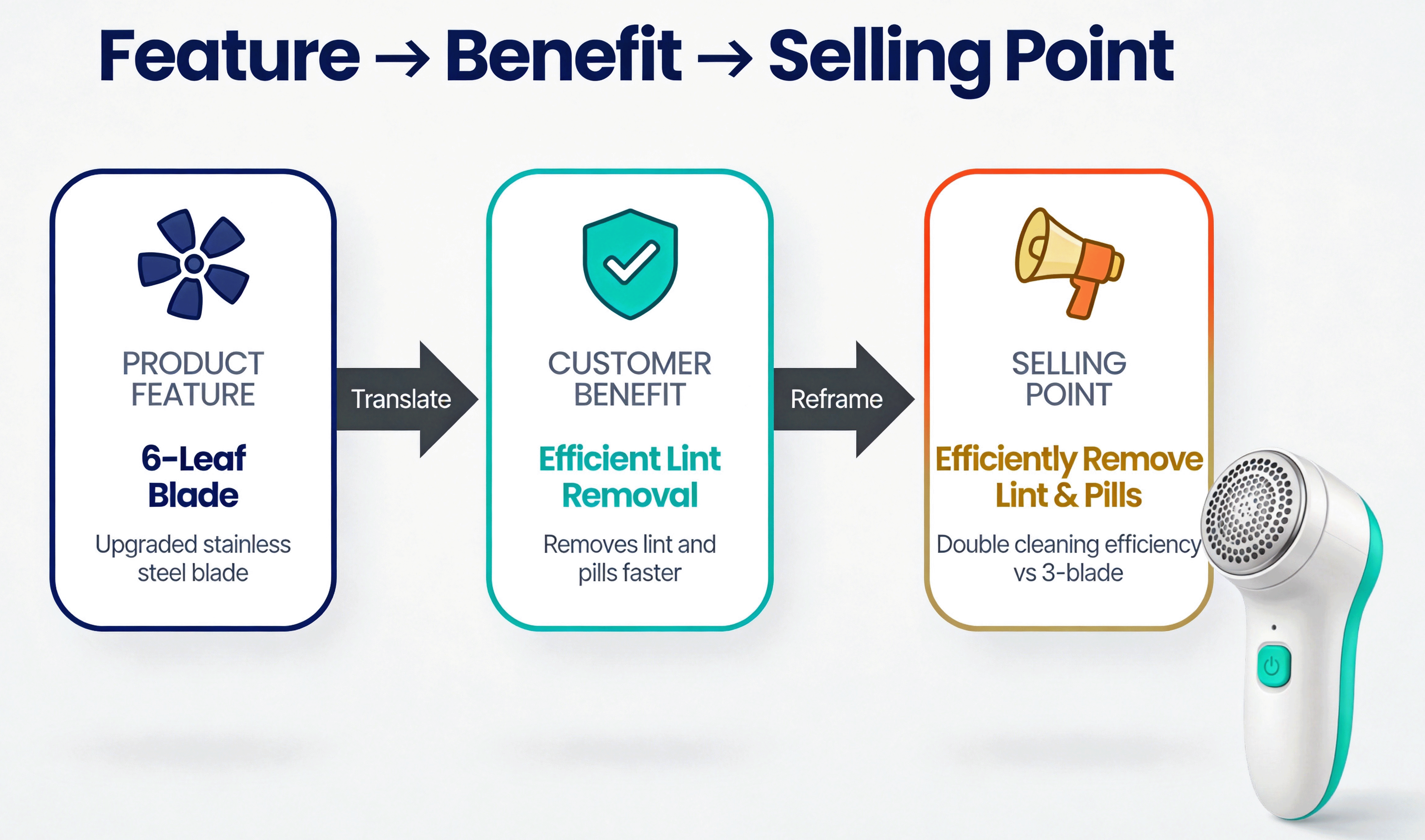
Take the fabric shaver:
Feature | Customer Benefit | Selling Point |
3-speed settings | Adjustable performance | Three speed settings for different fabric types and pilling levels — from socks and knitwear to thick sweaters and couch cushions |
6-leaf blade | More efficient cleaning | Upgraded 6-leaf blade designed for more efficient lint and pill removal compared to a standard 3-blade head |
Digital LED display | Clear visibility | Digital LED display makes it easy to monitor the speed setting during use |
The features don't change. What changes is the order of thinking: instead of "what does our product have?", the listing starts answering "what does this feature let the customer do?"
This is where AI becomes genuinely useful — not when it paraphrases a spec sheet, but when it can move beyond repeating product specifications and help sellers understand what those specifications mean to the customer.
How AI Can Improve Listing
AI listing optimization tends to create the most impact in three areas.
3.1 Prioritize the Right Information
More information isn't the same as better information. The RUNYES listing includes six-leaf blades, three speeds, LED display, safety protection, charging details, a removable lint container, and replacement blades — all valid features. But the question is: which information should shoppers see first?
AI can analyze a product against its category and audience, then reorder the information by buyer importance rather than by what's printed on the packaging. The result is a listing where the first title keyword, the first selling point, and the first image all answer the most common buyer question instead of the most technical one.
3.2 Make Titles and Selling Points More Customer-Focused
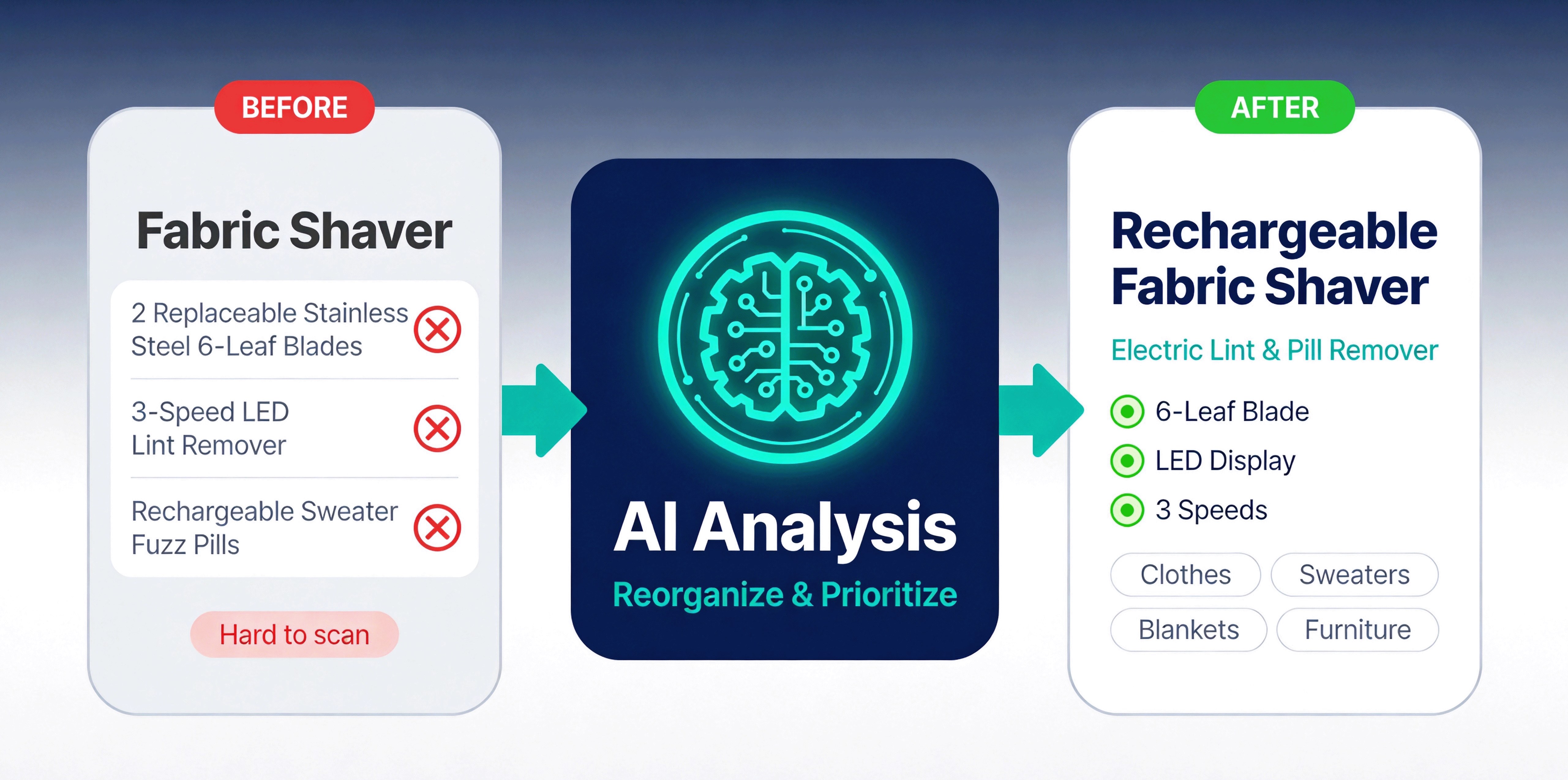
Compare the actual RUNYES title with a restructured version:
Before:
Rechargeable Fabric Shaver with 2 Replaceable Stainless Steel 6-Leaf Blades(1 Free Extra Included) | Lint Remover with 3-Speed Settings & LED Display - Efficient Sweater and Lint Shaver for Clothes, Removing Fuzz, Lint Balls, Pills.
After:
Rechargeable Fabric Shaver, Electric Lint & Pill Remover with 6-Leaf Blade, LED Display and 3 Speeds — for Clothes, Sweaters, Blankets, Curtains, and Furniture
The second version isn't shorter for the sake of being short. It has less specification stacking, a clearer product identity ("Lint & Pill Remover"), and stronger emphasis on relevant search terms and the actual use cases shoppers care about.
Optimization isn't about adding more keywords. It's about prioritizing the right information.
3.3 Turn Product Information into Conversion Content
Description, FAQs, and image direction should all work from the same product information — they just answer different shopper questions:
- Description explains what the product does, who it's for, and when to use it.
- FAQs address pre-purchase concerns: "Can I use it on different fabric types?", "How long does the battery last?", "What's included in the box?"
- Image direction turns key selling points into visual proof — a before/after on fabric, a close-up of the LED display, the three speed settings matched to fabric types.
The goal isn't to generate more content. It's to make the same product information easier to understand and act on.
AI Listing Optimization in Practice: A Fabric Shaver Case Study
Here's how this looks inside Navos, using the RUNYES fabric shaver listing as the input. The section follows the actual workflow: original listing, AI diagnosis, and AI optimization.
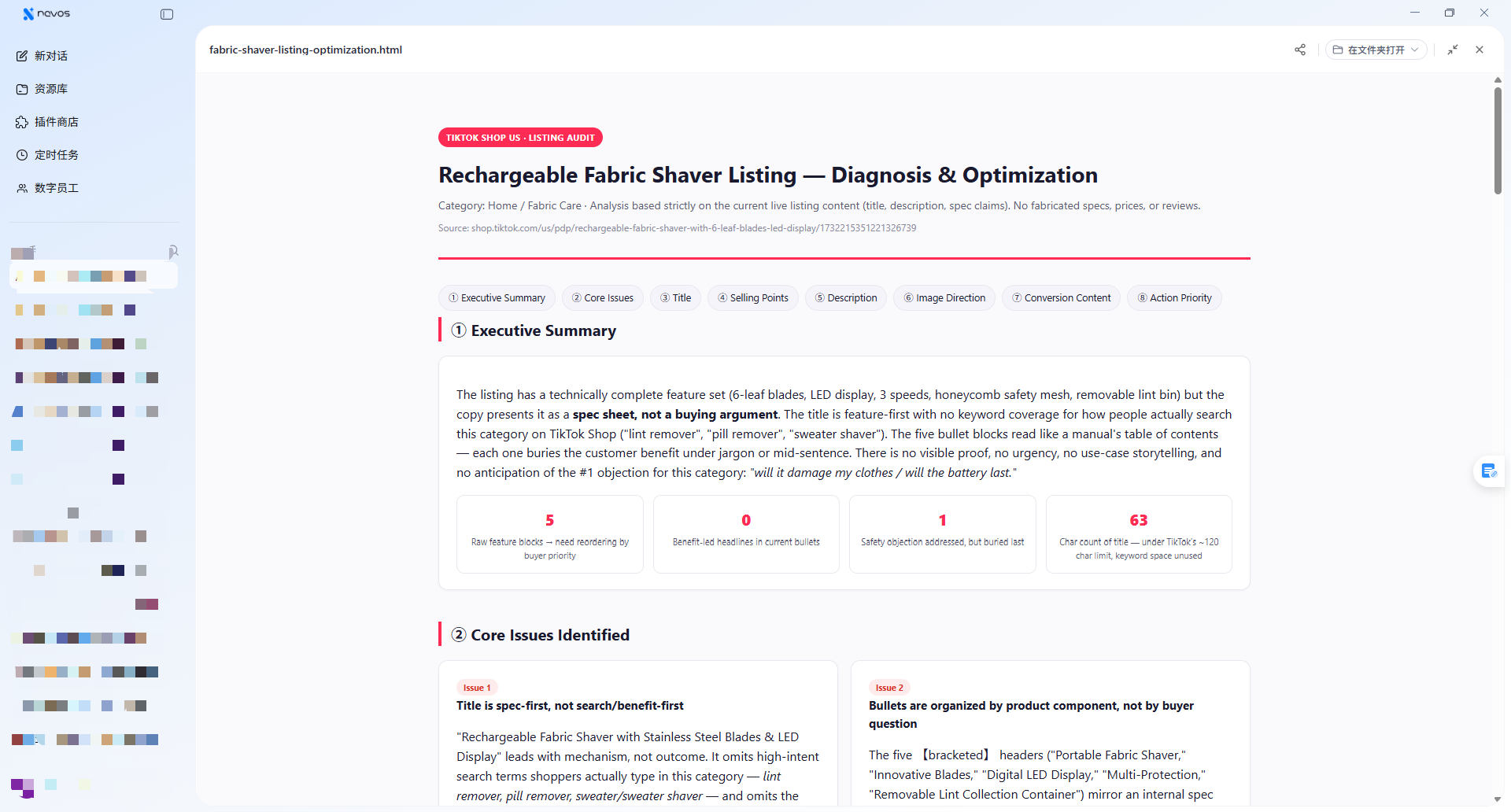
Original Listing
Title:
Rechargeable Fabric Shaver with 2 Replaceable Stainless Steel 6-Leaf Blades(1 Free Extra Included) | Lint Remover with 3-Speed Settings & LED Display - Efficient Sweater and Lint Shaver for Clothes, Removing Fuzz, Lint Balls, Pills.
Description opens with:
Note: Use only a 5V 1A adapter to charge the shaver. Fast-charging devices may damage the circuit board and render the shaver inoperable.
The listing contains valid product information — six-leaf blades, three speeds, digital LED display, rechargeable battery (2-hour charge for 3.5–4.5 hours of use), multi-protection safety, and a removable lint container. But it's presented in spec order, and the description leads with a warning.
AI Diagnosis
Navos analyzes the listing and surfaces four structural issues:
- Problem 1 — Spec-first title: The title leads with "2 Replaceable Stainless Steel 6-Leaf Blades" before identifying what the product is. A shopper scanning search results sees blade specs before "lint remover."
- Problem 2 — Selling points not prioritized: The description lists features in packaging order — portability, blades, LED, protection, container — instead of starting with the core benefit: removing lint and pills from clothes and furniture.
- Problem 3 — Warning placed too early: The very first line of the description is a charging caution ("Use only a 5V 1A adapter…"). Safety information matters, but it shouldn't be the first thing a shopper reads.
- Problem 4 — Visual content could be better structured: The listing should make the product's main benefit and use cases immediately clear through its first few images, guiding the shopper from "what is this?" to "does it work?" to "should I buy it?"
These aren't subjective opinions. They're structural patterns that separate listings shoppers understand from listings they scroll past.
AI Optimization
Navos reorganizes the product information and generates a restructured listing. Here are the three most impactful outputs.
① Title — Before → After
Before:
Rechargeable Fabric Shaver with 2 Replaceable Stainless Steel 6-Leaf Blades(1 Free Extra Included) | Lint Remover with 3-Speed Settings & LED Display…
After:
Rechargeable Fabric Shaver, Electric Lint & Pill Remover with 6-Leaf Blade, LED Display and 3 Speeds — for Clothes, Sweaters, Blankets, Curtains, and Furniture
The optimized title leads with what the product is ("Lint & Pill Remover"), front-loads the search-relevant features, and ends with use cases instead of blade material.
② Feature → Benefit → Selling Point
AI maps the raw specs through the value chain, staying strictly within what the original listing supports:
Product Feature | Customer Benefit | Selling Point |
6-leaf blade | More efficient lint removal | Upgraded 6-leaf blade provides double the cleaning efficiency compared to a standard 3-blade head |
3 adjustable speeds | Right setting for different fabrics | M1 for socks and knitwear, M2 for thick sweaters and jackets, M3 for coats, blankets, and sofas |
Digital LED display | Easy visibility during use | Monitor the speed setting at a glance |
Rechargeable battery | Cordless, long-lasting use | 2-hour charge delivers 3.5 to 4.5 hours of continuous use |
Multi-protection safety | Peace of mind during use | Bionic honeycomb mesh protects fabric; safety switch deactivates if the grid becomes loose |
The description is then rewritten to lead with value — what the product does, who it's for, and how to use it — before moving to charging notes and safety information.
③ Visual & Conversion Content
Beyond text, AI generates gallery direction based on the product's existing assets:
- Hero image: Product on a pilled garment with a clear before/after split — the most direct visual proof of what the product does
- Speed guide: M1 / M2 / M3 matched to fabric types, drawn from the product's own speed guidance
- Feature detail: Close-up of the digital LED display and 6-leaf blade, with the removable lint container shown detached for cleaning
For conversion content, Navos adds FAQ modules covering charging options (5V 1A adapter, computer, power bank, car charger), compatible fabric types, and what's included (shaver, 2 replaceable blades, with 1 extra included).
The result isn't simply a rewritten description. It's a more structured product listing built around what shoppers need to know and understand before they buy — and every claim traces back to the original product information.
How to Get Better Results from AI Listing Tools
The quality of AI output depends almost entirely on the quality of input. Three things make the biggest difference:
1 . Give AI accurate product information.
Don't make it guess dimensions, materials, battery capacity, or blade count. The RUNYES listing includes concrete specs — 180g, 2.4×2.3×6 inches, 2-hour charge, 3.5–4.5 hours of use. Pass those through. Wrong input produces wrong listings, and incorrect specifications erode trust fast.
2 . Define the market and audience.
A fabric shaver sold on TikTok Shop US uses different language, imagery, and priorities than one sold in the UK or Southeast Asia. Tell the AI who you're selling to and where.
3 . Provide use cases and constraints.
Don't only list what the product has. Tell the AI how customers actually use it — and what it shouldn't claim. The RUNYES listing specifies which speed setting matches which fabric type; that's useful context that makes the output more specific. Clear constraints also prevent AI from inventing selling points that aren't true.
Frequently Asked Questions
What makes a good TikTok Shop product listing?
A good TikTok Shop product listing combines a clear and search-relevant title, benefit-ordered selling points, a description that explains features and use cases, visual content that shows results quickly, and conversion content that answers pre-purchase questions. Together, these elements help shoppers find the product, understand its value, and feel confident enough to buy.
Can AI optimize an existing product listing?
Yes. AI can analyze an existing listing, identify structural issues — such as spec-first titles, poorly ordered selling points, or warnings placed before product value — and reorganize the product information into clearer titles, selling points, descriptions, and conversion content. The seller still needs to review the output for accuracy, but AI can significantly reduce the time spent diagnosing and rewriting.
What information should I provide to an AI listing tool?
At minimum: product name, accurate features and specifications, target market, target audience, and selling platform. For better results, include use cases, common customer questions, compatible fabrics or devices, what's included in the box, and any claims the product should not make. The more accurate context you provide, the more specific and trustworthy the generated listing will be.
Final Takeaway
Optimizing a product listing with AI isn't about pushing a button and getting a perfect page. It follows a clear chain:
Existing Listing → AI Diagnosis → Prioritize Value → Optimize Content → Review
AI doesn't replace product knowledge. It helps sellers organize product information around what shoppers need to find, understand, and trust.
Navos helps streamline this process by turning product information into structured selling points, titles, descriptions, visual directions, and conversion content in one workflow — so a good product finally gets the listing it deserves.