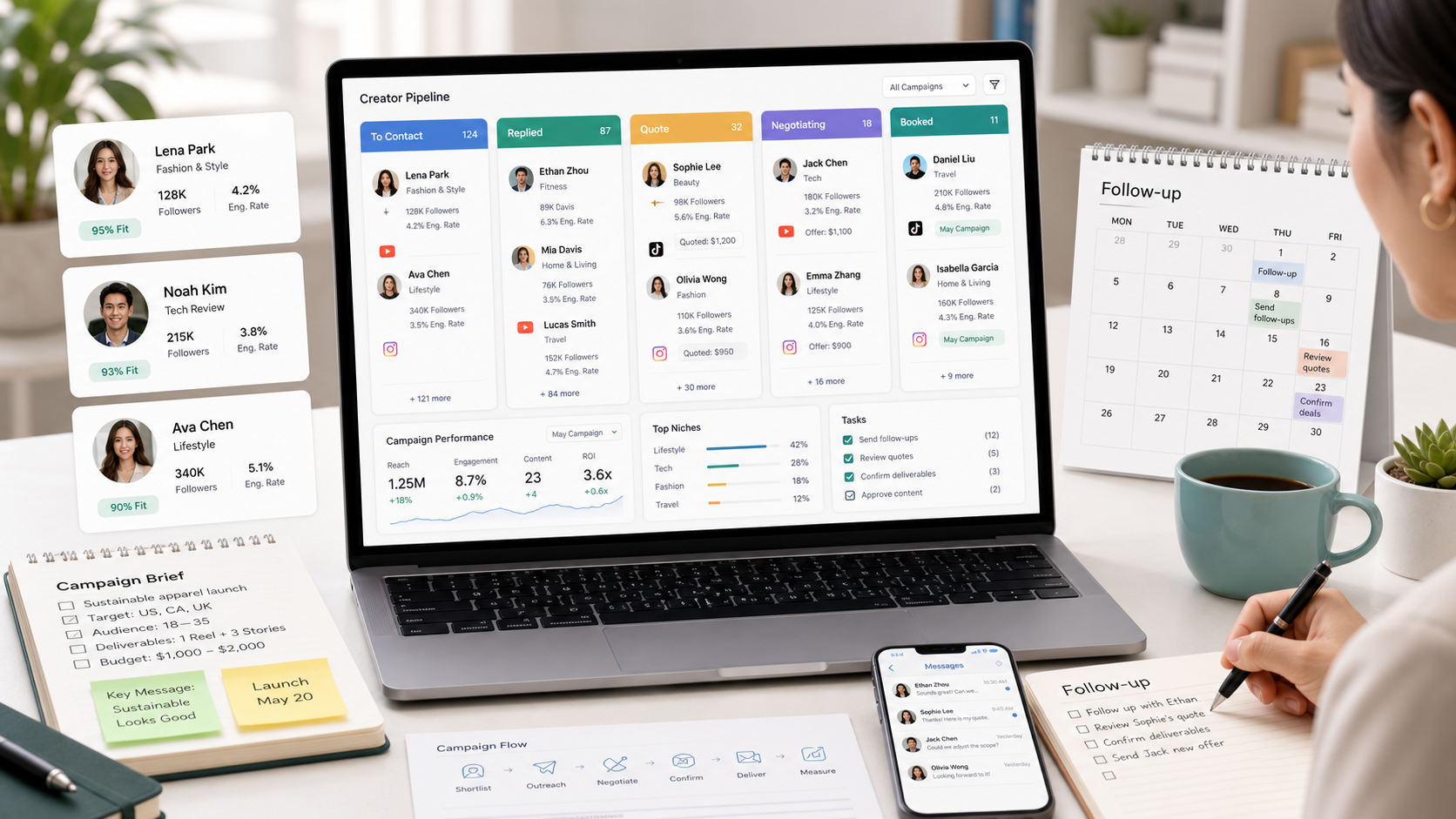

The TikTok Shop affiliate program lets sellers work with creators who promote products in shoppable videos, LIVEs, and affiliate links. In a commission-based collaboration, the creator earns when an attributed sale is made. Sellers can also use selected Target Collaborations with a flat creator fee when they need a specific video deliverable.
The simple part is turning the program on. The difficult part is deciding which products can support commission, which creators deserve samples, what to measure after content goes live, and when to stop spending.
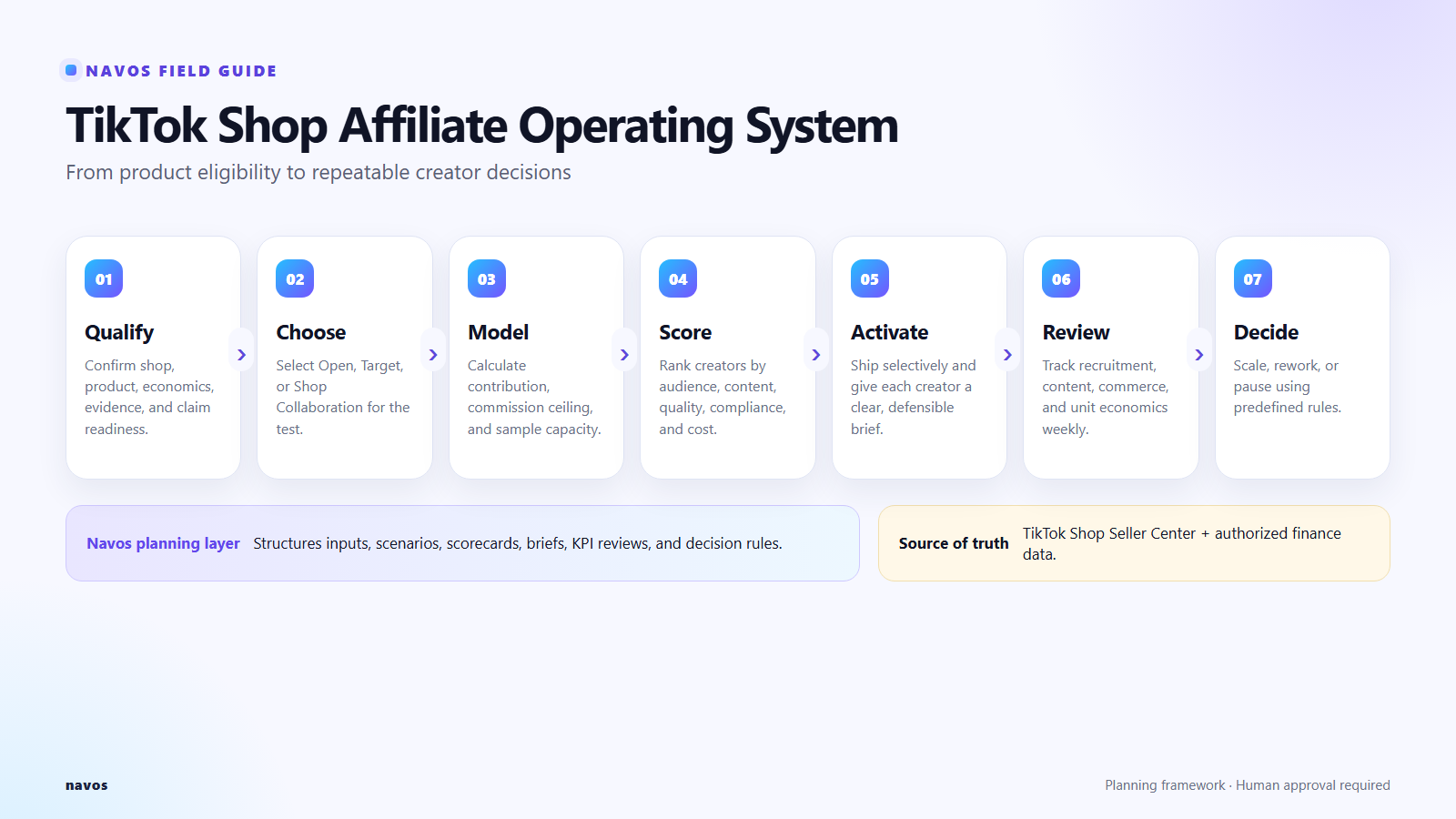
For a seller, the practical operating system is:
- Confirm that the shop, product, and creator are eligible.
- Choose the right collaboration type.
- Calculate commission and sample limits from unit economics.
- Score creators before outreach or sample approval.
- Track every creator from invitation to attributed order.
- Review contribution, content, and compliance every week.
- Scale only the combinations that remain profitable after all costs.
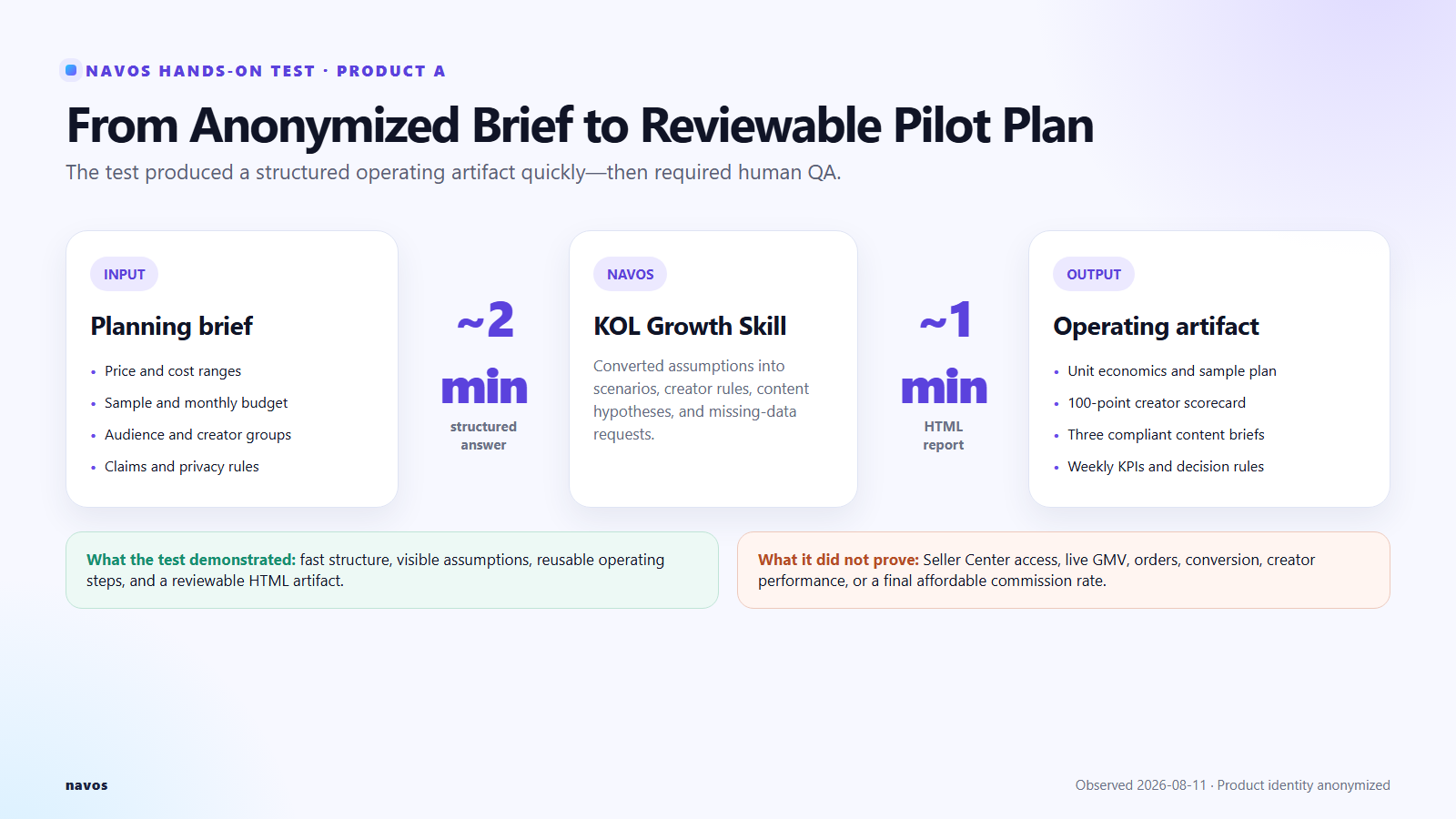
To test that workflow, we gave Navos an anonymized Product A brief with price, cost, sample, budget, audience, creator, and compliance inputs. The KOL Growth Community Social Growth Skill returned a structured answer in about two minutes and generated an HTML operating report in about one additional minute. It produced the scenario math, sample plan, creator scorecard, content hypotheses, weekly KPIs, and missing-data list used throughout this guide. Human review still had to correct several calculations and evidence labels before publication.
Navos is the planning and analysis layer in this workflow. TikTok Shop Seller Center and authorized finance data remain the source of truth for eligibility, commission settings, orders, refunds, and live performance.
Navos at a Glance: Six Practical Advantages
Navos does more here than generate a generic affiliate checklist. In the Product A test, it converted scattered commercial inputs into a reviewable operating system. These were the six clearest advantages observed in the workflow:
Navos advantage | What we observed in the Product A test | Why it matters to a seller |
Fast first planning draft | The Skill answered in about two minutes and generated the HTML report in about one additional minute | A team can move from loose inputs to a structured review without manually building every table first |
End-to-end operating structure | One report covered evidence readiness, unit economics, sample capacity, creator scoring, content briefs, a 30-day plan, weekly KPIs, and decision rules | Budget, creator, content, and measurement decisions stay connected instead of living in separate documents |
Evidence-aware output | The report separated supplied inputs, calculations, proposed rules, and unavailable data; live commission, fees, GMV, orders, conversion, and ROI were not invented | The team can see which conclusions are usable now and which require Seller Center or finance data |
Scenario-based decisions | Navos compared downside, base, and upside economics and exposed that the planned sample volume worked only under some budget combinations | Sellers can test the consequences of assumptions before committing samples or fixed creator fees |
Reusable creator operations | The Skill produced a 100-point scorecard, segment-specific briefs, a shared pipeline, and scale/rework/pause logic | The first pilot becomes a repeatable weekly system rather than a one-time creator list |
Flexible path from planning to live review | Sellers can begin with the free Price Calculator and supplied planning inputs, then use authorized TikTok API data or uploaded exports when live campaign fields are available | The workflow can start before launch and become more evidence-rich as the program generates real data |
The central advantage is not automatic access to a secret creator database or a guaranteed campaign outcome. It is the ability to turn assumptions, costs, creator criteria, content requirements, and later performance data into one decision-ready artifact. Because the formulas and missing fields remain visible, a human reviewer can challenge the output before money or live actions are approved.
What Is the TikTok Shop Affiliate Program?
TikTok Shop Affiliate connects eligible sellers and creators inside TikTok Shop. Sellers make qualified products available for promotion, creators publish content with a product link, and the platform attributes eligible sales and handles commission payment.
For sellers, this is not automatically a no-upfront-cost channel. A commission-only offer pays when a sale occurs, but your program may still include samples, shipping, staff time, creative fees, refunds, and paid usage rights. A Target Collaboration can also use a flat fee for an approved video.
Treat affiliate as a measurable creator acquisition and content operation, not a switch that guarantees sales.
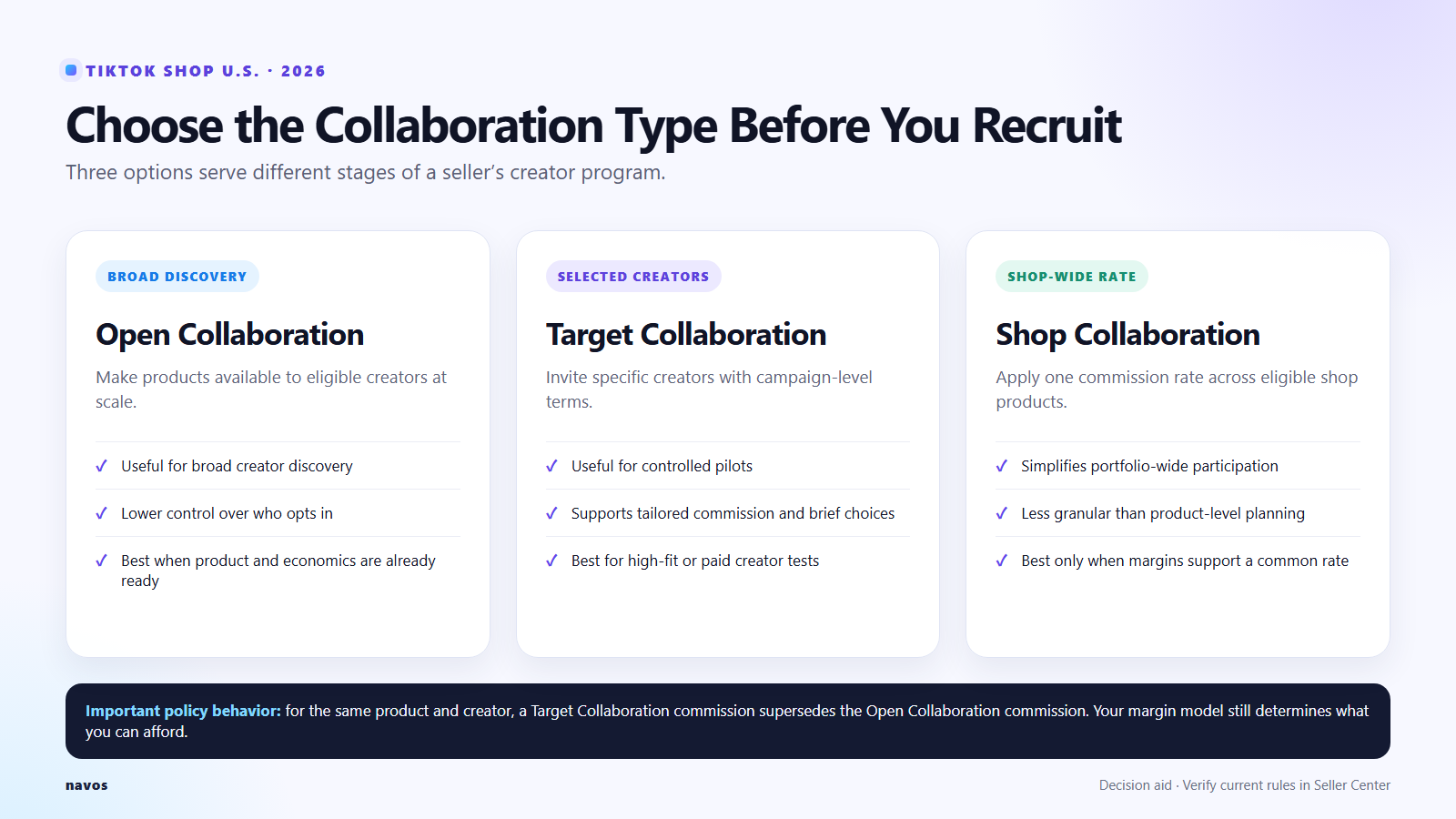
The three U.S. collaboration types in 2026
TikTok Shop's U.S. Affiliate Marketing Policy dated July 15, 2026 lists three collaboration types. Some older tutorials describe only Open and Target Collaboration, so check the current policy and your Seller Center interface before launch.
Collaboration | How it works | Best use | Main control point |
Open Collaboration | Qualified products are visible to affiliate creators, who can apply to promote them after seller approval | Broad creator discovery and commission-only testing | Product eligibility, commission, approval, and optional sample settings |
Target Collaboration | The seller invites specific creators to promote selected products | High-fit creators, hero content, or a controlled hybrid test | Creator selection, product, duration, fee structure, samples, and brief |
Shop Collaboration | The seller applies one universal commission rate across all affiliate products | A consistent shop-wide base offer | Whether one rate is economically safe across the full eligible catalog |
Target Collaboration deserves one more distinction. TikTok Shop's help documentation describes both commission-only and flat-fee structures. The flat-fee option is for video deliverables and is paid through TikTok Shop after approval. Commission-only pays when a sale occurs and is not limited to video.
If the same product is in Open and Target Collaborations, TikTok states that the Target commission supersedes the Open commission for that creator. That platform behavior does not tell you what rate you can afford; your margin model must do that.
Where Navos Fits Before You Launch
You do not need to wait for a completed campaign to use Navos. It can help structure the decisions that must exist before the first invitation or sample shipment.
Navos supports official TikTok API-connected advertising and shop scenarios as well as user-authorized file and planning workflows. The Product A test deliberately used supplied planning inputs rather than a connected Seller Center, so it is a planning and QA case—not evidence of a live campaign.
Seller decision | Navos workflow | Source-of-truth boundary |
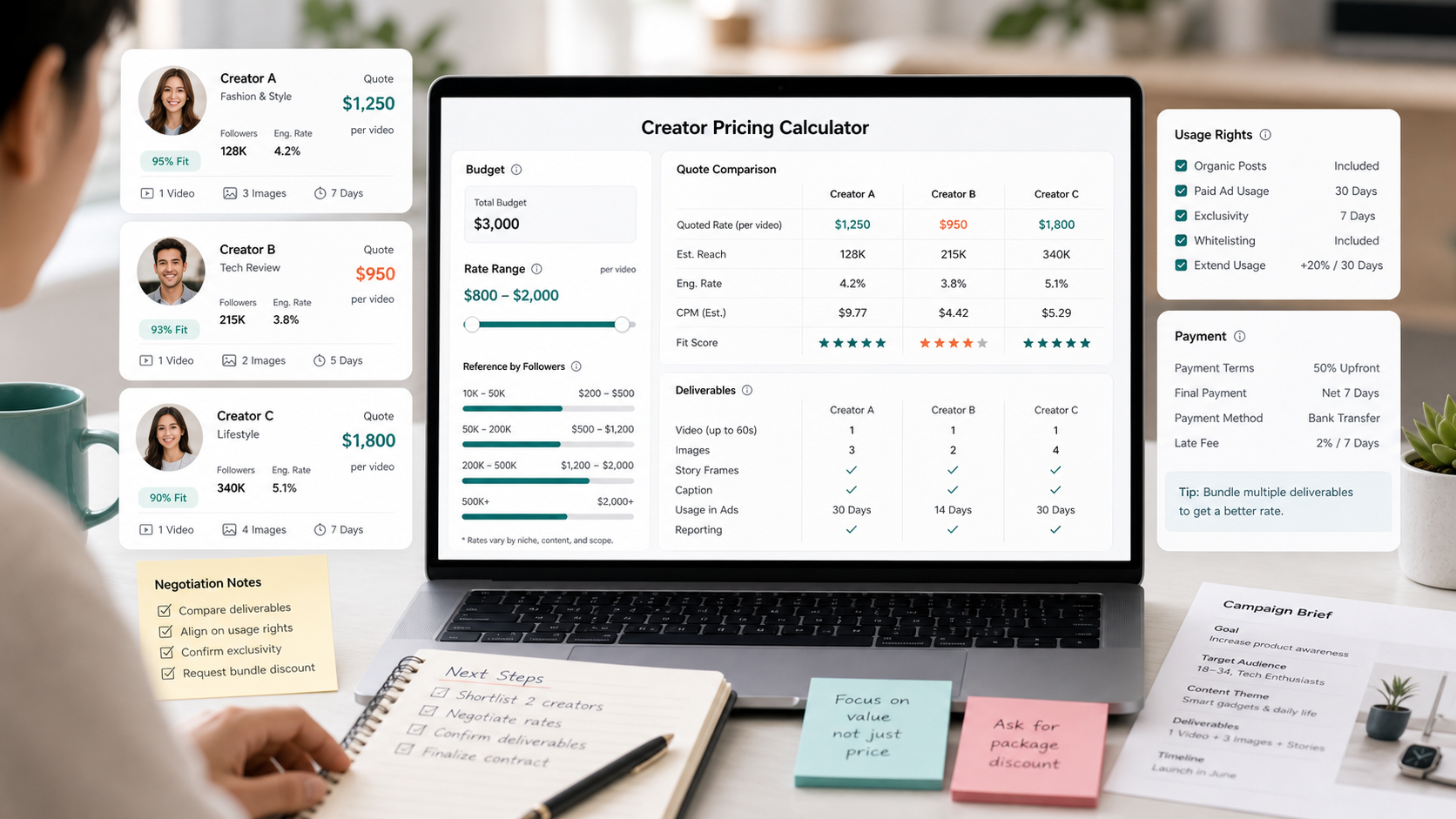
What might a paid or hybrid creator cost? | Use the free Influencer Price Calculator for a planning range by platform, niche, and follower band | The result is not an affiliate commission or guaranteed creator quote |
Can the product support commission and samples? | Give the Skill the price, cost, fulfillment, fee, refund, sample, and profit inputs; request downside, base, and upside scenarios | Missing finance inputs must remain unavailable rather than estimated |
Which creators should receive an invitation or sample? | Build a weighted scorecard around audience fit, content fit, engagement quality, compliance, reliability, and budget | Seller Center data and human content review still determine the final decision |
What should the creator publish? | Generate segment-specific briefs with proof requirements, prohibited claims, disclosure, and product-link checks | A human owner approves claims and any legal or brand requirement |
What happens after content goes live? | Turn authorized TikTok data or uploaded exports into a weekly review with actions and missing-data flags | A planning report cannot prove GMV, orders, conversion, or ROI without live data |
For a quick starting point, use the Navos Influencer Price Calculator for a paid-creator reference, then open Navos and use KOL Growth Community Social Growth Skill to build the complete pilot around your own economics.
Check Eligibility Before Recruiting Creators
Do not build a 500-creator list before verifying whether the shop and product can participate.
As of the July 15, 2026 U.S. policy:
- A shop needs a Shop Performance Score of at least 3.5 to qualify.
- Each product is evaluated separately. Its Voice of Customer Index must be below 1.5 times its category average when it is added, and it must not carry specified intellectual-property, fair-trading, customer-review, authenticity, or originality problems.
- Creator eligibility can depend on category. The policy lists a Promotion Performance Score of at least 3.5, a Creator Health Rating of at least 150, sales history, and sustained content quality among the signals.
These are policy thresholds, not campaign success benchmarks. TikTok can change them, and qualification does not mean a product will convert.
Before recruiting, record four readiness checks:
Check | Question | Decision if missing |
Shop | Is the shop currently eligible for Affiliate Marketing? | Fix account health before scaling recruitment |
Product | Is the selected SKU eligible, in stock, and operationally ready? | Do not recruit against an unavailable or unstable listing |
Economics | Can the product support commission, samples, fees, refunds, and target profit? | Calculate a ceiling before publishing the offer |
Evidence | Do you have first-party fields to track invitation, content, clicks, orders, revenue, and costs? | Define the export and owner before launch |
Set Commission From Unit Economics, Not a Generic Benchmark
TikTok Shop currently allows a wide commission range in Open and Target Collaborations. A supported range is not a recommended rate. The right rate depends on the contribution left after every cost that changes with the order.
In the Navos test, the Skill did not turn the Price Calculator result into a commission rate. It marked the seller-selected commission, platform fees, payment fees, refunds, and final affordable commission as unavailable, then built scenarios only from the supplied inputs. That evidence discipline is more useful than a precise-looking percentage built on missing costs.
Start with this planning formula:
Maximum affordable commission rate = (expected order revenue before creator commission − product cost − fulfillment − platform and payment fees − expected refund cost − target profit − allocated sample and fixed-fee cost per order) ÷ commissionable order value
Use the commissionable order value and fee definitions shown in your Seller Center and finance data. If you already have actual attributed orders and revenue, use them. Conversion rate is only needed when you must derive expected orders from clicks.
The final affordable rate is unavailable until the missing costs are supplied. Do not fill those gaps with a creator-rate calculator, a competitor's public offer, or a category average.
Product A: why sample cost changes the answer
Product A is an anonymized U.S. beauty and hair-care tool. The user-supplied planning inputs were:
- Retail price: $14.50–$18.00
- Product cost: $1.20–$2.50
- Fulfillment: $3.50–$4.50
- Delivered sample cost: $15–$20
- Target net margin: at least 25%
- Monthly creator and sample budget: $3,000–$5,000
- Proposed volume: 150–250 samples per month
These inputs were not audited against a live seller account. They are useful for scenario planning, not for claiming actual profit.
Scenario | Retail price | Product cost | Fulfillment | Contribution before fees, refunds, commission, sample, and target profit |
Downside | $14.50 | $2.50 | $4.50 | $7.50 |
Base | $16.25 | $1.85 | $4.00 | $10.40 |
Upside | $18.00 | $1.20 | $3.50 | $13.30 |
At a delivered sample cost of $15–$20, Product A needs approximately two to three attributed orders just to recover one sample cost in these scenarios. That calculation is still before platform fees, refunds, creator commission, and target profit. The true payback threshold therefore remains unavailable.
Reserve budget before approving samples
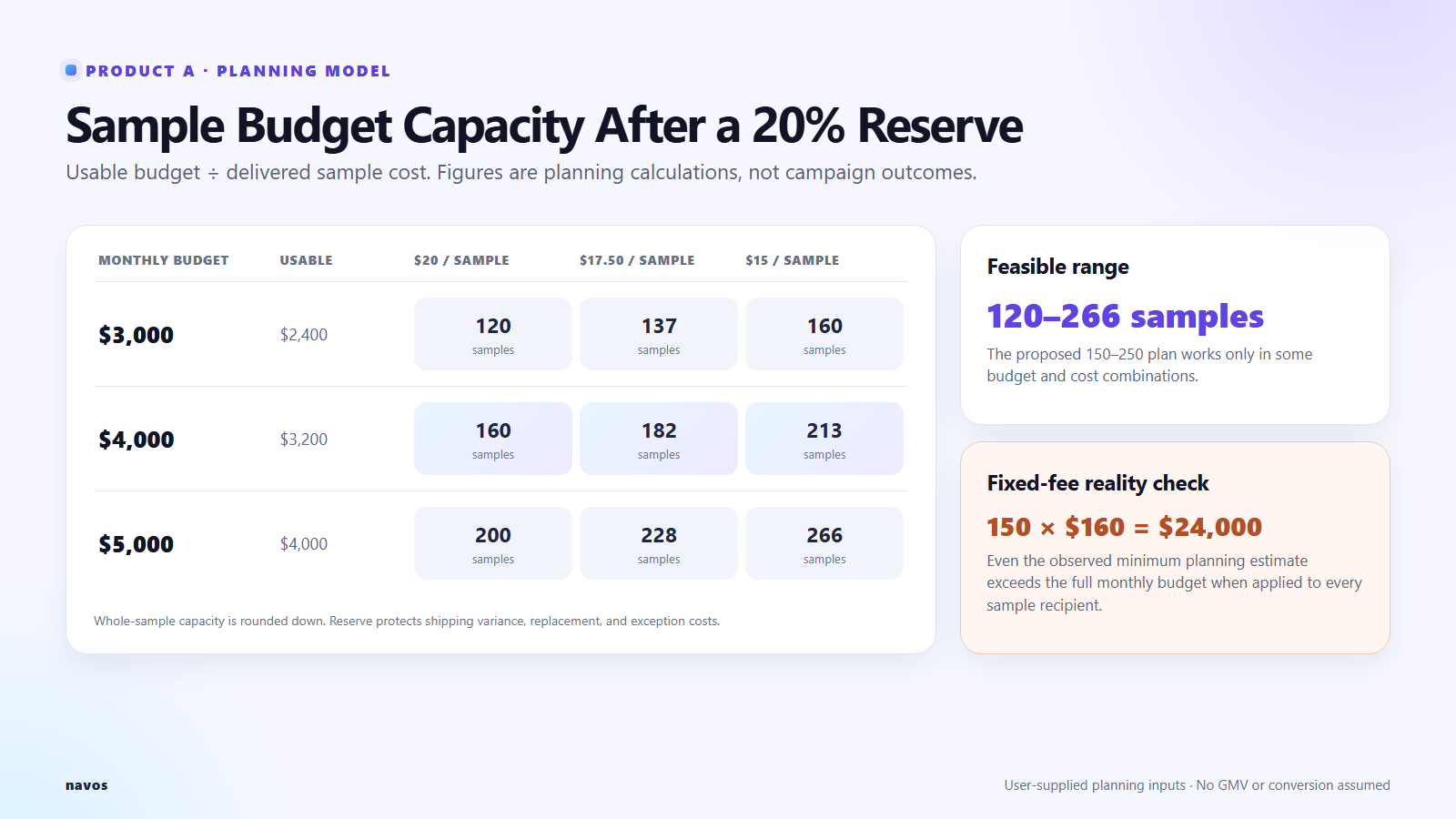
If Product A holds 20% of its $3,000–$5,000 monthly budget as an operating reserve, the remaining budget funds approximately 120–266 samples at $15–$20 each.
Monthly budget | Usable after 20% reserve | Samples at $20 | Samples at $17.50 | Samples at $15 |
$3,000 | $2,400 | 120 | 137 | 160 |
$4,000 | $3,200 | 160 | 182 | 213 |
$5,000 | $4,000 | 200 | 228 | 266 |
The proposed 150–250 monthly sample plan is feasible only in some budget and cost combinations. It is not a safe default across the whole range.
Use two budget tracks:
- Affiliate-only track: commission plus an approved free or refundable sample when appropriate.
- Hybrid track: sample plus a fixed creator fee plus commission for a small number of high-priority creators.
Do not pay a fixed content fee to every sample recipient. In the Navos test, the lowest displayed TikTok Beauty creator-price range started at $160. At that floor, fixed fees alone would cost $24,000 for 150 creators or $40,000 for 250 creators—before samples and commission.
For the Product A pilot, a $500 hybrid carve-out supported two paid creators after including a $160 planning fee and $20 sample per creator. An $800 carve-out supported four using a $160 fee and $15 sample. The rest of the program could remain commission- and sample-based.
Score Creators Before You Invite or Ship
Follower count is a routing field, not a qualification decision. A smaller creator with the right hair type, repeatable demonstration format, and buyer questions in the comments may be more useful than a larger general lifestyle account.
The Navos Product A plan used four creator segments:
- Curly-hair creators
- Hair and beauty educators
- GRWM and lifestyle creators
- Mom and family creators
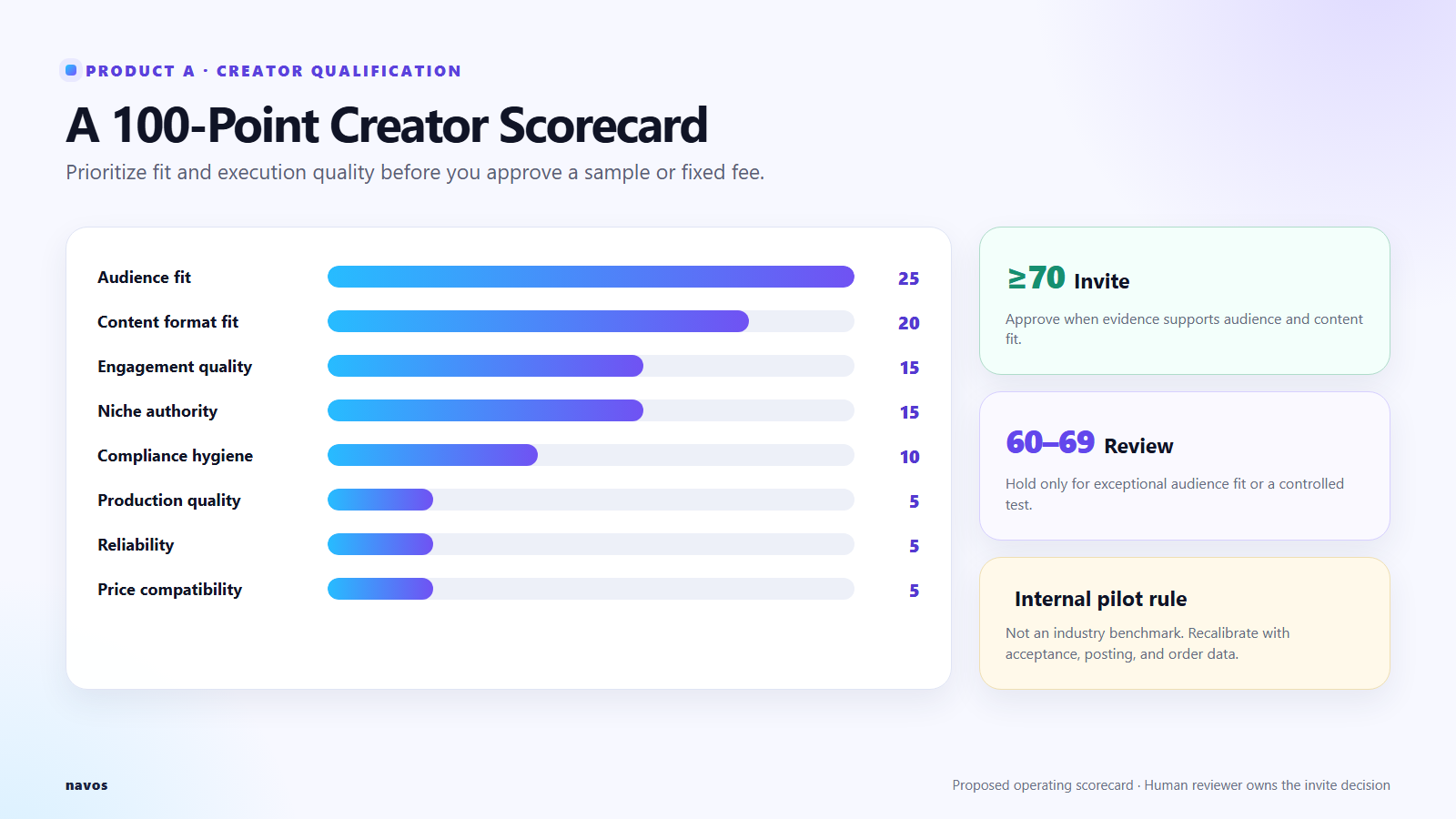
The Skill then turned those segments into a 100-point scorecard so that sample approval, Target invitations, and paid tests follow the same logic.
Scorecard pillar | Points | What to review |
Audience fit | 25 | U.S. audience, age and need-state fit, hair type, or parent use case |
Content-format fit | 20 | Demonstration, GRWM, routine, tutorial, or problem-solution format |
Engagement quality | 15 | Relevant comments, saves, watch-time consistency, and buyer questions |
Niche authority | 15 | Credible education or repeated experience in the product problem |
Compliance hygiene | 10 | Disclosures, truthful claims, and no prohibited medical or competitor claims |
Production quality | 5 | Lighting, sound, framing, and ability to show the result clearly |
Reliability | 5 | Response, prior collaboration completion, and on-time delivery |
Price compatibility | 5 | Fit with affiliate-only, sample-only, or the paid pilot budget |
Total | 100 |
For this pilot, Navos proposed inviting creators who scored at least 70 and holding 60–69 for exceptional audience fit. That is an internal test rule, not an industry benchmark. Your team should revise the threshold after it has real acceptance, posting, and order data.
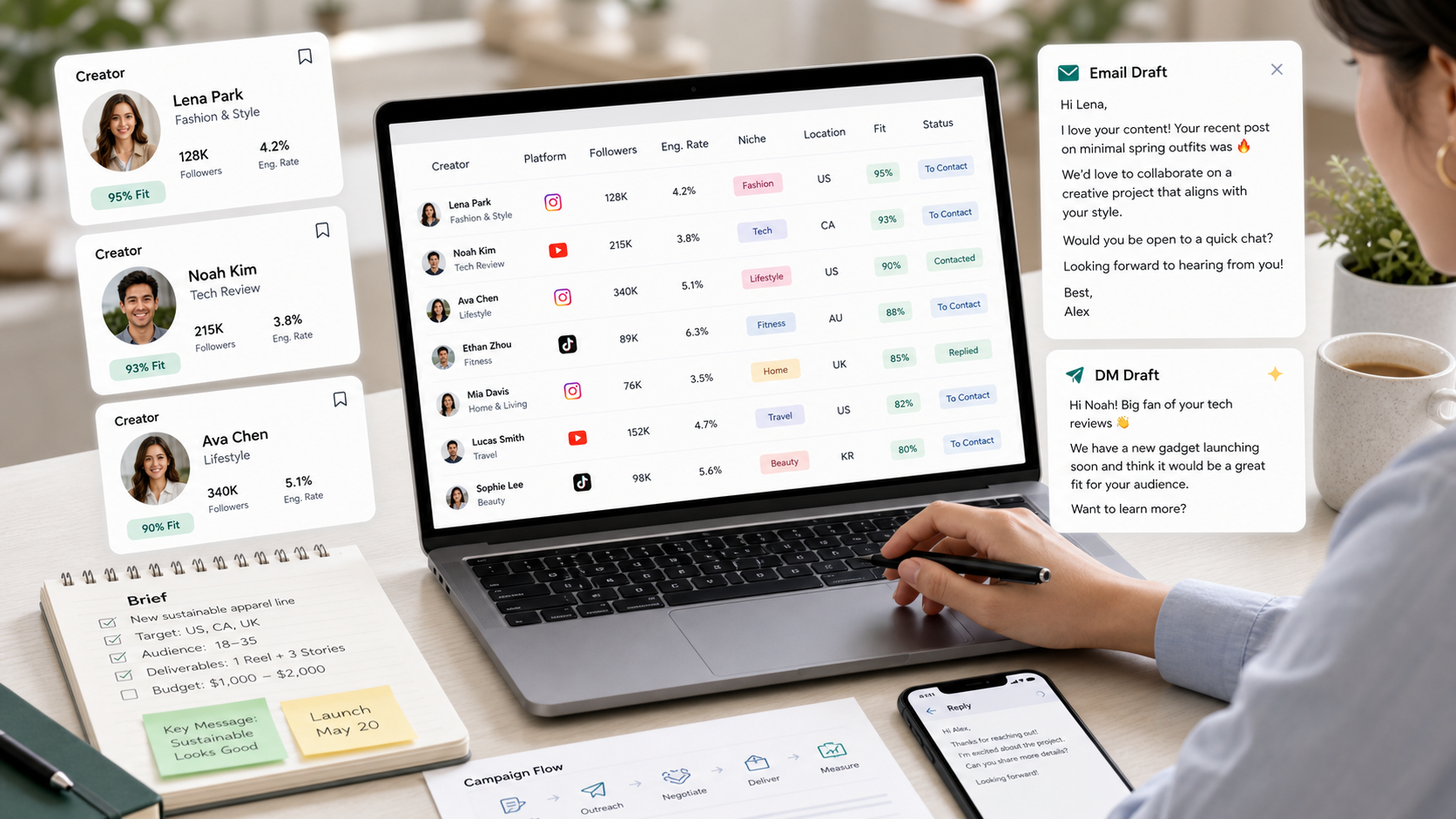
Once the list is scored, place every creator in a repeatable outreach pipeline. Use a specific reason for the match, a clear collaboration type, and one next step. If you need the message itself, adapt these influencer outreach email and DM templates.
Use Free and Refundable Samples Deliberately
TikTok Shop's U.S. sample guide dated June 10, 2026 describes two sample types.
Free samples
Eligible creators can request a free sample, subject to seller approval and seller-defined thresholds. The current guide says creators must publish qualifying promotional content within 14 days after receiving a free sample. A qualifying short-form video must remain public for at least three days, or the creator can run a qualifying LIVE for at least 10 minutes. The product link must be attached.
For sellers, the operational implication is simple: track delivery date, posting deadline, link status, content URL, and exception reason for every sample.
Refundable samples
The creator purchases the product first and receives a refund if the required sales goal is met within the platform window. The current U.S. guide describes a 120-day window and says sellers usually require one to three orders. This can reduce indiscriminate free-sample spend, but it does not remove the need to review creator fit and product economics.
Do not confuse TikTok's official 14-day free-sample posting requirement with a campaign measurement window. Product A separately used a proposed 14-day internal review point to inspect early content and funnel health. It was not presented as TikTok's attribution window or as enough time to declare long-term ROI.
Give Creators a Brief They Can Execute and Defend
A useful brief defines the audience, problem, proof, prohibited claims, disclosure, product link, and deadline. It should not force every creator to read the same script. Navos generated three starting hypotheses for Product A; the human reviewer kept the structure but tightened unsupported claims.
Product A used three content hypotheses:
Creator segment | Content hypothesis | Proof to capture | Claim boundary |
Curly-hair creator | Wet- or dry-hair detangling demonstration | Section-by-section process and visible handling | No “100% no breakage,” pain-free guarantee, or medical claim |
GRWM or lifestyle creator | Blow-dry routine using the vented design | Routine steps, timing context, and natural product use | Do not promise a universal drying-time reduction without substantiation |
Mom or family creator | Parent-child morning hair routine | Ease of use in a real routine | No guaranteed reaction, treatment, or unverified safety certification |
Because a commission, free sample, or discount is a material connection, the creator needs a clear disclosure. FTC guidance also says disclosures should be difficult to miss and included with the endorsement; a video disclosure should not rely only on the description. Ask legal counsel to review higher-risk categories and claims.
Build One Affiliate Pipeline From Discovery to Repeat
The creator list, outreach, samples, content, and attributed sales should not live in separate sheets with no common identifier. Navos converted the Product A plan into one pipeline structure, while leaving acceptance rate and live performance blank until the seller can supply real data.
Use this pipeline:
Stage | Required record | Weekly decision |
Source | Creator ID, profile URL, segment, discovery source | Is this creator worth scoring? |
Score | Scorecard values and reviewer notes | Open, Target, paid test, or reject? |
Invite | Collaboration type, product, commission, date, message | Follow up, change offer, or pause? |
Accept | Acceptance date and agreed scope | Approve sample or brief? |
Ship | SKU, sample type, cost, tracking, delivery date | Has the posting clock started? |
Publish | Content URL, format, disclosure, product link, post date | Is the content valid and compliant? |
Attribute | Clicks, orders, revenue, refunds, commission, costs | Is the creator generating contribution? |
Repeat | Reorder, resample, new brief, or paid usage | What should scale? |
Pause | Reason code and evidence | What should not be repeated? |
Do not assume a fixed acceptance rate. If you need 20 accepted creators and the observed acceptance rate is 10%, the source list must be larger than if acceptance is 40%. Measure the actual rate by segment and offer instead of importing someone else's funnel benchmark.
Track These TikTok Shop Affiliate KPIs Every Week
Organize the dashboard by decision, not by whichever fields are easiest to export.
Recruitment and activation
- Creators sourced and scored
- Invitations sent
- Acceptance rate
- Samples approved, shipped, delivered, and pending content
- Ship-to-post rate
- Median days from delivery to first valid post
- Posts with a valid product link
Content and audience response
- Valid videos and LIVEs by creator and segment
- Views, watch-time signals, product clicks, and click-through rate where available
- Content angle and hook
- Disclosure and claims review status
Commerce
- Attributed orders and revenue
- Conversion rate when clicks and attributed orders use compatible definitions
- Average order value
- Cancellations and refunds
- Revenue and orders by creator, product, content type, and collaboration
Unit economics
- Creator commission
- Sample, shipping, and fixed creator fees
- Product and fulfillment cost
- Platform and payment fees
- Refund reserve or actual refunds
- Campaign contribution
- Affiliate-program ROI
Use these formulas consistently:
Campaign contribution = attributed gross revenue − COGS − fulfillment − platform fees − refunds − creator commission − sample costs − fixed creator fees
Campaign ROI = campaign contribution ÷ total affiliate-program cost
If an order, fee, refund, or attribution field is missing, label the result incomplete. GMV alone is not profit.
A 30-Day TikTok Shop Affiliate Pilot
Week 1: qualify and design
- Verify current shop and product eligibility.
- Choose one or two hero products with visible demonstration potential and stable inventory.
- Build downside, base, and upside economics.
- Set the Open, Target, and any shop-wide commission logic.
- Define sample caps, claim restrictions, and the 100-point scorecard.
- Confirm the export fields and data owner.
Week 2: recruit and activate
- Launch the broad discovery track through Open Collaboration where appropriate.
- Send Target invitations to the highest-scoring creators.
- Approve free samples selectively; use refundable samples where they fit the operating model.
- Send three segment-specific briefs rather than one generic script.
- Record every invitation and shipment in the same pipeline.
Week 3: manage delivery and content
- Monitor deliveries and official sample posting deadlines.
- Validate that content is public, compliant, and connected to the correct product.
- Diagnose funnel problems: low acceptance, low posting, invalid links, or weak product clicks.
- Do not increase commission automatically when the real problem is creator fit or an unclear brief.
Week 4: review and decide
- Reconcile attributed orders, revenue, refunds, commission, samples, fixed fees, and other costs.
- Compare creator segments and content hypotheses.
- Repeat creators with strong contribution and compliant execution.
- Rework offers that attract the right creators but fail at activation.
- Pause combinations that remain negative after data definitions and costs are verified.
The first month is a learning system. Its output is not only revenue; it is a better offer, creator list, scorecard, brief library, and evidence base for the next cohort.
Hands-On Test: What Navos Produced for Product A
We tested the KOL Growth Community Social Growth Skill in Navos with an anonymized Product A brief. The first message supplied the product, audience, cost, sample, budget, creator, and compliance context. A second message requested an English report titled “Product A TikTok Shop Affiliate Pilot — 30-Day Plan and Weekly Operating System.”
Navos returned the task answer in about two minutes and generated the HTML report in about one additional minute.
The report included:
- An evidence and readiness audit
- Downside, base, and upside unit-economics scenarios
- Sample-budget capacity with a reserve
- Conservative, balanced, and aggressive operating plans
- Creator segments and a 100-point scorecard
- Open and Target Collaboration recommendations
- An affiliate pipeline
- Three compliant content briefs
- A four-week execution plan
- Weekly KPIs, formulas, and missing-data requests
That speed was useful, but the first output still needed human QA. We corrected the distinction between a creator content fee and an affiliate commission, replaced the campaign ROI formula, rechecked hybrid creator capacity, clarified sample logic, and labeled the proposed internal 14-day review point so it could not be confused with a TikTok attribution rule.
The final report did not claim Seller Center access, a launched campaign, real GMV, orders, conversion, creator performance, or a final affordable commission rate. Those require authorized shop data and live results.
A separate one-second creator-price check
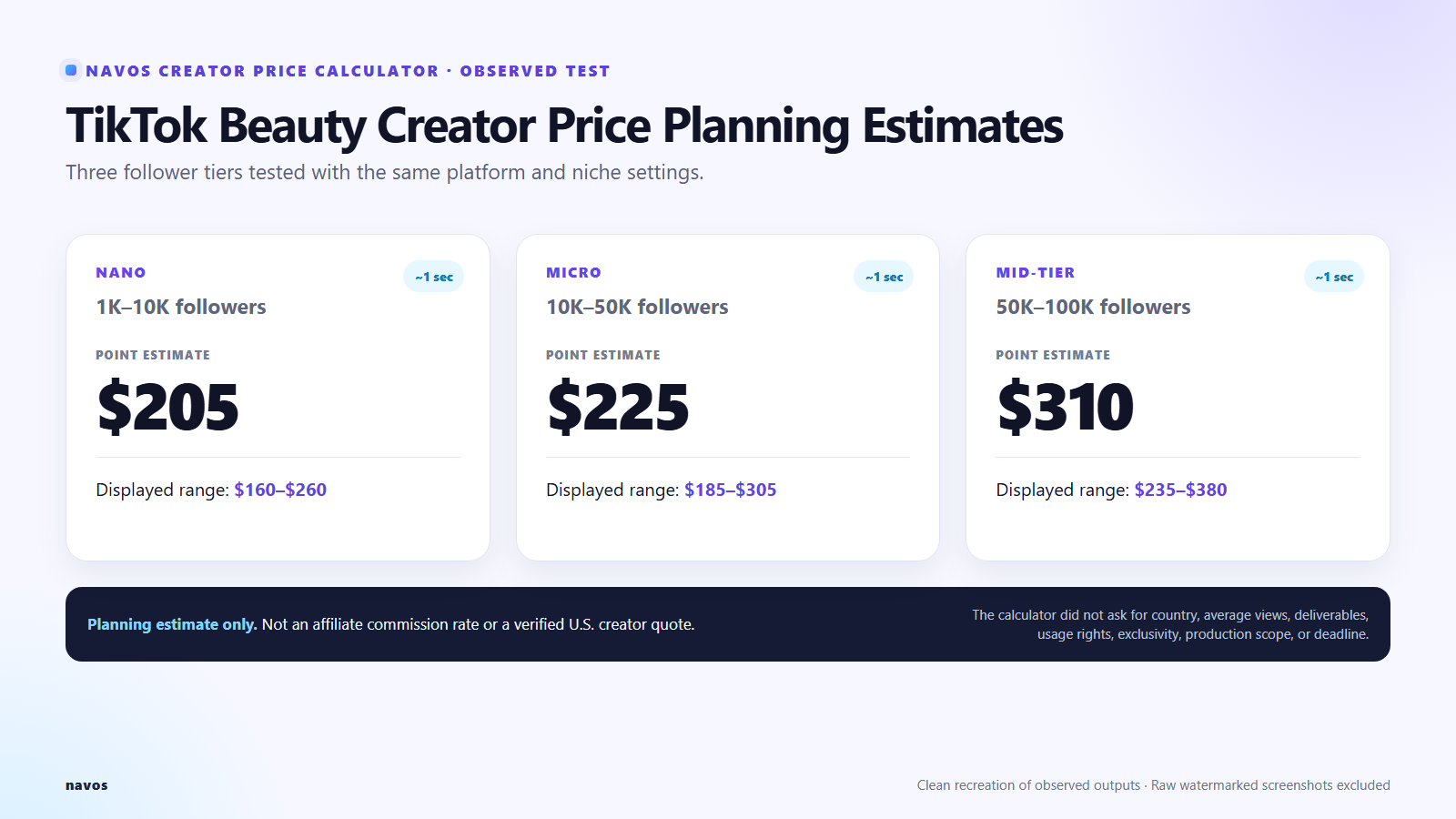
We also tested the free Navos Influencer Price Calculator with TikTok, Beauty, and three follower bands. Each result appeared in about one second.
Follower band | Displayed tier | Point estimate | Displayed range |
1K–10K | Nano | $205 | $160–$260 |
10K–50K | Micro | $225 | $185–$305 |
50K–100K | Mid-tier | $310 | $235–$380 |
These are platform-displayed planning estimates. The calculator did not ask for country, average views, content quantity, usage rights, exclusivity, production scope, or deadline. The ranges overlap, and they are not verified U.S. market rates or affiliate commission recommendations.
Use the free Navos Influencer Price Calculator to create a starting reference for a paid or hybrid creator quote. Then review the actual scope, recent content performance, usage rights, and audience before approving a fee. For negotiation, use the influencer rate and usage-rights checklist.
When to Scale, Rework, or Pause
Set your decision rules before results arrive. Do not call them industry benchmarks unless you have external evidence.
Scale
Scale a creator, segment, or brief when:
- Content is valid, on time, and compliant.
- Attributed orders and revenue use verified definitions.
- Contribution remains positive after commission, samples, refunds, fees, and other costs.
- The result repeats across more than one post or cohort.
- Inventory and fulfillment can support more demand.
Rework
Rework the system when:
- High-fit creators accept but fail to publish.
- Posts go live but the product link is missing or invalid.
- Content earns attention but few product clicks.
- Product clicks occur but attributed orders remain weak.
- Creators ask the same unanswered product or claims questions.
Each pattern points to a different fix: offer, operations, brief, product page, economics, or data quality.
Pause
Pause when:
- The shop or product loses eligibility.
- Inventory or fulfillment cannot support the promotion.
- A creator breaches the claims or disclosure rules.
- The program shows negative contribution after complete cost reconciliation.
- The team cannot verify attribution or the required finance fields.
Frequently Asked Questions
How does the TikTok Shop affiliate program work for sellers?
Eligible sellers add qualified products to an affiliate collaboration. Creators promote those products through shoppable content or affiliate links, and eligible sales are attributed to the creator. The seller pays the configured commission. Depending on the collaboration, the seller may also provide a sample or pay a flat fee for an approved video.
What is the difference between Open and Target Collaboration?
Open Collaboration makes qualified products available for broader creator discovery and application. Target Collaboration lets a seller invite selected creators for specific products and can use commission-only or flat-fee video structures. TikTok's July 2026 U.S. policy also lists Shop Collaboration, which applies a universal commission rate across affiliate products.
How much commission should a TikTok Shop seller offer?
There is no universal safe rate. Calculate the maximum from net revenue, product cost, fulfillment, platform and payment fees, refunds, target profit, samples, fixed creator fees, and the commissionable order value. A competitor's rate or the platform's supported range does not prove affordability.
Are TikTok Shop affiliates free for sellers?
Commission-only collaborations pay creators when an eligible sale occurs, but the full program can still incur sample, shipping, staff, refund, content, and usage-rights costs. A Target Collaboration may also include a flat video fee.
Should sellers send free samples to every creator?
No. Approve samples based on creator fit, content hypothesis, economics, and operational capacity. Refundable samples can be another option. Track each sample from approval through delivery, content, product-link validation, attributed orders, and repeat or pause.
What should sellers track every week?
Track invitations, acceptance, samples, delivery, posting, valid links, content performance, product clicks, attributed orders and revenue, refunds, commission, all program costs, contribution, compliance, and the next action for each creator.
Can Navos run a TikTok Shop affiliate campaign automatically?
Navos can help plan and analyze authorized TikTok workflows, but this hands-on test did not access Seller Center or launch a campaign. Live actions depend on the connected account, granted permissions, current product workflow, and human approval. The test proved planning speed and report structure, not campaign outcomes.
Build the System Before You Scale the List
The TikTok Shop affiliate program becomes easier to manage when every creator is tied to a product, collaboration, score, cost, content record, attributed result, and next action.
Start with one eligible product and a small set of creator hypotheses. Protect the margin, reserve the sample budget, separate affiliate-only from paid hybrid work, and measure the full funnel. Then use real contribution and compliance data—not follower count or GMV alone—to decide what earns the next dollar.
Use the Navos Influencer Price Calculator for a quick paid-creator planning range, then open Navos to build the full pilot with KOL Growth Community Social Growth Skill.