

A buyer says a bottle leaks. Another says it looked bigger in the video. A third mentions a late delivery and an unanswered message. All three reviews need attention, but each points to a different owner and a different next step.
TikTok Shop review analysis is the process of organizing buyer feedback into recurring themes, checking the supporting evidence, and assigning specific actions. A useful output lets someone trace each proposed fix back to the reviews that prompted it.
This guide explains how to build that output from a review file. It includes a controlled Navos example using fictional reviews, with the counting rules and checks you can reuse for your own authorized data.
1. Define the decision and collect a usable review file
Start with a question the team can act on: Which listing details are confusing buyers? Which product complaint needs a physical check? Which delivery or support issue needs a case review?
Choose the product scope, market, date window, and review source before you count anything. A file of recent one-star reviews can help investigate complaints, but it cannot describe the sentiment of all buyers. Record that selection rule beside the analysis.
For an existing product, keep reviews tied to its SKU or variant. For product research, treat feedback on other products as a source of hypotheses to test with samples and supplier questions. Do not merge those reviews into your own product's results.
Where to start in Seller Center
TikTok Shop's US Product Ratings documentation, updated June 2, 2026, directs sellers to Seller Center → Products → Product Ratings. The page supports review management and filtering. Its CSV export feature is described as available to whitelisted sellers, so check your account before planning around an export.
If export is unavailable, use an authorized manual sample and document how it was selected. Keep product reviews separate from video comments, support tickets, and survey responses. Those sources can inform the same investigation, but they have different contexts and denominators.
Keep the source fields intact
Use one row per source record and preserve the original file before cleaning it.
Field | Why it matters |
Review ID and source | Identify a record and trace it back to its source |
Product ID, SKU, or variant | Locate the item the feedback concerns |
Review date | Separate older feedback from a current issue |
Star rating | Keep the buyer's rating separate from text interpretation |
Original review text | Preserve the evidence for every theme |
Sample scope | Record the market, date window, filters, and collection method |
Keep translations and analyst notes in new columns. Missing dates or SKUs should remain visibly missing until verified; a model should not reconstruct them from context. Remove buyer names, contact details, and other unnecessary personal information before sharing the file for analysis.
2. Clean duplicates without deleting useful feedback
Deduplicate with a stable review ID within the same source. If the same ID appears twice, log which record you kept and why. If the records conflict, flag the difference for review instead of silently choosing the more convenient version.
Matching text alone is not enough to delete a row. In our fictional example, RV-1012 and RV-1019 both say:
The lid leaks if I carry it sideways.
They have different review IDs and different SKUs. Both stay in the sample. By contrast, repeated records for RV-1003 and RV-1006 are logged as duplicates.
Do not discard blank-text reviews just because they cannot support a detailed theme. Their ratings still belong in the rating distribution. An emoji-only review also needs its own handling rule; it does not provide evidence for a product defect.
Different stages count different units. The figures come from the fictional demonstration file.
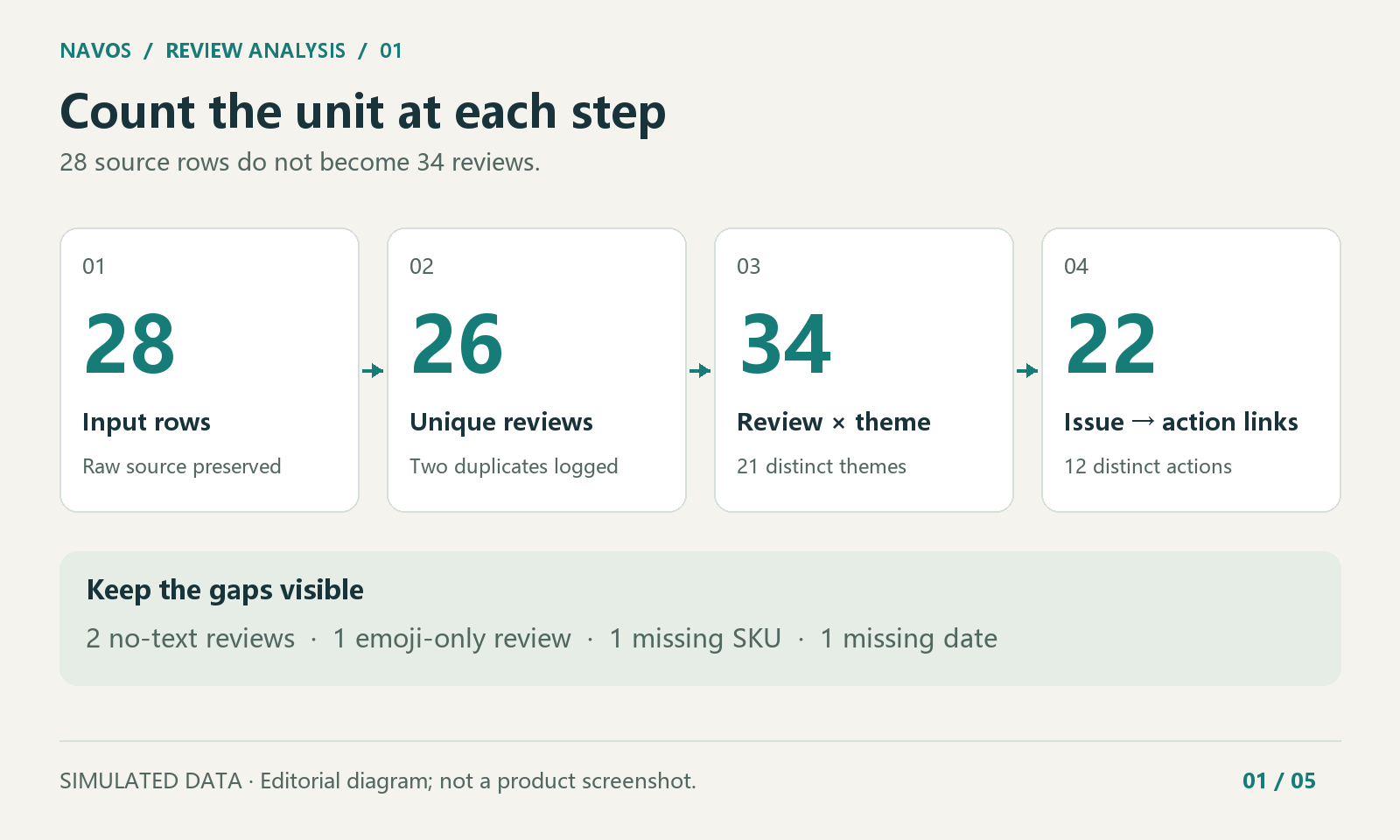
The example starts with 28 rows and ends with 26 unique reviews. Two reviews have no text; one contains only an emoji. One review is missing a SKU, and another is missing a date. Those gaps remain in the audit.
This small data-quality summary makes the later findings easier to interpret. A report that hides the exclusions can look precise while giving the reader an incomplete denominator.
3. Classify the business area, then the specific theme
Use two classification layers. First identify the broad area: product, logistics, service, mixed, or unknown. Then record the specific themes supported by the text, such as leaking lid, unclear pack quantity, wrong variant, or unanswered support.
The broad area helps route the review. The specific theme tells the owner what to investigate.
Owner assignments are proposed triage routes, not confirmed root causes.
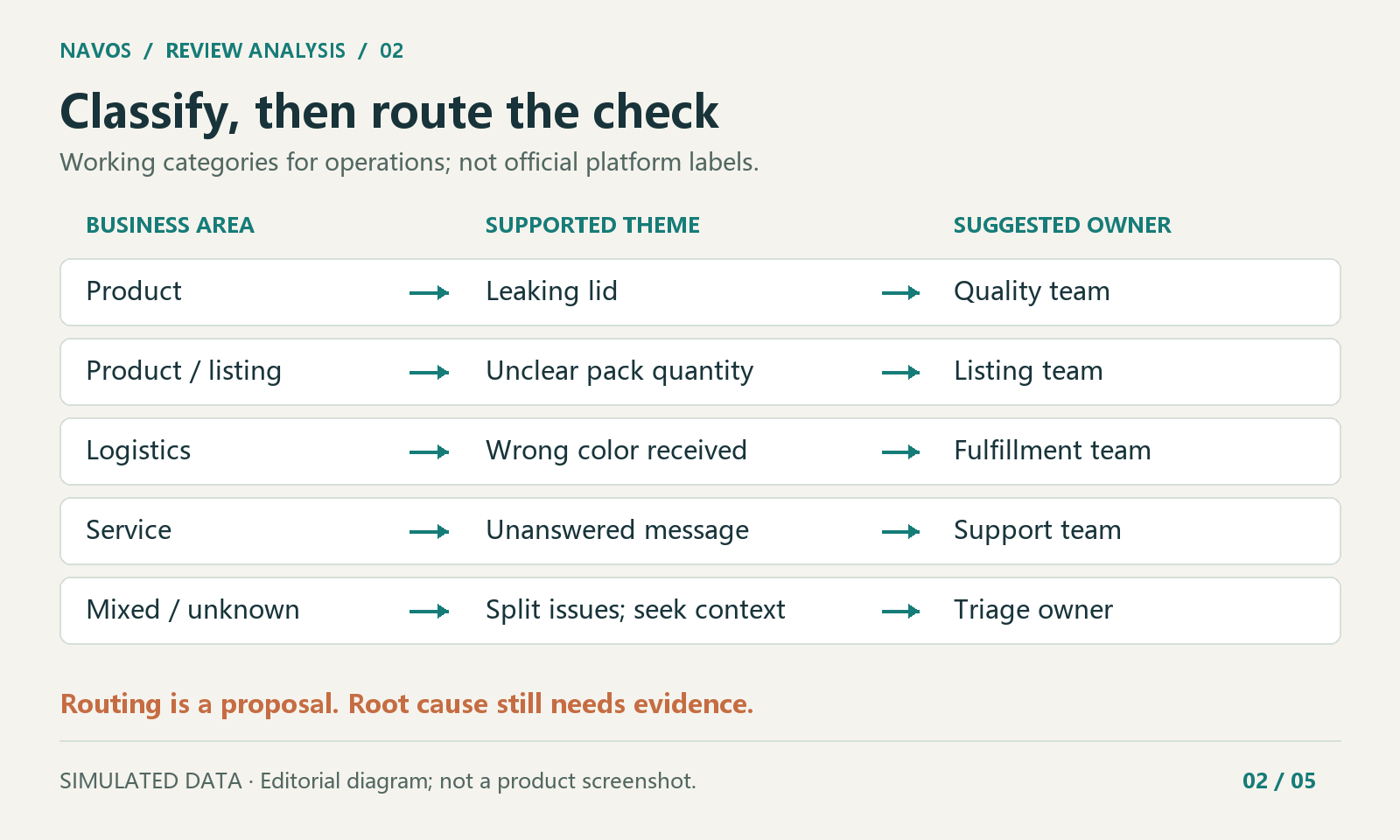
Area | Example theme | Initial owner | First check |
Product or listing | Size expectations | Listing team | Compare dimensions, imagery, and video framing |
Product | Leaking lid | Product or quality team | Test the reported orientation and inspect the seal |
Logistics | Wrong color received | Fulfillment team | Compare the order variant, pick record, and package |
Service | Unanswered message | Customer support | Review the conversation and response timeline |
Mixed or unknown | Several issues, or insufficient detail | Named triage owner | Split supported issues; request missing context |
These are working categories for analysis, not a reproduction of TikTok Shop's official classifications.
Let one review have several themes
RV-1006 in the fictional sample describes a delivery delay and an unanswered support message. It needs two theme records, with different owners. A single “negative” label would lose that distinction.
Keep positive evidence too. RV-1018 reports no leaks and easy cleaning. That does not cancel a leaking complaint, but it is a useful counterexample when investigating whether the problem varies by SKU, usage, or batch.
Treat reported symptoms and suspected causes as separate fields. A request for a replacement cap does not establish that the cap broke. “Looks smaller than the video” may indicate a presentation problem; it does not prove the factory supplied the wrong dimensions.
For non-English reviews, preserve the original and label the translation. The sample includes a Spanish statement about leaking when the bottle is on its side. Any English theme should remain traceable to that Spanish text, with uncertain wording flagged for human review.
4. Connect the evidence to a specific action
Build an evidence table before writing the summary. Each row should contain a review ID, theme, exact excerpt, interpretation, proposed owner, and next check.
Here are three examples from the fictional file. The checks are proposed follow-up work, not completed fixes.
Review | Evidence from the original text | Supported finding | Proposed next check |
RV-1001 | “The lid leaks when the bottle is on its side” | Reported leakage in a specific orientation | Quality team tests sideways placement and inspects lid fit |
RV-1003 | “The 20 oz size does not fit my cup holder.” | A compatibility concern | Listing team verifies dimensions and avoids broad cup-holder claims |
RV-1017 | “the care instructions were not in the box” | Reported missing instructions | Operations checks the packing standard and the affected order |
Separate issues from actions when the relationship is more complicated. One issue can require an immediate review and a material test. One action can also address several related review records.
Count an issue once even when it has more than one action.
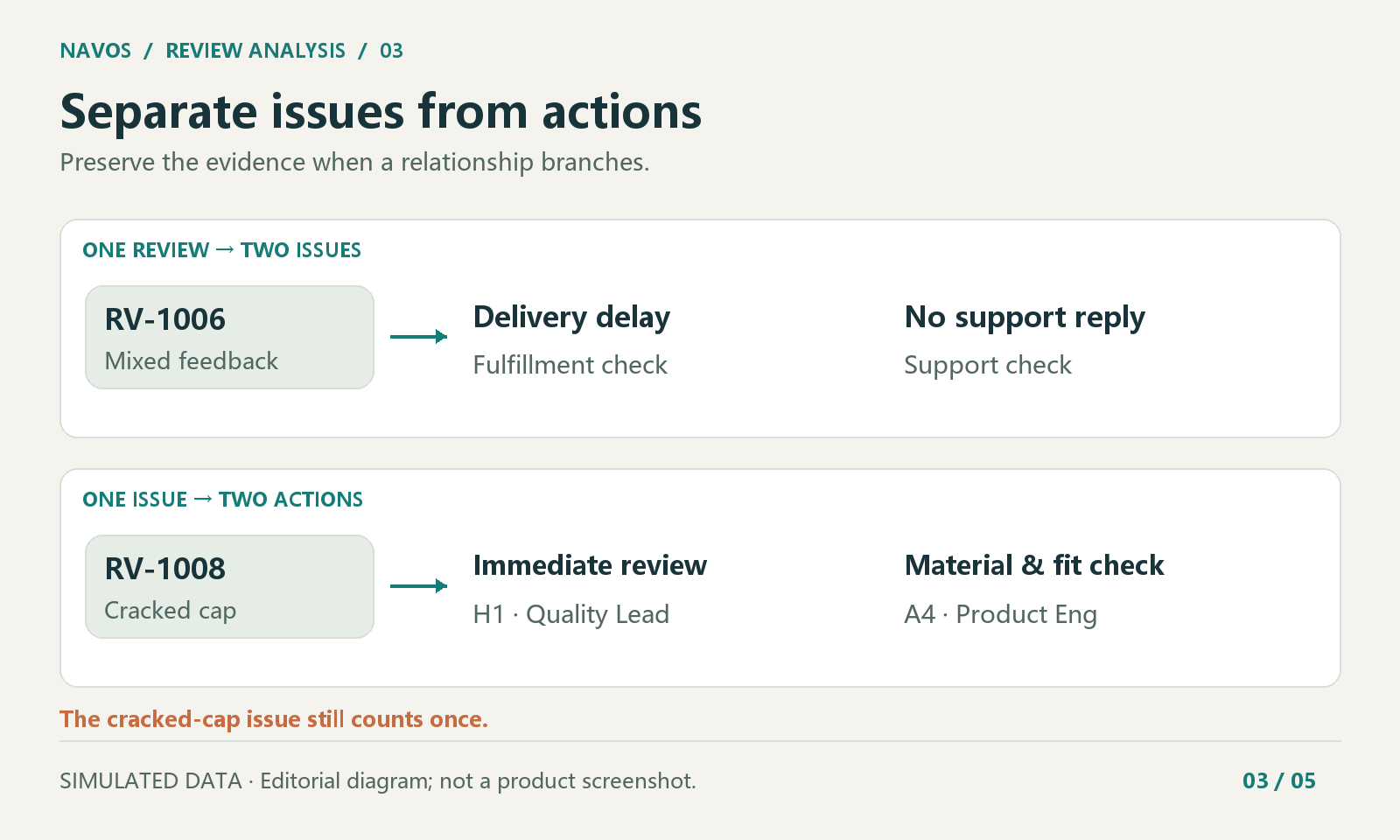
In the sample, RV-1008 reports a cracked cap. Its issue links to two actions. Expanding those links into two spreadsheet rows must not turn the original issue into two theme mentions. Keep a separate issue-to-action mapping table when you need that relationship.
For each action, add an owner, a target date, and evidence that would allow it to be closed. “Improve packaging” is difficult to verify. “Check the insert specification and photograph the next sampled pack against it” gives the team a concrete task.
5. Name the denominator before quoting a percentage
Review counts, theme mentions, and star ratings answer different questions. The controlled example produces these three results:
Metric | Calculation | Meaning |
Positive theme mentions | 13 / 34 = 38.2% | Share of review-theme records classified as positive |
Reviews with at least one positive theme | 8 / 26 = 30.8% | Share of unique reviews containing positive thematic evidence |
Reviews rated four or five stars | 9 / 26 = 34.6% | Share of unique reviews with a rating of at least four |
These are three views of the same fictional sample. They are not interchangeable sentiment scores.
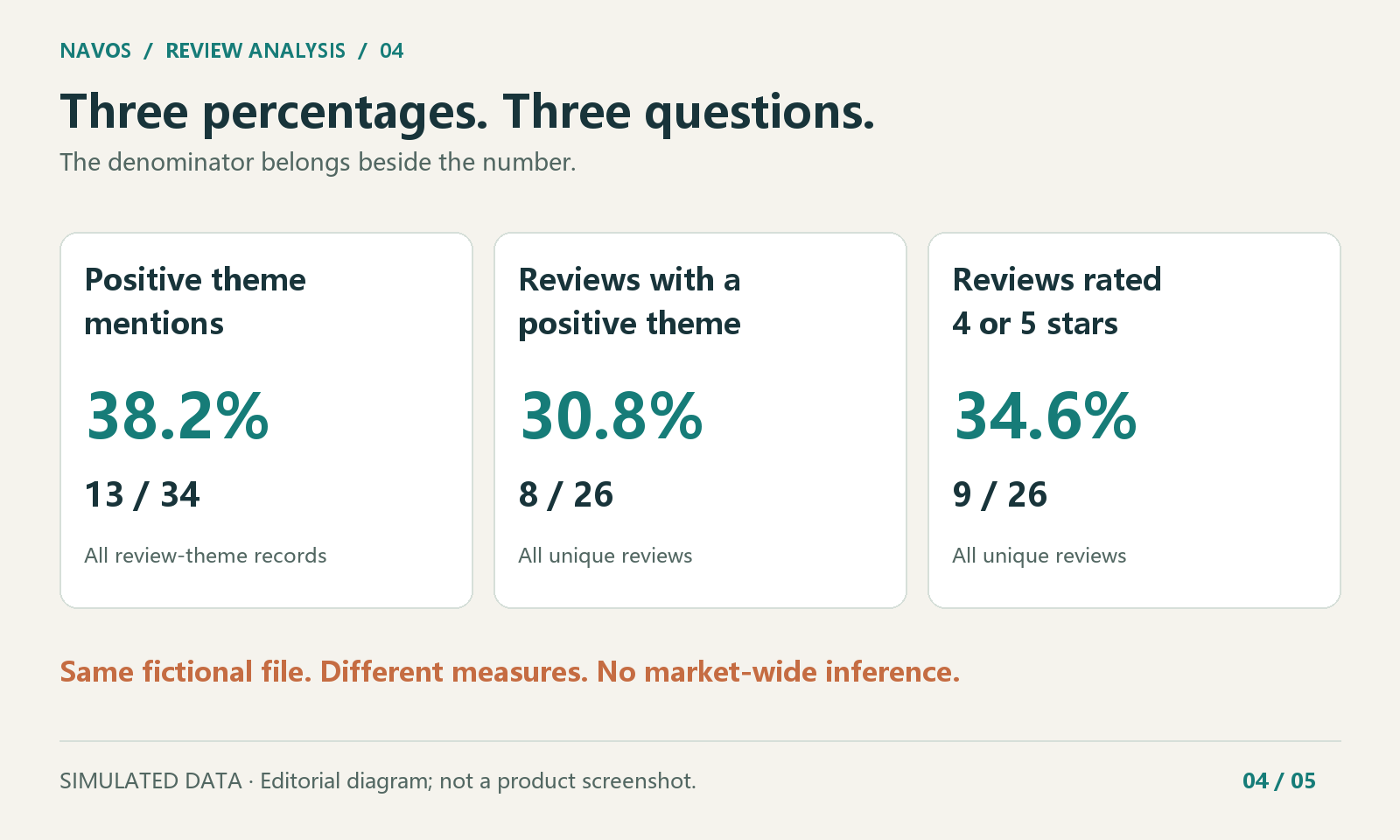
One review can contain both praise and criticism, so its rating and themes may point in different directions. A blank-text review can contribute to the star distribution without contributing a theme.
The leaking theme appears in four of the 26 unique reviews, across three SKUs. You can describe that as 4/26 reviews in this sample, or 15.4%. You cannot conclude that 15.4% of sold bottles leak. The file contains no order denominator, product inspection results, or representative sampling evidence.
For the same reason, do not label a percentage from an arbitrary CSV as the store's official Negative Review Rate. Use Seller Center for the platform metric and keep your file-based measures explicitly named.
6. Prioritize checks and give each fix an owner
Frequency is one input to prioritization. Also consider severity, how specific the evidence is, recency, whether independent reviews repeat the concern, and what the team can verify.
Escalate a credible safety concern through the appropriate process even if it appears once. For routine issues, start with evidence that supports a concrete check. An unclear pack-count image may be quick to correct after verification; a leakage report may require samples and technical investigation.
Workstream | Practical next step | Evidence to retain |
Listing | Verify dimensions, pack quantity, included accessories, and usage limits | Approved facts and before/after copy or images |
Product quality | Reproduce the reported symptom and compare relevant units | Test conditions, photos, SKU and batch information |
Fulfillment | Check variant selection, packing, and delivery milestones | Order and warehouse records, with access controlled |
Customer support | Review unresolved cases and response quality | Case outcome and response timeline |
If the evidence points to listing confusion, use the TikTok Shop SEO checklist to review how the facts appear on the page. The product description examples can help you explain verified dimensions, contents, and limitations clearly.
Do not turn a proposed fix into a result claim. Updating copy is an action completed; reducing confusion is an outcome to investigate in later, comparable data.
Make it a weekly review
Use a consistent collection window and record any changes to the sampling method. Review new themes, check previously assigned actions, and retain unresolved evidence gaps. For small samples, show the count beside the percentage.
Close a task when the agreed check is complete. Evaluate the outcome separately.
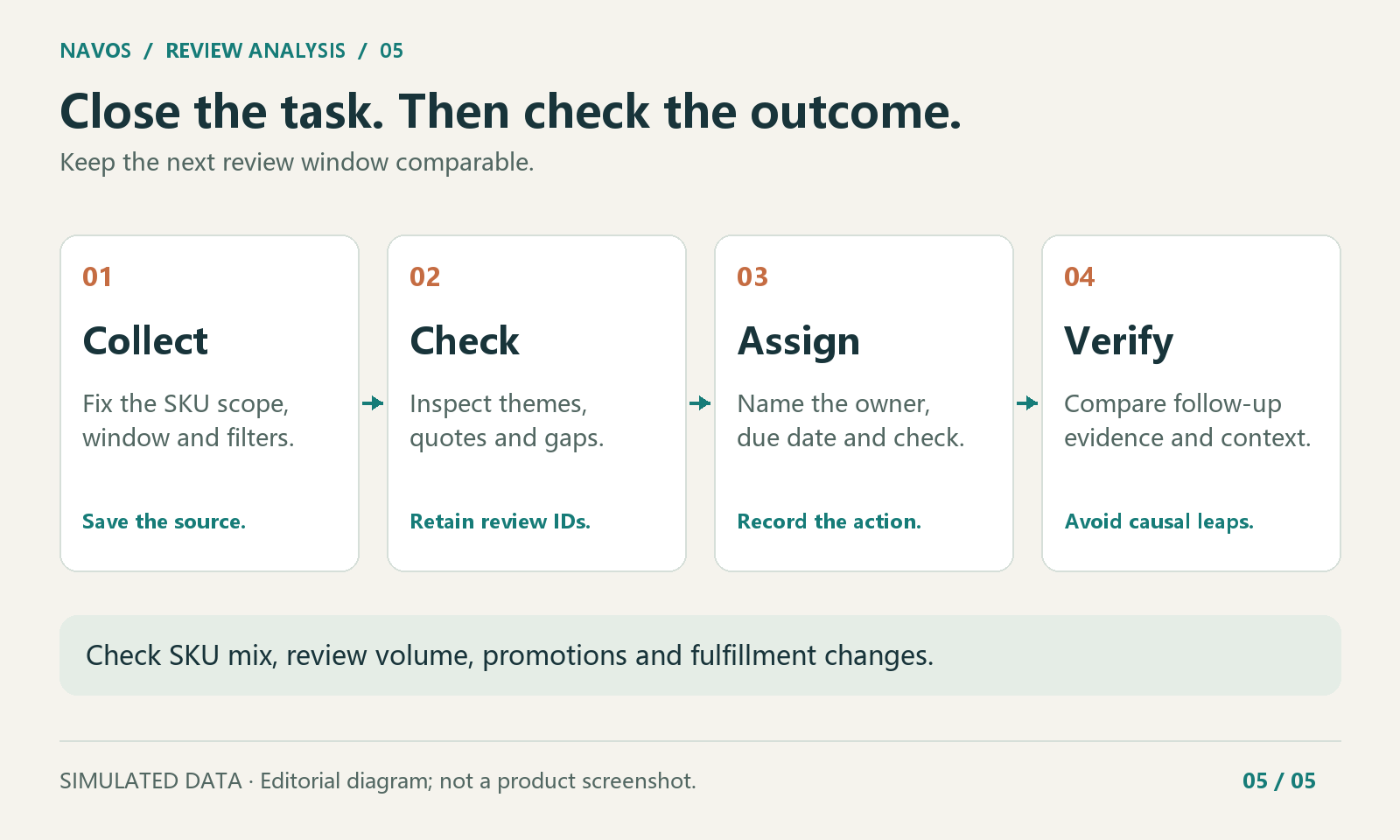
If a theme becomes less common after a change, check what else changed: the SKU mix, review volume, promotion activity, fulfillment method, or observation window. A before-and-after pattern can guide the next investigation without establishing causation on its own.
7. Use Navos to prepare a review audit you can check
For this guide, we reviewed Navos outputs from a deliberately constructed, fictional review file on October 20, 2026. The final package included an HTML report, an Excel workbook, CSV exports for the source and analysis tables, and an operational summary.
After review and revisions, the accepted package contained:
Output | Verified content |
Raw input and deduplicated reviews | 28 source rows and 26 unique reviews |
Deduplication log | Two duplicate records |
Theme detail | 34 unique review-theme records across 21 themes |
Action mapping | 22 issue-to-action links connecting to 12 actions |
Evidence trail | Original excerpts linked to the supporting reviews |
The review covered four output versions. Human checks caught counting and mapping problems before the final version was accepted. This example demonstrates a file-based workflow with reviewed outputs; it does not establish automatic accuracy, a live store connection, or an improvement in sales.
To use the same approach, prepare an authorized review file and give Navos a clear output contract. The prompt below is designed for a VOC analysis task:
Analyze the attached review file. First report its scope, missing fields, languages, blank text, and duplicate IDs. Preserve the raw input and log every deduplication decision. Keep identical text when review IDs differ. Assign broad business areas and specific themes, allowing several themes per review. For every theme, retain the review ID and an exact original-text excerpt. Separate reported symptoms from suspected causes. Build an action list with proposed owners and validation checks, plus a separate issue-to-action mapping table. Label all denominators and distinguish unique reviews, review-theme records, and action links. Flag uncertainty rather than inventing missing facts. Treat this file only as the stated sample.
For a teaching file, add: “All reviews are fictional; label every report and chart as simulated data.”
Before using the output, reconcile the source and cleaned row counts, inspect the excerpts, and check that every action points to evidence. Start with all rows for a small file. For a larger file, review high-risk items and ambiguous cases, and document any sampling used in the audit.
If you are choosing a broader feedback platform, the AI customer feedback analysis tools comparison covers that separate decision.
Frequently asked questions
Can every TikTok Shop seller export reviews to CSV?
Do not assume so. The US Product Ratings documentation describes CSV export for whitelisted sellers. Check the feature in your own account and record how the review file was collected.
How many reviews do I need?
There is no universal minimum for every decision. A specific complaint may justify checking an order or product sample. Estimating prevalence requires an appropriate sampling design and denominator. Describe a small file as a directional sample and include the counts.
Should I analyze only low-star reviews?
Use low-star reviews for a clearly defined complaint investigation. Include the broader rating range when you want to understand the feedback mix, preserve positive evidence, or compare themes. Record the filter either way.
Can AI sentiment analysis identify the root cause?
It can propose classifications and hypotheses from the text. Root-cause conclusions need additional evidence, such as product tests, order records, or support history. Keep the proposed explanation separate from what the reviewer actually reported.
Can video comments and product reviews be combined?
Keep their source labels and report them separately before drawing a combined interpretation. A video comment may come from someone who has never bought the product; treating it as a purchase review changes the meaning of the result.
How should the team respond to negative reviews?
Investigate the concern, address the buyer's case, and record the action taken. TikTok Shop's US Review Policy, updated June 30, 2026, prohibits asking buyers to change or remove reviews and offering rewards to influence them. Platform-supported review promotions have their own rules; check the current policy for your account and market.
Choose one product group and one defined time window for your first audit. Keep the source file, attach the evidence to each proposed action, and review the checks with the people who will perform them.