

Amazon's marketplace has grown into one of the most consequential commercial ecosystems in history. As of 2025, 9.7 million sellers have registered on the platform — but the real story is in the details: who's selling, where they're from, how much they earn, and where the market is heading.
This guide compiles the most current, verified Amazon seller statistics for 2025, drawn from Amazon's own investor reports, Capital One Shopping, Statista, and other primary sources.
Key Amazon Seller Statistics at a Glance (2025)
Metric | Value |
Total registered sellers (worldwide) | 9.7 million |
Active sellers | 1.9 million |
Third-party sales share | 60%+ |
New sellers per day | 550 (decade low) |
FBA adoption rate | 82% |
Third-party GMV | $575 billion |
Sellers with $1M+ annual revenue | 100,000 |
Sellers with $100M+ annual revenue | 235 |
How Many Sellers Are on Amazon in 2025?
Amazon has 9.7 million total registered seller accounts globally. However, the majority of these accounts are dormant or semi-active. The breakdown:
- Active sellers: 1.9 million (sellers with at least one product listed and recent sales activity)
- Semi-active sellers: ~1.0 million
- Dormant/inactive accounts: ~6.8 million
This means roughly 80% of all registered accounts are not actively selling. The 1.9 million active sellers represent the competitive landscape that matters for anyone entering or operating in the marketplace.
Amazon Seller Growth Trend: 2010–2025
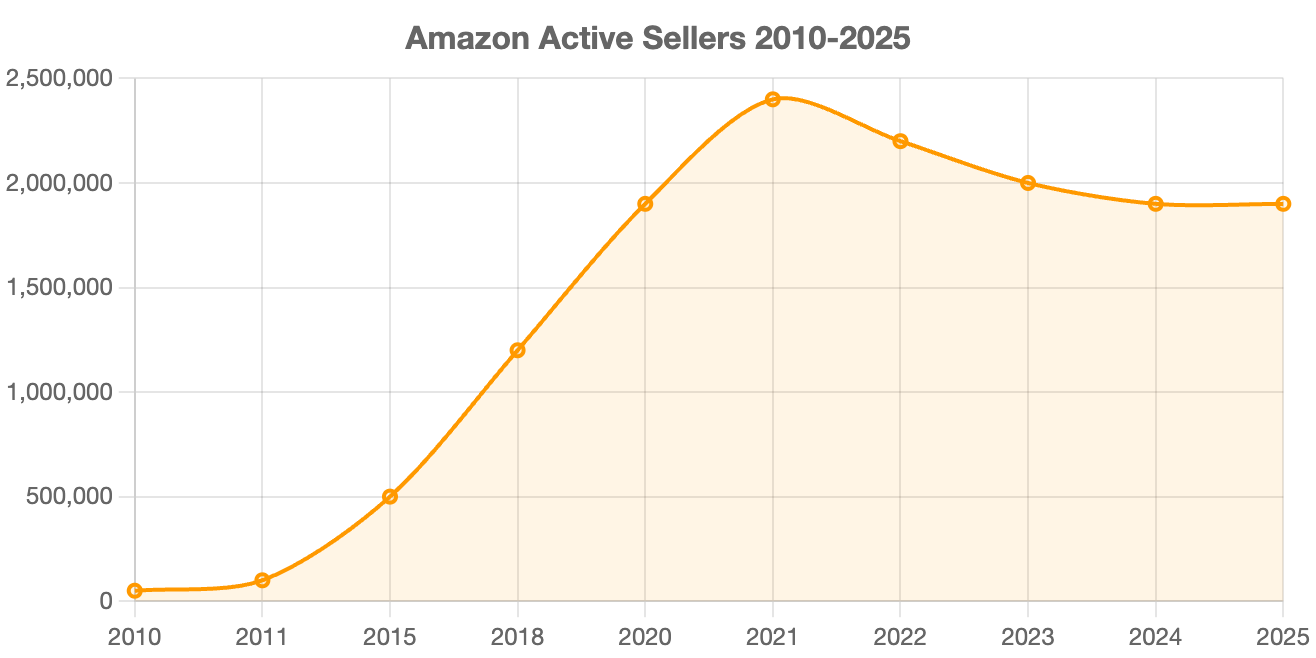
Amazon's seller base grew explosively through the 2010s, peaked during the pandemic, and has since contracted to a more stable level.
Year | Active Sellers |
2010 | ~50,000 |
2015 | ~500,000 |
2018 | ~1.2 million |
2020 | ~1.9 million |
2021 | 2.4 million (peak) |
2022 | 2.2 million |
2023 | 2.0 million |
2024 | 1.9 million |
2025 | 1.9 million |
Source: Marketplace Pulse seller tracking data
The peak of 2.4 million active sellers in 2021 coincided with pandemic-era e-commerce acceleration. Since then, the market has normalized. The current 1.9 million figure represents a stable, competitive baseline.
New Seller Registrations: A Decade Low
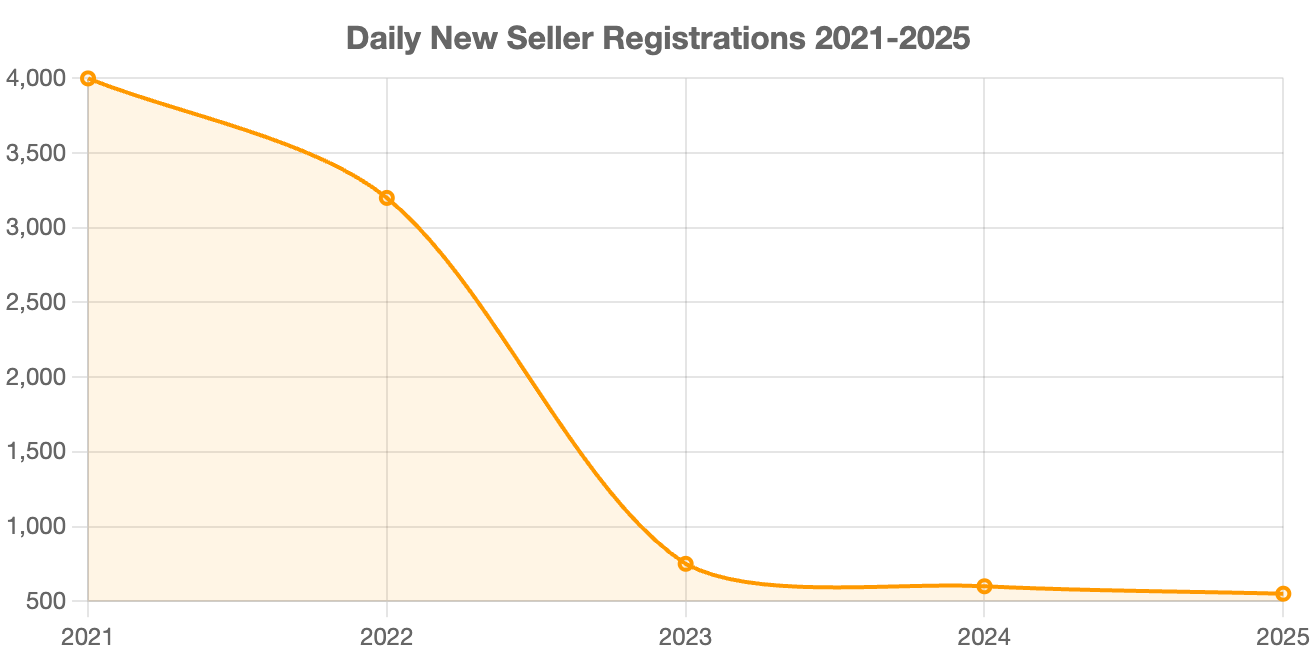
One of the most significant signals in 2025 is the sharp decline in new seller registrations. Amazon is now seeing approximately 550 new sellers per day — the lowest rate in a decade.
Year | Daily New Sellers |
2021 | ~4,000 |
2022 | ~3,200 |
2023 | ~750 |
2024 | ~600 |
2025 | ~550 |
Source: Marketplace Pulse seller tracking
The drop from 4,000/day in 2021 to 550/day in 2025 reflects several converging factors: increased competition, rising advertising costs, tighter margins, and greater seller sophistication required to succeed. The era of easy Amazon entry is over.
Third-Party Sales: 60% of All Amazon Revenue
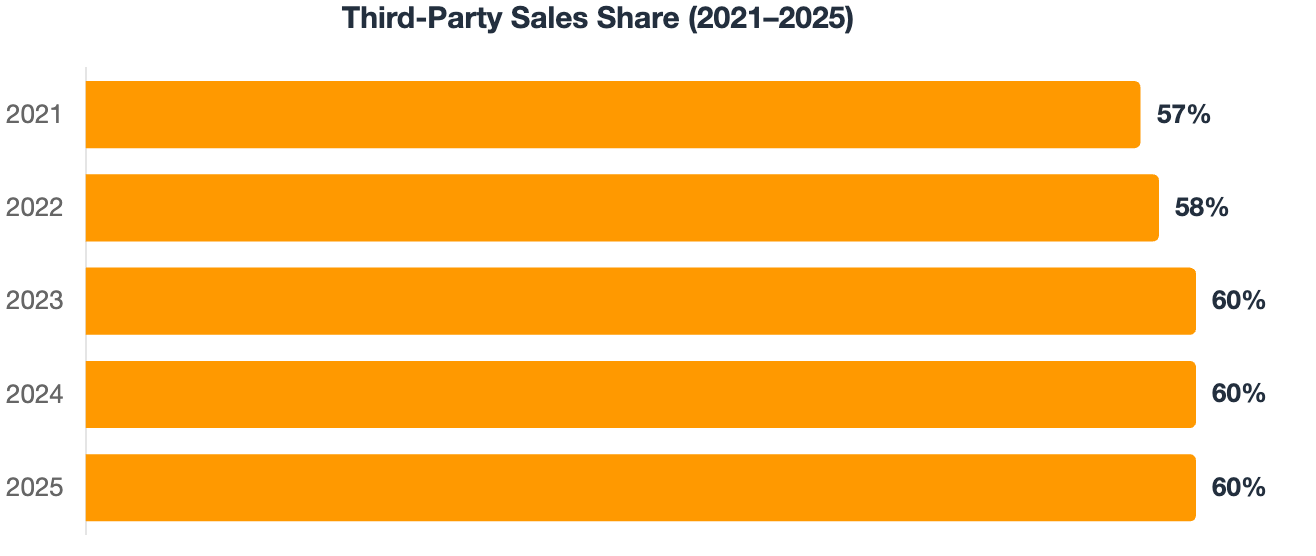
Third-party (3P) sellers now account for more than 60% of all units sold on Amazon — a figure that has grown steadily from 57% in 2021. For a deep dive into this shift, see Amazon Third-Party Seller Market Share Report.
Year | 3P Sales Share |
2021 | 57% |
2022 | 58% |
2023 | 60% |
2024 | 60% |
2025 | 60%+ |
Source: Amazon annual reports
This is a structural shift. Amazon began as a first-party retailer; it is now primarily a marketplace. Third-party sellers collectively generate an estimated $575 billion in GMV, making Amazon's marketplace one of the largest commercial platforms on earth.
Amazon Sellers by Region (2025)
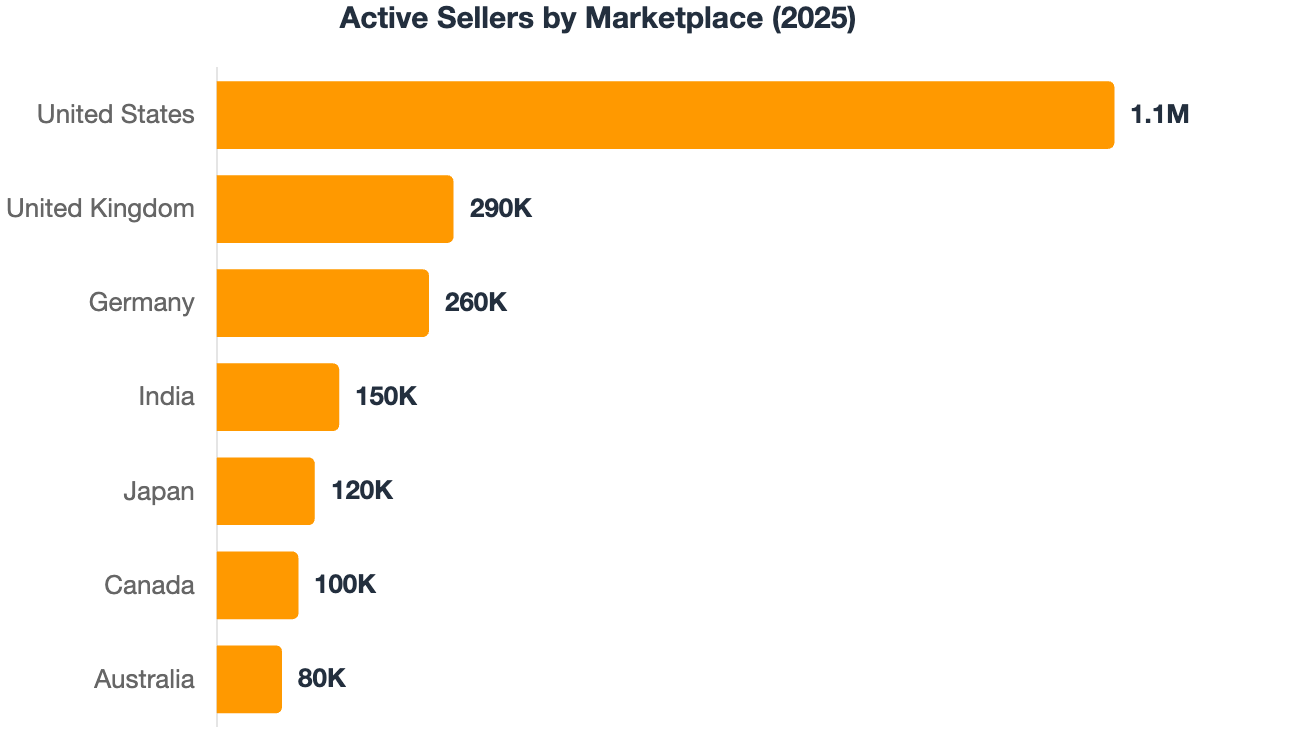
Active sellers are concentrated in a handful of markets, with the United States dominating.
Marketplace | Active Sellers |
United States | ~1.1 million |
United Kingdom | ~290,000 |
Germany | ~260,000 |
India | ~150,000 |
Japan | ~120,000 |
Canada | ~100,000 |
Australia | ~80,000 |
Source: Marketplace Pulse regional tracking
The US marketplace alone accounts for more than half of all active Amazon sellers globally.
Top Product Categories on Amazon (2025)
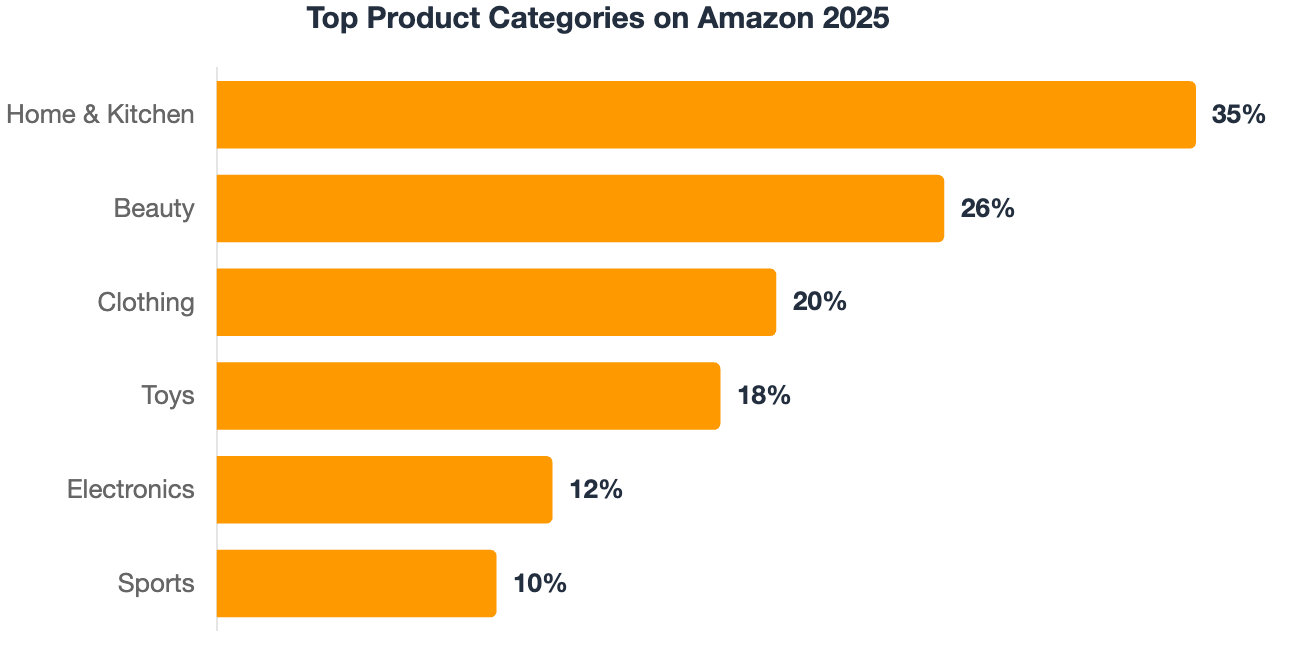
Sellers are not evenly distributed across categories. Home & Kitchen dominates, followed by beauty and apparel.
Category | % of Sellers |
Home & Kitchen | 35% |
Beauty & Personal Care | 26% |
Clothing, Shoes & Jewelry | 20% |
Toys & Games | 18% |
Electronics | 12% |
Sports & Outdoors | 10% |
Source: Jungle Scout category analysis
Home & Kitchen's dominance reflects the category's low barriers to entry, high search volume, and strong private label potential. For the full demographic breakdown, see Amazon Seller Demographics Report 2025.
Amazon Seller Business Models (2025)
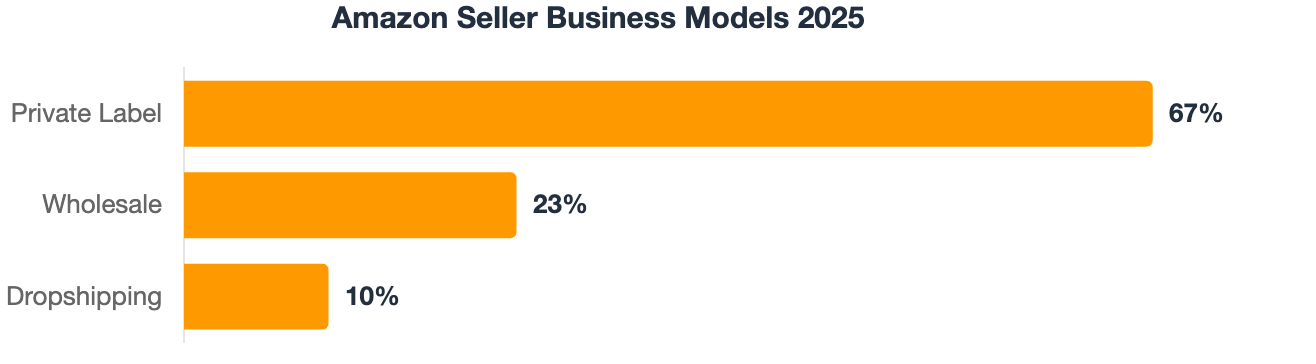
Most Amazon sellers use private label as their primary business model. For a full breakdown of seller origins, categories, and business models, see Amazon Seller Demographics Report 2025.
Business Model | % of Sellers |
Private Label | 67% |
Wholesale / Retail Arbitrage | 23% |
Dropshipping | 10% |
Source: Jungle Scout State of the Amazon Seller 2025
Private label — sourcing generic products and selling under a proprietary brand — remains the dominant strategy because it offers the highest margins and brand control.
What the Data Means for Sellers in 2025
The Amazon marketplace in 2025 is characterized by:
- Consolidation: Fewer new entrants, more experienced operators
- Professionalization: 82% FBA adoption signals sellers are investing in infrastructure
- Revenue concentration: 100,000 sellers ($1M+) drive a disproportionate share of GMV
- Geographic diversification: Chinese sellers represent 59.9% of new registrations, reshaping competitive dynamics
For sellers evaluating Amazon as a channel, the data suggests the platform rewards specialization, brand investment, and operational efficiency — not volume of listings.
Data Sources
- Amazon Investor Relations & Annual Reports
- Capital One Shopping Research
- Statista
- ElectroIQ
- Printful Research
Data reflects 2025 figures unless otherwise noted. Last updated: April 2026.