

Amazon's active seller count grew from roughly 50,000 in 2010 to a peak of 2.4 million in 2021 — a 4,700% increase in 11 years — before contracting to a stable 1.9 million by 2025. New seller registrations, which hit 4,000 per day at the 2021 peak, have since fallen to 550 per day, the lowest rate in a decade.
This article traces the complete growth arc of Amazon's seller marketplace, from its early days through the pandemic boom and into the current era of market maturation. For current seller data, see Amazon Seller Statistics Annual Report 2025.
Amazon Seller Growth: 15-Year Timeline
Year | Active Sellers | Key Context |
2010 | ~50,000 | Amazon Marketplace still nascent |
2011 | ~100,000 | 100% YoY growth; FBA gaining traction |
2015 | ~500,000 | 5x growth in 4 years; international expansion |
2018 | ~1,200,000 | Chinese seller influx accelerates growth |
2020 | ~1,900,000 | Pre-pandemic baseline |
2021 | 2,400,000 | Peak — pandemic e-commerce surge |
2022 | 2,200,000 | Post-pandemic normalization begins |
2023 | 2,000,000 | Continued contraction |
2024 | 1,900,000 | Stabilization |
2025 | 1,900,000 | Stable, mature marketplace |
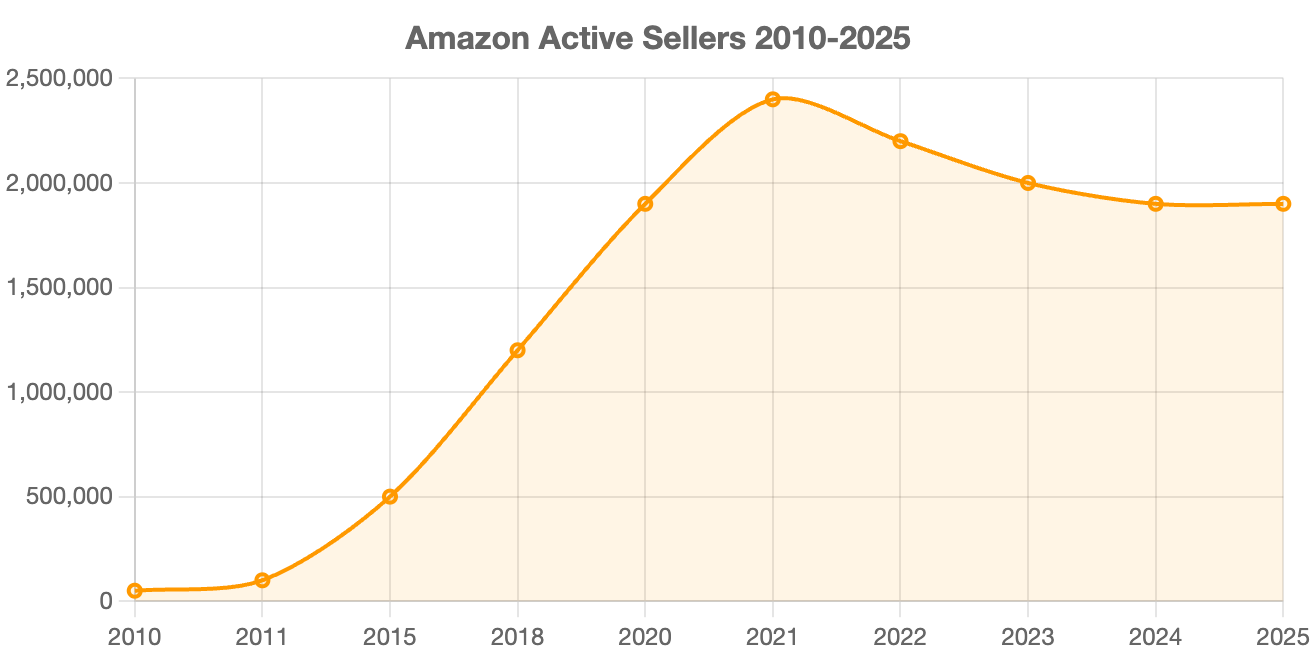
Source: Marketplace Pulse 15-year seller tracking
Phase 1: The Early Marketplace (2010–2015)
Amazon launched its third-party marketplace in 2000, but the ecosystem remained relatively small through the early 2010s. By 2010, approximately 50,000 active sellers were operating on the platform.
The period from 2010 to 2015 saw explosive growth, with active sellers growing from 50,000 to 500,000 — a 10x increase in five years. Key drivers:
- FBA launch and expansion: Amazon introduced FBA in 2006, but adoption accelerated through the early 2010s as sellers recognized the Prime eligibility advantage
- International marketplace expansion: Amazon opened marketplaces in Germany, UK, France, Italy, Spain, and Japan, dramatically expanding the addressable seller base
- E-commerce tailwinds: Consumer adoption of online shopping grew steadily, making Amazon an increasingly attractive sales channel
Phase 2: The Acceleration (2015–2021)
From 2015 to 2021, Amazon's seller base grew from 500,000 to a peak of 2.4 million active sellers — another 5x increase in six years.
The most significant driver of this phase was the influx of Chinese cross-border sellers. By 2025, Chinese sellers represent 59.9% of new Amazon seller registrations — a pattern that began accelerating around 2015–2018 as Chinese manufacturers recognized Amazon as a direct-to-consumer channel.
The COVID-19 pandemic in 2020–2021 added a final surge. E-commerce adoption accelerated by an estimated 3–5 years in a matter of months, and Amazon's marketplace saw a flood of new sellers attempting to capitalize on the shift to online shopping.
The 2021 peak of 2.4 million active sellers and ~4,000 new seller registrations per day represented the high-water mark of Amazon's marketplace growth.
Phase 3: Normalization and Maturation (2022–2025)
The post-pandemic period has been characterized by contraction and stabilization:
Year | Active Sellers | Daily New Registrations |
2021 | 2,400,000 | ~4,000 |
2022 | 2,200,000 | ~3,200 |
2023 | 2,000,000 | ~750 |
2024 | 1,900,000 | ~600 |
2025 | 1,900,000 | ~550 |
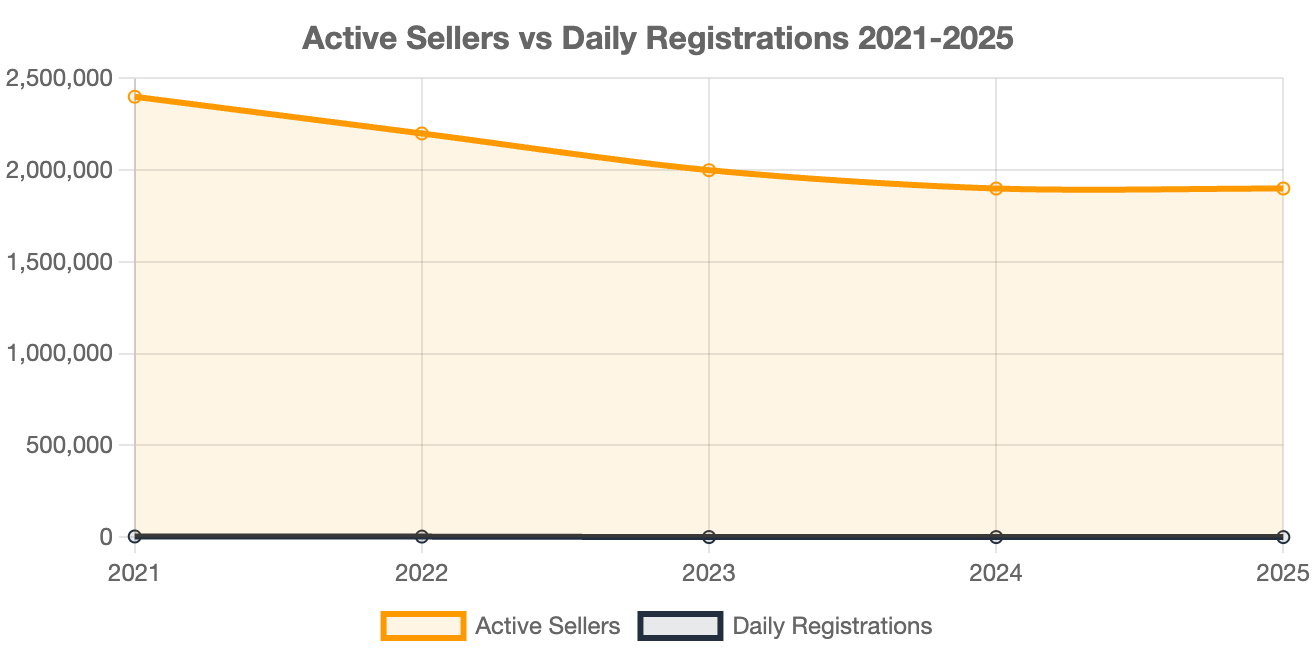
Source: Marketplace Pulse seller tracking
The decline in active sellers from 2.4 million to 1.9 million represents a 21% contraction from peak. The collapse in daily new registrations — from 4,000/day to 550/day — is even more dramatic: an 86% decline.
This is not a sign of Amazon's decline. It is a sign of marketplace maturation. The sellers who remain are more experienced, better capitalized, and more operationally sophisticated than the wave of opportunistic entrants who joined during the pandemic boom.
The Maturation Signal: More Revenue, Fewer Sellers
The most telling indicator of marketplace maturation is the divergence between seller count and revenue outcomes:
Metric | 2021 | 2025 | Change |
Active sellers | 2.4 million | 1.9 million | -21% |
$1M+ sellers | 60,000 | 100,000 | +67% |
$100M+ sellers | ~50 | 235 | +370% |
3P sales share | 57% | 60%+ | +3pp |
3P GMV | (lower) | $575 billion | Significant growth |
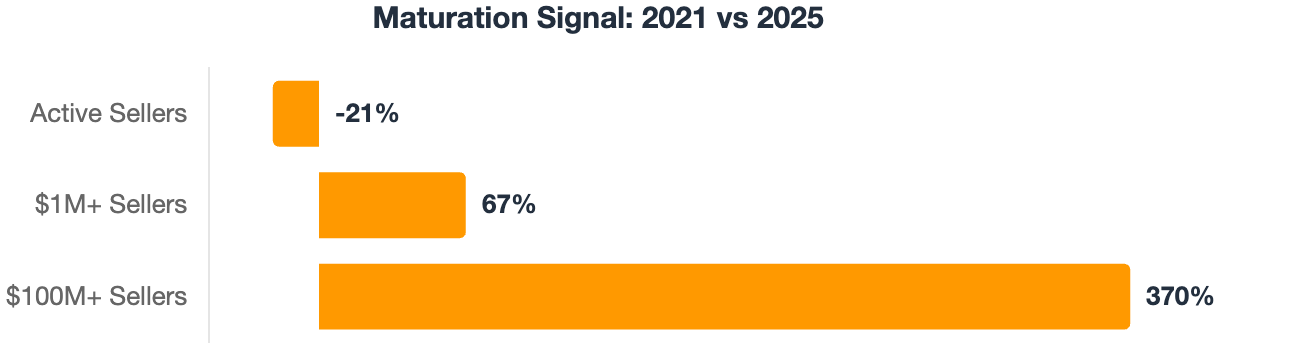
Source: Amazon Investor Relations, Jungle Scout
Fewer sellers, more revenue. This is the hallmark of a maturing marketplace: consolidation among high-performing operators, exit of marginal sellers, and increasing revenue concentration at the top.
Why Did Amazon New Seller Registrations Drop 77% in 2023?
The most dramatic single-year change in the data is the drop in daily new registrations from ~3,200 in 2022 to ~750 in 2023 — a 77% decline in one year.
Several factors converged:
- Rising advertising costs: Amazon's advertising platform became significantly more competitive and expensive, raising the effective cost of customer acquisition
- Increased competition: Category saturation in popular segments (Home & Kitchen, Electronics accessories) made it harder for new entrants to gain traction
- FBA fee increases: Amazon raised FBA fees multiple times, compressing margins for lower-priced products
- Post-pandemic demand normalization: The e-commerce surge that drove 2020–2021 registrations reversed, reducing the perceived opportunity
- Increased seller sophistication required: Success on Amazon in 2023+ requires capital, expertise, and patience that many opportunistic entrants lacked
The Third-Party Share Trajectory
As the seller base has evolved, the third-party sales share has grown steadily:
Year | 3P Sales Share |
2021 | 57% |
2022 | 58% |
2023 | 60% |
2024 | 60% |
2025 | 60%+ |
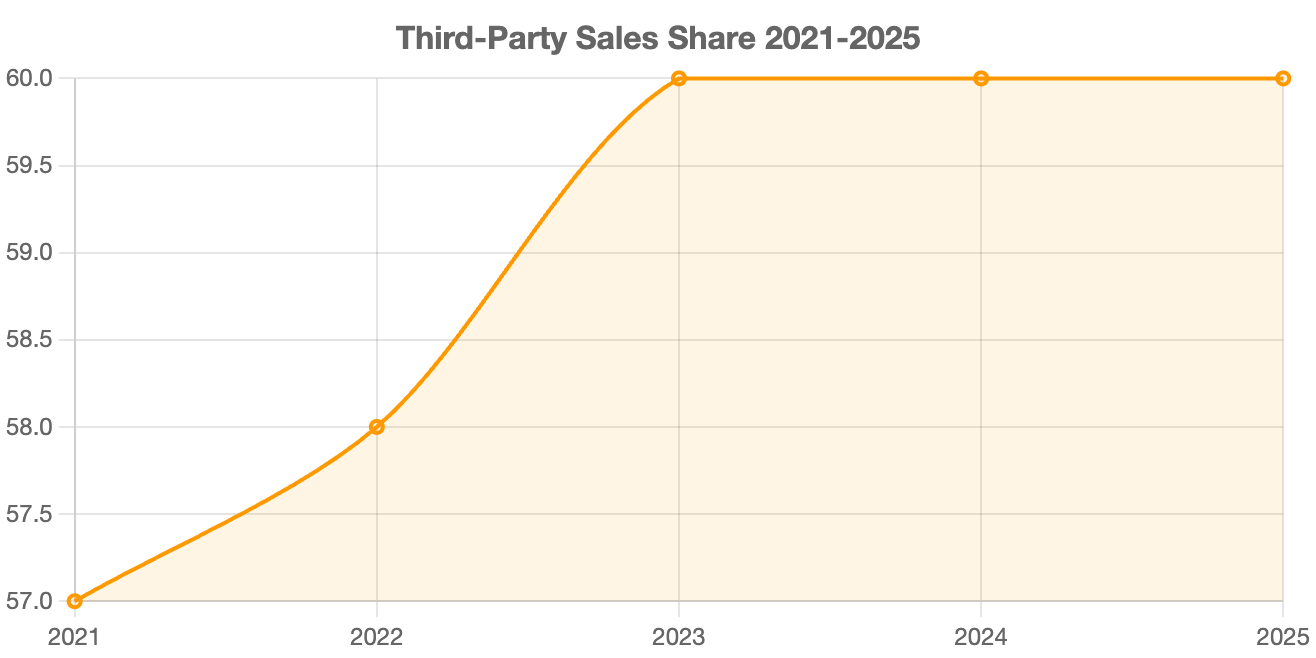
Source: Amazon annual reports and Marketplace Pulse analysis
The stabilization at 60% since 2023 suggests a structural equilibrium has been reached. Amazon's own retail operation (1P) continues to exist alongside the marketplace, but the majority of consumer purchases are now fulfilled by independent sellers.
Regional Growth Patterns
The geographic distribution of active sellers reflects both the history of Amazon's marketplace expansion and the current competitive landscape:
Marketplace | Active Sellers (2025) |
United States | ~1.1 million |
United Kingdom | ~290,000 |
Germany | ~260,000 |
India | ~150,000 |
Japan | ~120,000 |
Canada | ~100,000 |
Australia | ~80,000 |
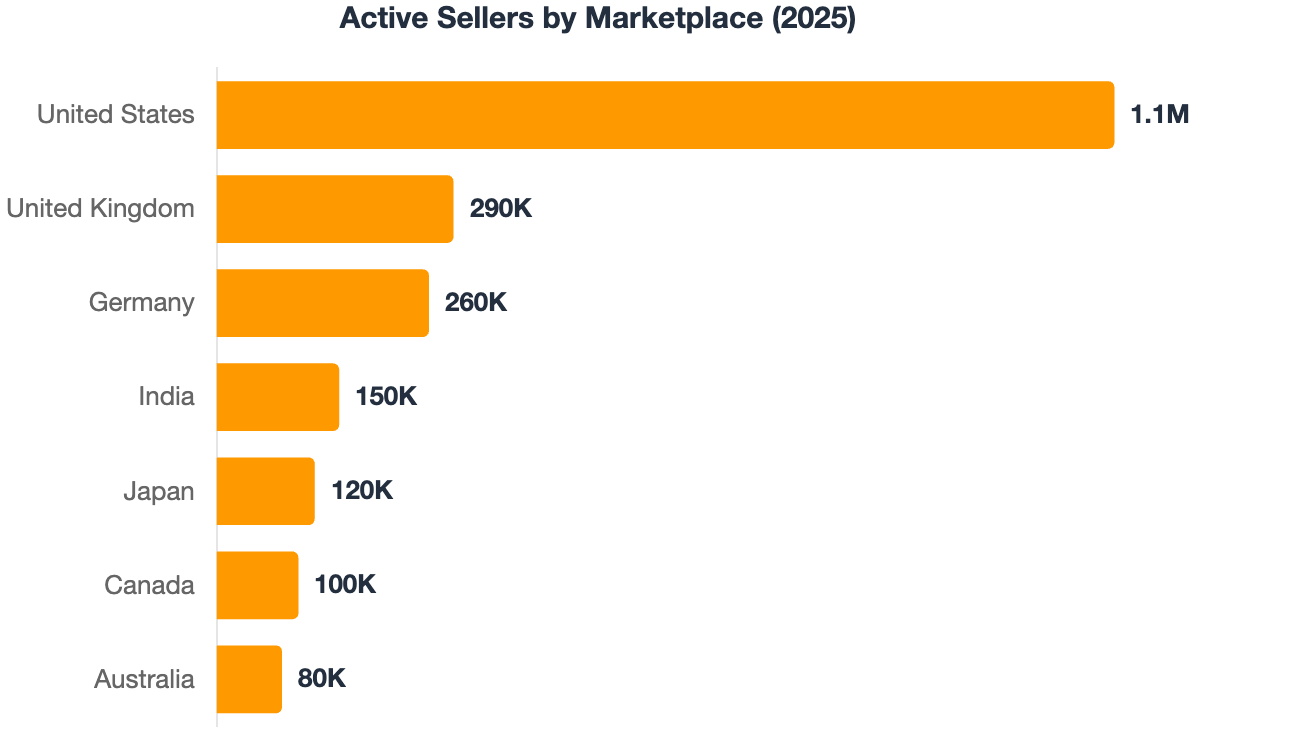
Source: Marketplace Pulse regional tracking
The U.S. marketplace remains dominant, hosting more than half of all active sellers globally. The UK and Germany marketplaces are the largest European markets, reflecting Amazon's early international expansion into these regions.
What the Growth History Tells Us About 2025 and Beyond
The 15-year growth arc of Amazon's marketplace suggests several conclusions about the current state and near-term trajectory:
- The growth phase is over. Active seller counts have stabilized at 1.9 million. The era of explosive new entrant growth ended in 2021.
- Maturation favors incumbents. Established sellers with brand equity, review velocity, and operational infrastructure have significant advantages over new entrants.
- Revenue concentration will continue. The trend toward more million-dollar and $100M+ sellers, even as total seller counts decline, suggests ongoing consolidation.
- Chinese seller influence will persist. With 59.9% of new registrations coming from China, the competitive pressure from manufacturing-direct sellers will remain a defining feature of the marketplace.
- FBA is the infrastructure layer. The 82% FBA adoption rate is unlikely to decline significantly — it is the operational foundation of the modern Amazon marketplace.
Key Takeaways
- Amazon's seller base grew 48x from 50,000 (2010) to 2.4 million (2021 peak)
- Active sellers have since stabilized at 1.9 million — a mature, competitive baseline
- New registrations have fallen 86% from peak (4,000/day → 550/day)
- Despite fewer sellers, revenue outcomes have improved: more million-dollar and $100M+ sellers than ever
- The marketplace has transitioned from a growth phase to a maturation phase — consolidation, professionalization, and revenue concentration define the current era
Data Sources
- Amazon Investor Relations & Annual Reports
- Capital One Shopping Research
- Statista
- ElectroIQ
- Business of Apps
- Printful Research
Data reflects 2025 figures unless otherwise noted. Last updated: April 2026.