

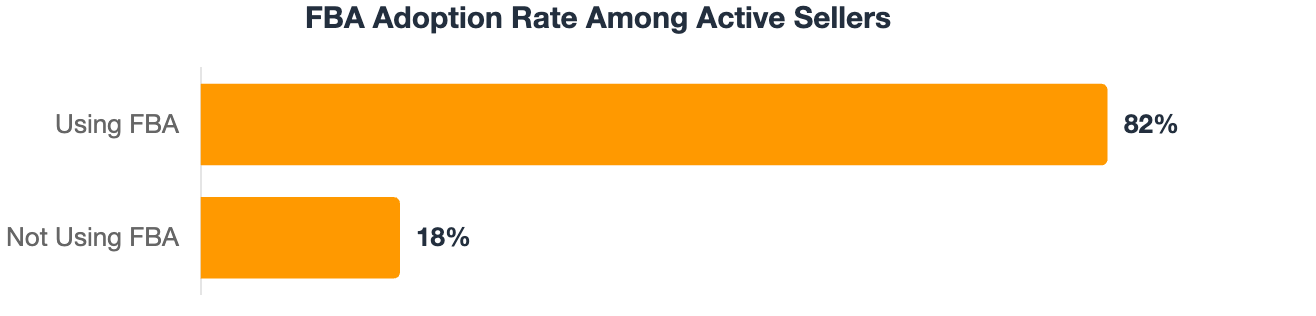
Fulfillment by Amazon (FBA) has become the dominant logistics model for Amazon sellers. As of 2025, 82% of active Amazon sellers use FBA for at least part of their inventory — a figure that reflects both the program's operational advantages and its role in driving seller revenue outcomes.
This article examines the FBA adoption data, what it means for sellers, and how FBA correlates with revenue performance across Amazon's global marketplace. For a broader overview, see Amazon Seller Statistics Annual Report 2025.
FBA Adoption Rate: Key Statistics
Metric | Value |
FBA adoption rate (active sellers) | 82% |
Active sellers using FBA | ~1.56 million |
Active sellers not using FBA | ~342,000 |
Third-party GMV (FBA + FBM combined) | $575 billion |
Source: Marketplace Pulse FBA tracking
With 1.9 million active sellers on Amazon and an 82% FBA adoption rate, approximately 1.56 million sellers are currently enrolled in FBA. The remaining 18% use Fulfillment by Merchant (FBM) or Seller Fulfilled Prime (SFP).
Why Do 82% of Amazon Sellers Use FBA?
FBA's near-universal adoption among serious Amazon sellers is driven by several compounding advantages:
1. Prime Eligibility
FBA products automatically qualify for Amazon Prime — the program's 200+ million global subscribers. Prime eligibility directly increases conversion rates, as Prime members are more likely to purchase products with the Prime badge.
2. Buy Box Advantage
Amazon's Buy Box algorithm favors FBA sellers, particularly for competitive listings. Winning the Buy Box is critical: the vast majority of Amazon purchases are made through the Buy Box.
3. Customer Service Offload
FBA sellers delegate returns, refunds, and customer service to Amazon. This reduces operational overhead significantly, particularly for sellers managing large SKU catalogs.
4. Scalability
FBA allows sellers to scale without proportionally increasing logistics headcount. A seller doing $100K/year and a seller doing $10M/year can use the same FBA infrastructure.
Does FBA Increase Amazon Seller Revenue?
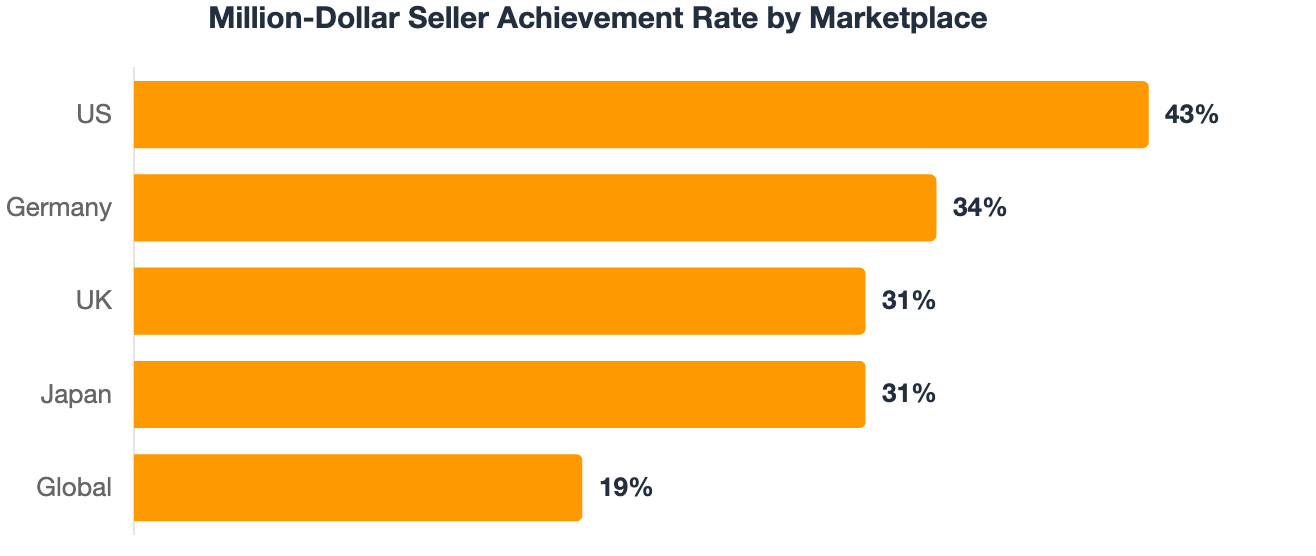
The correlation between FBA adoption and revenue achievement is significant. Looking at the percentage of sellers achieving $100,000+ in annual revenue by marketplace:
Marketplace | % Achieving $100K+ Annual Revenue |
United States | 43% |
Germany | 34% |
United Kingdom | 31% |
Japan | 31% |
Global Average | 19% |
Source: Jungle Scout Million-Dollar Seller Report
The U.S. marketplace — where FBA infrastructure is most mature and Prime penetration is highest — shows the strongest revenue outcomes, with 43% of active sellers crossing the $100K threshold.
FBA and the Rise of High-Revenue Sellers
FBA's scalability has been a key enabler of Amazon's growing class of high-revenue sellers:
- 100,000 sellers now generate $1 million or more in annual revenue (up from 60,000 in 2021)
- 235 sellers generate $100 million or more annually (up from ~50 four years ago)
The 370% growth in $100M+ sellers over four years is partly attributable to FBA's ability to support high-volume operations without proportional logistics cost increases.
When Should Amazon Sellers Use FBM Instead of FBA?
The 18% of sellers who don't use FBA typically fall into specific categories:
- Oversized or heavy items: FBA fees for large/heavy products can erode margins
- Hazmat products: Certain product categories face FBA restrictions
- Custom or made-to-order products: Items that can't be pre-stocked in fulfillment centers
- High-margin, low-volume sellers: Where FBA storage fees outweigh the conversion benefit
- Sellers with existing 3PL relationships: Who have negotiated competitive rates elsewhere
For most standard-size, high-velocity products, FBA remains the economically rational choice.
FBA Adoption in Context: The Broader Marketplace
FBA's 82% adoption rate exists within a marketplace where:
- 60%+ of all Amazon sales come from third-party sellers
- $575 billion in GMV flows through the third-party marketplace
- 1.9 million active sellers compete across all categories
- 550 new sellers register daily (a decade low, suggesting market maturation)
FBA is not just a logistics program — it is the infrastructure layer that makes Amazon's third-party marketplace function at scale. Its near-universal adoption among active sellers reflects this structural role.
For the full picture on Amazon seller revenue, see How Many Amazon Sellers Make $1 Million? and Amazon Seller Statistics Annual Report 2025.
Key Takeaways
- 82% FBA adoption makes it the de facto standard for Amazon sellers in 2025
- FBA is a key driver of the $575B third-party GMV figure
- FBA adoption correlates with higher revenue outcomes — U.S. sellers using FBA achieve $100K+ at a 43% rate
- The growth of 100,000 million-dollar sellers is partly enabled by FBA's scalability
- The 18% who don't use FBA have specific, legitimate reasons — FBA is not universally optimal
Data Sources
- Amazon Investor Relations & Annual Reports
- Capital One Shopping Research
- Statista
- ElectroIQ
Data reflects 2025 figures unless otherwise noted. Last updated: April 2026.