

Amazon's third-party marketplace refers to the portion of Amazon's platform where independent sellers — not Amazon itself — list and sell products directly to consumers. As of 2025, third-party sellers account for more than 60% of all units sold on Amazon, generating an estimated $575 billion in gross merchandise value (GMV) — up from 57% in 2021.
Amazon launched as a first-party retailer. Today, that model is secondary. Understanding the data behind this structural shift is essential for anyone selling on, competing with, or analyzing the platform. For a complete overview of all Amazon seller data, see Amazon Seller Statistics Annual Report 2025.
Amazon Third-Party Market Share: Key Statistics
Metric | Value |
Third-party sales share (2025) | 60%+ |
Third-party GMV | $575 billion |
Active third-party sellers | 1.9 million |
Total registered sellers | 9.7 million |
FBA adoption among 3P sellers | 82% |
The Growth of Third-Party Sales Share: 2021–2025
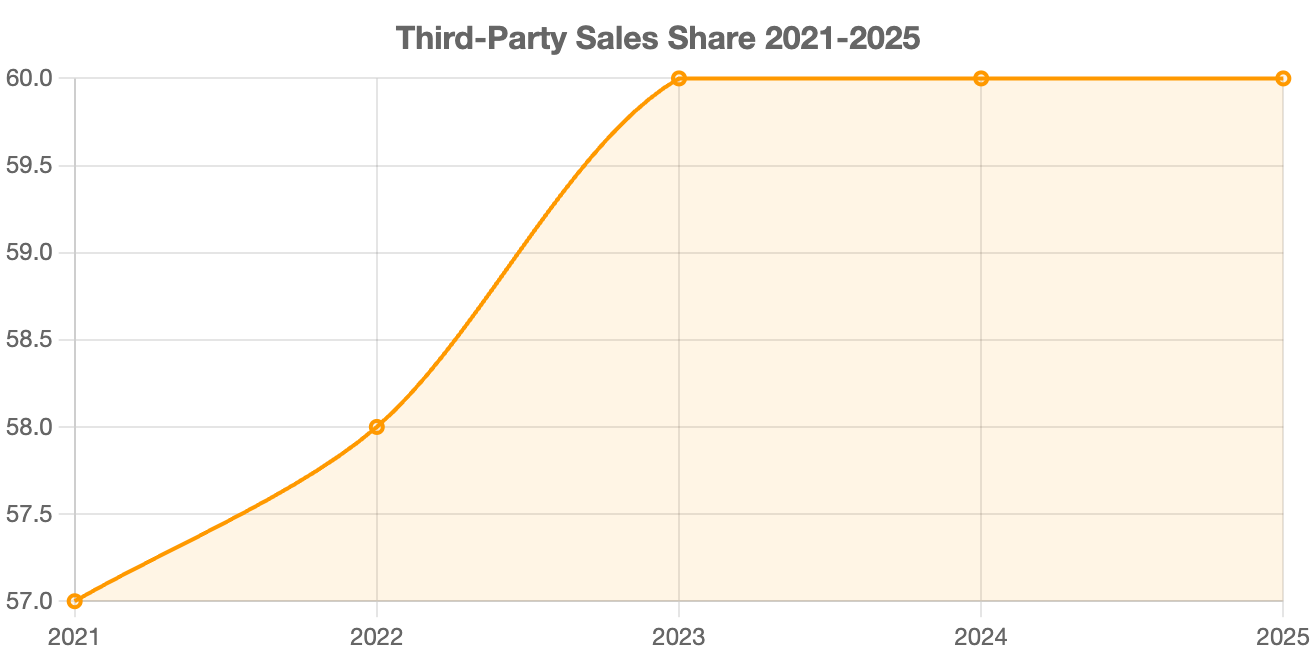
Amazon's third-party sales share has grown steadily over the past five years:
Year | 3P Sales Share |
2021 | 57% |
2022 | 58% |
2023 | 60% |
2024 | 60% |
2025 | 60%+ |
Source: Amazon annual reports and Marketplace Pulse analysis
The stabilization at 60% since 2023 suggests the market has reached a structural equilibrium — Amazon continues to operate its own retail business (1P), but the majority of consumer purchases are fulfilled by independent sellers.
What $575 Billion in Third-Party GMV Means
The $575 billion GMV figure represents the total value of goods sold by independent sellers through Amazon's platform. To put this in context:
- It exceeds the GDP of countries like Sweden, Poland, and Argentina
- It represents roughly 60% of Amazon's total retail GMV
- It is larger than the entire U.S. e-commerce market was just a decade ago
This GMV flows through 1.9 million active sellers, with significant concentration at the top: 100,000 sellers generate $1M+ annually, and 235 sellers generate $100M+ annually.
Why Third-Party Share Has Grown
Several structural factors explain why 3P sellers now dominate Amazon's sales:
1. Amazon's Strategic Shift
Amazon has deliberately expanded its marketplace model because 3P sales are more profitable for the company. Amazon earns referral fees, FBA fees, and advertising revenue from 3P sellers — without the inventory risk of first-party retail.
2. Seller Ecosystem Maturation
The professionalization of Amazon selling — driven by FBA adoption (82%), private label strategies (67% of sellers), and sophisticated advertising tools — has made 3P sellers increasingly competitive with Amazon's own retail.
3. Category Breadth
Third-party sellers cover categories and SKUs that Amazon's retail operation cannot efficiently stock. The long tail of Amazon's catalog is almost entirely 3P.
4. Chinese Seller Expansion
Chinese sellers now represent 59.9% of new Amazon seller registrations, bringing manufacturing-direct pricing that competes effectively with both Amazon retail and other 3P sellers.
Third-Party Sellers vs. Amazon Retail: The Competitive Dynamic
The relationship between Amazon's first-party retail and third-party sellers is complex:
- Amazon retail (1P): Amazon buys inventory wholesale, sets prices, controls the listing
- Third-party sellers (3P): Independent sellers list products, set prices, fulfill orders (via FBA or FBM)
- Hybrid sellers: Some brands sell both directly to Amazon (1P) and through their own seller account (3P)
The 60% 3P share means that for every 10 items purchased on Amazon, 6 are shipped by an independent seller — even if the customer never realizes it.
Revenue Distribution Among Third-Party Sellers
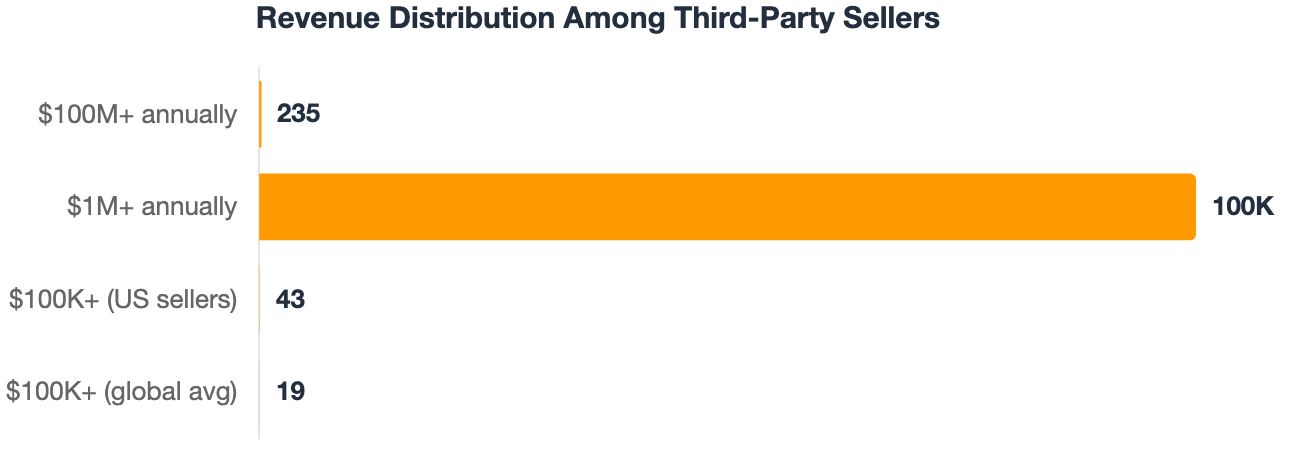
The $575B GMV is not evenly distributed. Revenue is highly concentrated:
Revenue Tier | Number of Sellers |
$100M+ annually | 235 |
$1M+ annually | 100,000 |
$100K+ annually (U.S.) | 43% of active U.S. sellers |
$100K+ annually (global avg) | 19% of active sellers |
Source: Jungle Scout Million-Dollar Seller Report
The top 235 sellers ($100M+) represent a tiny fraction of the 1.9 million active sellers but account for a disproportionate share of GMV. The long tail of smaller sellers fills out the catalog but contributes less to total volume.
Geographic Distribution of Third-Party Sellers
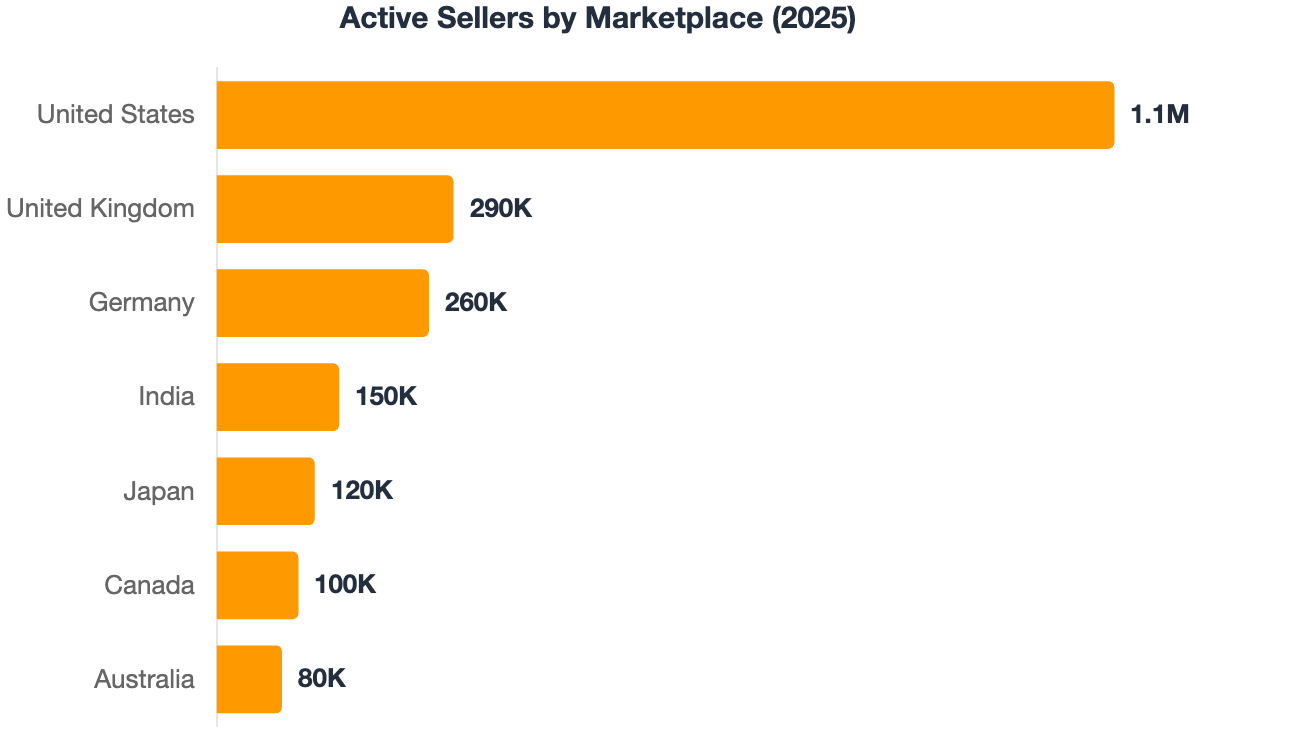
Active sellers by marketplace:
Marketplace | Active Sellers |
United States | ~1.1 million |
United Kingdom | ~290,000 |
Germany | ~260,000 |
India | ~150,000 |
Japan | ~120,000 |
Canada | ~100,000 |
Australia | ~80,000 |
Source: Marketplace Pulse regional tracking
The U.S. marketplace dominates in both seller count and revenue outcomes. U.S. sellers achieve $100K+ revenue at a 43% rate, compared to 19% globally.
The Slowdown in New Seller Growth
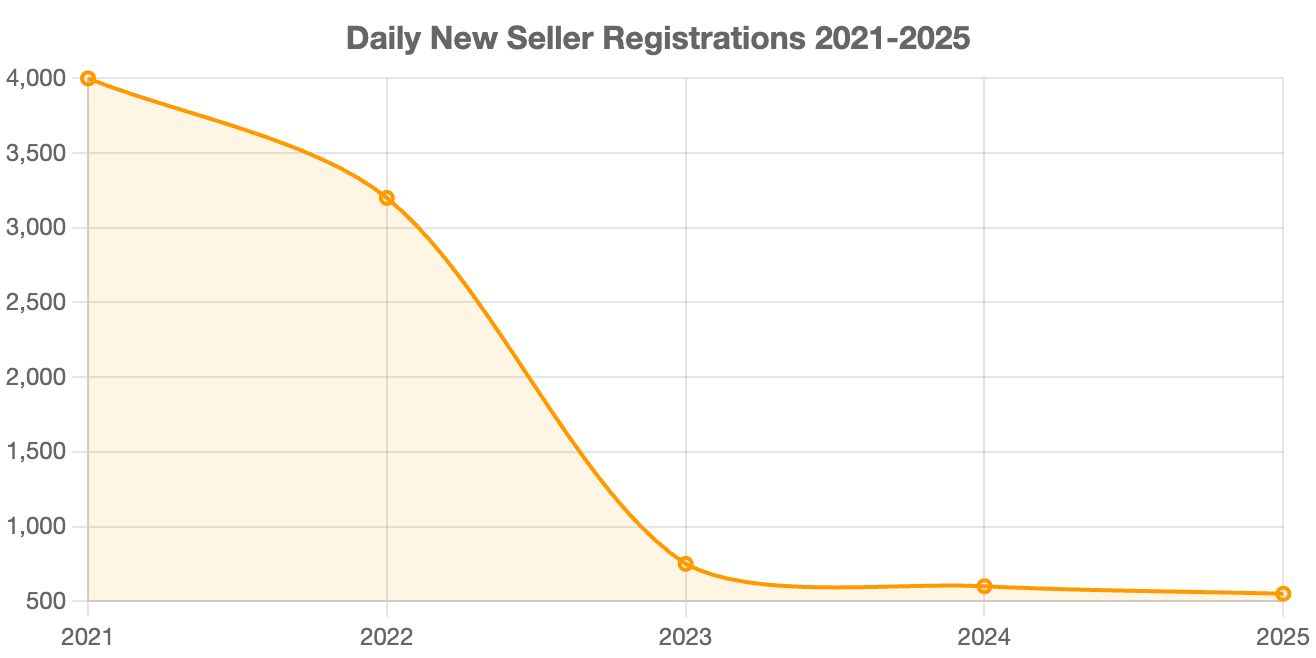
Despite the dominance of 3P sellers, new seller registrations have fallen sharply:
Year | Daily New Sellers |
2021 | ~4,000 |
2022 | ~3,200 |
2023 | ~750 |
2024 | ~600 |
2025 | ~550 |
Source: Marketplace Pulse seller tracking
The 86% decline from 2021 to 2025 reflects market maturation. The 3P marketplace is no longer a gold rush — it is a competitive, professionalized industry where success requires capital, expertise, and operational discipline.
Key Takeaways
- 60%+ of Amazon sales come from independent third-party sellers — Amazon is now primarily a marketplace, not a retailer
- $575 billion in 3P GMV makes Amazon's marketplace one of the largest commercial platforms globally
- 82% FBA adoption among 3P sellers is the infrastructure that makes this scale possible
- Chinese sellers (59.9% of new registrations) are reshaping the competitive landscape
- New seller growth has collapsed — the 3P marketplace is maturing, not expanding
Data Sources
- Amazon Investor Relations & Annual Reports
- Capital One Shopping Research
- Statista
- ElectroIQ
- Business of Apps
Data reflects 2025 figures unless otherwise noted. Last updated: April 2026.