

Who are Amazon's 1.9 million active sellers? Where do they come from, what do they sell, and how do they operate? The demographic data behind Amazon's seller base reveals a marketplace shaped by Chinese manufacturing, private label strategy, and a handful of dominant product categories.
Amazon's active seller base in 2025 is 59.9% Chinese by new registrations, 67% private label by business model, and concentrated in Home & Kitchen (35% of sellers). The U.S. marketplace hosts 1.1 million of the 1.9 million active sellers globally.
This article breaks down the complete demographic profile of Amazon sellers in 2025. For a broader overview, see Amazon Seller Statistics Annual Report 2025.
Amazon Seller Demographics: Key Statistics
Metric | Value |
Active sellers worldwide | 1.9 million |
Chinese sellers (% of new registrations) | 59.9% |
U.S. sellers (% of new registrations) | 16.3% |
Private label sellers | 67% |
Wholesale/arbitrage sellers | 23% |
Dropshipping sellers | 10% |
Top category (Home & Kitchen) | 35% of sellers |
FBA adoption rate | 82% |
Where Amazon Sellers Come From: Country of Origin
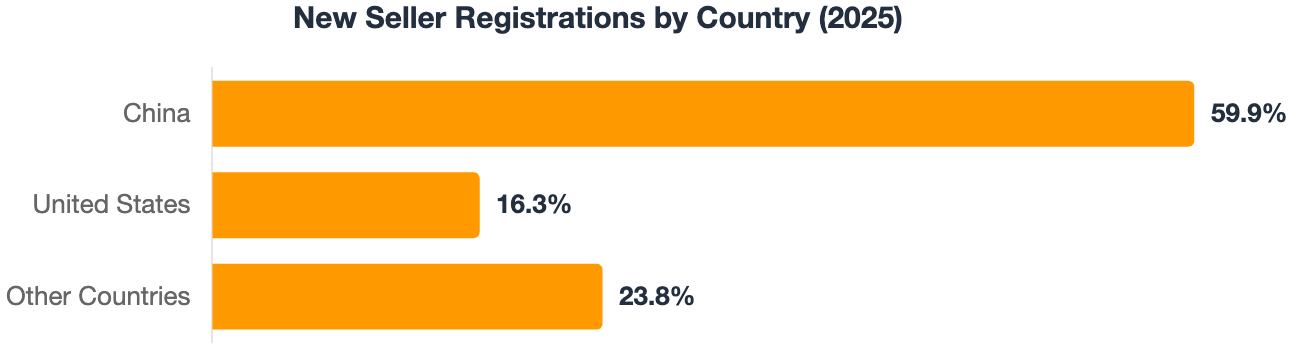
New Seller Registrations by Country (2025)
The geographic origin of new Amazon seller registrations reveals a marketplace heavily influenced by Chinese cross-border commerce:
Origin | % of New Registrations |
China | 59.9% |
United States | 16.3% |
Other Countries | 23.8% |
Source: Marketplace Pulse seller registration tracking
Chinese sellers represent nearly 60% of all new Amazon seller registrations — a figure that reflects the deep integration between Chinese manufacturing and Amazon's global marketplace. Chinese sellers typically offer manufacturing-direct pricing, which creates significant competitive pressure in many product categories.
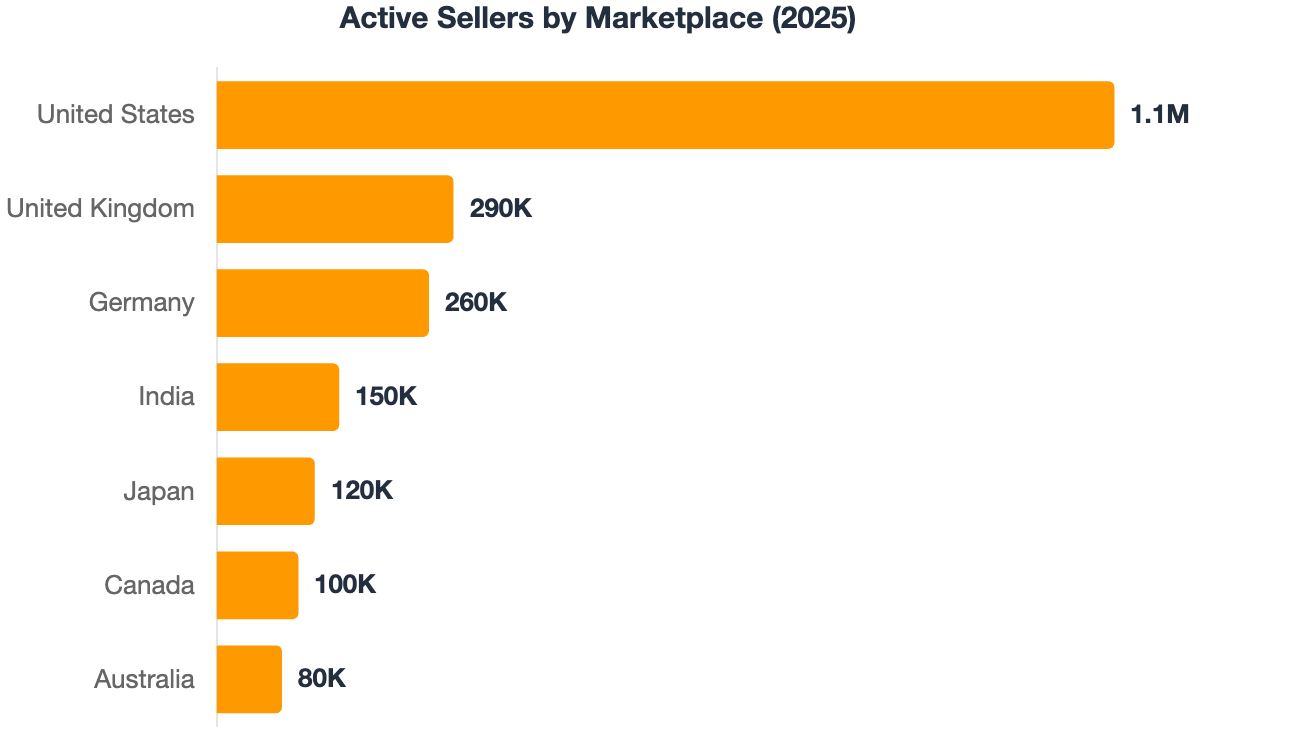
Active Sellers by Marketplace (2025)
While Chinese sellers dominate new registrations, the distribution of active sellers by marketplace tells a different story:
Marketplace | Active Sellers |
United States | ~1.1 million |
United Kingdom | ~290,000 |
Germany | ~260,000 |
India | ~150,000 |
Japan | ~120,000 |
Canada | ~100,000 |
Australia | ~80,000 |
Source: Marketplace Pulse regional tracking
The U.S. marketplace hosts the largest concentration of active sellers — approximately 1.1 million, or more than half of all active sellers globally. Many Chinese sellers operate across multiple marketplaces simultaneously, which is why the new registration data and active seller data tell different stories.
What Amazon Sellers Sell: Top Product Categories
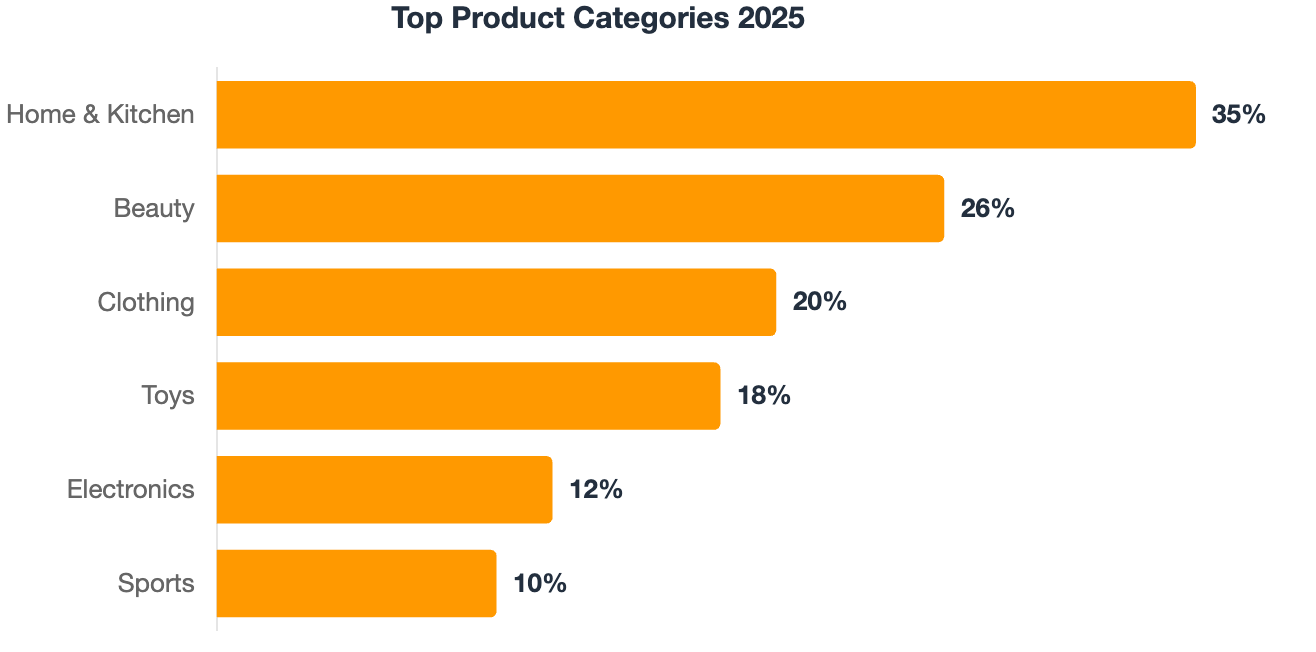
Sellers are not evenly distributed across Amazon's catalog. A handful of categories dominate:
Category | % of Sellers |
Home & Kitchen | 35% |
Beauty & Personal Care | 26% |
Clothing, Shoes & Jewelry | 20% |
Toys & Games | 18% |
Electronics | 12% |
Sports & Outdoors | 10% |
Source: Jungle Scout category analysis
Why Home & Kitchen Dominates?
Home & Kitchen is the most popular category for Amazon sellers for several reasons:
- Low barriers to entry: Products are generally not regulated or restricted
- High search volume: Consumers actively search for home products on Amazon
- Private label potential: Many home products can be sourced generically and branded
- Repeat purchase potential: Consumable and replaceable items drive recurring revenue
Beauty & Personal Care: The Second-Largest Category
Beauty & Personal Care (26% of sellers) has grown significantly as a seller category, driven by:
- Strong demand from Amazon's female-skewing customer base
- High margins on branded products
- Subscription and repeat purchase dynamics
- Influencer-driven discovery that converts on Amazon
How Amazon Sellers Operate: Business Models
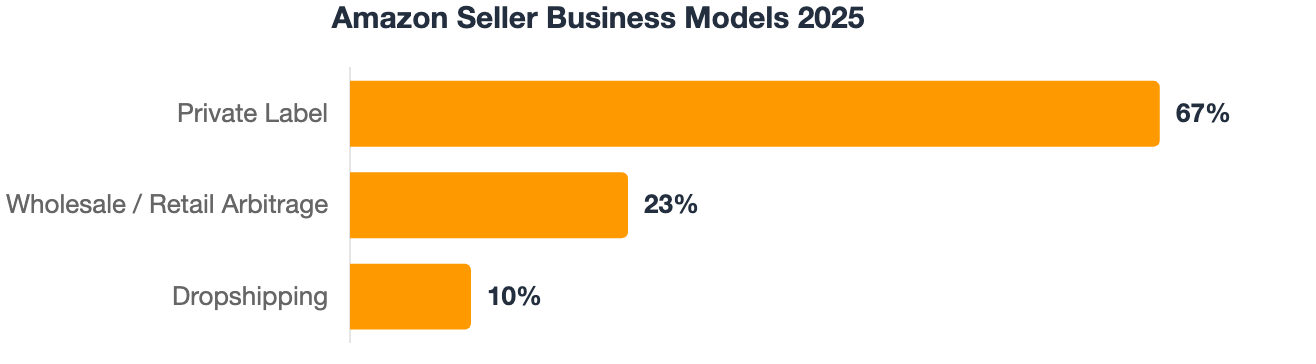
The three primary business models used by Amazon sellers in 2025:
Business Model | % of Sellers | Description |
Private Label | 67% | Source generic products, sell under proprietary brand |
Wholesale / Retail Arbitrage | 23% | Resell branded products purchased at wholesale or retail |
Dropshipping | 10% | List products without holding inventory; supplier ships directly |
Source: Jungle Scout State of the Amazon Seller 2025
Private Label: The Dominant Strategy
67% of Amazon sellers use private label as their primary business model. Private label involves sourcing products (often from Chinese manufacturers) and selling them under a proprietary brand name.
Private label dominates because it offers:
- Higher margins than wholesale reselling
- Brand control and defensibility
- Ability to differentiate on packaging, formulation, or features
- Long-term brand equity that can be sold or licensed
Wholesale and Retail Arbitrage: 23%
Wholesale and retail arbitrage sellers purchase branded products at wholesale or retail prices and resell them on Amazon at a markup. This model requires less upfront brand investment but faces margin pressure from competition and brand restrictions.
Dropshipping: 10%
Dropshipping — listing products without holding inventory, with the supplier shipping directly to the customer — represents 10% of Amazon sellers. Amazon has strict policies around dropshipping, requiring sellers to be the seller of record and prohibiting direct-from-supplier shipping that reveals the supplier's identity.
Seller Account Status: Active vs. Dormant
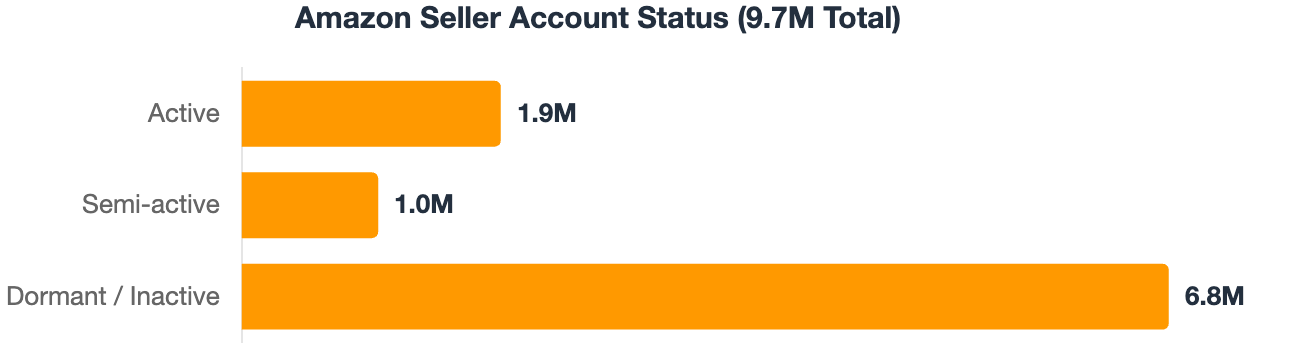
Of Amazon's 9.7 million total registered seller accounts:
Status | Count |
Active | 1.9 million (19.6%) |
Semi-active | ~1.0 million |
Dormant/Inactive | ~6.8 million |
Source: Marketplace Pulse account tracking
The 80% dormancy rate reflects the high attrition among new sellers. Many register, attempt to sell, and either fail to gain traction or abandon the effort. The 1.9 million active sellers represent the competitive landscape that matters.
The Chinese Seller Phenomenon: What 59.9% Means
The dominance of Chinese sellers in new registrations (59.9%) has reshaped Amazon's competitive dynamics in several ways:
- Price compression: Chinese manufacturers selling direct-to-consumer on Amazon have compressed margins in many categories
- Category saturation: Categories like electronics accessories, home goods, and apparel face intense competition from Chinese sellers
- Quality variance: The range of product quality from Chinese sellers is wide, creating both opportunity (for quality-focused brands) and risk (for consumers)
- FBA adoption: Chinese sellers have embraced FBA at high rates, using Amazon's logistics infrastructure to compete effectively with domestic sellers
For U.S. and European sellers, the Chinese seller presence is both a competitive challenge and a sourcing opportunity — many Western private label sellers source their products from the same Chinese manufacturers who also sell directly on Amazon.
Revenue Outcomes by Geography
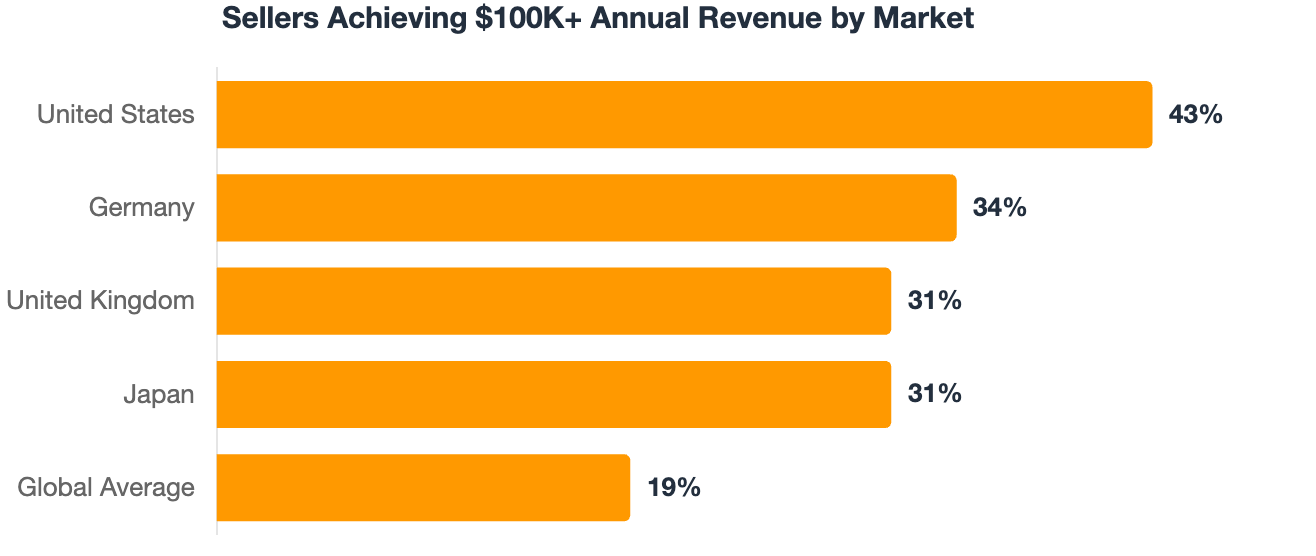
The demographic data connects directly to revenue outcomes:
Marketplace | % Achieving $100K+ Annual Revenue |
United States | 43% |
Germany | 34% |
United Kingdom | 31% |
Japan | 31% |
Global Average | 19% |
Source: Jungle Scout Million-Dollar Seller Report
U.S.-based sellers achieve the highest revenue rates, reflecting the size and purchasing power of the U.S. consumer market. The global average of 19% means roughly 1 in 5 active sellers worldwide crosses the $100K threshold.
Key Takeaways
- Chinese sellers dominate new registrations at 59.9%, reshaping competitive dynamics across categories
- U.S. sellers (16.3% of new registrations) operate in the most revenue-favorable marketplace
- Private label (67%) is the dominant business model, driven by margin and brand control advantages
- Home & Kitchen (35%) is the most popular category, followed by Beauty (26%) and Clothing (20%)
- 82% FBA adoption cuts across all seller demographics — it is the universal fulfillment standard
- 80% of registered accounts are dormant — the 1.9 million active sellers are the competitive reality
Data Sources
- Amazon Investor Relations & Annual Reports
- Capital One Shopping Research
- Statista
- ElectroIQ
- Printful Research
Data reflects 2025 figures unless otherwise noted. Last updated: April 2026.