

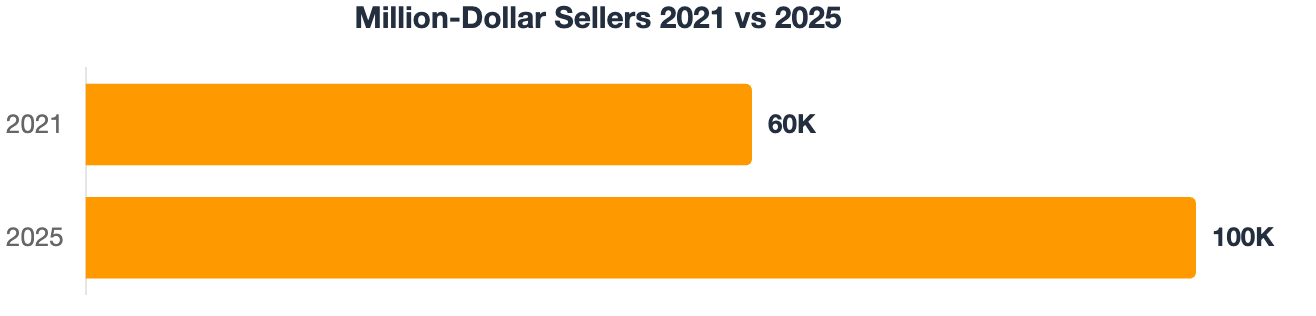
The number of Amazon sellers generating seven-figure annual revenue has reached a new milestone. As of 2025, 100,000 sellers on Amazon generate $1 million or more in annual revenue — a 67% increase from the 60,000 million-dollar sellers recorded in 2021.
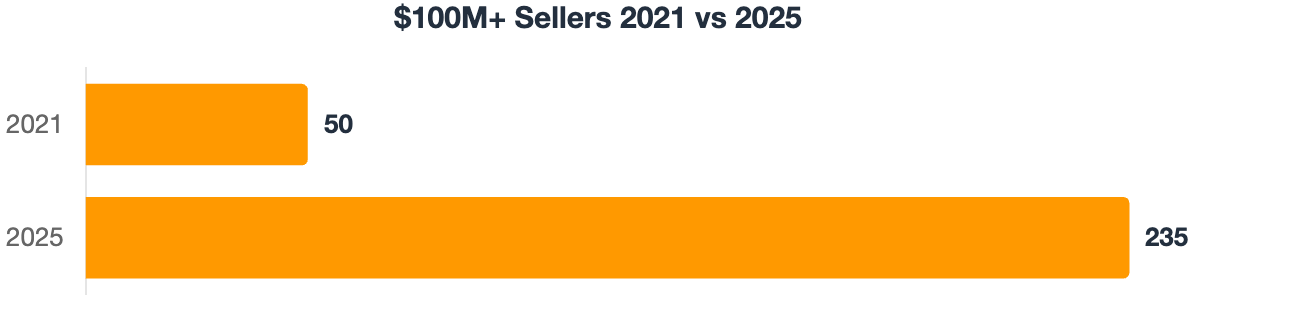
At the very top, 235 sellers now generate $100 million or more annually, up from approximately 50 just four years ago — a 370% increase.
This article examines the data behind Amazon's high-revenue seller segment, the revenue distribution across the marketplace, and what the numbers reveal about the economics of selling on Amazon in 2025. For a full overview of all seller data, see Amazon Seller Statistics Annual Report 2025.
Amazon High-Revenue Seller Statistics at a Glance
Metric | Value |
Sellers with $1M+ annual revenue | 100,000 |
Sellers with $1M+ annual revenue (2021) | 60,000 |
Growth in $1M+ sellers (2021–2025) | +67% |
Sellers with $100M+ annual revenue | 235 |
Sellers with $100M+ annual revenue (~2021) | ~50 |
Growth in $100M+ sellers (4 years) | +370% |
U.S. sellers achieving $100K+ annually | 43% |
Global average achieving $100K+ annually | 19% |
The Growth of Million-Dollar Sellers: 2021–2025
The trajectory of Amazon's million-dollar seller segment tells a story of marketplace maturation and increasing seller sophistication.
Year | $1M+ Sellers |
2021 | 60,000 |
2025 | 100,000 |
Source: Jungle Scout Million-Dollar Seller Report
The 40,000 additional million-dollar sellers added between 2021 and 2025 represent a significant expansion of the high-revenue tier — even as the total number of active sellers declined from 2.4 million to 1.9 million over the same period.
This means the ratio of million-dollar sellers to total active sellers has improved: from 2.5% in 2021 to approximately 5.3% in 2025. The marketplace is producing more high-revenue sellers even as it becomes more selective.
The $100M+ Seller Segment: 370% Growth in Four Years
The most dramatic growth has occurred at the very top of the revenue distribution.
Period | $100M+ Sellers |
~2021 | ~50 |
2025 | 235 |
Source: Jungle Scout Million-Dollar Seller Report
The jump from 50 to 235 sellers generating $100 million or more annually represents a 370% increase in four years. This growth reflects:
- FBA scalability: Amazon's fulfillment infrastructure allows high-volume sellers to scale without proportional logistics cost increases
- Private label maturation: Established private label brands have had years to build customer loyalty and review velocity
- Advertising sophistication: Top sellers have mastered Amazon's advertising platform to drive efficient customer acquisition
- International expansion: Many $100M+ sellers operate across multiple Amazon marketplaces simultaneously
Revenue Achievement Rates by Marketplace
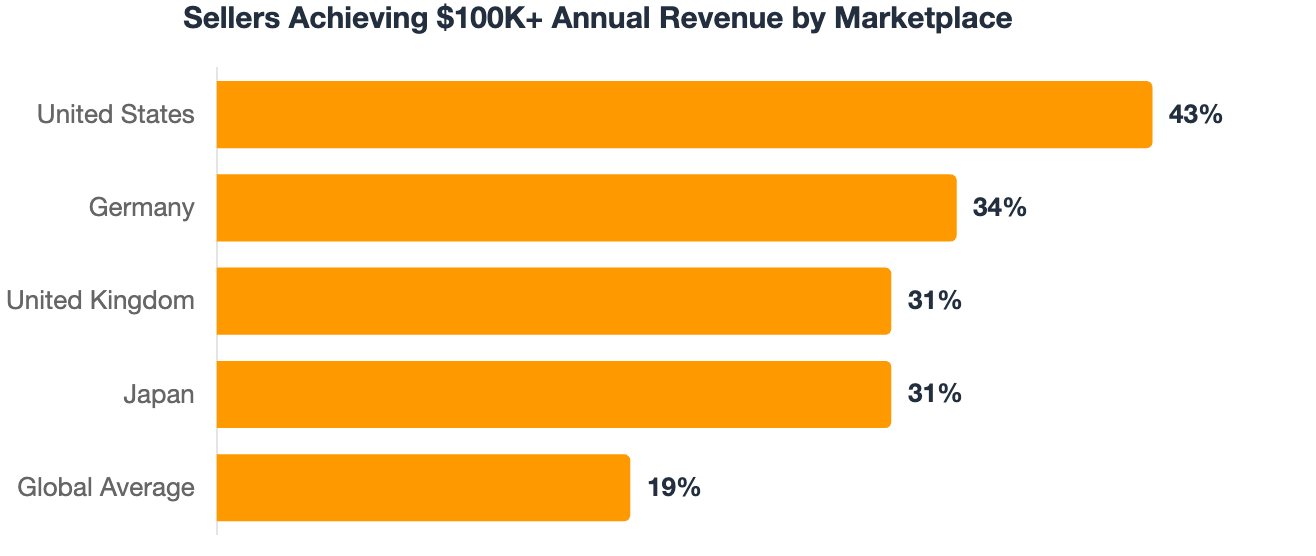
Not all Amazon marketplaces offer equal revenue potential. The percentage of active sellers achieving $100,000+ in annual revenue varies significantly by geography:
Marketplace | % of Sellers Achieving $100K+ |
United States | 43% |
Germany | 34% |
United Kingdom | 31% |
Japan | 31% |
Global Average | 19% |
Source: Jungle Scout Million-Dollar Seller Report
The United States marketplace offers the highest probability of reaching six-figure revenue, with 43% of active U.S. sellers crossing the $100K threshold. This is more than double the global average of 19%.
The U.S. advantage reflects:
- The largest consumer market with highest purchasing power
- Most mature FBA infrastructure
- Highest Prime membership penetration
- Deepest advertising ecosystem
Revenue Distribution: The Long Tail Reality
While 100,000 sellers generate $1M+, the full revenue distribution reveals significant concentration:
- 235 sellers generate $100M+ (top 0.012% of active sellers)
- 100,000 sellers generate $1M+ (top 5.3% of active sellers)
- 43% of U.S. sellers generate $100K+ (in the most favorable market)
- 19% of global sellers generate $100K+ (global average)
The implication: the majority of Amazon's 1.9 million active sellers generate less than $100,000 annually. The marketplace follows a power law distribution — a small number of sellers capture a disproportionate share of revenue.
What Separates Million-Dollar Sellers from the Rest
The data points to several characteristics common among Amazon's high-revenue sellers:
Business Model
67% of Amazon sellers use private label — and this model dominates among high-revenue sellers. Private label offers higher margins, brand control, and defensibility compared to wholesale or arbitrage.
Fulfillment
82% of active sellers use FBA, and this rate is even higher among high-revenue sellers. FBA's Prime eligibility and Buy Box advantages are critical for the conversion rates needed to reach seven-figure revenue.
Geography
High-revenue sellers are disproportionately concentrated in the U.S. marketplace, where revenue achievement rates are highest. Many also expand to Germany, UK, and Japan to multiply their addressable market.
Category Selection
The top categories by seller count — Home & Kitchen (35%), Beauty & Personal Care (26%), Clothing & Jewelry (20%) — are also where many million-dollar sellers operate, though competition is intense.
The Context: A Maturing, Selective Marketplace
The growth of million-dollar sellers is occurring against a backdrop of overall marketplace contraction:
- Active sellers have declined from 2.4 million (2021) to 1.9 million (2025)
- New seller registrations have fallen from 4,000/day (2021) to 550/day (2025)
- The marketplace is becoming more concentrated among experienced, well-capitalized operators
This dynamic — fewer total sellers, more high-revenue sellers — suggests the Amazon marketplace is evolving from a broad-access platform into a more professionalized commercial environment. The barriers to entry are rising, but so are the rewards for those who clear them.
Key Takeaways
- 100,000 sellers now generate $1M+ annually on Amazon — a 67% increase since 2021
- 235 sellers generate $100M+ annually — a 370% increase in four years
- 43% of U.S. sellers achieve $100K+ revenue, versus 19% globally
- Revenue is highly concentrated: the top sellers capture a disproportionate share of the $575B third-party GMV
- The marketplace is becoming more selective — fewer new entrants, but more high-revenue operators
Data Sources
- Amazon Investor Relations & Annual Reports
- Capital One Shopping Research
- Statista
- ElectroIQ
- Printful Research
Data reflects 2025 figures unless otherwise noted. Last updated: April 2026.