If you're still manually building ad campaigns, writing copy one by one, and staring at dashboards to adjust bids in 2026 — you're already falling behind.
A new force is reshaping digital marketing: the AI Ad Agent. It's not a simple automation script, nor an "image generator that makes you a poster". It's a "virtual ad optimizer" that thinks independently, makes autonomous decisions, and continuously improves.
In this guide, you'll learn what an AI Ad Agent really is, what it can do, how it compares to traditional tools and ad agencies, and how to choose the right AI Ad Assistant for your needs.
What Exactly Is an AI Ad Agent?
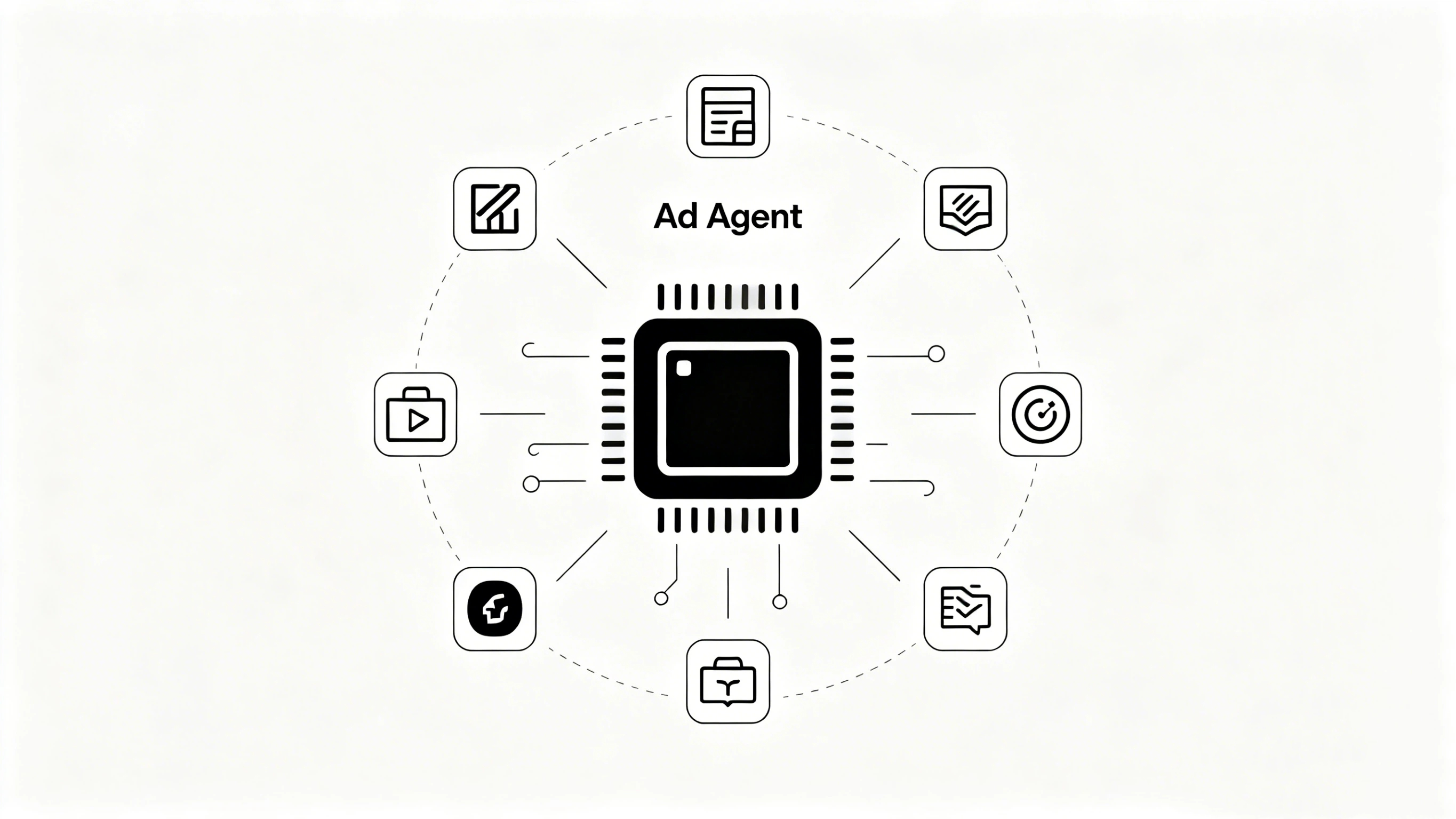
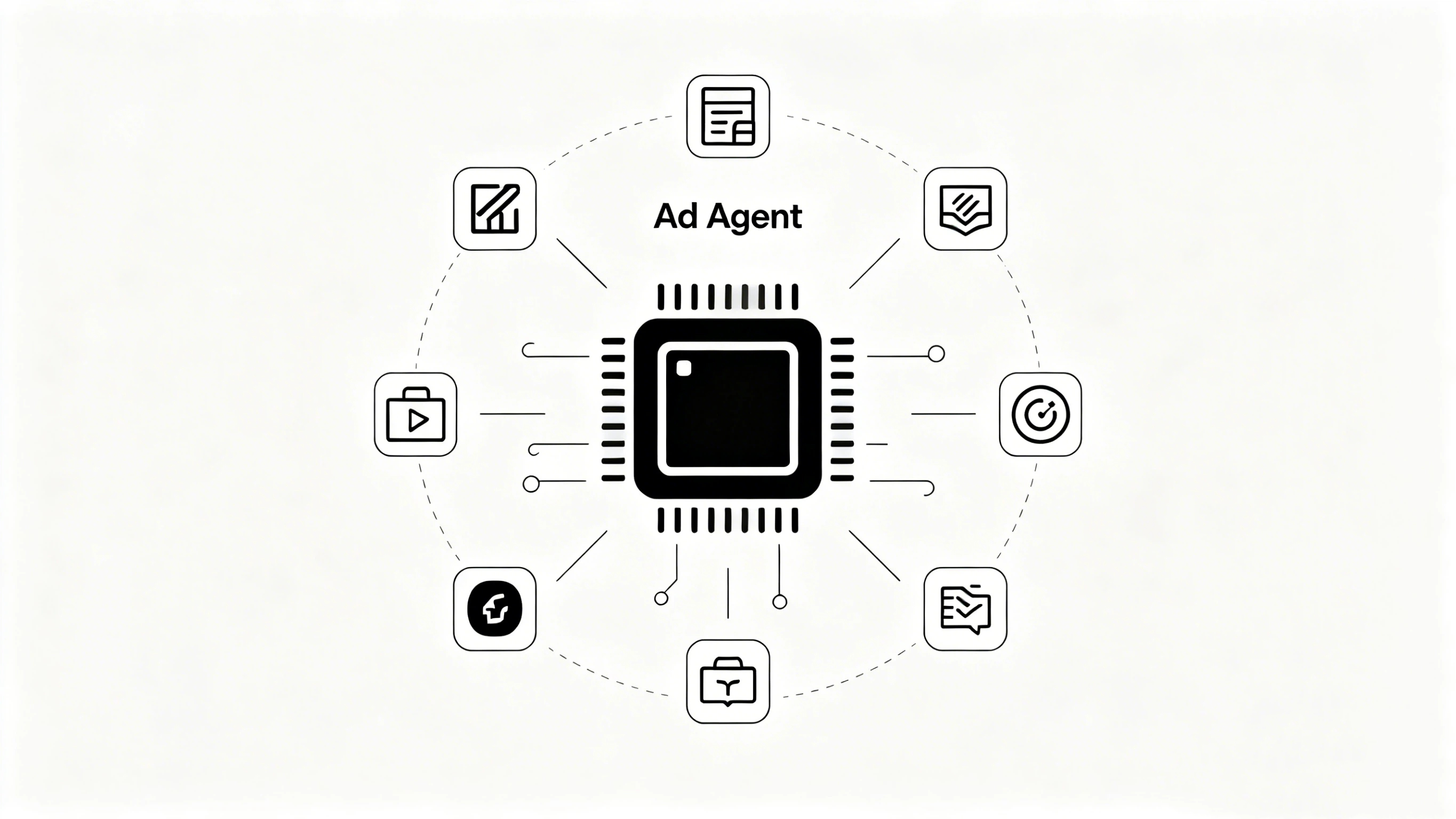
An AI Ad Agent is an intelligent advertising system built on large language models and autonomous decision-making capabilities. It independently handles the entire ad workflow — from strategy formulation and creative generation to audience targeting, bid optimization, and performance analysis.
Simply put: it's not a tool. It's an AI employee — a super ad operator that works 24/7 and can manage hundreds of ad accounts simultaneously.
Traditional ad tools like Google Ads' smart bidding or Meta's Advantage+ are essentially rule-driven automations — you set a goal, and they execute by the rules. The core difference with an AI Ad Agent is autonomous decision-making: it perceives environmental changes, understands business objectives, formulates action plans, and continuously learns and adjusts during execution — all with minimal human intervention.
Think of it this way: traditional ad tools are like a programmed machine — you tell it "bid no more than $50" and it strictly follows. An AI Ad Agent is more like an experienced ad optimizer — it proactively thinks "What are my competitors doing right now? How has my audience's behavior shifted recently? Why is this creative underperforming?" and then makes its own judgments and adjustments.
AI Ad Agent vs. Traditional Ad Tools — Core Differences:
Dimension | Traditional Ad Tools | AI Ad Agent |
Decision Making | Rule-driven, manually set | Autonomous reasoning, dynamic decisions |
Execution Scope | Single platform, single task | Cross-platform, full-funnel |
Learning Ability | Limited algorithmic optimization | Continuous learning, transferable experience |
Human Intervention | Frequent adjustments needed | Low-frequency supervision only |
Creative Capability | None | Can generate copy, images, videos |
Why Are AI Ad Agents Suddenly Everywhere?
In 2026, AI Ad Agents went from a niche concept to one of the most talked-about topics in marketing. Three converging forces are driving this shift.
1. Ad Campaign Complexity Has Grown Exponentially
Five years ago, an ad optimizer only needed to manage Google and Facebook. Today? Google, Meta, TikTok, Xiaohongshu (RED), Kuaishou, WeChat, Bilibili, YouTube… each platform has its own algorithm logic, creative specs, and audience tagging systems. A mid-sized e-commerce team can easily burn through the time of 3-4 people just on routine creative updates, bid adjustments, and report summaries — let alone competitor analysis, strategy planning, and creative testing.
This exponential growth in complexity has driven labor costs through the roof, while performance has actually declined — because human capacity is finite. AI Ad Agents have no such ceiling.
2. The Growing Scissors Gap Between Labor Costs and Ad Performance
Since 2024, average CPMs across major platforms have continued to rise, while conversion rates have dropped due to fragmented user attention and worsening ad fatigue. Advertisers face a harsh reality: spending more money for fewer results. In this environment, improving ad efficiency is no longer a "nice-to-have" — it's a matter of survival.
3. AI Large Models Have Crossed the "Inflection Point"
The maturation of AI large models has made "autonomous decision-making" truly possible. Past AI tools could only offer "assisted creation" — writing a few copy options, generating some images. But these were still just tools requiring human judgment, selection, and execution. After 2025, large models like GPT-4o and Claude 3.5 made qualitative leaps in reasoning, tool use, and multi-step task execution. The maturation of AI Agent frameworks (like LangChain and AutoGen) gave AI a true "perceive — think — act — feedback" loop. That's what pushed AI Ad Agents from concept to practical reality.
What Can an AI Ad Agent Do?
At Navos, an AI Ad Agent isn't a mere collection of features, but rather an AI advertising team
of specialized "digital experts" working together to transform the tedious ad workflow into an efficient, automated loop.
1. Intelligent Strategy Formulation
Before any ad runs, the most time-consuming step isn't execution — it's strategy. Who should we target? What creatives are competitors using? Is now the right time to enter the market?
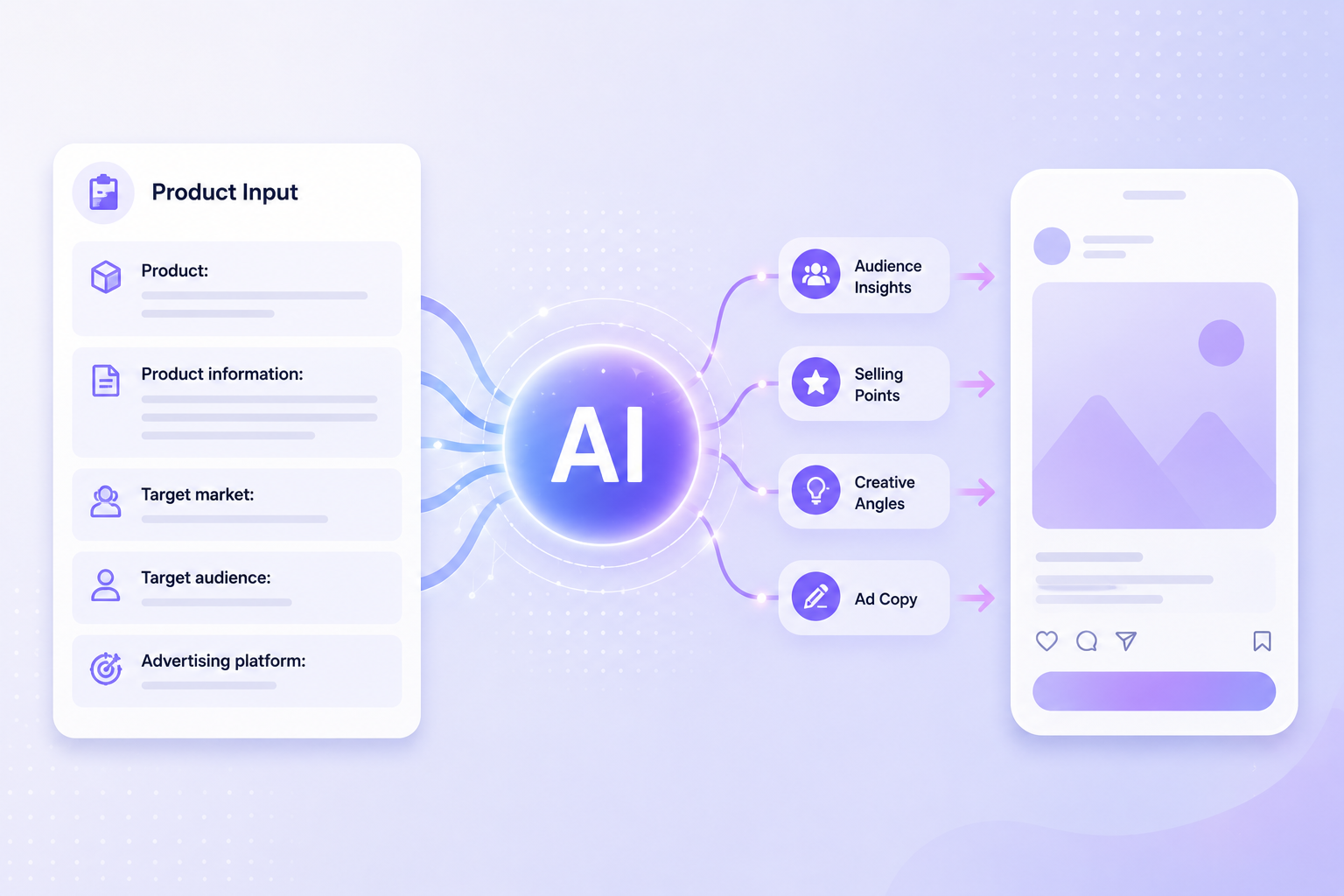
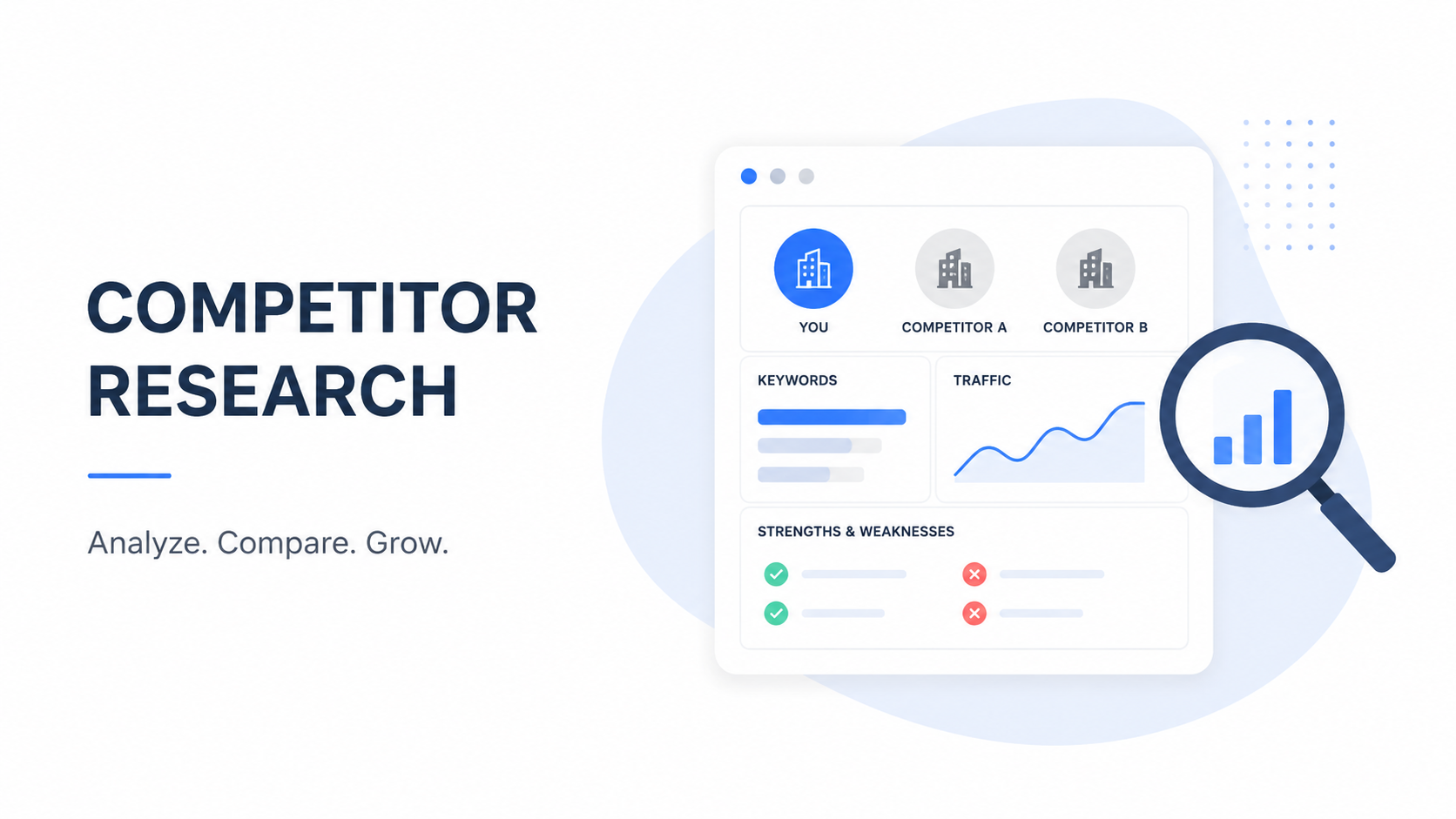
A great campaign starts with a great strategy. An AI Ad Agent automatically scrapes and analyzes competitor ad data, industry trends, and platform traffic shifts. Combined with your product positioning and historical performance data, it generates actionable strategy recommendations — including recommended platforms, budget allocation ratios, core audience profiles, and creative directions.
Case Study:
An outdoor camping gear e-commerce store. Two weeks before a major holiday sale, the AI Ad Agent detected that competitors had ramped up spending on Xiaohongshu (RED), and that searches for "camping beginner" had jumped 40%. The agent adjusted strategy on its own, recommending shifting 30% of budget from Google to Xiaohongshu and prioritizing "camping beginner" tutorial-style creatives. The entire analysis and recommendation took less than 10 minutes.
2. Automated Creative Generation & Optimization
Creatives are the biggest driver of ad performance — and the most labor-intensive. A mature ad account may need to test dozens or even hundreds of creatives per week.
An AI Ad Agent generates multiple versions of ad copy, image concepts, and short video scripts (emotional, promotional, feature-focused…) based on your product info, target audience, and platform style. More importantly, it doesn't just "generate" — it automatically runs A/B tests, determines which versions perform better based on real-time data, and scales winners while pausing losers.
This means you no longer need to "pull your hair out thinking of copy" — the AI Ad Agent continuously tests, learns, and iterates to find the optimal creative mix.
Case Study:
A SaaS product team used to spend a full week recreating ad creatives after every major product update. Now, they simply feed the update notes into the AI Ad Agent, which automatically generates 20 ad copies from different angles (feature-driven, pain-point-driven, social-proof-driven…) with matching image creatives, and pushes them directly to all platform accounts for testing.
3. Precision Audience Targeting
Audience targeting precision directly determines whether your ad spend is worth it. An AI Ad Agent integrates first-party data (your CRM, website behavior data) with platform data, analyzing massive amounts of user behavior, purchase history, and interest tags to build detailed audience profiles.
More importantly, it dynamically adjusts during campaigns based on real-time conversion data — increasing spend on converting audiences and excluding non-converting ones in real time. This dynamic adjustment is something manual operations simply can't match. While human adjustments are typically reactive ("change after seeing bad data"), the AI Ad Agent is predictive ("adjust before data gets bad").
Case Study:
A local gym running Meta ads found that women aged 25-30 had high click-through rates but significantly lower in-store conversion rates compared to women aged 30-35. The AI Ad Agent automatically shifted budget weight to the higher-converting age group, reducing cost-per-acquisition by 22% in two weeks.
4. Real-Time Bidding & Budget Allocation
Ad bidding is a split-second, dynamic marketplace. If a competitor drops prices at 3 AM, is your ad still getting traffic at a reasonable price? During weekend traffic peaks, has your budget already been exhausted?
An AI Ad Agent monitors the bidding environment 24/7, dynamically adjusting bids and budget allocation based on real-time competition, traffic quality, and conversion predictions. It never "goes off work" and misses the best ad windows, and never "fails to notice" and wastes budget on low-quality traffic.
It also intelligently distributes budget across multiple campaigns and platforms, ensuring every dollar is spent where it counts — rather than discovering at month-end that one campaign burned 80% of the budget but delivered only 5% of conversions.
Case Study:
A cross-border e-commerce seller targeting the U.S. market faced a time-zone problem: U.S. users' active hours (Beijing time midnight to morning) coincided with the team's off-hours. Previously, ads during this period either under-bid and under-delivered, or spiraled out of budget control. After connecting an AI Ad Agent, the system automatically raised bids and increased budget during active U.S. hours while tightening during low-efficiency periods, improving overall ROAS by 35%.
5. Cross-Platform Unified Management
Managing multiple platforms is one of the biggest headaches for ad optimizers. Google, Meta, Douyin, Xiaohongshu, Kuaishou, Tencent Ads… each platform has different interfaces, data standards, and creative specs. Switching between platforms wastes time — and opportunities.
An AI Ad Agent connects to all major platforms via API, providing a unified management dashboard and data view. You can see all platform data and adjust all platform strategies in one place. More importantly, it coordinates budget across platforms — automatically shifting spend from rising-cost platforms to higher-ROI ones for optimal overall performance.
Case Study:
A brand marketing team ran ads on Google, Meta, Douyin, and Xiaohongshu simultaneously. Previously, morning data consolidation alone took an hour, plus manual cross-platform comparison reports. Now, the AI Ad Agent automatically consolidates all platform data and delivers a unified performance report with optimization recommendations every morning. The team completes their daily review in just 15 minutes.
6. Data Insights & Reporting
Data analysis is the foundation of ad optimization — and one of the most time-consuming steps. Going from raw data to actionable insights requires significant cleaning, organizing, and analysis.
An AI Ad Agent doesn't just generate structured analysis reports — it interprets the data:
- Auto-generates daily, weekly, and monthly reports, explaining what the numbers actually mean in plain language
- Uncovers hidden growth opportunities (e.g., a neglected keyword suddenly surging)
- Alerts on anomalous fluctuations (e.g., CTR dropping 50% could signal creative fatigue or competitor moves)
- Provides actionable optimization recommendations — not just charts
AI Ad Agent vs. Traditional Ad Tools vs. Ad Agencies
Business leaders may wonder: "I have ad tools, and I've considered agencies — why do I need an AI Ad Agent?"
Dimension | Traditional Ad Tools | Ad Agency | AI Ad Agent |
Core Positioning | Execution tool | Human service | Autonomous decision system |
Decision Ability | Rule-based automation | Human judgment | AI autonomous reasoning |
Response Speed | Real-time (within rules) | Hours to days | Real-time (24/7) |
24/7 Operation | ❌ | ❌ | ✅ |
Platform Coverage | Usually single-platform | Multi-platform (manual) | Multi-platform (automatic) |
Creative Capability | None | Yes (human-made) | Yes (AI-generated) |
Cost Structure | Tool subscription | Service fees (high) | Tool subscription (moderate) |
Learning Curve | Moderate | Low (outsourced) | Low (zero-code) |
Continuous Optimization | Manual updates required | Depends on optimizer skill | Autonomous learning, improves over time |
Data Transparency | High | Medium (report-dependent) | High |
From this table, the core advantage of an AI Ad Agent is clear: agency-quality service at tool-subscription pricing, with 24/7 autonomous operation. For small and medium businesses with limited budgets who don't want to "pay tuition" on ads, this is a highly compelling option.
Use Cases for AI Ad Agents
E-commerce Sellers
Auto-adjust pricing and creatives during major sales events
E-commerce mega-sales (Double 11, 618, Black Friday) are the most intense and competitive periods for ad spending. Traffic costs can double within hours, competitors adjust strategies constantly, and creative lifespans may be just a day or two.
The AI Ad Agent shines in these scenarios by:
- Analyzing historical data to predict traffic and conversion trends during sales events
- Monitoring the bidding environment in real time, automatically adjusting bids to scale when costs are reasonable and pulling back when they spike
- Testing multiple promotional creatives simultaneously to quickly identify the most compelling angles
- Auto-swapping creatives based on user feedback to keep high-converting ads running
- For multi-SKU sellers, automatically adjusting ad budgets per product based on inventory levels — preventing burning ad spend on out-of-stock items
SaaS / App Promotion
Precision acquisition + LTV optimization
SaaS and App products focus on user Lifetime Value (LTV). The core challenge isn't acquisition volume — it's acquisition quality. An AI Ad Agent feeds post-acquisition behavioral data (registration, activation, payment, renewal) back into the ad strategy, continuously optimizing the path to acquiring "high-LTV users." It automatically identifies which channels, audiences, and creatives bring the highest-quality users, then concentrates budget on these high-value acquisition paths.
Local Businesses
Small budgets can still perform
Local businesses (restaurants, gyms, beauty salons, training centers) typically have limited budgets and no dedicated ad optimizer. Previously, they either paid premium agency fees or fumbled with inconsistent results on their own. AI Ad Agents lower the barrier to professional ad management. A local business only needs to input basic info (address, target audience), and the system automatically generates a strategy and starts running on Google Local Ads, WeChat Moments, Douyin Local Push, and more. Small budgets can achieve precise reach — no more "spray and pray" waste.
Brand Marketing Teams
Free from execution, focus on strategy
For established brand marketing teams, the value of an AI Ad Agent isn't "replacing people" — it's "freeing people up".
When daily execution tasks (bid adjustments, creative testing, data reporting) are handled automatically by AI, team members can focus on higher-value work: brand strategy, creative direction, user insights, cross-department collaboration. This human-AI collaboration model often produces far greater output than simply adding more headcount.
How to Choose the Right AI Ad Agent for Your Needs?
The market is flooded with AI ad tools, but the level of "intelligence" varies wildly. Here are four key dimensions to evaluate:
1. Does It Have True "Autonomous Decision-Making" Capability?
This is the key differentiator between a real AI Ad Agent and a basic automation tool. Many tools just "automate" manual workflows — you still need to set rules, bids, and audiences, and they simply execute.
True autonomous decision-making means: the system proactively adjusts strategy based on environmental changes without manual instructions. You set the goal ("500 conversions this month at under $50 CPA"), and it finds the optimal path. Ask your vendor: Can the system automatically adjust bids when it detects competitor moves? Can it pause underperforming creatives and launch backups automatically? If the answer is "you need to manually set trigger rules," it's an automation tool — not a true agent.
2. Does It Support Multi-Platform / Multi-Account Management?
If you only advertise on one platform, many built-in smart tools will suffice. The core value of an AI Ad Agent lies in cross-platform unified management and coordination. Confirm it supports the platforms you actually use, and that it truly integrates data and coordinates budget across platforms — not just displaying data from multiple platforms in one interface.
3. Data Security & Privacy Protection
Ad data involves massive amounts of user behavior data and business-sensitive information. When choosing an AI Ad Agent, verify that the vendor's data storage and processing comply with relevant regulations (GDPR, China's Personal Information Protection Law), whether your data is used to train models or shared with third parties, and whether data access controls are robust.
4. Ease of Use & Learning Curve
No matter how powerful a tool is, if the learning curve is too steep, it'll end up gathering dust. A good AI Ad Agent should be "ready out of the box" — no technical background needed, no complex configuration, and usable by business staff immediately. Vendor support and training resources are also important, especially during the cold-start phase.
If you're looking for an AI Ad Agent optimized for the Chinese market with simple onboarding and comprehensive features, Navos Agent is one of the most noteworthy products currently available. Key features include:
- Full Chinese-language interface, optimized for the Chinese market — no language barriers
- One-stop management for Google, Meta, TikTok, and other major platforms
- True autonomous decision-making — not just rule-triggered automation
- Zero-code onboarding — business staff can operate independently without technical backgrounds
- Robust data security mechanisms compliant with domestic data regulations
Navos Agent offers a free trial, so you can run it for a period and see actual results before committing. Whether you're an e-commerce seller, SaaS company, or brand, Navos Agent can be your 24/7 ad optimizer.
Limitations & Things to Keep in Mind of AI Ad Agent
Every tool has boundaries, and AI Ad Agents are no exception. Here are a few limitations to understand before adopting one.
1. It Can't Fully Replace Human Creative Judgment
AI Ad Agents excel at data analysis, efficiency optimization, and scaled execution. But when it comes to creative judgment involving brand tone, emotional resonance, and cultural insight, there are clear limitations. It can generate a wealth of creatives, but questions like "Does this creative align with our brand personality?" or "Could this copy be controversial?" still require experienced human oversight.
2. Requires Baseline Data and a Cold-Start Period
An AI Ad Agent's intelligence largely depends on the quality and quantity of data it can learn from. If you have a brand-new ad account with no historical data, the agent's initial performance may not be much better than manual operations. A typical cold-start period of 2-4 weeks is needed to accumulate enough data before the system truly unlocks its autonomous optimization capabilities.
3. Adaptation Risk from Platform Policy Changes
Ad platform policies and algorithms are constantly evolving. AI Ad Agents need to keep pace with these changes. If a vendor's product iteration can't match platform updates, functionality may break or compliance risks may arise. When choosing a vendor, pay attention to their product update frequency and response speed to platform policy changes.
4. Data Quality Determines the Agent's Ceiling
An AI's intelligence is only as good as the data it's fed. Ensure your accounts have sufficient data accumulation and regularly clean low-quality data to maximize AI value. If your conversion tracking isn't properly configured, CRM data is inaccurate, or audience tags are messy, the AI Ad Agent's optimization direction will be off course.
Future Outlook: Will AI Ad Agents Replace Ad Optimizers?
This is the question on every ad professional's mind. The answer: not in the short term, but the industry landscape will change profoundly.
Short Term (1-2 Years)
AI Ad Agents will primarily handle repetitive, rule-based execution work — bid adjustments, creative testing, data reporting. The ad optimizer's role will shift from "executor" to "supervisor and strategist." Those who quickly learn to collaborate with AI will gain a significant competitive edge over those who resist new tools.
Mid Term (3-5 Years)
As AI capabilities continue to evolve, AI Ad Agents will independently manage most routine ad campaigns — the full chain from strategy formulation and creative generation to execution and optimization. Human intervention frequency will drop further, concentrated mainly on brand strategy, major creative decisions, and anomaly handling.
Long Term (5+ Years)
AI Ad Agents will become "infrastructure" in the advertising industry. Just as nobody manually sends faxes today, nobody will manually build ad campaigns in the future. The core of industry competition will shift from "who knows how to run ads" to "who understands users better."
For today's ad professionals, the best strategy is clear: proactively learn how to collaborate with AI Ad Agents, turning them into your competitive advantage — rather than waiting for them to become your competitive threat.
Summary
AI Ad Agents aren't hype — they're an industry transformation already in progress. They're turning ad management from a "craft" into a "science" — data-driven decisions, algorithmic replacement of repetitive work, and intelligence unlocking creativity.
For SMEs, AI Ad Agents mean professional-grade ad capabilities at lower costs. For large enterprises, they mean scalable growth and efficiency leaps. For ad professionals, they're a partner that frees you from tedious work so you can focus on higher-value creation.
The future is already here — it's just unevenly distributed. Start using an AI Ad Agent today, and you're already ahead of most of your competitors.
Try Navos Agent now — your 24/7 AI Ad Assistant. Zero barrier to entry. Make every ad dollar work smarter.