Traffic is getting more expensive by the day. The old "cast a wide net and hope for conversions" playbook no longer works. CPMs are climbing, cost-per-acquisition keeps rising, and brands are stuck in the same trap — spending more while ROI keeps falling.
The problem usually isn't bad creative or the wrong platform. It's a broken ad funnel.
A full funnel marketing strategy solves this by mapping your ads to the actual customer decision journey — from first impression to final purchase.
This guide breaks down the TOF, MOF, and BOF framework, shows you how to structure budgets, design creative sequences, and leverage AI ad optimization to scale what works.
What is Full Funnel Marketing?
Today, advertising is no longer simply a matter of “buying traffic and driving conversions”; it has evolved into a systematic approach to managing the user decision-making journey. From the moment a user first encounters your brand to the final purchase, they undergo a complete journey of awareness. If your advertising strategy isn’t aligned with this journey, even the largest budget will be like pouring water into a bottomless bucket.
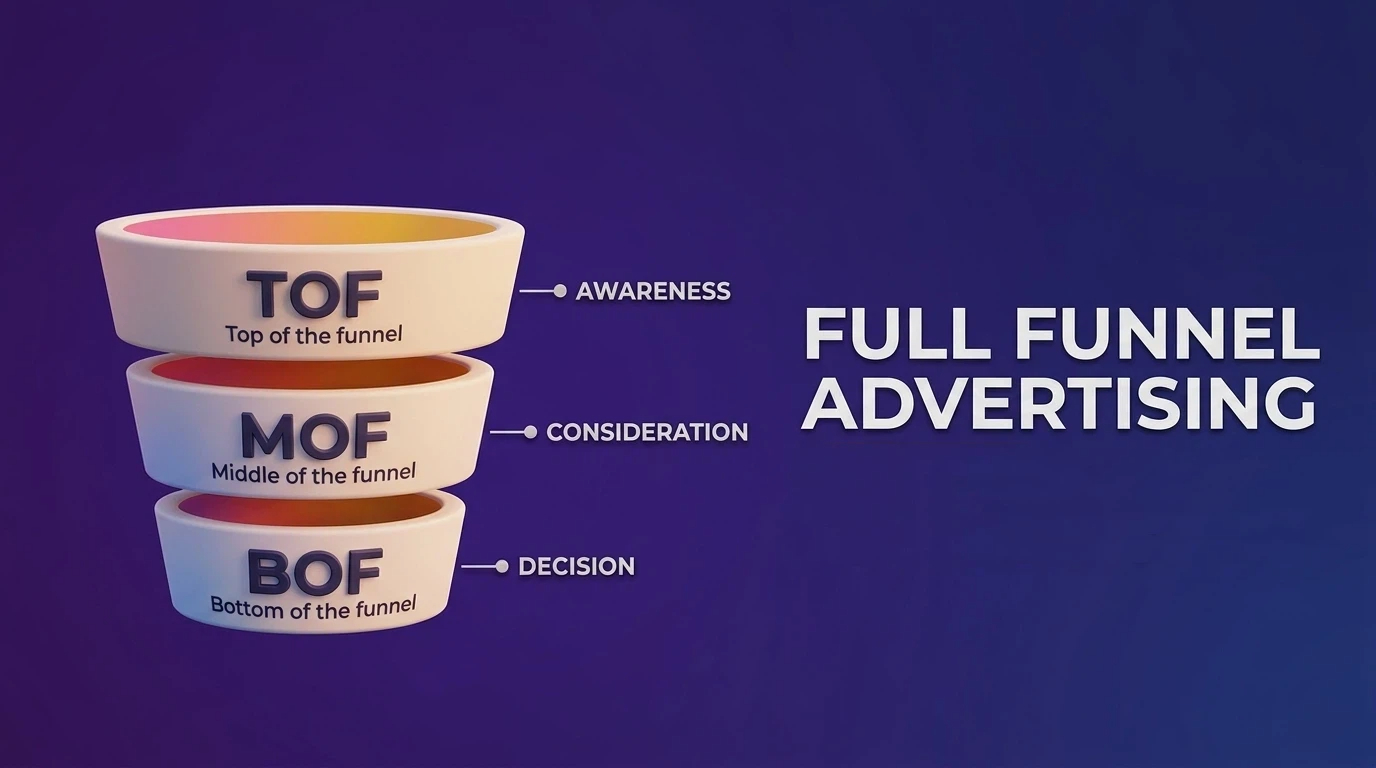
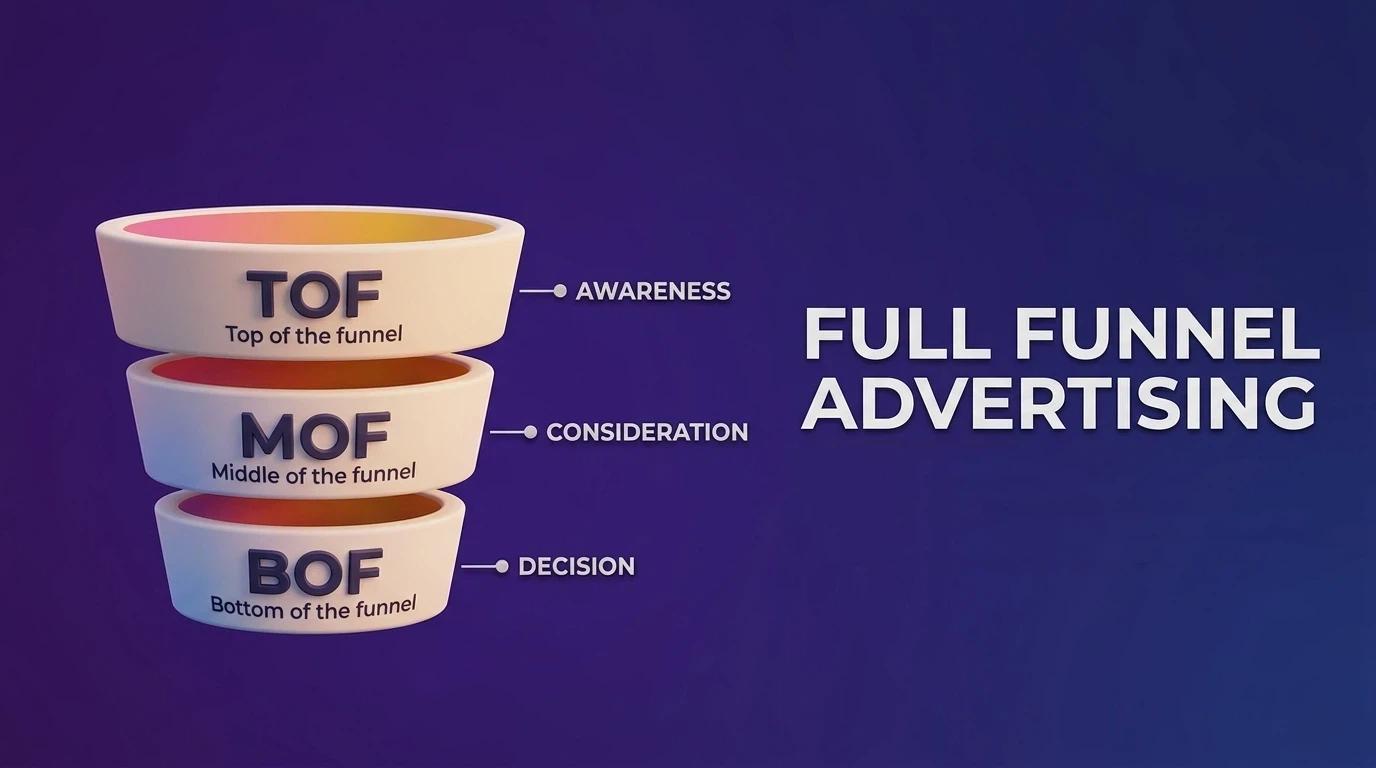
This is precisely the core value of a full-funnel marketing strategy—systematically breaking down the user journey from “Awareness → Consideration → Decision” and designing tailored advertising strategies, creative approaches, and metrics for each stage. The three-tier structure—TOF (Top of Funnel), MOF (Middle of Funnel), and BOF (Bottom of Funnel)—forms a comprehensive performance marketing funnel system.
What are TOF, MOF, and BOF?
Before building any full funnel marketing structure, you need a clear definition of each layer. Most brands fail because they blur the lines between stages — running awareness creatives to bottom-funnel audiences or pushing hard-sell offers to cold traffic.
1. Top of Funnel — The Awareness Layer
Top of funnel marketing is your entry point. The goal is simple: reach the maximum number of potential customers and get your brand into their awareness zone.
At this stage, users don't know you — and they may not even realize they have a need. Your ads should focus on capturing attention, building brand impressions, and sparking emotional resonance. Hard-selling here will backfire.
- Key metrics: CPM, CTR, video completion rate, reach
- Common ad formats: Short-form video ads, UGC-style content, influencer collaborations, brand storytelling
- Biggest mistake: Pushing "Buy Now" CTAs to cold audiences. A stranger won't buy from you on first sight — they need to know you exist first. Creative fatigue from running the same ad too long is another common TOF trap.
2. Middle of Funnel — The Interest Nurturing Layer
If TOF is casting the net, the Middle of Funnel is sorting the catch.
These users have already interacted with your brand — watched your video, clicked your ad, or visited your website — but haven't committed to buying yet. Your job: strengthen their interest and push them from "curious" to "considering".
- Key metrics: CTR, add-to-cart rate, time on page, engagement rate
- Common strategies: Retargeting ads based on user behavior, USP comparison content, product demos, social proof (media coverage, expert reviews)
- Biggest mistake: Treating all "clicked-before" users the same. A user who watched 90% of your product video is in a very different headspace than someone who scrolled past your ad. Layering creative without progression kills the conversion path.
3. Bottom of Funnel — The Conversion Layer
The bottom of funnel is your harvest zone. These are high-intent users — they've added items to cart but not checked out, revisited product pages multiple times, or actively searched your brand name.
Your objective is clear: remove the last barrier to purchase and close the deal.
- Key metrics: CPA, ROAS, CVR
- Common strategies: Limited-time offers, bundle deals, free gifts, real customer reviews and UGC testimonials, personalized dynamic ads based on browsing history
- Biggest mistake: A shrinking BOF pool caused by upstream starvation. If TOF and MOF aren't feeding enough new users into the funnel, your retargeting audience gets smaller, frequency skyrockets, and users start blocking your ads. This is why "retargeting keeps getting more expensive" is almost always a top-of-funnel problem in disguise.
The Standard Full Funnel Marketing Split Model
Understanding the three layers is step one. Turning them into an executable structure is where most advertisers struggle. Here's a proven framework across three dimensions: budget allocation, audience segmentation, and creative sequencing.
1. Budget Allocation
Budget distribution is the most misunderstood part of any full funnel marketing strategy. Many brands dump 70–80% of their spend into BOF because "that's where conversions happen." That logic only works if your upper funnel is already pumping enough volume through the pipeline.
A recommended starting split:
Funnel Stage | Budget Share | Primary Goal |
Top of Funnel | 50%–70% | Acquire new users, build brand awareness |
Middle of Funnel | 20%–30% | Nurture and qualify high-intent audiences |
Bottom of Funnel | 10%–20% | Convert warm audiences efficiently |
Golden rule:
Upper funnel prioritizes scale. Lower funnel prioritizes efficiency. Flip this, and your funnel will collapse.
2. Audience Segmentation Logic
A funnel is only as strong as its audience layers. Static interest tags and demographic targeting are no longer enough. Effective segmentation must be built on behavioral signals.
- TOF audiences: Broad targeting + interest-based expansion. Let the algorithm find high-potential users within a large pool.
- MOF audiences: Users with prior engagement — 75%+ video completion, ad clicks, profile visits. These behavioral signals indicate genuine interest.
- BOF audiences: High-intent behaviors — cart abandoners, repeat product-page visitors, brand-keyword searchers. These users need one final push to convert.
The core logic: Behavior is the best label. A 35-year-old female doesn't automatically equal your target customer. But someone who just watched 90% of your product video and navigated to the checkout page? That's your highest-value audience — regardless of demographics.
3. Creative Sequencing Strategy
Creative is usually the weakest link in funnel execution. Running the same ad from TOF through BOF wastes budget and breaks the user's cognitive journey.
- TOF creative: Emotion and scenario-driven. Grab attention in 3 seconds. Use relatable lifestyle scenes, visually striking brand imagery, and narrative-driven short videos.
- MOF creative: Feature and comparison-driven. Build trust. USP comparisons, product demos, expert or KOL reviews work best here.
- BOF creative: Incentive and urgency-driven. Remove the last objection. Limited-time discounts, 5-star buyer reviews, "order now and get X" offers.
Think of it as a story, not a repeat. Each layer should feel like the next chapter — not the same paragraph on loop.
Why Most Brands' Full Funnel Marketing Fail?
Even with the framework above, many brands still see disappointing results. Here are the root causes.
1. There Is No Real Funnel — Just Single-Layer Campaigns
Many brands think they're running a full funnel when they've simply labeled the same campaign differently. Without genuine audience segmentation and differentiated creative, "TOF/MOF/BOF" becomes a cosmetic grouping — not a real user journey.
2. Creative Is Not Layered
One of the most common execution errors. A brand-awareness TOF video gets repurposed as a BOF conversion ad. Result: it fails to build awareness at the top and fails to trigger purchases at the bottom.
3. Data Gaps — No Visibility Into Where Users Drop Off
Without cross-funnel tracking, you can't tell whether users are leaking out at TOF, stalling at MOF, or bouncing at BOF. Data gaps mean optimization decisions are based on guesswork — not evidence.
4. Manual Optimization Can't Keep Pace
Ad platform algorithms change in real time. User behavior shifts. Competitors adjust. Managing a multi-funnel, multi-channel, multi-creative structure manually is slow, exhausting, and almost guaranteed to miss critical optimization windows.
The bottom line: Most full funnel failures aren't budget problems. They're structural problems — compounded by missing execution systems.
How AI Transforms Full Funnel Marketing?
Identifying the problem is only half the battle. The real question is: how do you systematically solve it at scale?
1. From Manual Funnels to Automated Funnels
Traditional ad management has three built-in bottlenecks:
- Audience segmentation depends entirely on the advertiser's experience
- Creative production can't keep up with testing velocity
- Data feedback lags 24–48 hours behind, making real-time optimization impossible
This is exactly where the Navos AI Ad Agent steps in. Navos uses intelligent behavioral path analysis to automatically classify each user as TOF, MOF, or BOF — then dynamically reallocates budget across channels in real time. No more making today's decisions based on yesterday's data.
Navos also unifies cross-channel attribution, eliminating the "data silo" problem that plagues traditional ad management. Every user signal, regardless of platform, feeds into a single funnel model — so you can finally see exactly where users are dropping off.
2. Creative × Funnel — AI-Driven Creative at Scale
Creative production is often the bottleneck that slows down full funnel strategy execution. TOF needs high-volume test creatives, MOF needs comparison and proof content, BOF needs personalized conversion-focused ads. A human creative team simply can't produce all of this fast enough.
Navos' AI Creative Director automatically generates funnel-matched ad creatives:
- TOF: Batch-generate UGC-style content variants to find the highest-resonance creative direction fast
- MOF: Auto-produce USP comparison and feature-highlight creative combinations
- BOF: Generate promotion-heavy, social-proof-driven conversion content — and iterate based on live performance data
Creative stops being a bottleneck and becomes a scalable growth engine.
3. Real-Time AI Decision Systems
The real value of AI ad optimization is shifting ad management from "experience-driven" to "data-driven + AI real-time decision-making".
Navos' Real-Time AI Marketing Agent continuously monitors full-funnel performance, auto-pauses underperforming ad sets, dynamically boosts budget for high-ROAS combinations, and rapidly identifies the winning "creative + audience" pairing — all in real time and at a scale no human team can match.
Compared to manual management, this system delivers both faster response times and broader coverage — a human media buyer can optimize dozens of ad sets per day, while an AI system monitors and adjusts hundreds or thousands of variables simultaneously, 24/7.
For brands building or refining their full funnel marketing strategy, integrating AI ad optimization is no longer optional. It's a competitive necessity.
Three Principles for High-Performance Full Funnel Marketing
To wrap up, here are the three non-negotiable principles for getting this right:
Principle 1: Structure beats tactics.
No matter how ingenious the advertising techniques may be, if they’re built on a flawed funnel structure, they’re simply running fast in the wrong direction. Build the full funnel ad structure correctly before optimizing anything. Ask yourself: are my TOF, MOF, and BOF real — or just labels?
Principle 2: Creative must be layered.
The essence of a full-funnel marketing strategy is to present users with content that best aligns with their current stage of awareness at every key touchpoint along their decision-making journey. TOF captures attention, MOF builds trust, and BOF drives action—each layer has its own mission and requires its own unique creative approach.
Principle 3: Systems set your ceiling — and AI is raising it.
The ceiling for manual optimization is getting lower and lower. Brands that are the first to integrate AI-powered ad optimization capabilities into their full-funnel advertising systems will gain an increasingly significant structural advantage in future traffic competition.
An advertising funnel structure is not something you can set up once and then rest easy; it is a dynamic system that requires continuous evolution and real-time optimization. And this is precisely where AI truly demonstrates its value.
Ready to Build Your Full Funnel MArketing Strategy?
If you're facing any of these challenges:
- Rising ad costs with no clear optimization path
- Creative production can't keep up with algorithm changes
- Confused funnel structure with cross-layer ad interference
- Fragmented data — no visibility into where users drop off
You don't need more budget. You need the right full funnel marketing strategy — and an AI-powered system to run it efficiently.
Navos provides brands with an end-to-end solution — from full funnel strategy planning and AI creative generation to real-time ad optimization and cross-channel attribution — helping advertisers maximize every dollar on a solid structural foundation.
Reach out to the Navos team for a free full funnel audit and a customized strategy plan — and make every layer of your funnel truly work.