Over the past decade, the advertising industry’s production systems have undergone rapid digitization, but this has also introduced problems that can’t be ignored: processes have become increasingly fragmented, tools ever more complex, and repetitive work and communication costs keep rising. A single project often spans multiple platforms, several departments, and countless files, and any small change in delivery can trigger a complete reexecution of the whole workflow.
These problems essentially stem from a structural contradiction: companies still rely on a “people using tools” production model rather than an intelligent structure where “systems collaborate to complete tasks.”
Starting in 2025, as multimodal large models gained the ability to understand intent, execute chains of tasks, and autonomously orchestrate tools, the advertising industry began to experience a fundamental shift across the value chain. This shift doesn’t come from yet another new tool, but from a comprehensive upgrade in the way work is done.
Entering the era of Agent collaboration, AI is no longer a plugin for a single step; it becomes an agent that understands goals and takes responsibility for outcomes.
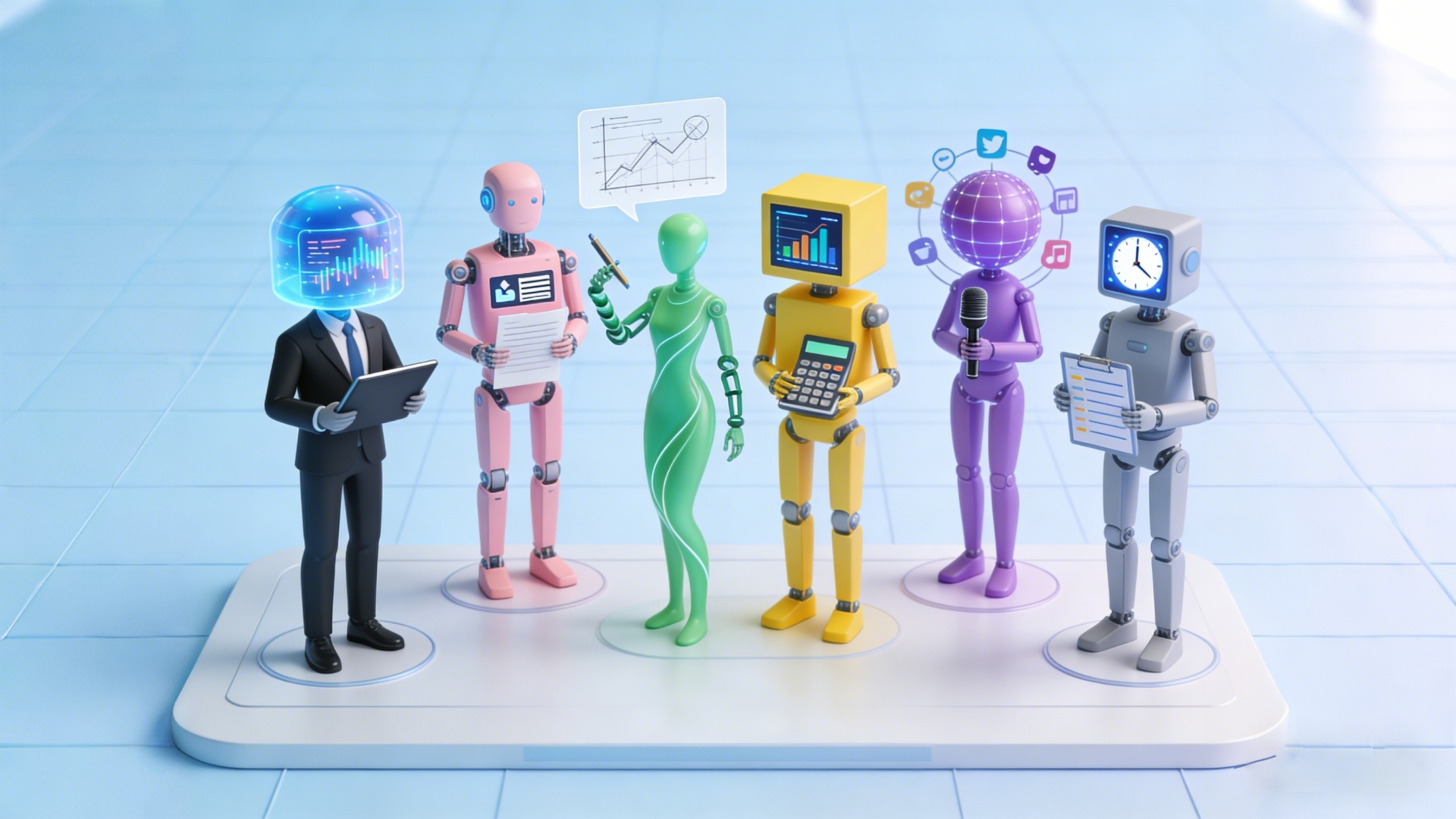
New Agent Collaboration Model
AI is no longer software; it becomes a role on the team that delivers results.
Traditionally, we treated AI as a tool—like Photoshop, Excel, or an ad platform. You input commands, it returns outputs, and then you take those outputs to do the next step. That human–tool interaction model is still essentially “people using tools.”
But AI Agents represent a completely different model. They no longer wait passively for instructions; they can understand complex business objectives, break them into multiple subtasks, autonomously execute those tasks, make judgments and adjustments along the way, and be accountable for the final results. More importantly, they can remember prior conversations, understand your brand voice, learn your business logic, and even anticipate your needs. This is no longer merely a “tool”; it’s more like a professional teammate.
In this new model, advertising teams upgrade from a “people + tools” setup to a collaborative “people + AI Agent” system. Human and AI members form true collaborative roles, rather than a simple directive-execution relationship.
Core Capabilities of a Marketing Agent
To understand how an AI Agent becomes a team member, we need to see its capability boundaries. A mature marketing Agent has four core capability domains.
- Creative intelligence: The AI Agent can scan global content trends to identify emerging creative directions, hot topics, and audience interests. Based on those insights, it can generate ad scripts, copy variants, and creative concepts, and rapidly transform the same core creative into multiple versions suitable for different platforms, formats, and audiences. This multi-format creative capability can exponentially increase the value of a single creative idea.
- Traffic (media) intelligence: The AI Agent can coordinate ad delivery across platforms like Meta, Google, and TikTok—not just simple multi-channel distribution, but understanding each platform’s algorithmic characteristics, audience profiles, and best practices. It can design structured A/B testing matrices and search for optimal combinations across different variables. This intelligence far surpasses traditional “set it and forget it” campaign setups.
- Operational intelligence: During campaign execution, the AI Agent continuously monitors hundreds of metrics, detects anomalous fluctuations, and automatically adjusts bidding strategies, audience targeting, and asset allocation. It knows when to scale up, when to tighten budgets, and when to swap creative, and it can react immediately if audience behavior shifts at 3 a.m., without waiting for humans to start their workday.
- Knowledge intelligence: This is perhaps the most easily overlooked but potentially the most important dimension. The AI Agent can build and maintain a brand knowledge base, retain performance data, successes, and lessons learned from past campaigns, understand industry-specific terminology, guidelines, and best practices, and even identify patterns and regularities in massive historical datasets that humans might miss. This institutional memory ensures the team’s knowledge doesn’t disappear with staff turnover.
The combination of these capabilities makes the Agent a true form of “new labor.” It not only produces content but also takes responsibility for the workflow and optimization cycle, continuously internalizing team experience into its intelligence. Each campaign execution helps the AI Agent better understand your brand, your audience, and your market, so the next performance will be even better.
The Reconstruction of Human Roles
From Execution to “Strategy + Judgment”.
When AI can write scripts, design visuals, and edit videos, many creatives start to worry: where does my value lie? The truth is that creative work is undergoing a reallocation of value — human value isn’t disappearing; it’s becoming purer and more advanced.
In the new division of labor, AI does handle roughly 80% of creative “output” work — the parts that require large volume, speed, and many variants. It can produce 50 ad script variations in minutes, transform a core concept into 15 different visual treatments, and adjust tone and emotional appeal for different audience segments. This scale of production is beyond human reach.
But the “soul” of creativity — that crucial 20% — remains firmly in human hands.
What Does That 20% Include?
- Brand direction control: AI can generate a thousand ideas, but which ones align with a brand’s long-term strategy? Which will strengthen the brand’s position in consumers’ minds? Which might drive short-term clicks but harm brand equity over time? Those judgments require humans with deep brand understanding.
- Aesthetic judgment: Although AI can learn design principles and visual rules, the aesthetics that truly move people often come from subtle, hard-to-articulate feelings. Whether a composition is elegant, whether the color palette has tension, whether the overall mood fits the brand’s tone — these evaluations still need trained human taste.
- Cultural sensitivity: Advertising is highly context-dependent. The same idea can land completely differently across cultures; an expression that’s funny in one culture can be offensive in another. AI can learn explicit cultural rules, but for those subtle, constantly evolving taboos and social moods, human judgment remains irreplaceable.
- Deep user insight: Data can tell us what users are doing, but only humans can truly understand why they do it — their inner desires, fears, contradictions, and dreams. This empathy and insight into human nature are the wellsprings of creativity and can’t be replicated by AI.
- System design and workflow capability: The core competitive advantage for future advertisers won’t be a single skill but the ability to orchestrate agents into a closed-loop system covering strategy, content, channels, and assets.
As AI takes on more executional work, these five directions form the “upshift path” for future talent. Tomorrow’s advertisers won’t just be creators of work; they’ll be the creative directors, brand strategists, and guardians of values.
That also means career progression will accelerate across the board. In the past, you might start as a copy assistant, spend five years writing copy before becoming a senior copywriter, and then become a creative director after a few more years. In the AI era, that path no longer holds — because AI can reach the level of a three-year-experience copywriter in days. The new career trajectory is to shift from executor to strategist faster: cultivate systems thinking, business insight, and leadership earlier, and learn to lead a human-AI collaborative team rather than do every task yourself.
The Future Advertising Team Structure
An AI × human collaborative growth team.
Traditional ad teams are organized by flat functional divisions: copywriting, design, media buying, data analysis each handling their own piece. But future ad teams will no longer be organized around departments; they will be structured around the “intent-to-outcome” workflow. The introduction of Agents isn’t meant to replace teams, but to rebuild collaboration so humans and AI each operate in the domains where they excel.
The new team model consists of three parts—strategy layer, human-creative layer, and AI-execution layer—which are not hierarchical but a collaboration system based on clearly defined responsibilities.
1. Strategy Layer
The strategy layer answers “why we do it.” This layer typically includes the brand stakeholders, growth leads, marketing heads, and strategy teams. They no longer directly manage task details but focus on defining directional information: how the brand should be perceived, growth priorities, budget and resource allocation, and success/failure criteria. In the past, you had to continuously break these high-level goals into executable tasks, incurring heavy communication and coordination costs. In an Agent model, these strategic directives are conveyed to AI as “intent language” and no longer need to be disaggregated into tiny tasks. For example, you don’t tell an Agent “generate 10 scripts and adapt them for 3 platforms”; you tell it “build a week-long cross-platform awareness funnel for a new product launch, emphasizing a sense of technology and efficiency,” and the Agent constructs the strategy and execution flow. This lets the strategy layer disengage from operations and concentrate on long-term brand value and key decisions.
2. Creative Layer
The creative layer answers “how to do it right.” This layer is made up of creative leads, content directors, visual designers, and data analysts. They are the core carriers of human creativity but are no longer shackled by high-volume production work. Previously, creative teams had to iterate across countless versions, tweak sizes, and repeatedly adapt formats. Future creators will no longer “make content” in the executional sense; they will “define content” like directors. They are responsible for setting creative direction, judging brand consistency, assessing cultural appropriateness of symbols, and making critical decisions and rulings where opinions diverge. AI can generate concepts, scripts, assets, and variants, but it cannot replace genuine human insight and cultural sensitivity. The creative layer becomes the core of quality control and directional guidance, not a production line of executors.
3. AI execution Layer
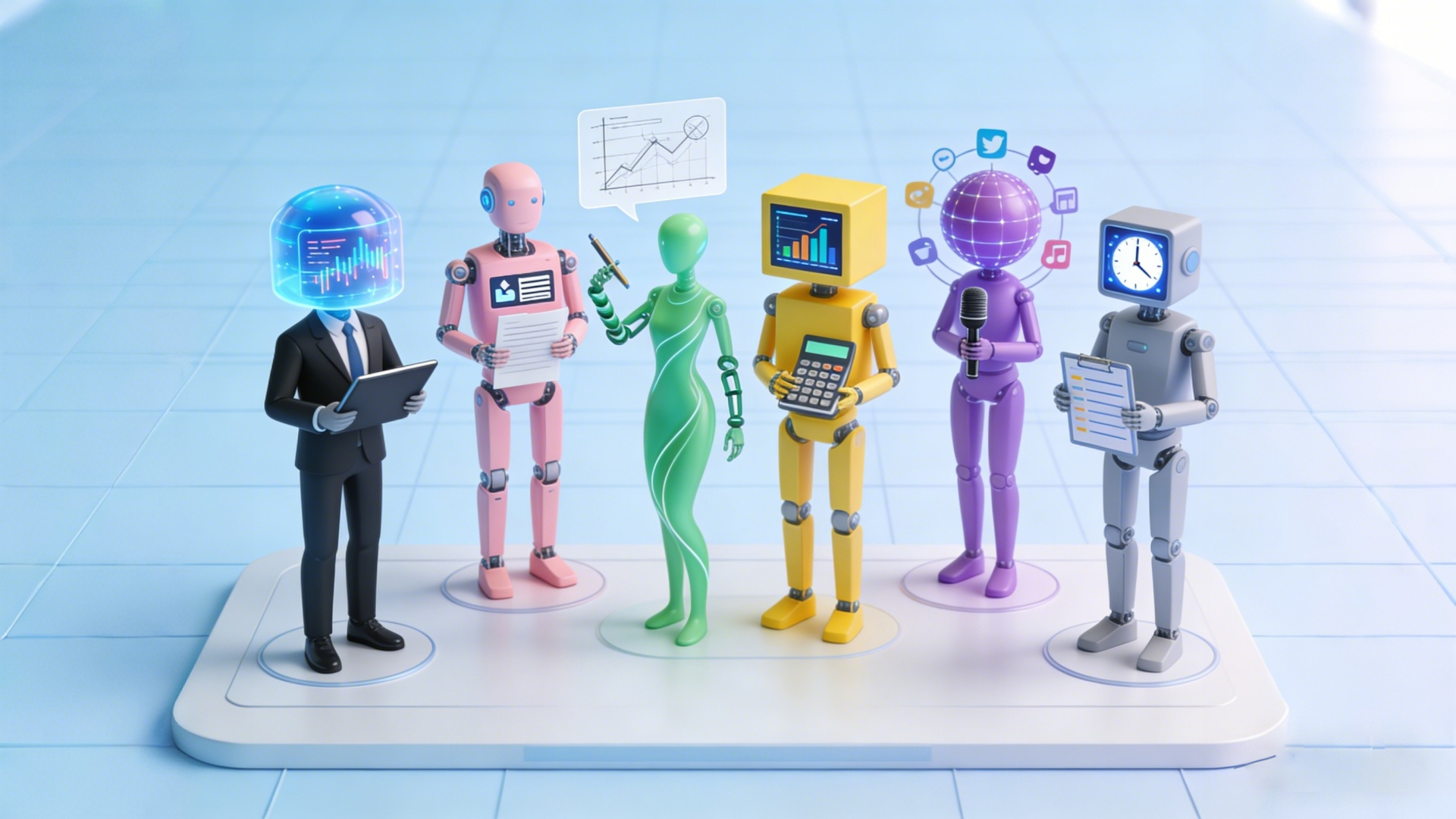
The AI execution layer is composed of multiple specialized Agents and serves as the team’s “production engine.” Each Agent has its own role, forming an end-to-end marketing execution capability.
- Insights Agent continuously scans industry trends, user signals, platform mechanism changes, and competitor strategies, transforming dispersed data into structured insights to inform the strategy and creative layers.
- Planning Agent automatically decomposes tasks based on strategic intent, producing campaign blueprints, content matrices, channel cadences, and resource allocation plans. It understands goals and constraints and creates cohesive cross-platform plans.
- Creative Agent handles most of the creative production work. It can automatically output scripts, visual language, copy, and edit sequences from planning blueprints, generating multiple versions to support experimentation and optimization. It is a “fast creative production line.”
- Delivery Agent deeply understands each platform’s ad logic, handling ad structure configuration, asset distribution, experiment setup, and continuously adjusting strategy and budget allocation based on feedback so creative work actually reaches target users.
- Analytics Agent converts asset performance, conversion funnels, and user behavior feedback into clear optimization recommendations through real-time monitoring, causal analysis, and trend modeling, and feeds these insights back to relevant Agents.
- Asset Management Agent is responsible for long-term knowledge and asset accumulation, including brand visual style, tone preferences, asset libraries, script templates, and historical success cases—making the team’s knowledge reusable and accumulable.
These three layers collaborate to form a complete marketing system that can drive “measurable outcomes” directly from “strategic intent.” The process is no longer linear and sequential but dynamically synchronized: humans define intent, Agents auto-generate strategies and execution flows, the creative layer makes directional judgments at key nodes, the Analytics Agent provides feedback, and the system enters the next iteration.
At its core, this is a real-time learning, continuously optimizing marketing brain. Team size need not increase, yet output and quality can improve significantly; human creativity and judgment are not consumed by process but amplified to a higher level; a company’s brand assets and knowledge are no longer scattered across individual experience but are systematically accumulated, reused, and upgraded.
The future ad team won’t be a “bigger team,” but a “smarter team.” This is the structural change driven by the three-layer collaborative system of strategy, human creativity, and AI Agents.
What Skills will Future Advertisers Need?
When team structures and ways of working change, the skill mix individuals need changes completely. In the AI era, the skills advertisers need can be summarized in six core dimensions.
1. Prompt Strategy and Optimization
Prompt strategy is the most fundamental and important new skill. This isn’t simply “being able to write prompts”; it’s the ability to translate complex business intentions into clear, actionable, and bounded instructions. A good prompt optimizer understands the limits of AI, knows which tasks are suitable for AI, which require human–AI collaboration, how to decompose complex goals, how to set constraints, and how to guide AI to optimal outputs through iterative dialogue. This ability is essentially an “AI translator” — turning human creative intent into language AI can understand and execute.
2. Creative Direction
The importance of creative direction hasn’t diminished; it’s become even more prominent. When AI can generate massive volumes of ideas, the ability to judge what makes a good idea, what matches a brand’s tone, and what will truly move an audience becomes extremely scarce. This requires deep aesthetic sensibility, sharp cultural insight, a profound understanding of the brand, and an often indescribable sense of taste. Future creative directors won’t produce every idea themselves; they’ll identify the diamonds among AI-generated options and steer AI to iterate in the right direction.
3. AI Workflow Design
AI workflow design is a whole new capability dimension. This requires thinking like a systems architect: how do you design collaboration processes between humans and AI, and among multiple AIs? How does information flow between different agents? At which points is human review required? How do you set feedback loops for continuous optimization? A great workflow designer can build efficient, stable, and scalable human–AI collaboration systems that make the whole team operate like a finely tuned machine.
4. Data Interpretation and Insight Generation
The demands for data-interpretation skills are also evolving. AI can automatically analyze data and generate reports, but the true value isn’t the data itself — it’s the insight behind the data. Why did this creative perform well? What audience psychology does it reflect? What market opportunity does this trend signal? How do you turn data insights into creative directions? This ability to move from numbers to insight, from phenomenon to essence, requires a combination of business sensitivity, market understanding, and creative thinking.
5. Optimization Mindset
An optimization mindset represents a new work philosophy: experiment-centered, data-driven, and continuously iterative. In the AI era, advertising is no longer a linear “create — launch — wait for results” process; it’s a loop of “hypothesis — test — learn — optimize.” People with an optimization mindset are skilled at forming testable hypotheses, designing rigorous experiments, learning quickly from results, and applying those learnings to the next iteration. This approach upgrades ad teams from “doing things by experience” to “finding answers through experiments.”
6. AI Collaboration Skills
AI collaboration is a meta-skill that combines several abilities: understanding AI’s capabilities and limits, knowing how to ask and give feedback, evaluating the quality of AI outputs, and knowing when to trust AI and when to question it. It’s like collaborating with human colleagues — you need to know their strengths and weaknesses, establish effective communication methods, and build a rhythm of tacit coordination. As AI capabilities evolve rapidly, this collaboration skill also requires continuous updating.
What Do Advertisers No Longer Need?
Equally important is clarifying which skills are rapidly losing value in the AI era. This isn’t to say these tasks are unimportant — rather, AI can already perform them better, and continuing to spend large amounts of human time on them is a misallocation of resources.
Repetitive content production is the first type of work being replaced. Writing product descriptions, social media copy, and standard-form press releases — tasks that require some expertise but follow highly repeatable patterns — can now be done by AI in seconds with consistent quality. Roles that rely on “quickly producing a large volume of acceptable copy” as their core competitive advantage have almost no survival space in the AI era.
Manual asset versioning has also lost its value. In the past, adapting the same creative into different sizes, platform formats, and languages was time-consuming. Now AI can automate these conversions — not only faster, but intelligently adjusted for each platform’s characteristics, often producing better results than manual versioning.
Large amounts of manual, tracking-style data wrangling are being automated. Exporting data from platforms, cleaning formats, merging sheets, calculating metrics, and making charts used to take data analysts considerable time; now AI can handle these tasks automatically. Humans should focus on data insights and strategic recommendations rather than wrestling with Excel and data exports.
The manual “grunt work” of ad operations — creating ad groups by hand, uploading creative one-by-one, setting targeting parameters, adjusting bids — is being fully taken over by deployment agents. Future media buyers won’t be “the ones most adept at operations” but rather “the ones who best understand strategy and design experiments.”
Cross-media repetitive tasks are an especially clear example of inefficiency. Repeating the same setup on each platform, managing multiple backends, and manually syncing data are tedious and error-prone. AI can coordinate across platforms via API integrations and automated workflows, making cross-media buying simple and efficient.
Recognizing these skills that are being replaced is crucial for personal career development. If your core competencies still lie in these areas, you need to transition quickly and invest your energy in the high-value skills that AI cannot replace.
Why is Navos Part of the Future Advertising Team?
Navos = An End-to-end AI Advertising Team
After understanding the team structures and skills needed in the AI era, a practical question emerges: how do you build such a human–AI collaborative team? Do you buy different AI tools separately and piece them together? That’s what most teams try, and it usually doesn’t work well—tools can’t interoperate, data islands persist, and humans end up acting as “manual APIs” between systems, which increases workload.
This is exactly why Navos was created. Built by Tidong Tech as a leading global advertising AI assistant, Navos’s core idea isn’t to deliver isolated AI features one by one, but to construct a complete, unified AI advertising team.
What Navos means for advertising teams is this: it’s not a pile of tools, but a single intelligent-agent framework that lets all AI “employees” work together in the same ecosystem—sharing knowledge, passing information, and forming real team collaboration.
From creative ideation to campaign delivery, from data to optimization, Navos provides an agent-collaboration system that covers the entire process. More importantly, these agents aren’t isolated; they form an organic collaborative network. Market-insight agents pass trends automatically to creative-planning agents, creative-creation agents send assets directly to ad-delivery agents, and data generated during delivery is fed back in real time to data-analysis agents. Insights from analysis then guide the next round of creative optimization. This closed-loop collaboration is the core value of an AI team.
Another key feature of Navos is its ability to learn. This isn’t a team with fixed skills; it’s an evolving team. Every campaign execution enriches its knowledge base, every experiment updates its strategy models, and every human feedback adjusts its judgment criteria. Over time, Navos gains deeper understanding of your brand, your market, and your audience—becoming more like a seasoned team member.
What’s even more exciting is that Navos is scalable. When you need to enter a new market, try a new platform, or explore a new format, you don’t have to rehire and retrain—simply activate the relevant agent capabilities. It’s like a professional team on standby, able to expand or contract quickly based on business needs without the knowledge gaps caused by staff turnover.
How Does Navos Integrate into Team Roles?
To truly understand Navos’ value, we need to see how each AI employee fits into the team structure described above and how they take on specific role responsibilities.
The Market Insights Agent acts as the team’s “industry advisor”. It continuously monitors global creative platforms, social media, industry reports, and competitor activity to identify emerging creative trends, hot topics, and shifts in audience interests. More importantly, it doesn’t just pile up information; it can discern opportunity areas related to your brand from vast amounts of data. For example, when it spots a new content format gaining traction with your target audience, a social issue sparking widespread discussion, or a competitor’s creative direction attracting high attention, it immediately alerts the team and proposes possible response strategies. This real-time, intelligent market scanning keeps the team at the forefront of trends.
The Campaign Planning Agent serves as the “creative director”. Once the team has set marketing goals, it can design a complete campaign plan: how to advance in phases, what the core message of each phase should be, which channel mix to choose, how to allocate budget, and what types of content best fit each phase’s objectives. Grounded in historical data, industry benchmarks, and real-time market intelligence, it delivers scientific, actionable plans rather than gut-feel guesses. Human planners can focus on creative differentiation and strategic imagination while handing framework building, resource planning, and pacing design—the systematic work—to the AI.
The Creative Generation Agent is the “creative designer”. Based on the plan and brand tone, it can rapidly produce large volumes of creative assets—from copy and scripts to visual designs, from short-video storyboards to long-form articles—generating high-quality drafts. Even more powerful, it performs intelligent asset optimization: automatically adjusting copy’s emotional appeal, the visual focal point of imagery, and a video’s pacing and edits based on performance feedback. This data-driven creative iteration continually improves asset performance while human creative teams focus on direction, soul, and brand consistency.
The Campaign Launch & Monitoring Agent plays the “media buyer” role. It manages complex cross-platform ad delivery systems—but in a way that’s completely different from traditional execution. It doesn’t simply apply human-set parameters; it proactively designs structured experiments, testing different audience, creative, and bidding strategy combinations, learning continuously from results to dynamically optimize delivery. It understands each platform’s algorithmic characteristics: how to get through Meta’s learning phase, how Google’s smart bidding should be coordinated, and TikTok’s traffic allocation logic. It can also perform fine-grained cost control: maximizing the value of every dollar through intelligent budget allocation and bid adjustments while maintaining results. Most importantly, it works 24/7, capturing traffic opportunities that arise late at night or on weekends, while human media teams focus on strategy and performance assessment.
The Data Analytics Agent is the “data analyst”. It doesn’t just generate reports; it provides actionable insights. It automatically monitors hundreds of metrics and detects anomalies: why did the cost for a certain ad group suddenly increase? Why did a particular creative perform especially well during a certain period? Why did conversions fall for a specific audience segment? It not only identifies problems but offers possible causes and recommended solutions. Its reports aren’t cold spreadsheets; they are structured narratives: what happened, why it happened, what it means, and what should be done. This elevates the team from “looking at data” to “understanding data.”
The Asset Management Agent is the “asset administrator”, responsible for handling the trivial but essential operational tasks. Account audits, permission settings, ad replenishment, invoice management, compliance checks—these tasks may seem simple, but mishandling them can severely impact team efficiency. The Asset Management Agent ensures all of this infrastructure runs smoothly so the team can focus on strategy and creativity rather than being bogged down by operational details.
These six agents form a complete, mutually supportive intelligent AI marketing team that covers every step of the advertising workflow. They don’t replace humans; they enable people to concentrate on higher-value work: strategic thinking, creative guidance, insight distillation, and brand building.
Why Do Leading Teams Choose Navos Agent?
In the advertising industry, AI is widening the gap between leaders and followers. Teams that are first to adopt AI agents are gaining an almost irreversible competitive advantage. This is not an exaggeration; it’s based on four clear business rationales.
1. Optimization of cost structure
Traditional advertising teams have costs dominated by labor, and labor costs grow linearly with business scale. To handle twice the ad volume, you generally need to hire nearly twice the people. In Navos’ AI-driven ad teams, much of the execution work is handled by AI staff, making cost growth non-linear. The same level of business may only require half the personnel, and those people are concentrated in high-value roles. This not only reduces absolute costs, but more importantly changes the cost structure, significantly improving the team’s profitability.
2. Faster growth
Under the traditional model, a campaign might take two weeks from concept to launch; testing 30 creative variants could take a month. With a Navos AI team, those cycles can shrink to days or even hours. A tenfold increase in experiment speed means a tenfold increase in learning speed, and a tenfold acceleration in finding effective strategies. In a fiercely competitive market, speed is an advantage: whoever iterates and optimizes faster gains the edge.
3. Systematic knowledge retention
The biggest risk for traditional teams is knowledge loss when key personnel leave. When the creative director who knows your brand best departs, their experience and judgment go with them. In a Navos AI marketing team, knowledge, experience, and best practices are embedded in the system. Every successful campaign, every effective strategy, every insight is learned and retained by the AI staff. Team growth no longer depends on individual skill accumulation but on the evolution of system capabilities. This compound effect of organizational capability is the core of long-term competitiveness.
4. Unlocking talent value
When AI staff take on repetitive, execution-level work, every team member can focus on higher-value work. Creatives are freed from endless asset production and can concentrate on brand storytelling and creative direction; media buyers are relieved of tedious operations and can focus on strategy and performance optimization; data analysts stop wrangling spreadsheets and move to insight synthesis and strategic recommendations. This not only improves job satisfaction but, more importantly, allows talent to perform at their highest level, helping attract and retain top performers.
That’s why we see more leading brands, top agencies, and growth-stage DTC teams embracing AI agentization. They don’t see it as a “nice-to-have” upgrade but as a must-do: not adopting it means falling behind.
The Future Ad Team is not “AI vs. Humans”, But “AI × Humans”
Looking back at the history of humans and technology, every major technological leap faced panic and resistance, yet ultimately amplified rather than diminished human capabilities. The printing press didn’t put storytellers out of work; it spread stories further. The camera didn’t eliminate painters; it liberated artists’ imagination. Computers didn’t make accountants obsolete; they freed them from calculations so they could focus on strategic analysis.
AI’s impact on advertising follows the same logic. It’s not here to replace creatives, media experts, or analysts, but to free them from repetitive, low-value work so they can focus on the uniquely human parts: strategic thinking, aesthetic judgment, insight generation, brand building, and emotional resonance.
The best ad teams will be those that achieve seamless collaboration between humans and AI. The mission of Navos is to help every advertising team make that transformation. It’s more than a tool—it becomes part of your team: an ever-ready, continuously learning AI colleague. It understands your brand, remembers your experience, executes your strategy, and optimizes your results, letting you focus on the things that truly require human wisdom.
Ready to co-build your future AI marketing team with Navos?